Top Client Questions: Tariffs Ruled Unconstitutional, Iran, GDP, and Private Credit
This is a very fluid situation, and events are unfolding rapidly, but here are the key facts thus far:
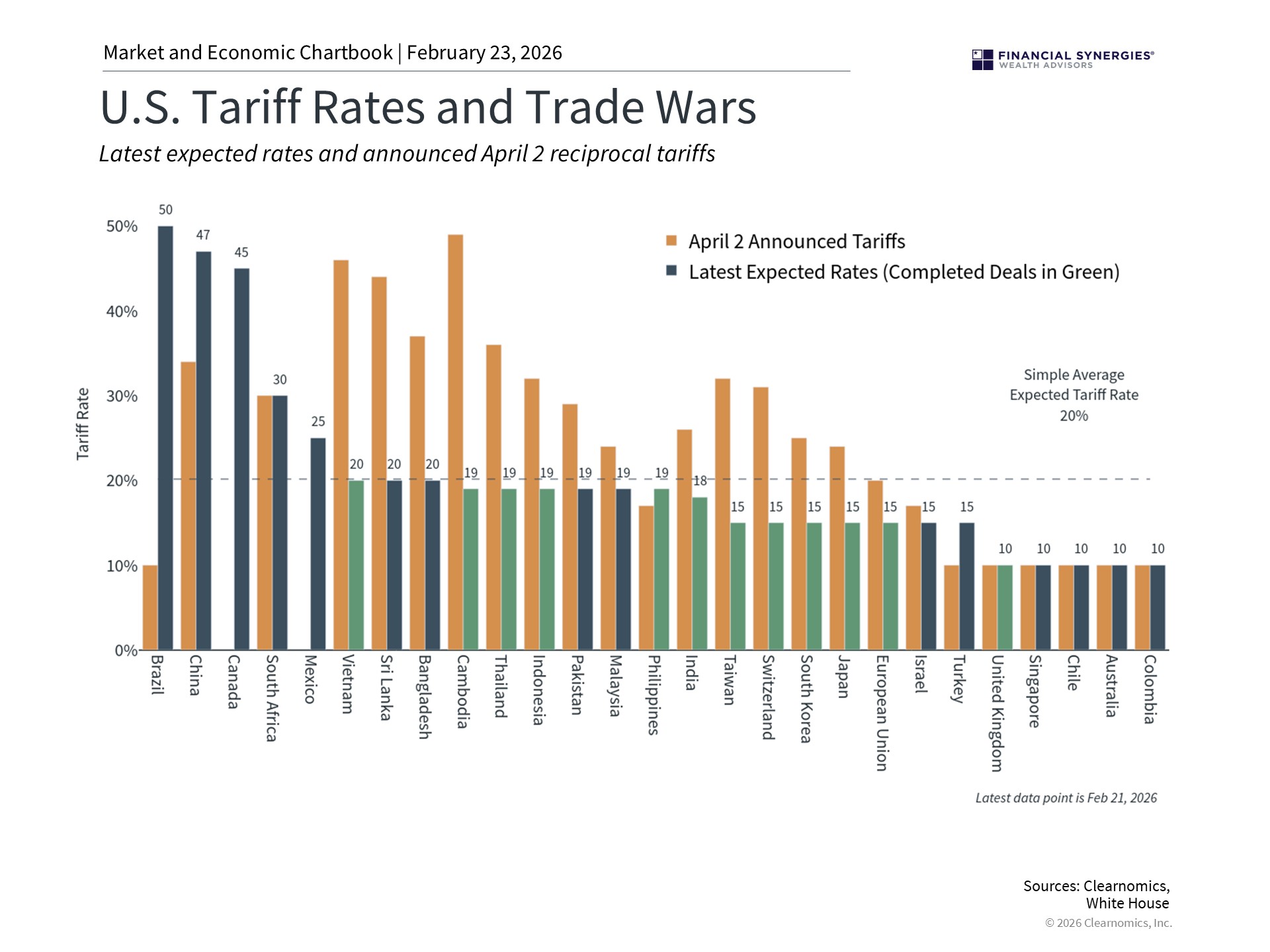
• On February 20, 2026, the Supreme Court ruled 6-3 that the broad tariffs enacted by the White House under the International Emergency Economic Powers Act (IEEPA) were illegal. This matters for investors because trade policy has been a major source of market volatility and has affected all parts of the economy.
• The ruling struck down tariffs on virtually every country tied to trade deficits, as well as those on Mexico, Canada, and China over fentanyl concerns, though smaller tariffs on steel, aluminum, and cars remain in place. This includes the “reciprocal tariffs” that were announced during last April’s “liberation day.”
• It’s unclear whether refunds will be provided and how they will be enacted. Thousands of businesses were part of the lawsuits that made their way to the Supreme Court, so this could impact many sectors. According to data from U.S. Customs and Border Protection, roughly $90 billion of the approximately $195 billion in tariffs collected under IEEPA may need to be refunded.
• The White House may attempt to re-enact tariffs under other legal frameworks, though those laws have procedural limits and may not allow tariffs as sweeping as the ones struck down. So, while this minimizes one tool the administration has been using for international negotiations, they may still be able to implement tariffs in other ways.
The included chart shows the level of import tariffs across different countries. These tariffs have led to short-term volatility, but the market has remained resilient over the past year.
While policy changes like this can create short-term uncertainty, it is worth remembering that corporate earnings, economic growth, and valuations tend to be the true drivers of long-term market performance.
Here are some key factors to consider:
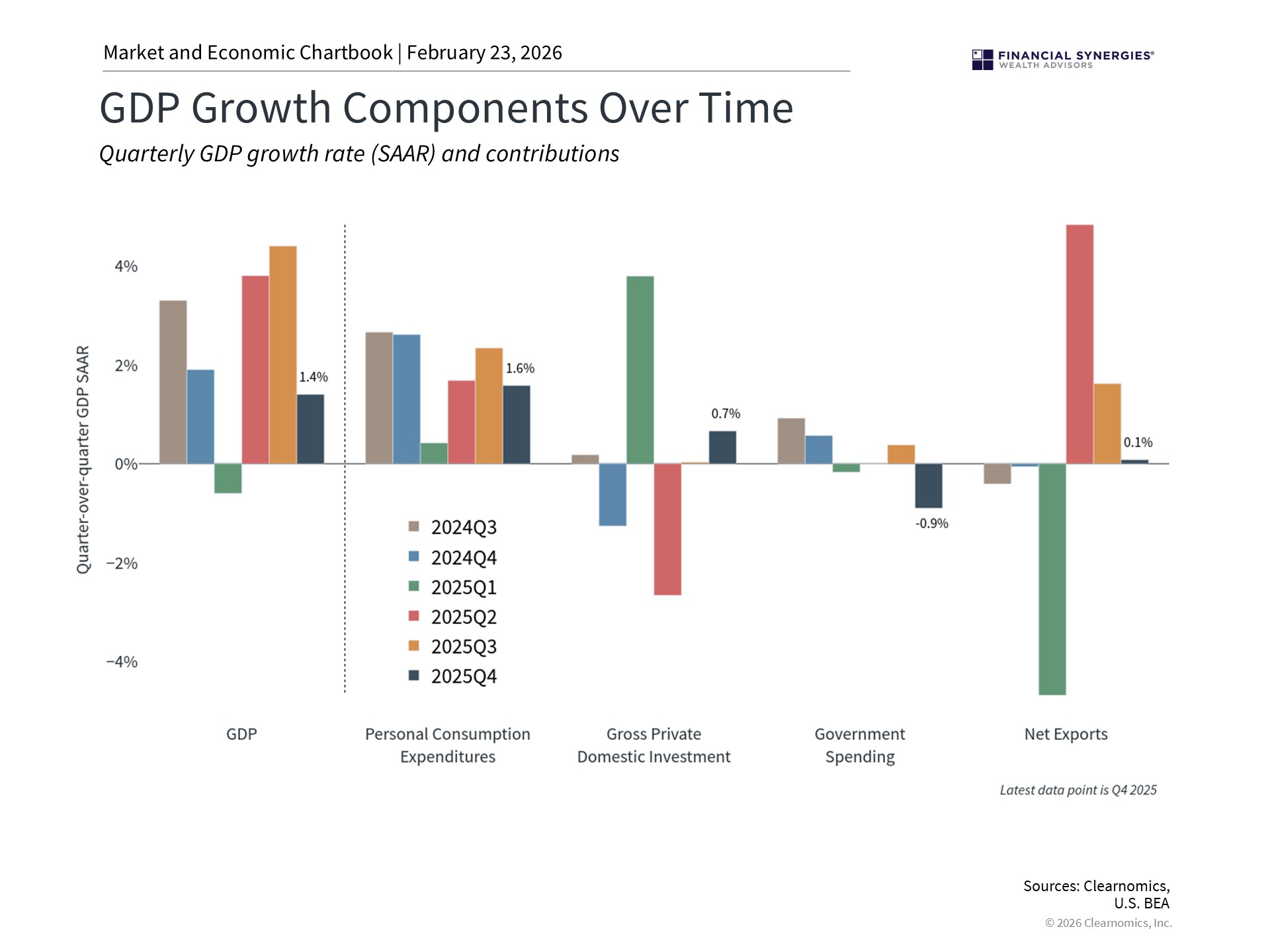
• The latest report by the Bureau of Economic Analysis shows that real GDP grew at a 1.4% annual rate in the fourth quarter of 2025. This is below the 2.8% economists had expected and a significant step down from the 4.4% growth in the third quarter.
• This deceleration was primarily due to government spending and trade. The domestic economy, which is measured by a calculation called “real final sales to private domestic purchasers,” increased 2.4% in Q4. This means that consumer spending and business investment were quite healthy.
• Federal government spending fell at a 16.6% rate, subtracting nearly 1.2 percentage points from GDP, largely due to the government shutdown from October to mid-November 2025. Meanwhile, net exports contributed very little to GDP after adding to growth in Q2 and Q3 last year.
• Investors and economists are concerned about a “K-shaped” economy in which some experience growth while others are struggling. This can be seen in the divergence between corporate profits and broad economic growth, versus the slowing job market and poor consumer sentiment.
The included chart shows recent GDP components, helping to illustrate how government spending, consumer activity, and trade each contributed to last quarter’s results.
While short-term GDP data can raise questions, the broader trend of steady consumer spending and business investment is a reminder that long-term investors are best served by focusing on the overall trajectory of the economy rather than any single quarter.
Here are some key points to consider:
• Tensions between the U.S. and Iran have escalated, with the Trump administration deploying F-35 and F-22 fighters, a second aircraft carrier, and air defenses to the Middle East. The U.S. is demanding an end to Iran’s nuclear enrichment program and constraints on its ballistic-missile program. President Trump has signaled that the U.S. would decide its next move by early March if Iran does not agree to a nuclear deal.
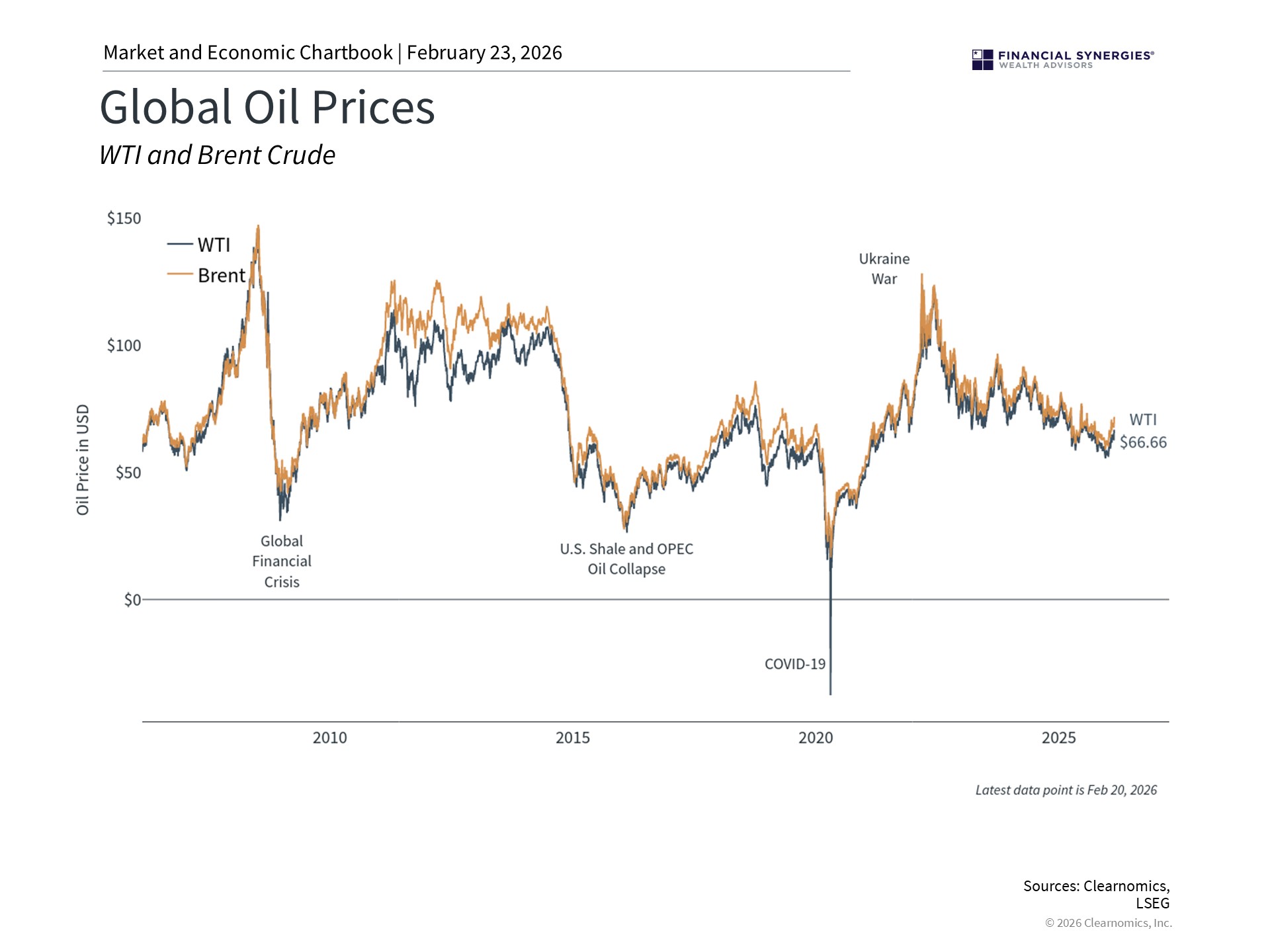
• Energy markets have begun to react, with Brent crude and West Texas Intermediate both rising. This year, oil prices have risen approximately $10 per barrel, with Brent crude jumping from $60 per barrel to around $70. However, it’s important to keep in mind that these prices are still low by historical standards.
• A key risk is whether any conflict could threaten the Strait of Hormuz, a critical waterway carrying roughly one-third of the world’s oil supply. A disruption there could send oil prices significantly higher and add to inflationary pressures globally. This has been a concern over the past several years as Middle East tensions have flared.
• For investors, geopolitical risks are an unavoidable fact of investing. Historically, market and economic indicators have generally recovered from geopolitical volatility once the initial situation passes. This was true earlier this year when the U.S. conducted operations in Venezuela as well.
The included chart on oil prices provides helpful context on how markets have historically responded to major world events. While events like Russia’s invasion of Ukraine and the Hamas attack on Israel caused short-term volatility, oil prices have remained fairly stable over the past few years.
While geopolitical events can cause short-term market turbulence, history consistently reminds us that staying patient and focused on long-term financial goals has generally been the most rewarding approach for investors navigating uncertain times.
Here are some key points to consider:
• The latest concerns arose when Blue Owl Capital, a private credit manager, announced it was permanently ending redemption requests for one of its large funds. It also liquidated $1.4 billion in assets to meet redemption requests from investors wanting to exit its funds. This news rattled confidence in the industry and sparked new questions around the rapid growth of these assets.
• The big picture is that, since 2008, significant lending activity has shifted from traditional banks to “non-depository financial institutions” (NDFIs) such as private credit funds, mortgage companies, insurance companies, online lenders, and more. This has fueled the industry, with many wondering when the growth would either slow or cracks would begin to form.
• There were signs of stress last year when some private companies declared bankruptcy or were accused of fraud. Famously, Jamie Dimon, the CEO of JPMorgan, made a comment that when you find one cockroach, there are likely to be others. Broader signs of stress in private credit include a jump in redemption requests at the end of 2025 and a slowdown in new investments flowing into these funds, which could weigh on future earnings growth for the sector.
• An important consideration in evaluating private market investments is that fund performance is largely driven by the manager’s investment strategy, deal sourcing capabilities, experience, and execution. As a result, challenges encountered by one private credit fund do not necessarily extend to others. That said, in the event of a broader economic slowdown, many portfolio companies could face pressure. Additionally, the semi-liquid nature of private market funds may amplify such stresses.
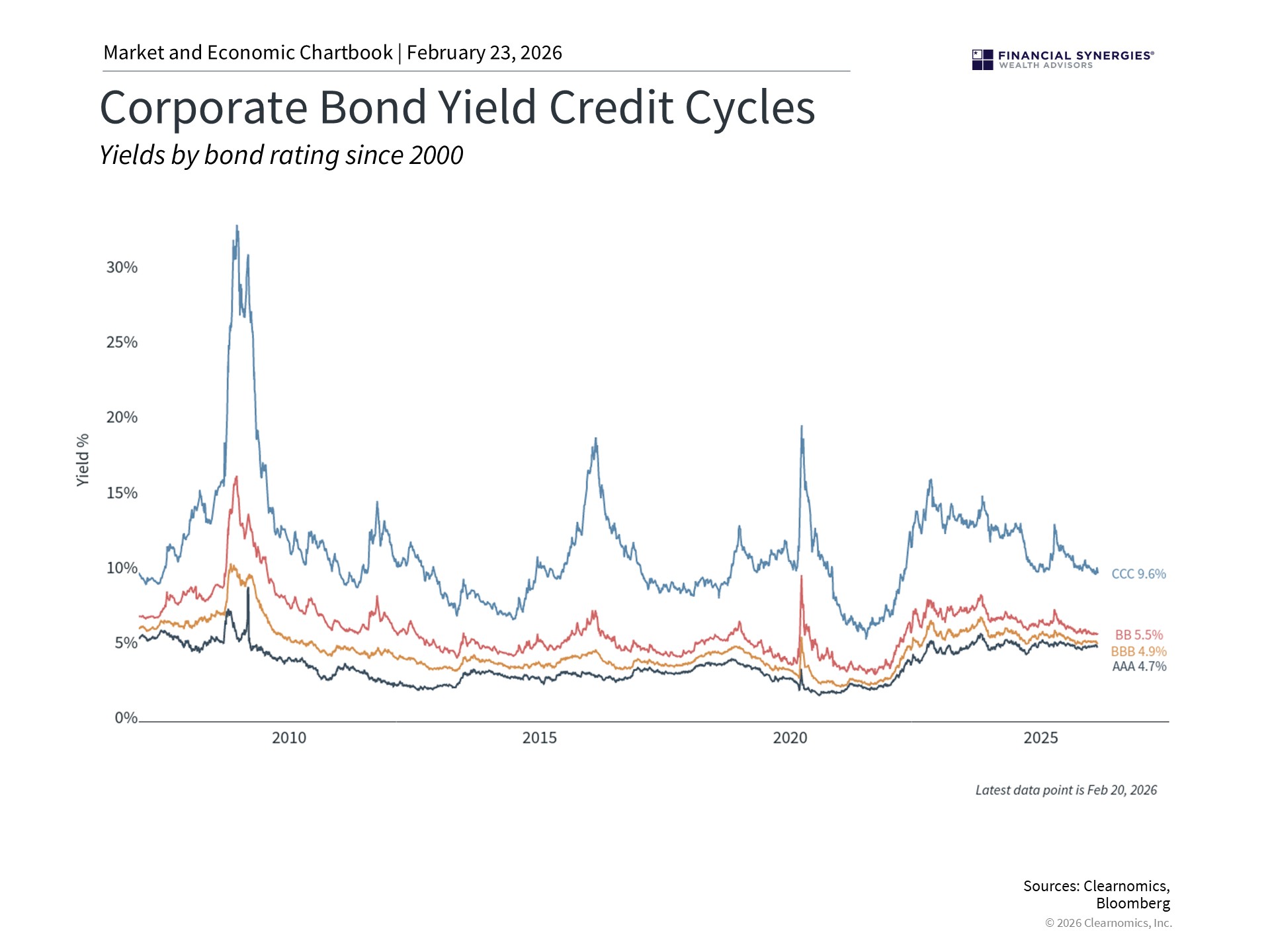
• For long-term investors, public credit and bonds most likely play a larger role in portfolios. Public credit markets remain healthy, with spreads still quite low. In fact, areas like high yield still offer healthy yields for investors seeking income.
The included chart shows corporate credit yields across credit cycles, helping illustrate how credit conditions in public markets compare to the stress emerging in private credit today.
While short-term turbulence in private credit deserves attention, staying focused on diversification and long-term fundamentals remains the most reliable path to financial success.
Summary
The bottom line is that while there’s no shortage of headlines right now, the bigger picture hasn’t changed. The Supreme Court’s tariff decision reduces one layer of trade uncertainty, even if some policy questions remain. GDP slowed last quarter, but the core drivers of the economy, especially consumer spending and business investment, are still holding up. Tensions with Iran and the recent moves in oil prices are worth watching, yet history reminds us that markets have consistently worked through geopolitical shocks. And while some private credit funds are showing signs of strain, broader credit markets remain on solid footing. Short-term volatility is part of investing, but long-term outcomes are driven by fundamentals, discipline, and a well-diversified plan.
Concerns or questions about how your investment portfolio will hold up in the current market environment? Contact Financial Synergies today.
We are a boutique, financial advisory and total wealth management firm with over 35 years helping clients navigate turbulent markets. To learn more about our approach to investment management please reach out to us. One of our seasoned advisors would be happy to help you build a custom financial plan to help ensure you accomplish your financial goals and objectives. Schedule a conversation with us today.
More relevant articles by Financial Synergies:
Blog Disclosures
This content, which contains security-related opinions and/or information, is provided for informational purposes only and should not be relied upon in any manner as professional advice, or an endorsement of any practices, products or services. There can be no guarantees or assurances that the views expressed here will be applicable for any particular facts or circumstances, and should not be relied upon in any manner. You should consult your own financial advisors as to legal, business, tax, and other related matters concerning any investment.
The commentary in this “post” (including any related blogs, videos, and social media) reflects the personal opinions, viewpoints, and analyses of the Financial Synergies Wealth Advisors, Inc. employees providing such comments, and should not be regarded as the views of Financial Synergies Wealth Advisors, Inc. or its respective affiliates or as a description of advisory services provided by Financial Synergies Wealth Advisors, Inc. or performance returns of any Financial Synergies Wealth Advisors, Inc. client.
Any opinions expressed herein do not constitute or imply endorsement, sponsorship, or recommendation by Financial Synergies Wealth Advisors, Inc. or its employees. The views reflected in the commentary are subject to change at any time without notice.
Nothing on this website constitutes investment or financial planning advice, performance data or any recommendation that any particular security, portfolio of securities, transaction or investment strategy is suitable for any specific person. It also should not be construed as an offer soliciting the purchase or sale of any security mentioned. Nor should it be construed as an offer to provide investment advisory services by Financial Synergies Wealth Advisors, Inc.
Any mention of a particular security and related performance data is not a recommendation to buy or sell that security. Financial Synergies Wealth Advisors, Inc. manages its clients’ accounts using a variety of investment techniques and strategies, which are not necessarily discussed in the commentary. Investments in securities involve the risk of loss. Past performance is no guarantee of future results.
Any charts provided here or on any related Financial Synergies Wealth Advisors, Inc. personnel content outlets are for informational purposes only, and should also not be relied upon when making any investment decision. Any indices referenced for comparison are unmanaged and cannot be invested into directly. As always please remember investing involves risk and possible loss of principal capital; please seek advice from a licensed professional. Any projections, estimates, forecasts, targets, prospects and/or opinions expressed in these materials are subject to change without notice and may differ or be contrary to opinions expressed by others. Information in charts have been obtained from third-party sources and data, and may include those from portfolio securities of funds managed by Financial Synergies Wealth Advisors, Inc. While taken from sources believed to be reliable, Financial Synergies Wealth Advisors, Inc. has not independently verified such information and makes no representations about the enduring accuracy of the information or its appropriateness for a given situation. All content speaks only as of the date indicated.
Financial Synergies Wealth Advisors, Inc. is a registered investment adviser. Advisory services are only offered to clients or prospective clients where Financial Synergies Wealth Advisors, Inc. and its representatives are properly licensed or exempt from licensure. Investments in securities involve the risk of loss. Past performance is no guarantee of future results.
See Full Disclosures Page Here
 Skip to content


Top Client Questions: Tariffs Ruled Unconstitutional, Iran, GDP, and Private Credit
Top Client Questions: Tariffs Ruled Unconstitutional, Iran, GDP, and Private Credit
How does the Supreme Court’s tariff ruling affect the economy?
This is a very fluid situation, and events are unfolding rapidly, but here are the key facts thus far:
• On February 20, 2026, the Supreme Court ruled 6-3 that the broad tariffs enacted by the White House under the International Emergency Economic Powers Act (IEEPA) were illegal. This matters for investors because trade policy has been a major source of market volatility and has affected all parts of the economy.
• The ruling struck down tariffs on virtually every country tied to trade deficits, as well as those on Mexico, Canada, and China over fentanyl concerns, though smaller tariffs on steel, aluminum, and cars remain in place. This includes the “reciprocal tariffs” that were announced during last April’s “liberation day.”
• It’s unclear whether refunds will be provided and how they will be enacted. Thousands of businesses were part of the lawsuits that made their way to the Supreme Court, so this could impact many sectors. According to data from U.S. Customs and Border Protection, roughly $90 billion of the approximately $195 billion in tariffs collected under IEEPA may need to be refunded.
• The White House may attempt to re-enact tariffs under other legal frameworks, though those laws have procedural limits and may not allow tariffs as sweeping as the ones struck down. So, while this minimizes one tool the administration has been using for international negotiations, they may still be able to implement tariffs in other ways.
The included chart shows the level of import tariffs across different countries. These tariffs have led to short-term volatility, but the market has remained resilient over the past year.
While policy changes like this can create short-term uncertainty, it is worth remembering that corporate earnings, economic growth, and valuations tend to be the true drivers of long-term market performance.
Why did GDP weaken last quarter?
Here are some key factors to consider:
• The latest report by the Bureau of Economic Analysis shows that real GDP grew at a 1.4% annual rate in the fourth quarter of 2025. This is below the 2.8% economists had expected and a significant step down from the 4.4% growth in the third quarter.
• This deceleration was primarily due to government spending and trade. The domestic economy, which is measured by a calculation called “real final sales to private domestic purchasers,” increased 2.4% in Q4. This means that consumer spending and business investment were quite healthy.
• Federal government spending fell at a 16.6% rate, subtracting nearly 1.2 percentage points from GDP, largely due to the government shutdown from October to mid-November 2025. Meanwhile, net exports contributed very little to GDP after adding to growth in Q2 and Q3 last year.
• Investors and economists are concerned about a “K-shaped” economy in which some experience growth while others are struggling. This can be seen in the divergence between corporate profits and broad economic growth, versus the slowing job market and poor consumer sentiment.
The included chart shows recent GDP components, helping to illustrate how government spending, consumer activity, and trade each contributed to last quarter’s results.
While short-term GDP data can raise questions, the broader trend of steady consumer spending and business investment is a reminder that long-term investors are best served by focusing on the overall trajectory of the economy rather than any single quarter.
What are the market risks of a possible escalation with Iran?
Here are some key points to consider:
• Tensions between the U.S. and Iran have escalated, with the Trump administration deploying F-35 and F-22 fighters, a second aircraft carrier, and air defenses to the Middle East. The U.S. is demanding an end to Iran’s nuclear enrichment program and constraints on its ballistic-missile program. President Trump has signaled that the U.S. would decide its next move by early March if Iran does not agree to a nuclear deal.
• Energy markets have begun to react, with Brent crude and West Texas Intermediate both rising. This year, oil prices have risen approximately $10 per barrel, with Brent crude jumping from $60 per barrel to around $70. However, it’s important to keep in mind that these prices are still low by historical standards.
• A key risk is whether any conflict could threaten the Strait of Hormuz, a critical waterway carrying roughly one-third of the world’s oil supply. A disruption there could send oil prices significantly higher and add to inflationary pressures globally. This has been a concern over the past several years as Middle East tensions have flared.
• For investors, geopolitical risks are an unavoidable fact of investing. Historically, market and economic indicators have generally recovered from geopolitical volatility once the initial situation passes. This was true earlier this year when the U.S. conducted operations in Venezuela as well.
The included chart on oil prices provides helpful context on how markets have historically responded to major world events. While events like Russia’s invasion of Ukraine and the Hamas attack on Israel caused short-term volatility, oil prices have remained fairly stable over the past few years.
While geopolitical events can cause short-term market turbulence, history consistently reminds us that staying patient and focused on long-term financial goals has generally been the most rewarding approach for investors navigating uncertain times.
What do the latest private credit headlines mean for investors?
Here are some key points to consider:
• The latest concerns arose when Blue Owl Capital, a private credit manager, announced it was permanently ending redemption requests for one of its large funds. It also liquidated $1.4 billion in assets to meet redemption requests from investors wanting to exit its funds. This news rattled confidence in the industry and sparked new questions around the rapid growth of these assets.
• The big picture is that, since 2008, significant lending activity has shifted from traditional banks to “non-depository financial institutions” (NDFIs) such as private credit funds, mortgage companies, insurance companies, online lenders, and more. This has fueled the industry, with many wondering when the growth would either slow or cracks would begin to form.
• There were signs of stress last year when some private companies declared bankruptcy or were accused of fraud. Famously, Jamie Dimon, the CEO of JPMorgan, made a comment that when you find one cockroach, there are likely to be others. Broader signs of stress in private credit include a jump in redemption requests at the end of 2025 and a slowdown in new investments flowing into these funds, which could weigh on future earnings growth for the sector.
• An important consideration in evaluating private market investments is that fund performance is largely driven by the manager’s investment strategy, deal sourcing capabilities, experience, and execution. As a result, challenges encountered by one private credit fund do not necessarily extend to others. That said, in the event of a broader economic slowdown, many portfolio companies could face pressure. Additionally, the semi-liquid nature of private market funds may amplify such stresses.
• For long-term investors, public credit and bonds most likely play a larger role in portfolios. Public credit markets remain healthy, with spreads still quite low. In fact, areas like high yield still offer healthy yields for investors seeking income.
The included chart shows corporate credit yields across credit cycles, helping illustrate how credit conditions in public markets compare to the stress emerging in private credit today.
While short-term turbulence in private credit deserves attention, staying focused on diversification and long-term fundamentals remains the most reliable path to financial success.
Summary
The bottom line is that while there’s no shortage of headlines right now, the bigger picture hasn’t changed. The Supreme Court’s tariff decision reduces one layer of trade uncertainty, even if some policy questions remain. GDP slowed last quarter, but the core drivers of the economy, especially consumer spending and business investment, are still holding up. Tensions with Iran and the recent moves in oil prices are worth watching, yet history reminds us that markets have consistently worked through geopolitical shocks. And while some private credit funds are showing signs of strain, broader credit markets remain on solid footing. Short-term volatility is part of investing, but long-term outcomes are driven by fundamentals, discipline, and a well-diversified plan.
Concerns or questions about how your investment portfolio will hold up in the current market environment? Contact Financial Synergies today.
We are a boutique, financial advisory and total wealth management firm with over 35 years helping clients navigate turbulent markets. To learn more about our approach to investment management please reach out to us. One of our seasoned advisors would be happy to help you build a custom financial plan to help ensure you accomplish your financial goals and objectives. Schedule a conversation with us today.
More relevant articles by Financial Synergies:
Blog Disclosures
This content, which contains security-related opinions and/or information, is provided for informational purposes only and should not be relied upon in any manner as professional advice, or an endorsement of any practices, products or services. There can be no guarantees or assurances that the views expressed here will be applicable for any particular facts or circumstances, and should not be relied upon in any manner. You should consult your own financial advisors as to legal, business, tax, and other related matters concerning any investment.
The commentary in this “post” (including any related blogs, videos, and social media) reflects the personal opinions, viewpoints, and analyses of the Financial Synergies Wealth Advisors, Inc. employees providing such comments, and should not be regarded as the views of Financial Synergies Wealth Advisors, Inc. or its respective affiliates or as a description of advisory services provided by Financial Synergies Wealth Advisors, Inc. or performance returns of any Financial Synergies Wealth Advisors, Inc. client.
Any opinions expressed herein do not constitute or imply endorsement, sponsorship, or recommendation by Financial Synergies Wealth Advisors, Inc. or its employees. The views reflected in the commentary are subject to change at any time without notice.
Nothing on this website constitutes investment or financial planning advice, performance data or any recommendation that any particular security, portfolio of securities, transaction or investment strategy is suitable for any specific person. It also should not be construed as an offer soliciting the purchase or sale of any security mentioned. Nor should it be construed as an offer to provide investment advisory services by Financial Synergies Wealth Advisors, Inc.
Any mention of a particular security and related performance data is not a recommendation to buy or sell that security. Financial Synergies Wealth Advisors, Inc. manages its clients’ accounts using a variety of investment techniques and strategies, which are not necessarily discussed in the commentary. Investments in securities involve the risk of loss. Past performance is no guarantee of future results.
Any charts provided here or on any related Financial Synergies Wealth Advisors, Inc. personnel content outlets are for informational purposes only, and should also not be relied upon when making any investment decision. Any indices referenced for comparison are unmanaged and cannot be invested into directly. As always please remember investing involves risk and possible loss of principal capital; please seek advice from a licensed professional. Any projections, estimates, forecasts, targets, prospects and/or opinions expressed in these materials are subject to change without notice and may differ or be contrary to opinions expressed by others. Information in charts have been obtained from third-party sources and data, and may include those from portfolio securities of funds managed by Financial Synergies Wealth Advisors, Inc. While taken from sources believed to be reliable, Financial Synergies Wealth Advisors, Inc. has not independently verified such information and makes no representations about the enduring accuracy of the information or its appropriateness for a given situation. All content speaks only as of the date indicated.
Financial Synergies Wealth Advisors, Inc. is a registered investment adviser. Advisory services are only offered to clients or prospective clients where Financial Synergies Wealth Advisors, Inc. and its representatives are properly licensed or exempt from licensure. Investments in securities involve the risk of loss. Past performance is no guarantee of future results.
See Full Disclosures Page Here
Recent Posts
Happy Birthday to the Bull Market 🎉
Quarterly Webinar: Q4 2026 Market and Economic Themes
Medicare Open Enrollment 2026: What to Know
Subscribe to Our Blog
Chief Investment Officer | Managing Partner