Markets have been very volatile this week, and we wanted to share some perspective on what’s behind the moves. Stocks fell sharply on Thursday, November 5, just one day after a broad rally that followed the midterm elections. Swings like this can be unsettling, especially after a long stretch of gains and with so many headlines competing for attention. Let’s review what happened this week, the questions investors are weighing, and the broader impact on the market and the economy.
What Happened This Week
On Wednesday, markets welcomed the election results. Democrats won both the House and the Senate, creating a divided government. Markets tend to favor certainty over uncertainty, and divided government has historically been viewed as a more predictable policy environment, reducing the likelihood of major changes to the status quo. The S&P 500 rose +1.6%, and the Dow Jones had its best day after a midterm election in more than 40 years.
On Thursday, attention turned to data centers. The S&P 500 fell more than ‑4%, its largest one-day decline since April 2025, while the Nasdaq fell more than ‑5% as technology stocks led the selling. The Nasdaq traded lower nearly ‑12% below its October high, so you may see headlines calling it a “correction,” the common term for a decline of 10% or more from a recent high. The VIX, a widely followed measure of expected stock market volatility, rose to its highest level since late March.
However, the selling pressure was heavier in some parts of the market than in others. The S&P 500 is about ‑6% below its record and remains up about +7% this year. In contrast, the equal-weight S&P 500, which gives every company the same weight, set a record high on Wednesday, an indication of relative strength outside the largest technology companies.
Questions About the Pace and Cost of AI Investment
The selloff centered on AI, the theme that has led the stock market in recent years. The largest technology companies are spending hundreds of billions of dollars a year on data centers and computer chips, and for several of them that spending now exceeds the cash their businesses bring in. More of it is being financed with debt, and investors are asking when that spending will pay off. Demand doesn’t appear to be the issue: one major chipmaker reported that its data-center sales nearly doubled from a year ago, and another described its main challenge as supply rather than demand. Meanwhile, demand for computing power continues to grow, even as investors debate the pace and cost of the buildout.
The midterm elections raised a second question: how quickly new data centers can be built. Nationally, Democrats won control of both the House and the Senate, setting up a divided government when the new Congress begins in January. Locally, voters in about ten states voted on roughly 40 ballot measures related to data centers, and most of the results went against new development. The votes reflected concerns about electricity costs, land use, and the strain on local power grids, concerns shared across the political spectrum. Investors are now weighing whether tighter rules could slow construction. Delays and higher costs are not the same as cancellations, but they can change how quickly companies earn a return on what they spend.
Stock prices reflect expectations for future earnings and how much investors are willing to pay for them, and those expectations can change quickly even when hiring and spending hold steady. That’s especially true for companies whose shares were priced for years of rapid AI growth. A market decline doesn’t by itself mean a recession is coming, and the latest data describe an economy that’s still growing.
Putting This Week Into Perspective
The selling has been heaviest in a narrow group of large technology companies, while several other parts of a diversified portfolio have done their job. The equal-weight S&P 500 set a record high the day after the election. Bonds traded higher as stocks fell: the 10-year Treasury yield has declined from about 5.3% in early October to below 4.9%, and bond prices rise when yields fall. High-quality bonds are also paying meaningful income again, something that was hard to find for much of the past decade.
Recent data suggest the underlying fundamentals remain solid. The economy is growing, corporate earnings are rising, and demand for AI computing power remains strong. The debate is about the pace and cost of the buildout, not whether the demand exists. Valuations have also come down. Because earnings have grown much faster than stock prices over the past year, the S&P 500 now trades at about 18 times expected earnings for the next 12 months. That is down from about 23 times a year ago and closer to its long-term average.
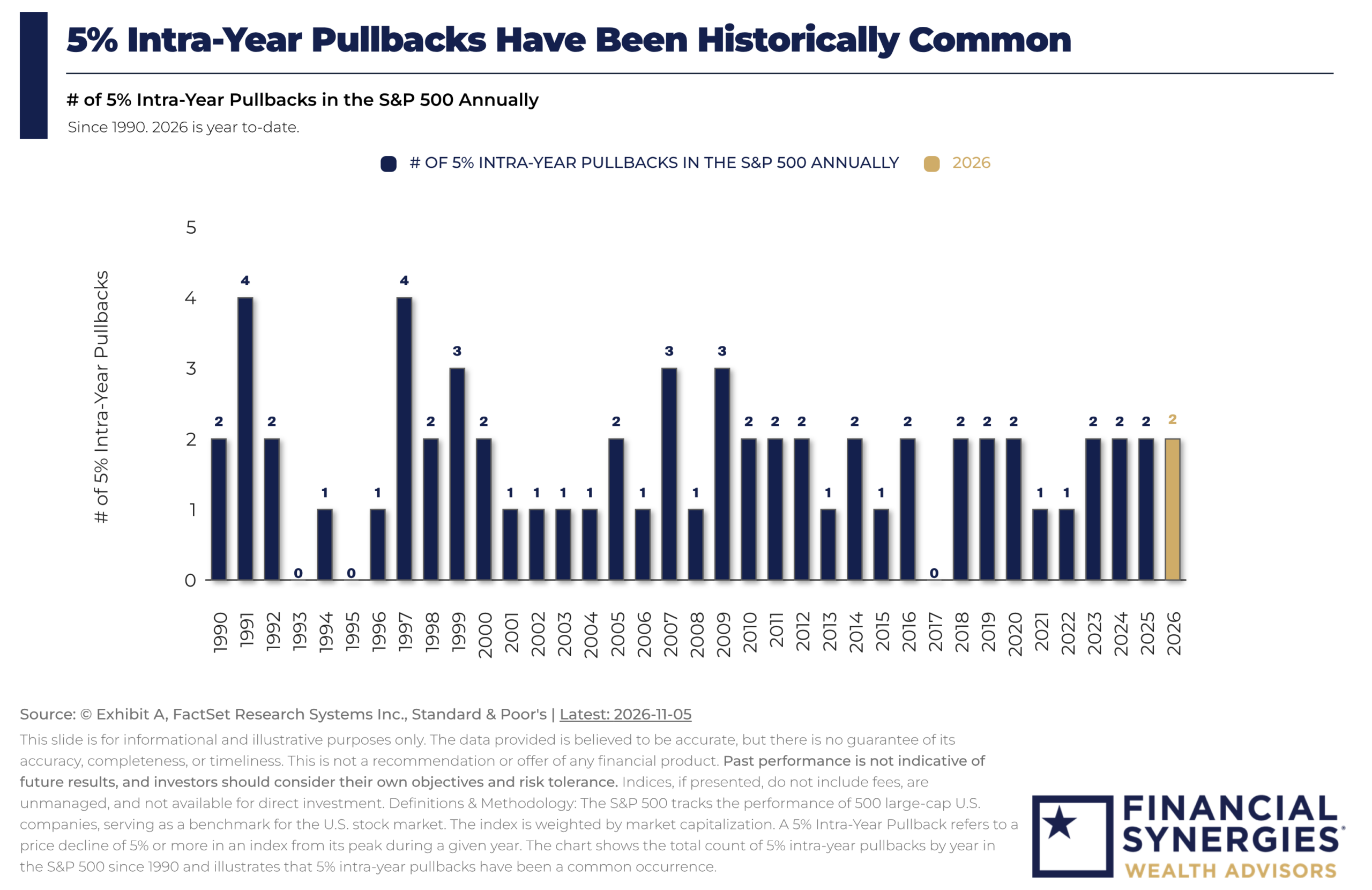
Finally, history argues for patience. Since 1980, the S&P 500 has dropped ‑5% or more at some point in nearly every year. Some of the market’s strongest days have historically come shortly after its weakest, so stepping out after a decline can mean missing the recovery. No one can say how long this volatility will last, but a portfolio built around long-term goals is designed with periods like this in mind.
Data Source: MarketDesk Research, LLC
Concerns or questions about your financial plan or investment portfolio? Contact Financial Synergies today.
We are a boutique, financial advisory and total wealth management firm with over 35 years helping clients navigate turbulent markets. To learn more about our approach to investment management, financial planning, and retirement planning, please reach out to us. One of our seasoned advisors would be happy to help you build a custom financial plan to help ensure you accomplish your financial goals and objectives. Schedule a conversation with us today.
More relevant articles by Financial Synergies:
Blog Disclosures
This content, which contains security-related opinions and/or information, is provided for informational purposes only and should not be relied upon in any manner as professional advice, or an endorsement of any practices, products or services. There can be no guarantees or assurances that the views expressed here will be applicable for any particular facts or circumstances, and should not be relied upon in any manner. You should consult your own financial advisors as to legal, business, tax, and other related matters concerning any investment.
The commentary in this “post” (including any related blogs, videos, and social media) reflects the personal opinions, viewpoints, and analyses of the Financial Synergies Wealth Advisors, Inc. employees providing such comments, and should not be regarded as the views of Financial Synergies Wealth Advisors, Inc. or its respective affiliates or as a description of advisory services provided by Financial Synergies Wealth Advisors, Inc. or performance returns of any Financial Synergies Wealth Advisors, Inc. client.
Any opinions expressed herein do not constitute or imply endorsement, sponsorship, or recommendation by Financial Synergies Wealth Advisors, Inc. or its employees. The views reflected in the commentary are subject to change at any time without notice.
Nothing on this website constitutes investment or financial planning advice, performance data or any recommendation that any particular security, portfolio of securities, transaction or investment strategy is suitable for any specific person. It also should not be construed as an offer soliciting the purchase or sale of any security mentioned. Nor should it be construed as an offer to provide investment advisory services by Financial Synergies Wealth Advisors, Inc.
Any mention of a particular security and related performance data is not a recommendation to buy or sell that security. Financial Synergies Wealth Advisors, Inc. manages its clients’ accounts using a variety of investment techniques and strategies, which are not necessarily discussed in the commentary. Investments in securities involve the risk of loss. Past performance is no guarantee of future results.
Any charts provided here or on any related Financial Synergies Wealth Advisors, Inc. personnel content outlets are for informational purposes only, and should also not be relied upon when making any investment decision. Any indices referenced for comparison are unmanaged and cannot be invested into directly. As always please remember investing involves risk and possible loss of principal capital; please seek advice from a licensed professional. Any projections, estimates, forecasts, targets, prospects and/or opinions expressed in these materials are subject to change without notice and may differ or be contrary to opinions expressed by others. Information in charts have been obtained from third-party sources and data, and may include those from portfolio securities of funds managed by Financial Synergies Wealth Advisors, Inc. While taken from sources believed to be reliable, Financial Synergies Wealth Advisors, Inc. has not independently verified such information and makes no representations about the enduring accuracy of the information or its appropriateness for a given situation. All content speaks only as of the date indicated.
Financial Synergies Wealth Advisors, Inc. is a registered investment adviser. Advisory services are only offered to clients or prospective clients where Financial Synergies Wealth Advisors, Inc. and its representatives are properly licensed or exempt from licensure. Investments in securities involve the risk of loss. Past performance is no guarantee of future results.
See Full Disclosures Page Here
 Skip to content


Putting This Week’s Market Volatility in Perspective
Markets have been very volatile this week, and we wanted to share some perspective on what’s behind the moves. Stocks fell sharply on Thursday, November 5, just one day after a broad rally that followed the midterm elections. Swings like this can be unsettling, especially after a long stretch of gains and with so many headlines competing for attention. Let’s review what happened this week, the questions investors are weighing, and the broader impact on the market and the economy.
What Happened This Week
On Wednesday, markets welcomed the election results. Democrats won both the House and the Senate, creating a divided government. Markets tend to favor certainty over uncertainty, and divided government has historically been viewed as a more predictable policy environment, reducing the likelihood of major changes to the status quo. The S&P 500 rose +1.6%, and the Dow Jones had its best day after a midterm election in more than 40 years.
On Thursday, attention turned to data centers. The S&P 500 fell more than ‑4%, its largest one-day decline since April 2025, while the Nasdaq fell more than ‑5% as technology stocks led the selling. The Nasdaq traded lower nearly ‑12% below its October high, so you may see headlines calling it a “correction,” the common term for a decline of 10% or more from a recent high. The VIX, a widely followed measure of expected stock market volatility, rose to its highest level since late March.
However, the selling pressure was heavier in some parts of the market than in others. The S&P 500 is about ‑6% below its record and remains up about +7% this year. In contrast, the equal-weight S&P 500, which gives every company the same weight, set a record high on Wednesday, an indication of relative strength outside the largest technology companies.
Questions About the Pace and Cost of AI Investment
The selloff centered on AI, the theme that has led the stock market in recent years. The largest technology companies are spending hundreds of billions of dollars a year on data centers and computer chips, and for several of them that spending now exceeds the cash their businesses bring in. More of it is being financed with debt, and investors are asking when that spending will pay off. Demand doesn’t appear to be the issue: one major chipmaker reported that its data-center sales nearly doubled from a year ago, and another described its main challenge as supply rather than demand. Meanwhile, demand for computing power continues to grow, even as investors debate the pace and cost of the buildout.
The midterm elections raised a second question: how quickly new data centers can be built. Nationally, Democrats won control of both the House and the Senate, setting up a divided government when the new Congress begins in January. Locally, voters in about ten states voted on roughly 40 ballot measures related to data centers, and most of the results went against new development. The votes reflected concerns about electricity costs, land use, and the strain on local power grids, concerns shared across the political spectrum. Investors are now weighing whether tighter rules could slow construction. Delays and higher costs are not the same as cancellations, but they can change how quickly companies earn a return on what they spend.
Stock prices reflect expectations for future earnings and how much investors are willing to pay for them, and those expectations can change quickly even when hiring and spending hold steady. That’s especially true for companies whose shares were priced for years of rapid AI growth. A market decline doesn’t by itself mean a recession is coming, and the latest data describe an economy that’s still growing.
Putting This Week Into Perspective
The selling has been heaviest in a narrow group of large technology companies, while several other parts of a diversified portfolio have done their job. The equal-weight S&P 500 set a record high the day after the election. Bonds traded higher as stocks fell: the 10-year Treasury yield has declined from about 5.3% in early October to below 4.9%, and bond prices rise when yields fall. High-quality bonds are also paying meaningful income again, something that was hard to find for much of the past decade.
Recent data suggest the underlying fundamentals remain solid. The economy is growing, corporate earnings are rising, and demand for AI computing power remains strong. The debate is about the pace and cost of the buildout, not whether the demand exists. Valuations have also come down. Because earnings have grown much faster than stock prices over the past year, the S&P 500 now trades at about 18 times expected earnings for the next 12 months. That is down from about 23 times a year ago and closer to its long-term average.
Finally, history argues for patience. Since 1980, the S&P 500 has dropped ‑5% or more at some point in nearly every year. Some of the market’s strongest days have historically come shortly after its weakest, so stepping out after a decline can mean missing the recovery. No one can say how long this volatility will last, but a portfolio built around long-term goals is designed with periods like this in mind.
Data Source: MarketDesk Research, LLC
Concerns or questions about your financial plan or investment portfolio? Contact Financial Synergies today.
We are a boutique, financial advisory and total wealth management firm with over 35 years helping clients navigate turbulent markets. To learn more about our approach to investment management, financial planning, and retirement planning, please reach out to us. One of our seasoned advisors would be happy to help you build a custom financial plan to help ensure you accomplish your financial goals and objectives. Schedule a conversation with us today.
More relevant articles by Financial Synergies:
Blog Disclosures
This content, which contains security-related opinions and/or information, is provided for informational purposes only and should not be relied upon in any manner as professional advice, or an endorsement of any practices, products or services. There can be no guarantees or assurances that the views expressed here will be applicable for any particular facts or circumstances, and should not be relied upon in any manner. You should consult your own financial advisors as to legal, business, tax, and other related matters concerning any investment.
The commentary in this “post” (including any related blogs, videos, and social media) reflects the personal opinions, viewpoints, and analyses of the Financial Synergies Wealth Advisors, Inc. employees providing such comments, and should not be regarded as the views of Financial Synergies Wealth Advisors, Inc. or its respective affiliates or as a description of advisory services provided by Financial Synergies Wealth Advisors, Inc. or performance returns of any Financial Synergies Wealth Advisors, Inc. client.
Any opinions expressed herein do not constitute or imply endorsement, sponsorship, or recommendation by Financial Synergies Wealth Advisors, Inc. or its employees. The views reflected in the commentary are subject to change at any time without notice.
Nothing on this website constitutes investment or financial planning advice, performance data or any recommendation that any particular security, portfolio of securities, transaction or investment strategy is suitable for any specific person. It also should not be construed as an offer soliciting the purchase or sale of any security mentioned. Nor should it be construed as an offer to provide investment advisory services by Financial Synergies Wealth Advisors, Inc.
Any mention of a particular security and related performance data is not a recommendation to buy or sell that security. Financial Synergies Wealth Advisors, Inc. manages its clients’ accounts using a variety of investment techniques and strategies, which are not necessarily discussed in the commentary. Investments in securities involve the risk of loss. Past performance is no guarantee of future results.
Any charts provided here or on any related Financial Synergies Wealth Advisors, Inc. personnel content outlets are for informational purposes only, and should also not be relied upon when making any investment decision. Any indices referenced for comparison are unmanaged and cannot be invested into directly. As always please remember investing involves risk and possible loss of principal capital; please seek advice from a licensed professional. Any projections, estimates, forecasts, targets, prospects and/or opinions expressed in these materials are subject to change without notice and may differ or be contrary to opinions expressed by others. Information in charts have been obtained from third-party sources and data, and may include those from portfolio securities of funds managed by Financial Synergies Wealth Advisors, Inc. While taken from sources believed to be reliable, Financial Synergies Wealth Advisors, Inc. has not independently verified such information and makes no representations about the enduring accuracy of the information or its appropriateness for a given situation. All content speaks only as of the date indicated.
Financial Synergies Wealth Advisors, Inc. is a registered investment adviser. Advisory services are only offered to clients or prospective clients where Financial Synergies Wealth Advisors, Inc. and its representatives are properly licensed or exempt from licensure. Investments in securities involve the risk of loss. Past performance is no guarantee of future results.
See Full Disclosures Page Here
Recent Posts
Putting This Week’s Market Volatility in Perspective
The Midterms Changed Congress, Not the Fundamentals
Monthly Market Update: Market Leadership Rotates as Investors Reassess the AI Trade
Subscribe to Our Blog
Chief Investment Officer | Managing Partner