In the famous words of Ferris Bueller, “Life moves pretty fast. If you don’t stop and look around once in a while, you could miss it.” This certainly applies to the stock market recently!
Stocks have been all over the place. Volatile markets are often driven by a combination of factors, and recent swings across major indices are no exception. Several recent developments, including leadership changes at Nvidia and Anthropic’s initial public offering (IPO), extended beyond AI stocks and pushed the S&P 500 and Dow Jones Industrial Average to market correction levels, while the Nasdaq briefly erased its year-to-date gains.1
Since then, many parts of the market have rebounded and have offset some of those losses, particularly with the reinstatement of Jensen Huang as Nvidia’s CEO, with the reported involvement of the White House.2 This demonstrates how quickly markets can react to new information and why it’s important to maintain a long-term perspective. While these events continue to unfold, the underlying question continues to be whether the hundreds of billions of dollars being invested in AI infrastructure will ultimately generate sufficient returns.
It’s also important to point out that even as investors were focused on these market moves, there were new breakthroughs being published. Specifically, a mathematician at Anthropic, with the help of AI, developed a proof of what’s known as the “Riemann Hypothesis,” a 167-year-old problem at the heart of many parts of mathematics.3 While this will not immediately affect the lives of everyday people and investors, its importance cannot be overstated.
Despite these rapid developments, the benefits of AI for companies and investors can still seem abstract, while the impact on free cash flows as companies invest in AI infrastructure is real and immediate. Many investors will naturally consider opportunities and risks by comparing today’s environment to periods such as the dot-com bust of the early 2000s. While there are surface-level similarities, a more useful lesson from that era may be that it built the infrastructure that powered the following decades of innovation. How can investors keep all of this in balance amid ongoing market volatility?
Corrections are a normal part of investing
At their worst point recently, the S&P 500 and Dow fell into correction territory, defined as a decline of between 10% and 20% from their recent peaks, while the Nasdaq erased its year-to-date gains and came close to bear market levels, defined as a fall of 20% or more.4 These broad market declines were concentrated in technology stocks, including semiconductor companies that build AI hardware. For instance, between October 6 and November 20, Nvidia shares declined about 48%, driving pullbacks of about 18% for the Nasdaq and 12% for the S&P 500.5
Technology stocks are naturally volatile, so it’s not unusual to see swings like these on a short-term basis. While attention is on the latest moves, the Nasdaq has experienced several of these swings in just the past year. From early June to the end of July, for instance, the Nasdaq declined 9.8% from its peak due to many of the same AI concerns driving markets today.6 This was followed by a sharp rebound of 13.0% when it reached a new all-time high in early October.7 From October 2025 to the beginning of the Iran war in March, the Nasdaq declined 12.6%, before it rebounded into the summer.8
Recent volatility has also moved in both directions. While the story is still playing out, the news that Jensen Huang has been reinstated as CEO led the Nasdaq, S&P 500, and Dow to sharp recoveries. Swings like these are typical of event-driven markets, where prices adjust quickly as new information arrives. They are also exactly the type of environment that balanced portfolios are designed to help investors navigate.
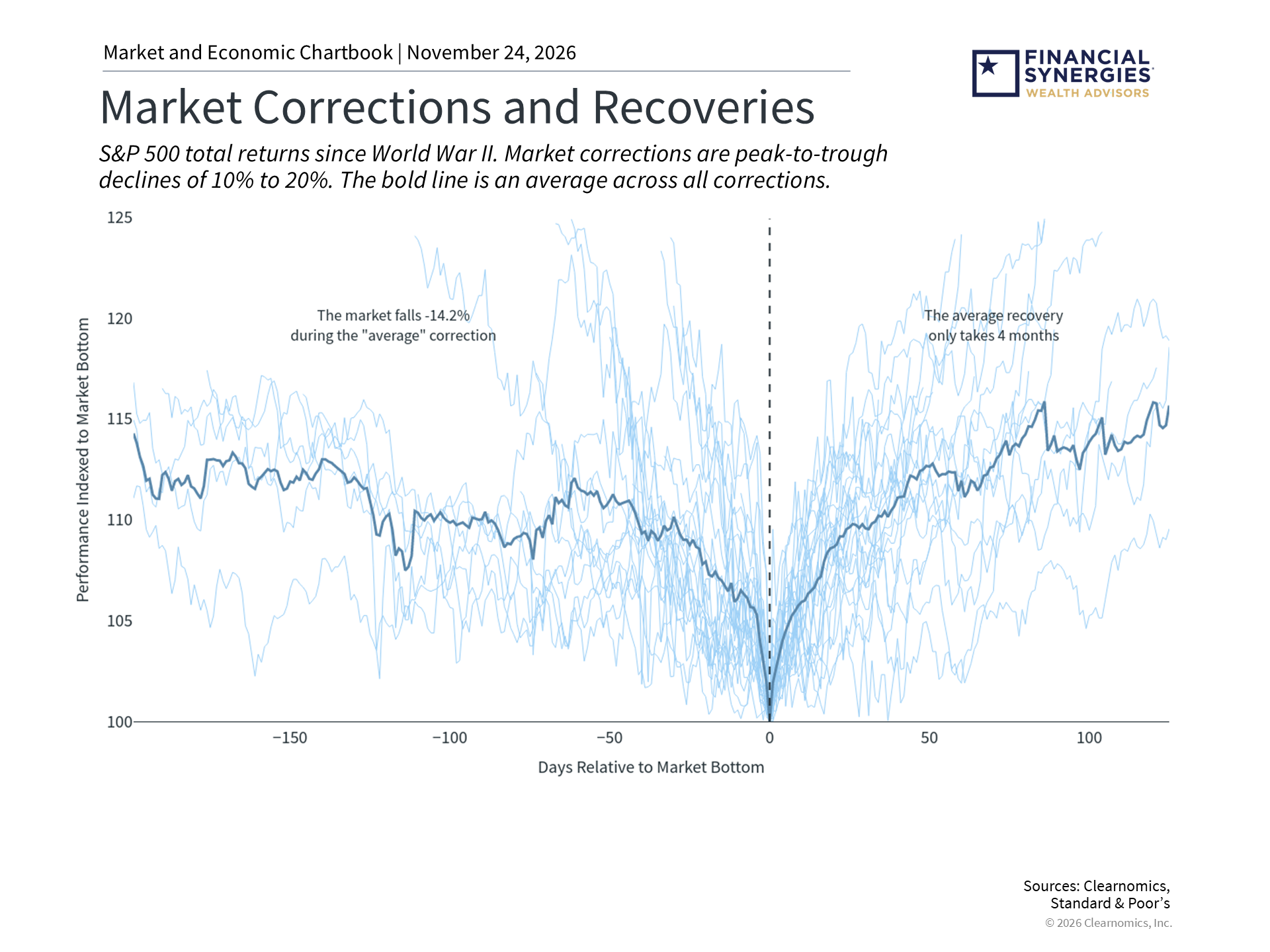
The accompanying chart can help investors take a broad perspective on market corrections. Since World War II, the S&P 500 has declined about 14% on average during corrections and has recovered within roughly four months.9 No two market corrections are the same, and history shows that the depth and length of a decline depend on its underlying cause. Mild pullbacks, including several that have occurred since the beginning of 2025 such as the market’s reaction to the “Liberation Day” tariffs, have rebounded quickly due to strong corporate profits and economic growth.
Strong fundamentals do not prevent corrections, and the history of market rebounds is no guarantee that they will always recover quickly or that they cannot decline further. However, these examples demonstrate that a healthy economic foundation can support portfolios in the long run.
Innovation drives markets over long periods
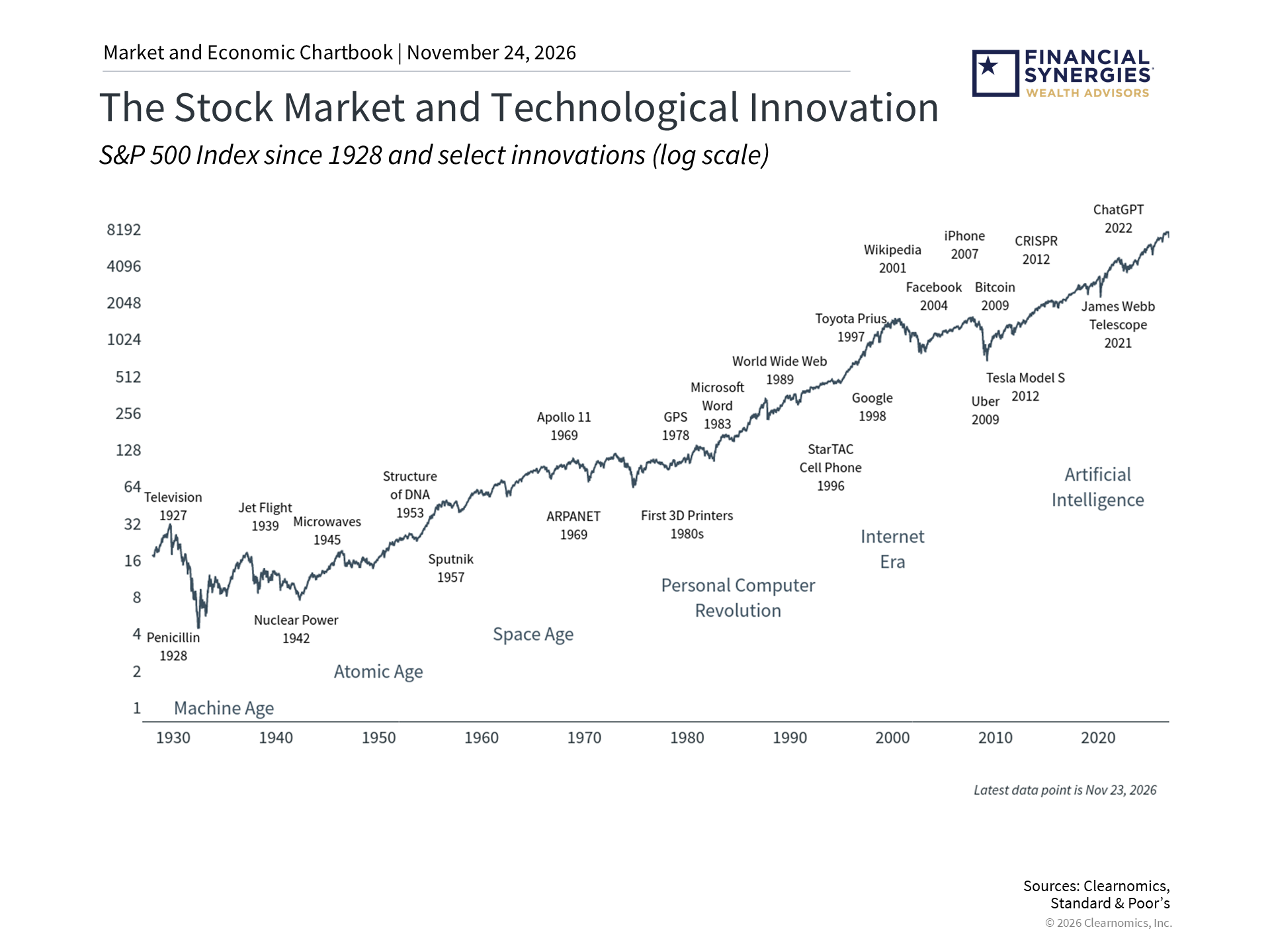
The chart above shows that each wave of innovation over the past century was accompanied by both excitement and uncertainty, yet the stock market has steadily risen as new technologies were adopted by the broader economy. What mattered most was not which companies attracted the most attention early on, but whether new technologies ultimately changed how businesses operated and how people lived.
The dot-com era is a useful point of comparison. While many investors tend to think about the many unprofitable dot-com companies that were founded during this time, there was also significant infrastructure that was constructed as well. Beginning in the late 1990s, telecommunications companies laid millions of miles of fiber optic cable in anticipation of rapidly growing internet traffic. Much of this bandwidth was not used immediately, and indeed some of the companies that overexpanded failed, largely because some never achieved profitability. However, this network became the foundation for many of the new technologies that became part of everyday life in the decades since. This includes streaming video, cloud computing, smartphones, new digital services, and the always-connected economy that powers many industries today.
Whether today’s AI investments will follow a similar path is the open question driving market uncertainty. While activity surrounding data centers and chips has driven economic growth and corporate profits, it could take time for the benefits and costs to consumers and businesses to become known, beyond simple use cases such as chatbots and web search. Similarly, it will take time to understand the long-term impact on employment, productivity, inflation, and other factors that affect everyday individuals.
For long-term investors, Anthropic’s recent IPO is also a sign that the market for AI companies is maturing. One benefit of companies going public is that they create greater access for a broader group of investors over time. For example, companies listed on the Nasdaq exchange are added to the Nasdaq Composite Index, and over time, possibly to broad market indices like the S&P 500 based on certain rules. This means that diversified investors can naturally gain exposure as these companies grow.
Volatility can create long-term opportunities
During bull market cycles, investors often wish they could invest at lower prices and more attractive valuations. However, when this does occur, it is often during periods of heightened uncertainty that prevents investors from taking advantage of the situation. This is why it’s important to view market swings not in terms of market timing, but instead in terms of portfolio balance, aligned with financial planning and long-term investing goals.
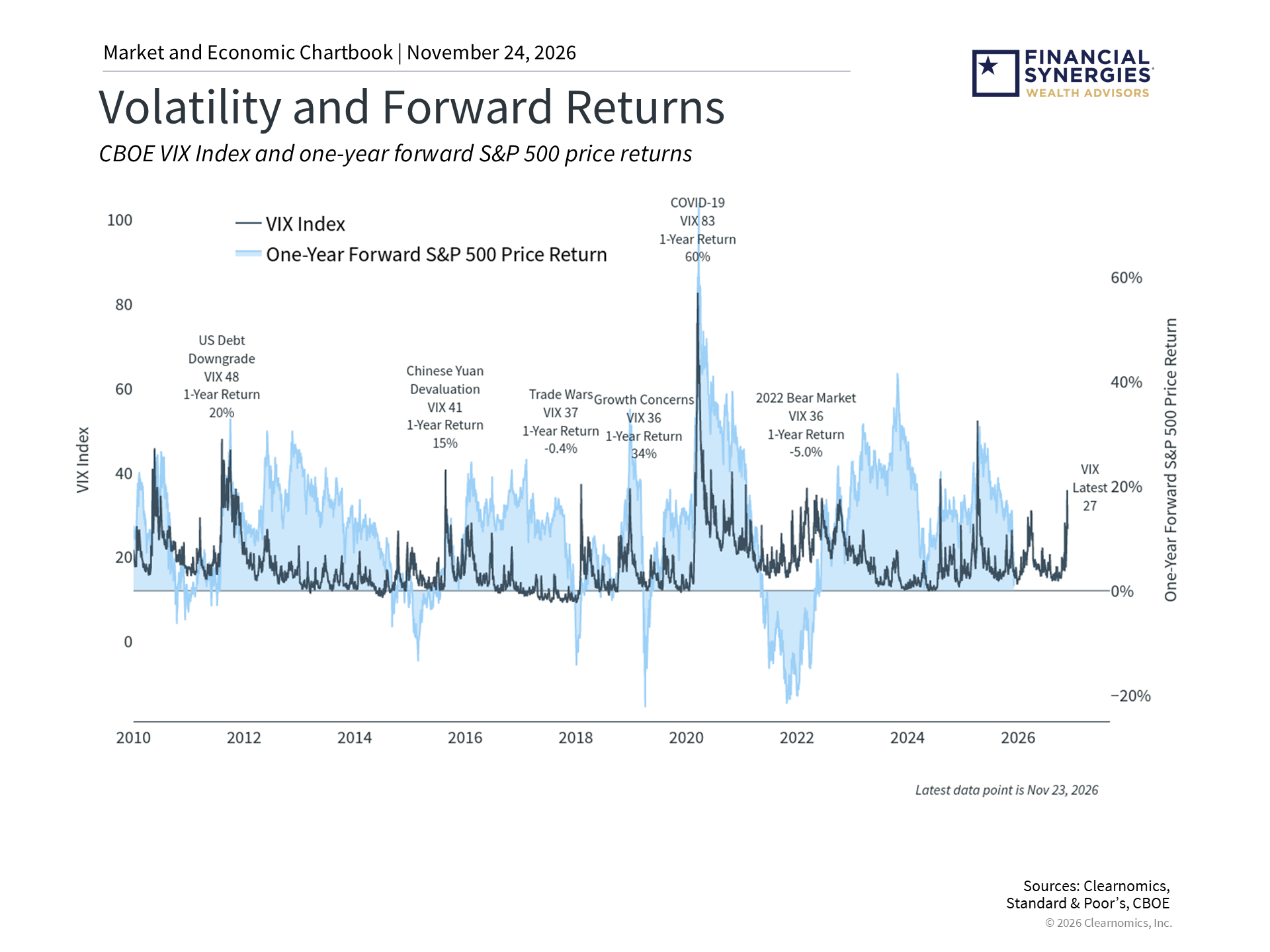
As the accompanying chart shows, times when the CBOE Volatility Index (VIX) index, a measure of stock market volatility, has historically been high, tend to correspond to healthy returns over the next year.10 This is the case even though these are periods when some investors become worried, possibly even seeking the safety of cash. This has been the case across dozens of examples in just the past few years alone.
Periods of volatility can also create financial planning opportunities. For example, with year-end approaching, tax-loss harvesting can allow investors with taxable accounts to realize losses that can offset gains elsewhere, subject to rules such as the wash-sale rule, which prevents investors from acquiring the same or a “substantially identical” security within 30 days before or after the sale.11 Tax strategies like these can add value regardless of how markets perform in the near term. Viewing market movements through this lens can be far more impactful than wondering what individual stocks will do next.
References
1. Clearnomics research using Standard and Poor’s, Dow Jones, and Nasdaq data, as of November 20, 2026
2. https://nvidianews.nvidia.com/news/nvidia-board-reinstates-jensen-huang-as-president-ceo-and-board-director
3. https://www.claymath.org/millennium/riemann-hypothesis/
4. Clearnomics research using Standard and Poor’s, Dow Jones, and Nasdaq data, from the market peak on October 6 to November 20, 2026
5. Clearnomics research using Nvidia stock price and Standard and Poor’s and Nasdaq data, as of November 20, 2026
6. Clearnomics research using Nasdaq data, from June 2, 2026 to July 29, 2026
7. Clearnomics research using Nasdaq data, from July 29, 2026 to October 6, 2026
8. Clearnomics research using Nasdaq data, from October 29, 2025 to March 27, 2026
9. Clearnomics research using Standard and Poor’s data, as of November 20, 2026
10. Clearnomics research using Standard and Poor’s and CBOE data, as of November 20, 2026
11. https://www.irs.gov/pub/irs-pdf/i1040sd.pdf
Concerns or questions about how your investment portfolio will hold up in the current market environment? Contact Financial Synergies today.
We are a boutique financial advisory and total wealth management firm with over 35 years of helping clients navigate turbulent markets. To learn more about our approach to investment management and financial planning, please reach out to us. One of our seasoned advisors would be happy to help you build a custom financial plan to help ensure you accomplish your financial goals and objectives. Schedule a conversation with us today.
More relevant articles by Financial Synergies Wealth Advisors:
Blog Disclosures
This content, which contains security-related opinions and/or information, is provided for informational purposes only and should not be relied upon in any manner as professional advice, or an endorsement of any practices, products or services. There can be no guarantees or assurances that the views expressed here will be applicable for any particular facts or circumstances, and should not be relied upon in any manner. You should consult your own financial advisors as to legal, business, tax, and other related matters concerning any investment.
The commentary in this “post” (including any related blogs, videos, and social media) reflects the personal opinions, viewpoints, and analyses of the Financial Synergies Wealth Advisors, Inc. employees providing such comments, and should not be regarded as the views of Financial Synergies Wealth Advisors, Inc. or its respective affiliates or as a description of advisory services provided by Financial Synergies Wealth Advisors, Inc. or performance returns of any Financial Synergies Wealth Advisors, Inc. client.
Any opinions expressed herein do not constitute or imply endorsement, sponsorship, or recommendation by Financial Synergies Wealth Advisors, Inc. or its employees. The views reflected in the commentary are subject to change at any time without notice.
Nothing on this website constitutes investment or financial planning advice, performance data or any recommendation that any particular security, portfolio of securities, transaction or investment strategy is suitable for any specific person. It also should not be construed as an offer soliciting the purchase or sale of any security mentioned. Nor should it be construed as an offer to provide investment advisory services by Financial Synergies Wealth Advisors, Inc.
Any mention of a particular security and related performance data is not a recommendation to buy or sell that security. Financial Synergies Wealth Advisors, Inc. manages its clients’ accounts using a variety of investment techniques and strategies, which are not necessarily discussed in the commentary. Investments in securities involve the risk of loss. Past performance is no guarantee of future results.
Any charts provided here or on any related Financial Synergies Wealth Advisors, Inc. personnel content outlets are for informational purposes only, and should also not be relied upon when making any investment decision. Any indices referenced for comparison are unmanaged and cannot be invested into directly. As always please remember investing involves risk and possible loss of principal capital; please seek advice from a licensed professional. Any projections, estimates, forecasts, targets, prospects and/or opinions expressed in these materials are subject to change without notice and may differ or be contrary to opinions expressed by others. Information in charts have been obtained from third-party sources and data, and may include those from portfolio securities of funds managed by Financial Synergies Wealth Advisors, Inc. While taken from sources believed to be reliable, Financial Synergies Wealth Advisors, Inc. has not independently verified such information and makes no representations about the enduring accuracy of the information or its appropriateness for a given situation. All content speaks only as of the date indicated.
Financial Synergies Wealth Advisors, Inc. is a registered investment adviser. Advisory services are only offered to clients or prospective clients where Financial Synergies Wealth Advisors, Inc. and its representatives are properly licensed or exempt from licensure. Investments in securities involve the risk of loss. Past performance is no guarantee of future results.
See Full Disclosures Page Here
 Skip to content


Broad Market Volatility and AI Uncertainty
In the famous words of Ferris Bueller, “Life moves pretty fast. If you don’t stop and look around once in a while, you could miss it.” This certainly applies to the stock market recently!
Stocks have been all over the place. Volatile markets are often driven by a combination of factors, and recent swings across major indices are no exception. Several recent developments, including leadership changes at Nvidia and Anthropic’s initial public offering (IPO), extended beyond AI stocks and pushed the S&P 500 and Dow Jones Industrial Average to market correction levels, while the Nasdaq briefly erased its year-to-date gains.1
Since then, many parts of the market have rebounded and have offset some of those losses, particularly with the reinstatement of Jensen Huang as Nvidia’s CEO, with the reported involvement of the White House.2 This demonstrates how quickly markets can react to new information and why it’s important to maintain a long-term perspective. While these events continue to unfold, the underlying question continues to be whether the hundreds of billions of dollars being invested in AI infrastructure will ultimately generate sufficient returns.
It’s also important to point out that even as investors were focused on these market moves, there were new breakthroughs being published. Specifically, a mathematician at Anthropic, with the help of AI, developed a proof of what’s known as the “Riemann Hypothesis,” a 167-year-old problem at the heart of many parts of mathematics.3 While this will not immediately affect the lives of everyday people and investors, its importance cannot be overstated.
Despite these rapid developments, the benefits of AI for companies and investors can still seem abstract, while the impact on free cash flows as companies invest in AI infrastructure is real and immediate. Many investors will naturally consider opportunities and risks by comparing today’s environment to periods such as the dot-com bust of the early 2000s. While there are surface-level similarities, a more useful lesson from that era may be that it built the infrastructure that powered the following decades of innovation. How can investors keep all of this in balance amid ongoing market volatility?
Corrections are a normal part of investing
At their worst point recently, the S&P 500 and Dow fell into correction territory, defined as a decline of between 10% and 20% from their recent peaks, while the Nasdaq erased its year-to-date gains and came close to bear market levels, defined as a fall of 20% or more.4 These broad market declines were concentrated in technology stocks, including semiconductor companies that build AI hardware. For instance, between October 6 and November 20, Nvidia shares declined about 48%, driving pullbacks of about 18% for the Nasdaq and 12% for the S&P 500.5
Technology stocks are naturally volatile, so it’s not unusual to see swings like these on a short-term basis. While attention is on the latest moves, the Nasdaq has experienced several of these swings in just the past year. From early June to the end of July, for instance, the Nasdaq declined 9.8% from its peak due to many of the same AI concerns driving markets today.6 This was followed by a sharp rebound of 13.0% when it reached a new all-time high in early October.7 From October 2025 to the beginning of the Iran war in March, the Nasdaq declined 12.6%, before it rebounded into the summer.8
Recent volatility has also moved in both directions. While the story is still playing out, the news that Jensen Huang has been reinstated as CEO led the Nasdaq, S&P 500, and Dow to sharp recoveries. Swings like these are typical of event-driven markets, where prices adjust quickly as new information arrives. They are also exactly the type of environment that balanced portfolios are designed to help investors navigate.
The accompanying chart can help investors take a broad perspective on market corrections. Since World War II, the S&P 500 has declined about 14% on average during corrections and has recovered within roughly four months.9 No two market corrections are the same, and history shows that the depth and length of a decline depend on its underlying cause. Mild pullbacks, including several that have occurred since the beginning of 2025 such as the market’s reaction to the “Liberation Day” tariffs, have rebounded quickly due to strong corporate profits and economic growth.
Strong fundamentals do not prevent corrections, and the history of market rebounds is no guarantee that they will always recover quickly or that they cannot decline further. However, these examples demonstrate that a healthy economic foundation can support portfolios in the long run.
Innovation drives markets over long periods
The chart above shows that each wave of innovation over the past century was accompanied by both excitement and uncertainty, yet the stock market has steadily risen as new technologies were adopted by the broader economy. What mattered most was not which companies attracted the most attention early on, but whether new technologies ultimately changed how businesses operated and how people lived.
The dot-com era is a useful point of comparison. While many investors tend to think about the many unprofitable dot-com companies that were founded during this time, there was also significant infrastructure that was constructed as well. Beginning in the late 1990s, telecommunications companies laid millions of miles of fiber optic cable in anticipation of rapidly growing internet traffic. Much of this bandwidth was not used immediately, and indeed some of the companies that overexpanded failed, largely because some never achieved profitability. However, this network became the foundation for many of the new technologies that became part of everyday life in the decades since. This includes streaming video, cloud computing, smartphones, new digital services, and the always-connected economy that powers many industries today.
Whether today’s AI investments will follow a similar path is the open question driving market uncertainty. While activity surrounding data centers and chips has driven economic growth and corporate profits, it could take time for the benefits and costs to consumers and businesses to become known, beyond simple use cases such as chatbots and web search. Similarly, it will take time to understand the long-term impact on employment, productivity, inflation, and other factors that affect everyday individuals.
For long-term investors, Anthropic’s recent IPO is also a sign that the market for AI companies is maturing. One benefit of companies going public is that they create greater access for a broader group of investors over time. For example, companies listed on the Nasdaq exchange are added to the Nasdaq Composite Index, and over time, possibly to broad market indices like the S&P 500 based on certain rules. This means that diversified investors can naturally gain exposure as these companies grow.
Volatility can create long-term opportunities
During bull market cycles, investors often wish they could invest at lower prices and more attractive valuations. However, when this does occur, it is often during periods of heightened uncertainty that prevents investors from taking advantage of the situation. This is why it’s important to view market swings not in terms of market timing, but instead in terms of portfolio balance, aligned with financial planning and long-term investing goals.
As the accompanying chart shows, times when the CBOE Volatility Index (VIX) index, a measure of stock market volatility, has historically been high, tend to correspond to healthy returns over the next year.10 This is the case even though these are periods when some investors become worried, possibly even seeking the safety of cash. This has been the case across dozens of examples in just the past few years alone.
Periods of volatility can also create financial planning opportunities. For example, with year-end approaching, tax-loss harvesting can allow investors with taxable accounts to realize losses that can offset gains elsewhere, subject to rules such as the wash-sale rule, which prevents investors from acquiring the same or a “substantially identical” security within 30 days before or after the sale.11 Tax strategies like these can add value regardless of how markets perform in the near term. Viewing market movements through this lens can be far more impactful than wondering what individual stocks will do next.
References
1. Clearnomics research using Standard and Poor’s, Dow Jones, and Nasdaq data, as of November 20, 2026
2. https://nvidianews.nvidia.com/news/nvidia-board-reinstates-jensen-huang-as-president-ceo-and-board-director
3. https://www.claymath.org/millennium/riemann-hypothesis/
4. Clearnomics research using Standard and Poor’s, Dow Jones, and Nasdaq data, from the market peak on October 6 to November 20, 2026
5. Clearnomics research using Nvidia stock price and Standard and Poor’s and Nasdaq data, as of November 20, 2026
6. Clearnomics research using Nasdaq data, from June 2, 2026 to July 29, 2026
7. Clearnomics research using Nasdaq data, from July 29, 2026 to October 6, 2026
8. Clearnomics research using Nasdaq data, from October 29, 2025 to March 27, 2026
9. Clearnomics research using Standard and Poor’s data, as of November 20, 2026
10. Clearnomics research using Standard and Poor’s and CBOE data, as of November 20, 2026
11. https://www.irs.gov/pub/irs-pdf/i1040sd.pdf
Concerns or questions about how your investment portfolio will hold up in the current market environment? Contact Financial Synergies today.
We are a boutique financial advisory and total wealth management firm with over 35 years of helping clients navigate turbulent markets. To learn more about our approach to investment management and financial planning, please reach out to us. One of our seasoned advisors would be happy to help you build a custom financial plan to help ensure you accomplish your financial goals and objectives. Schedule a conversation with us today.
More relevant articles by Financial Synergies Wealth Advisors:
Blog Disclosures
This content, which contains security-related opinions and/or information, is provided for informational purposes only and should not be relied upon in any manner as professional advice, or an endorsement of any practices, products or services. There can be no guarantees or assurances that the views expressed here will be applicable for any particular facts or circumstances, and should not be relied upon in any manner. You should consult your own financial advisors as to legal, business, tax, and other related matters concerning any investment.
The commentary in this “post” (including any related blogs, videos, and social media) reflects the personal opinions, viewpoints, and analyses of the Financial Synergies Wealth Advisors, Inc. employees providing such comments, and should not be regarded as the views of Financial Synergies Wealth Advisors, Inc. or its respective affiliates or as a description of advisory services provided by Financial Synergies Wealth Advisors, Inc. or performance returns of any Financial Synergies Wealth Advisors, Inc. client.
Any opinions expressed herein do not constitute or imply endorsement, sponsorship, or recommendation by Financial Synergies Wealth Advisors, Inc. or its employees. The views reflected in the commentary are subject to change at any time without notice.
Nothing on this website constitutes investment or financial planning advice, performance data or any recommendation that any particular security, portfolio of securities, transaction or investment strategy is suitable for any specific person. It also should not be construed as an offer soliciting the purchase or sale of any security mentioned. Nor should it be construed as an offer to provide investment advisory services by Financial Synergies Wealth Advisors, Inc.
Any mention of a particular security and related performance data is not a recommendation to buy or sell that security. Financial Synergies Wealth Advisors, Inc. manages its clients’ accounts using a variety of investment techniques and strategies, which are not necessarily discussed in the commentary. Investments in securities involve the risk of loss. Past performance is no guarantee of future results.
Any charts provided here or on any related Financial Synergies Wealth Advisors, Inc. personnel content outlets are for informational purposes only, and should also not be relied upon when making any investment decision. Any indices referenced for comparison are unmanaged and cannot be invested into directly. As always please remember investing involves risk and possible loss of principal capital; please seek advice from a licensed professional. Any projections, estimates, forecasts, targets, prospects and/or opinions expressed in these materials are subject to change without notice and may differ or be contrary to opinions expressed by others. Information in charts have been obtained from third-party sources and data, and may include those from portfolio securities of funds managed by Financial Synergies Wealth Advisors, Inc. While taken from sources believed to be reliable, Financial Synergies Wealth Advisors, Inc. has not independently verified such information and makes no representations about the enduring accuracy of the information or its appropriateness for a given situation. All content speaks only as of the date indicated.
Financial Synergies Wealth Advisors, Inc. is a registered investment adviser. Advisory services are only offered to clients or prospective clients where Financial Synergies Wealth Advisors, Inc. and its representatives are properly licensed or exempt from licensure. Investments in securities involve the risk of loss. Past performance is no guarantee of future results.
See Full Disclosures Page Here
Recent Posts
Broad Market Volatility and AI Uncertainty
Weekly Market Recap – A Tough Week for Stocks as the AI Trade Cools
Chart of the Month | What History Says About Stocks When the Fed Starts Raising Rates
Subscribe to Our Blog
Chief Investment Officer | Managing Partner