If you woke up this morning feeling relieved, uneasy, or a bit of both about yesterday’s election results, you’re in good company. I, for one, will not miss the constant political ads and text messages. Midterms stir strong feelings, and our clients span the full political spectrum. So let’s set politics aside for a few minutes and look at what decades of market history actually tell us.
What changed, and what didn’t
As of this writing, major news organizations project that Democrats will control both the House and the Senate when the new Congress convenes in January. A few contests are still being counted, including Senate races in Alaska and Mississippi and dozens of House seats, so final margins may shift in the days and weeks ahead.
What didn’t change matters just as much. A midterm reshapes Congress, not the White House. President Trump remains in office, which means Washington is heading into a period of divided government: a Republican president working with a Democratic-led Congress.
Divided government has rarely been a headwind
Many investors assume markets prefer one party or the other. The record is more nuanced, and more comforting. A Motley Fool analysis of stock market data going back to 1874 found that in the 12 months after midterms that produced divided government, the S&P 500 averaged a 16% gain and rose 91% of the time. When a Republican president faced an opposing Congress, the market was higher in 13 of 14 cases. More recently, Morgan Stanley found that under Republican presidents, the S&P 500 averaged a 16% gain in the year after midterms that gave Democrats both chambers, and 23% in the year after midterms that left Congress split.
Why might gridlock be benign? When neither party controls all the levers of lawmaking, sweeping policy swings become less likely. Businesses and investors tend to value predictability, and a Congress and White House that must negotiate often deliver more of it.
To be fair, the evidence isn’t unanimous. Some studies that measure full calendar years, rather than the period after a midterm, find this particular combination has lagged others: Retirement Researcher’s data for 1926–2023 show a 7.33% average annual return across 34 years of divided government under a Republican president, versus 14.01% to 16.63% for the other configurations. But those averages rest on a small number of periods — a CNBC review counts just three midterms since 1980 (1986, 1990 and 2006) that produced today’s exact setup, and they averaged a 10.9% gain a year later — and the rankings shift depending on how the data are sliced. No arrangement of party control has reliably predicted poor markets.
Uncertainty resolved: the post-midterm pattern
Midterm years themselves are often bumpy. Capital Group found the S&P 500 has averaged a 4.7% price return in midterm years since 1931, about half the 9.5% of other years. Tension tends to build before Election Day and ease once the results are known, whoever wins; as Carson Group chief market strategist Ryan Detrick told CNBC, “There’s some anxiousness before these elections… Once you are through it, it’s a big relief, and markets tend to do pretty well.”
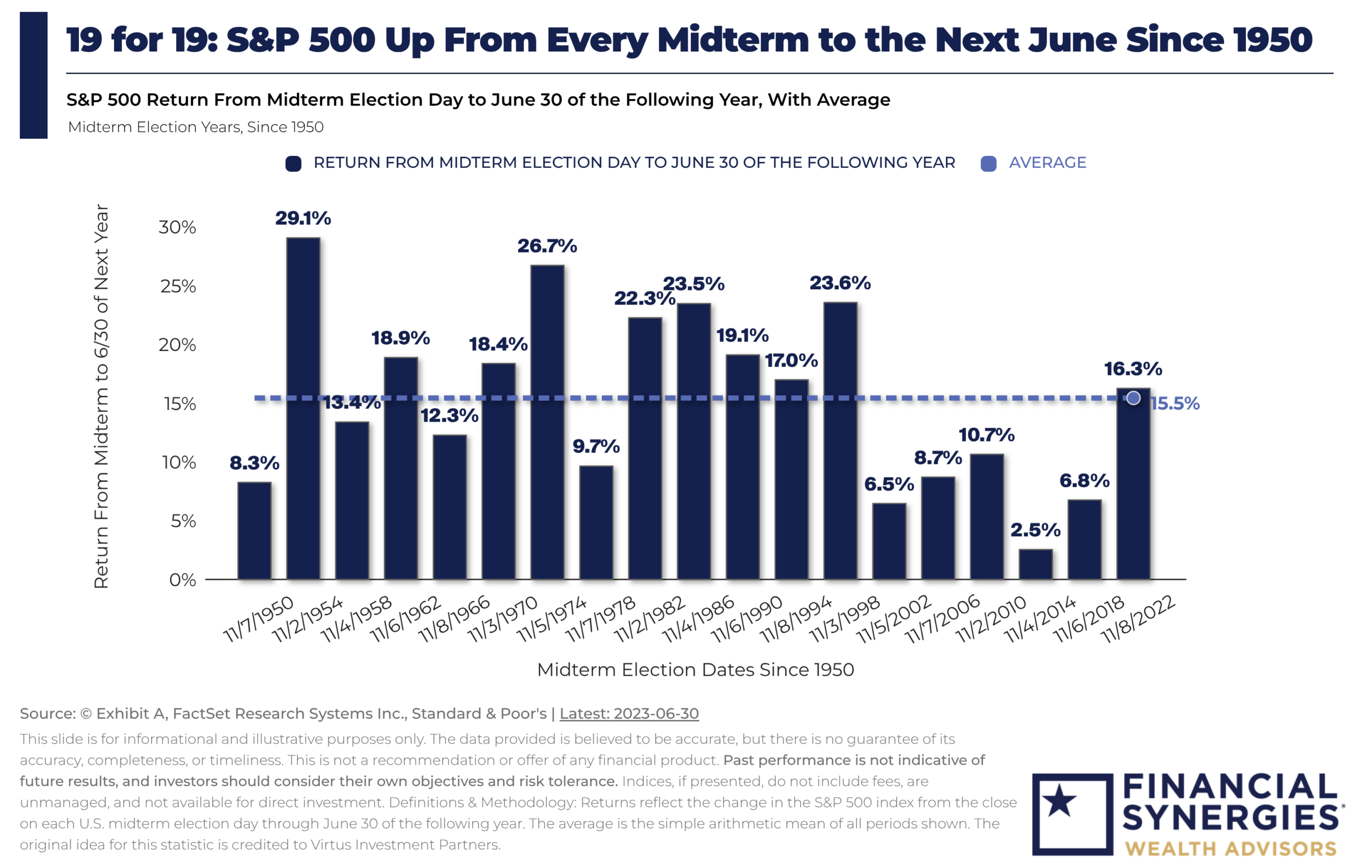
Our first chart shows that pattern. In all 19 midterm cycles since 1950, the S&P 500 has been higher from Election Day to June 30 of the following year, with an average gain of about 15.5% and a range of roughly 2.5% to 29%. Other firms that look at the full year after a midterm see much the same thing: Capital Group puts the average one-year return since 1950 at 15.4%, with no negative years.
Some perspective is in order. Nineteen observations is a small sample, these are price returns, and part of the strength likely reflects the broader presidential cycle, since the year after a midterm has historically been a strong one. Treat it as a historical tendency, not a forecast; past performance doesn’t guarantee future results. Today’s stock market rally is encouraging, but a single day tells us little about the months ahead.
What actually drives markets
Over time, stock prices follow earnings, interest rates, inflation, and the health of the economy. Those forces are shaped by the Federal Reserve, technology, global events, and the business cycle far more than by which party holds which chamber. For context, the Fed held its benchmark rate at 3.75%–4.00% at its October 28 meeting, and the S&P 500 closed Election Day at about 7,569. Those are the kinds of factors worth watching. Even when Princeton economists Alan Blinder and Mark Watson studied why economic growth has differed across administrations, they found that oil shocks, productivity shocks, international growth shocks, and shifts in consumer expectations jointly explain about half of the gap — forces largely outside Washington’s control.
The real risk: letting politics steer the portfolio
Our views of the economy tend to move with the political winds. The University of Michigan’s long-running consumer survey has found that people whose party holds the White House consistently feel better about the economy than those whose party doesn’t, and the positions flip when the presidency changes hands. In May 2026, Democrats’ sentiment reading was 32.8 while Republicans’ was 84.6. In June 2022, under the prior administration, Republicans’ reading had sunk to about 33. Same economy, very different perceptions.
Acting on those feelings can be expensive. Schwab strategists calculated that $10,000 invested in the S&P 500 in 1961 would have grown to about $102,000 by 2023 if invested only during Republican presidencies, and to about $500,000 if invested only under Democratic presidencies. What if you stayed invested regardless of who was in office? More than $5.1 million.
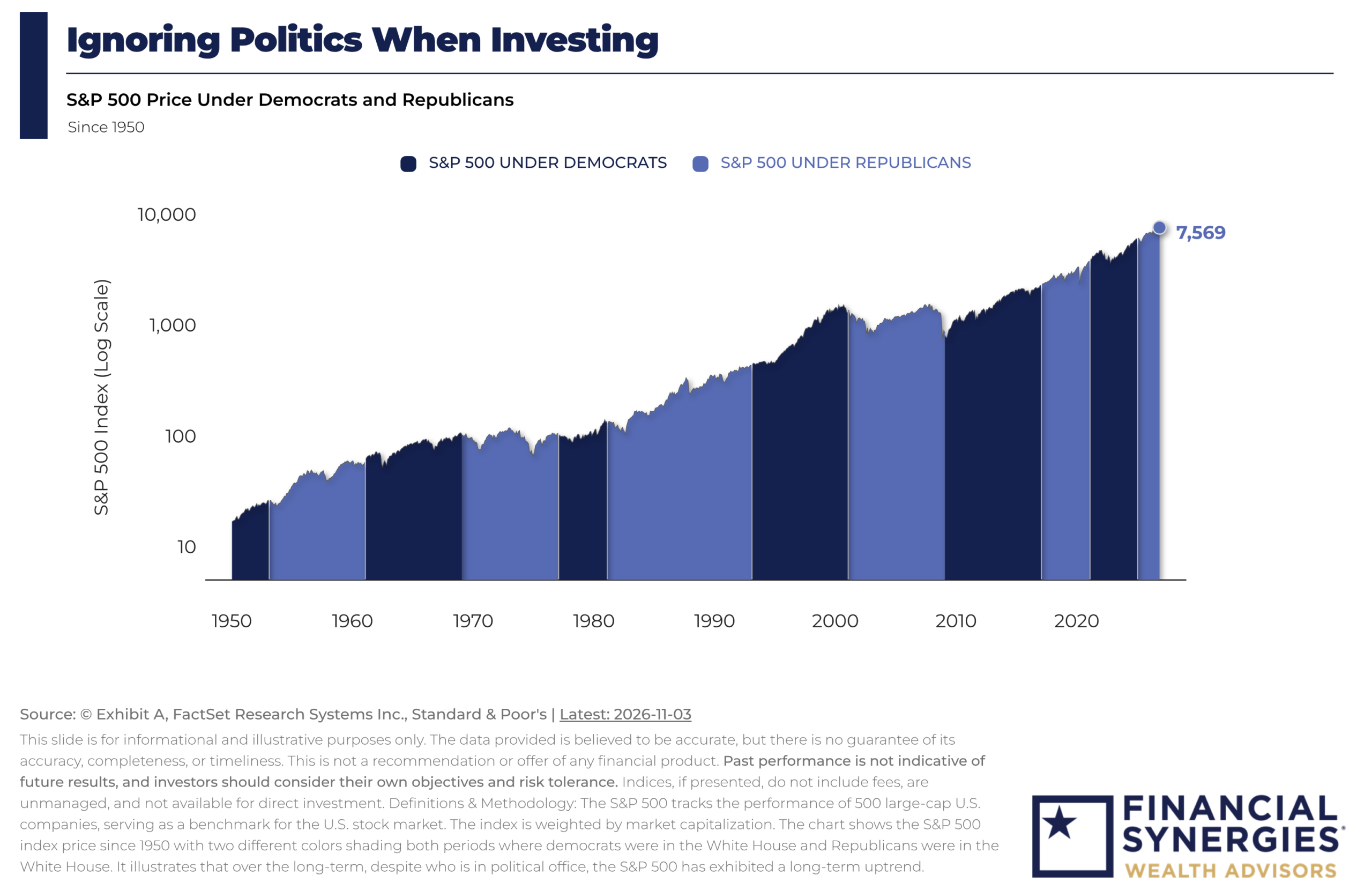
Our second chart tells the same story over a longer horizon. Since 1950, the S&P 500 has climbed from about 17 to roughly 7,569, through presidents of both parties and nearly every combination of control in Congress. Over the long run, politics has looked far more like a distraction than a signal.
The Bottom Line
Elections matter for many reasons. But for your financial plan, what counts are your goals, your time horizon, and your cash needs, not the balance of power in Washington. If yesterday’s results left you with questions, we’re always glad to talk them through.
Concerns or questions about your financial plan or investment portfolio? Contact Financial Synergies today.
We are a boutique, financial advisory and total wealth management firm with over 35 years helping clients navigate turbulent markets. To learn more about our approach to investment management, financial planning, and retirement planning, please reach out to us. One of our seasoned advisors would be happy to help you build a custom financial plan to help ensure you accomplish your financial goals and objectives. Schedule a conversation with us today.
More relevant articles by Financial Synergies:
Sources:
Blog Disclosures
This content, which contains security-related opinions and/or information, is provided for informational purposes only and should not be relied upon in any manner as professional advice, or an endorsement of any practices, products or services. There can be no guarantees or assurances that the views expressed here will be applicable for any particular facts or circumstances, and should not be relied upon in any manner. You should consult your own financial advisors as to legal, business, tax, and other related matters concerning any investment.
The commentary in this “post” (including any related blogs, videos, and social media) reflects the personal opinions, viewpoints, and analyses of the Financial Synergies Wealth Advisors, Inc. employees providing such comments, and should not be regarded as the views of Financial Synergies Wealth Advisors, Inc. or its respective affiliates or as a description of advisory services provided by Financial Synergies Wealth Advisors, Inc. or performance returns of any Financial Synergies Wealth Advisors, Inc. client.
Any opinions expressed herein do not constitute or imply endorsement, sponsorship, or recommendation by Financial Synergies Wealth Advisors, Inc. or its employees. The views reflected in the commentary are subject to change at any time without notice.
Nothing on this website constitutes investment or financial planning advice, performance data or any recommendation that any particular security, portfolio of securities, transaction or investment strategy is suitable for any specific person. It also should not be construed as an offer soliciting the purchase or sale of any security mentioned. Nor should it be construed as an offer to provide investment advisory services by Financial Synergies Wealth Advisors, Inc.
Any mention of a particular security and related performance data is not a recommendation to buy or sell that security. Financial Synergies Wealth Advisors, Inc. manages its clients’ accounts using a variety of investment techniques and strategies, which are not necessarily discussed in the commentary. Investments in securities involve the risk of loss. Past performance is no guarantee of future results.
Any charts provided here or on any related Financial Synergies Wealth Advisors, Inc. personnel content outlets are for informational purposes only, and should also not be relied upon when making any investment decision. Any indices referenced for comparison are unmanaged and cannot be invested into directly. As always please remember investing involves risk and possible loss of principal capital; please seek advice from a licensed professional. Any projections, estimates, forecasts, targets, prospects and/or opinions expressed in these materials are subject to change without notice and may differ or be contrary to opinions expressed by others. Information in charts have been obtained from third-party sources and data, and may include those from portfolio securities of funds managed by Financial Synergies Wealth Advisors, Inc. While taken from sources believed to be reliable, Financial Synergies Wealth Advisors, Inc. has not independently verified such information and makes no representations about the enduring accuracy of the information or its appropriateness for a given situation. All content speaks only as of the date indicated.
Financial Synergies Wealth Advisors, Inc. is a registered investment adviser. Advisory services are only offered to clients or prospective clients where Financial Synergies Wealth Advisors, Inc. and its representatives are properly licensed or exempt from licensure. Investments in securities involve the risk of loss. Past performance is no guarantee of future results.
See Full Disclosures Page Here
 Skip to content


The Midterms Changed Congress, Not the Fundamentals
If you woke up this morning feeling relieved, uneasy, or a bit of both about yesterday’s election results, you’re in good company. I, for one, will not miss the constant political ads and text messages. Midterms stir strong feelings, and our clients span the full political spectrum. So let’s set politics aside for a few minutes and look at what decades of market history actually tell us.
What changed, and what didn’t
As of this writing, major news organizations project that Democrats will control both the House and the Senate when the new Congress convenes in January. A few contests are still being counted, including Senate races in Alaska and Mississippi and dozens of House seats, so final margins may shift in the days and weeks ahead.
What didn’t change matters just as much. A midterm reshapes Congress, not the White House. President Trump remains in office, which means Washington is heading into a period of divided government: a Republican president working with a Democratic-led Congress.
Divided government has rarely been a headwind
Many investors assume markets prefer one party or the other. The record is more nuanced, and more comforting. A Motley Fool analysis of stock market data going back to 1874 found that in the 12 months after midterms that produced divided government, the S&P 500 averaged a 16% gain and rose 91% of the time. When a Republican president faced an opposing Congress, the market was higher in 13 of 14 cases. More recently, Morgan Stanley found that under Republican presidents, the S&P 500 averaged a 16% gain in the year after midterms that gave Democrats both chambers, and 23% in the year after midterms that left Congress split.
Why might gridlock be benign? When neither party controls all the levers of lawmaking, sweeping policy swings become less likely. Businesses and investors tend to value predictability, and a Congress and White House that must negotiate often deliver more of it.
To be fair, the evidence isn’t unanimous. Some studies that measure full calendar years, rather than the period after a midterm, find this particular combination has lagged others: Retirement Researcher’s data for 1926–2023 show a 7.33% average annual return across 34 years of divided government under a Republican president, versus 14.01% to 16.63% for the other configurations. But those averages rest on a small number of periods — a CNBC review counts just three midterms since 1980 (1986, 1990 and 2006) that produced today’s exact setup, and they averaged a 10.9% gain a year later — and the rankings shift depending on how the data are sliced. No arrangement of party control has reliably predicted poor markets.
Uncertainty resolved: the post-midterm pattern
Midterm years themselves are often bumpy. Capital Group found the S&P 500 has averaged a 4.7% price return in midterm years since 1931, about half the 9.5% of other years. Tension tends to build before Election Day and ease once the results are known, whoever wins; as Carson Group chief market strategist Ryan Detrick told CNBC, “There’s some anxiousness before these elections… Once you are through it, it’s a big relief, and markets tend to do pretty well.”
Our first chart shows that pattern. In all 19 midterm cycles since 1950, the S&P 500 has been higher from Election Day to June 30 of the following year, with an average gain of about 15.5% and a range of roughly 2.5% to 29%. Other firms that look at the full year after a midterm see much the same thing: Capital Group puts the average one-year return since 1950 at 15.4%, with no negative years.
Some perspective is in order. Nineteen observations is a small sample, these are price returns, and part of the strength likely reflects the broader presidential cycle, since the year after a midterm has historically been a strong one. Treat it as a historical tendency, not a forecast; past performance doesn’t guarantee future results. Today’s stock market rally is encouraging, but a single day tells us little about the months ahead.
What actually drives markets
Over time, stock prices follow earnings, interest rates, inflation, and the health of the economy. Those forces are shaped by the Federal Reserve, technology, global events, and the business cycle far more than by which party holds which chamber. For context, the Fed held its benchmark rate at 3.75%–4.00% at its October 28 meeting, and the S&P 500 closed Election Day at about 7,569. Those are the kinds of factors worth watching. Even when Princeton economists Alan Blinder and Mark Watson studied why economic growth has differed across administrations, they found that oil shocks, productivity shocks, international growth shocks, and shifts in consumer expectations jointly explain about half of the gap — forces largely outside Washington’s control.
The real risk: letting politics steer the portfolio
Our views of the economy tend to move with the political winds. The University of Michigan’s long-running consumer survey has found that people whose party holds the White House consistently feel better about the economy than those whose party doesn’t, and the positions flip when the presidency changes hands. In May 2026, Democrats’ sentiment reading was 32.8 while Republicans’ was 84.6. In June 2022, under the prior administration, Republicans’ reading had sunk to about 33. Same economy, very different perceptions.
Acting on those feelings can be expensive. Schwab strategists calculated that $10,000 invested in the S&P 500 in 1961 would have grown to about $102,000 by 2023 if invested only during Republican presidencies, and to about $500,000 if invested only under Democratic presidencies. What if you stayed invested regardless of who was in office? More than $5.1 million.
Our second chart tells the same story over a longer horizon. Since 1950, the S&P 500 has climbed from about 17 to roughly 7,569, through presidents of both parties and nearly every combination of control in Congress. Over the long run, politics has looked far more like a distraction than a signal.
The Bottom Line
Elections matter for many reasons. But for your financial plan, what counts are your goals, your time horizon, and your cash needs, not the balance of power in Washington. If yesterday’s results left you with questions, we’re always glad to talk them through.
Concerns or questions about your financial plan or investment portfolio? Contact Financial Synergies today.
We are a boutique, financial advisory and total wealth management firm with over 35 years helping clients navigate turbulent markets. To learn more about our approach to investment management, financial planning, and retirement planning, please reach out to us. One of our seasoned advisors would be happy to help you build a custom financial plan to help ensure you accomplish your financial goals and objectives. Schedule a conversation with us today.
More relevant articles by Financial Synergies:
Sources:
Blog Disclosures
This content, which contains security-related opinions and/or information, is provided for informational purposes only and should not be relied upon in any manner as professional advice, or an endorsement of any practices, products or services. There can be no guarantees or assurances that the views expressed here will be applicable for any particular facts or circumstances, and should not be relied upon in any manner. You should consult your own financial advisors as to legal, business, tax, and other related matters concerning any investment.
The commentary in this “post” (including any related blogs, videos, and social media) reflects the personal opinions, viewpoints, and analyses of the Financial Synergies Wealth Advisors, Inc. employees providing such comments, and should not be regarded as the views of Financial Synergies Wealth Advisors, Inc. or its respective affiliates or as a description of advisory services provided by Financial Synergies Wealth Advisors, Inc. or performance returns of any Financial Synergies Wealth Advisors, Inc. client.
Any opinions expressed herein do not constitute or imply endorsement, sponsorship, or recommendation by Financial Synergies Wealth Advisors, Inc. or its employees. The views reflected in the commentary are subject to change at any time without notice.
Nothing on this website constitutes investment or financial planning advice, performance data or any recommendation that any particular security, portfolio of securities, transaction or investment strategy is suitable for any specific person. It also should not be construed as an offer soliciting the purchase or sale of any security mentioned. Nor should it be construed as an offer to provide investment advisory services by Financial Synergies Wealth Advisors, Inc.
Any mention of a particular security and related performance data is not a recommendation to buy or sell that security. Financial Synergies Wealth Advisors, Inc. manages its clients’ accounts using a variety of investment techniques and strategies, which are not necessarily discussed in the commentary. Investments in securities involve the risk of loss. Past performance is no guarantee of future results.
Any charts provided here or on any related Financial Synergies Wealth Advisors, Inc. personnel content outlets are for informational purposes only, and should also not be relied upon when making any investment decision. Any indices referenced for comparison are unmanaged and cannot be invested into directly. As always please remember investing involves risk and possible loss of principal capital; please seek advice from a licensed professional. Any projections, estimates, forecasts, targets, prospects and/or opinions expressed in these materials are subject to change without notice and may differ or be contrary to opinions expressed by others. Information in charts have been obtained from third-party sources and data, and may include those from portfolio securities of funds managed by Financial Synergies Wealth Advisors, Inc. While taken from sources believed to be reliable, Financial Synergies Wealth Advisors, Inc. has not independently verified such information and makes no representations about the enduring accuracy of the information or its appropriateness for a given situation. All content speaks only as of the date indicated.
Financial Synergies Wealth Advisors, Inc. is a registered investment adviser. Advisory services are only offered to clients or prospective clients where Financial Synergies Wealth Advisors, Inc. and its representatives are properly licensed or exempt from licensure. Investments in securities involve the risk of loss. Past performance is no guarantee of future results.
See Full Disclosures Page Here
Recent Posts
The Midterms Changed Congress, Not the Fundamentals
Monthly Market Update: Market Leadership Rotates as Investors Reassess the AI Trade
Weekly Market Recap – Beneath the Headlines, Most of the Market Moved Higher
Subscribe to Our Blog
Chief Investment Officer | Managing Partner