With the 2026 Midterm Elections approaching in November, campaigns are starting to intensify across the country. Politics have only grown more divisive in recent decades, so it’s natural for investors to wonder whether the election should influence their financial decisions. More than ever, it’s important to separate our political views from investing, and not vote with our portfolios and financial plans.1
Midterm elections occur every four years at the halfway point between presidential election cycles and help determine the composition of Congress. Current polls suggest that the likely outcome is a divided government, but margins are thin in both chambers, so a lot can change in the coming months.2 In the House, 218 seats are needed for a majority and Republicans currently control 219 seats, so Democrats could win control with only a few races. In the Senate, Republicans have a firmer hold with 53 seats, but expectations in prediction markets have been shifting.3
As citizens, voters, and taxpayers, there is nothing more important than the 2026 Midterm Elections. This is because elections shape the direction of policy on issues including entitlement programs, taxes, and the federal debt. However, this doesn’t mean investors should get caught in the details. History shows that Washington politics matter far less to long-term portfolio outcomes than many might believe. Why is this, and how can investors stay focused on the long-term as the election season heats up?
Midterm years have been positive on average
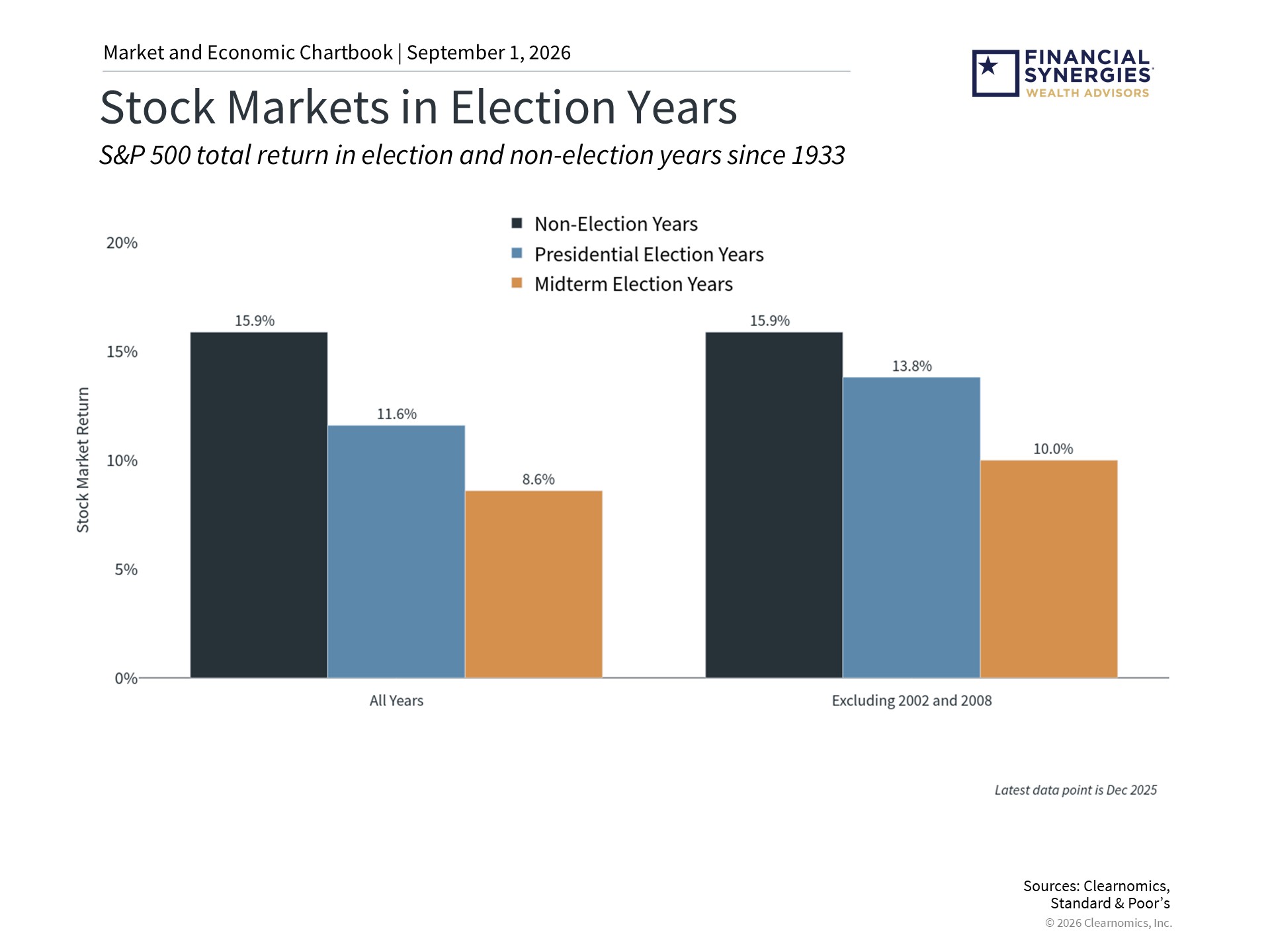
It seems natural to believe that politics should impact the stock market, and that investors may want to avoid election years altogether. Since elections affect economic policies, which in turn impact industries and companies, it’s easy to assume that election years may simply be more volatile.
However, history shows that this isn’t the case. The accompanying chart highlights the fact that returns have been positive across different types of election and non-election years going back to the Great Depression. While there is natural variation between the averages of these types of years, markets have performed well under Republicans, Democrats, and divided governments.4
This does not mean that all years are positive. Each period was driven by a unique set of circumstances depending on the phase of the business cycle. Recent midterm election years, for instance, include 2022 which experienced significant inflation in the wake of the pandemic, and 2018 when many worried about global growth and Fed policy. In both cases, returns were negative due to the underlying trends, not because they happened to be midterm election years.
Similarly, longer-term market trends often have little to do with politics. This includes the information technology revolution that began in the 1990s, the housing boom and bust of the mid-2000s, the inflationary impact of the pandemic after 2020, and today’s AI innovations. Each of these periods influenced markets in important ways that had little to do with the White House and Congress.
It’s also common for a president who starts with a majority in Congress to lose it during a midterm election. In recent decades, this was the case for President Biden during his single term, Obama during his first term, George W. Bush in his second term, Clinton in his first term, and more. There are many reasons for this that have been studied by political scientists, including changing voter preferences and psychology two years into a four-year presidential term. Regardless of the exact causes, both markets and the economy have grown steadily over these decades.
The 2026 Midterm Elections: The economy affects portfolios more than elections
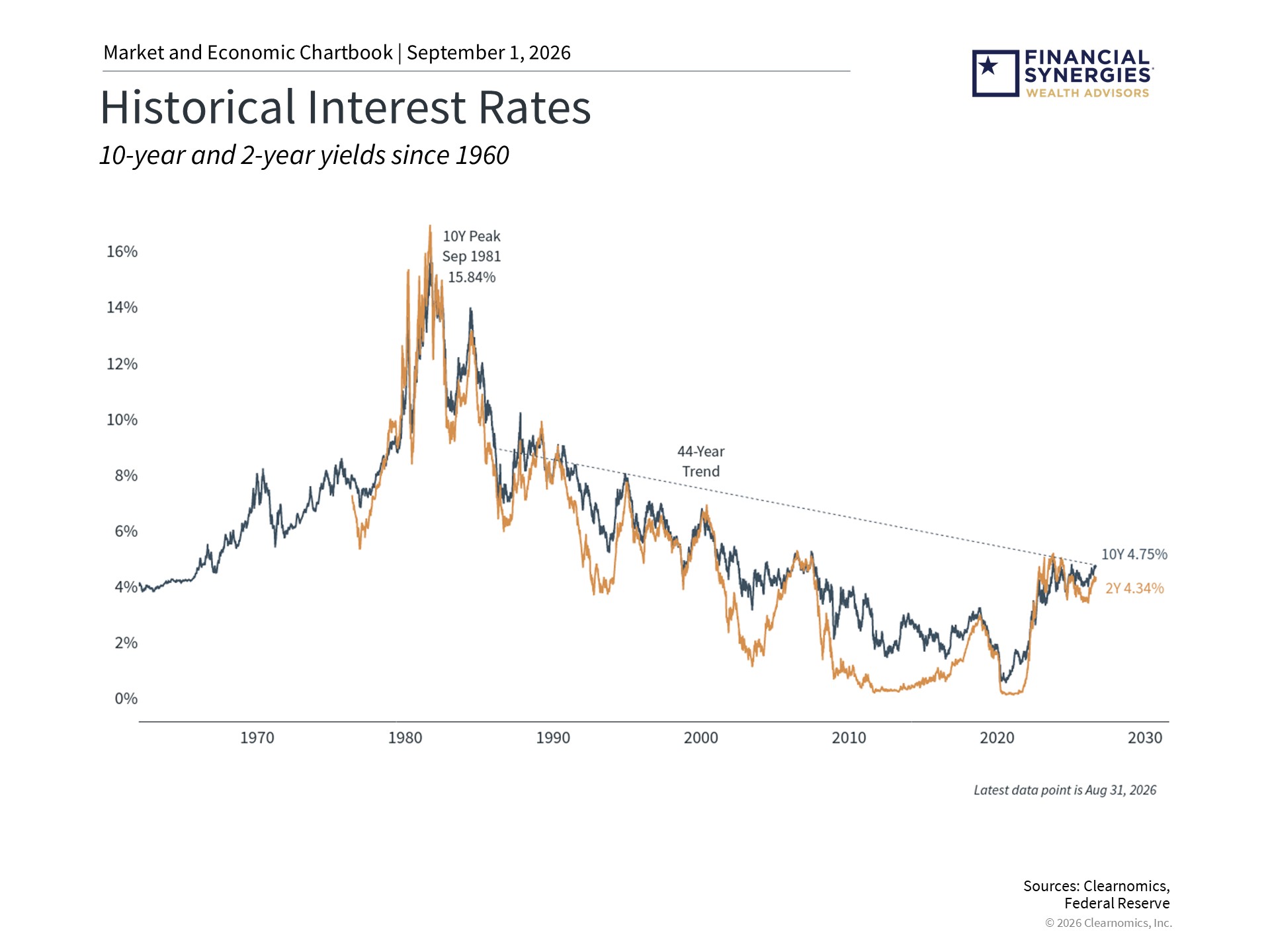
For long-term investors, the business cycle and interest rates have historically been far more important drivers of markets and portfolios than who controls the White House or Congress. The chart above highlights the current period of elevated rates affecting markets, businesses, and consumers. While interest rates can be influenced by policymakers, they are ultimately determined by longer-term trends.
This matters because political change usually occurs incrementally and with lags. The fact that majorities in Washington are difficult to sustain reflects the design of our political system. Even when there are shifts in policies that appear significant, such as with taxes and tariffs in recent years, they often don’t have as large or as immediate an effect, positive or negative, as some might predict. This is because the pace of economic growth, corporate earnings, inflation, and jobs are influenced by many other important factors.
The 2026 Midterm Elections are taking place against a backdrop of geopolitical conflict, inflation, AI concerns, and more. These factors have been far larger drivers of markets, corporate earnings, and interest rates than the specifics of each Congressional race. And yet, major stock market indices have generated double-digit returns despite short periods of uncertainty. So, while the midterm election happens to be taking place this year, it’s important to focus on the broader environment.
The 2026 Midterm Elections: Markets have grown across both political parties
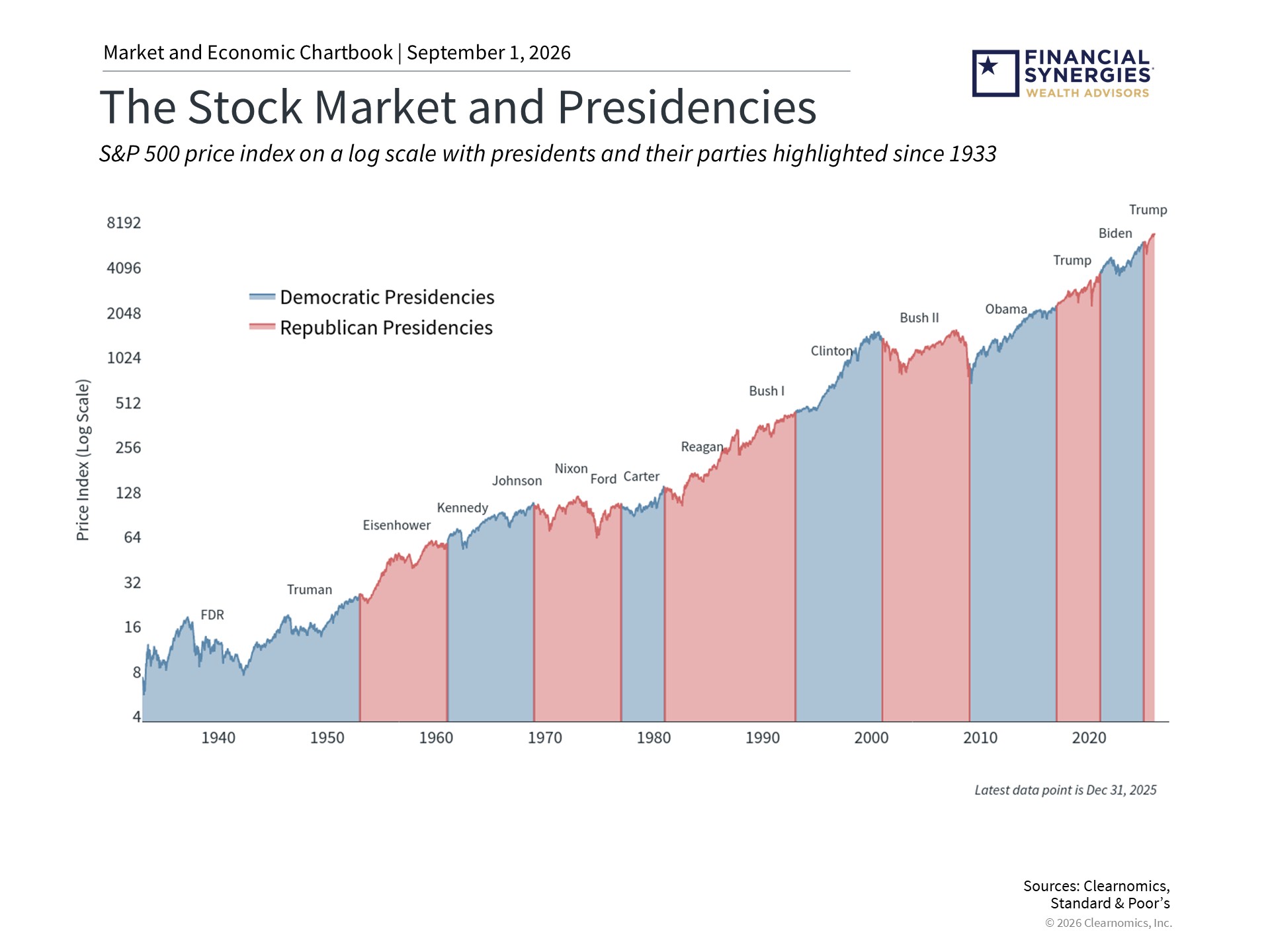
Perhaps the most important perspective for long-term investors ahead of the 2026 Midterm Elections is that markets have performed well across many different political cycles. The accompanying chart shows that the S&P 500 has grown over the past century, spanning political periods, wars, recessions, policy shifts, and everything in between.5
This does not mean that policy isn’t important or that the stock market doesn’t experience volatility. Debates around tax rates, defense spending, and the federal debt could have real consequences for the economy over time. Today, the outcome of the election could influence the legislative agenda, including the trajectory of the Iran conflict, tax provisions, tariffs, and the national debt. These are issues that many investors care about.
However, the key is to distinguish between what we can and cannot control when it comes to our portfolios and financial plans. It’s important for voters to make their voices heard, but not with their hard earned savings. Instead, holding a portfolio designed to perform across a range of economic and political environments is more important than trying to predict the result of a single election.
The bottom line? The 2026 Midterm Elections are important for the country, but it’s important to separate politics from investing. History shows that, even during election years, staying disciplined and focused on fundamentals is the best way to achieve financial goals.
References
1. https://www.usa.gov/midterm-elections
2. https://www.realclearpolling.com/latest-polls/2026
3. https://polymarket.com/event/balance-of-power-2026-midterms
4. Clearnomics research and Standard & Poor’s data, as of August 7, 2026
5. Clearnomics research and Standard & Poor’s data, as of August 7, 2026
Concerns or questions about how your investment portfolio will hold up in the current market environment? Contact Financial Synergies today.
We are a boutique, financial advisory and total wealth management firm with over 35 years helping clients navigate turbulent markets. To learn more about our approach to investment management, financial planning, and retirement planning, please reach out to us. One of our seasoned advisors would be happy to help you build a custom financial plan to help ensure you accomplish your financial goals and objectives. Schedule a conversation with us today.
More relevant articles by Financial Synergies:
Blog Disclosures
This content, which may contain security-related opinions and/or information, is provided for informational purposes only and should not be relied upon in any manner as professional advice, or an endorsement of any practices, products or services. There can be no guarantees or assurances that the views expressed here will be applicable for any particular facts or circumstances, and should not be relied upon in any manner. You should consult your own financial advisors as to legal, business, tax, and other related matters concerning any investment.
The commentary in this “post” (including any related blogs, videos, and social media) reflects the personal opinions, viewpoints, and analyses of the Financial Synergies Wealth Advisors, Inc. employees providing such comments, and should not be regarded as the views of Financial Synergies Wealth Advisors, Inc. or its respective affiliates or as a description of advisory services provided by Financial Synergies Wealth Advisors, Inc. or performance returns of any Financial Synergies Wealth Advisors, Inc. client.
Any opinions expressed herein do not constitute or imply endorsement, sponsorship, or recommendation by Financial Synergies Wealth Advisors, Inc. or its employees. The views reflected in the commentary are subject to change at any time without notice.
Nothing on this website or Blog constitutes investment or financial planning advice, performance data or any recommendation that any particular security, portfolio of securities, transaction or investment strategy is suitable for any specific person. It also should not be construed as an offer soliciting the purchase or sale of any security mentioned. Nor should it be construed as an offer to provide investment advisory services by Financial Synergies Wealth Advisors, Inc.
Any mention of a particular security and related performance data is not a recommendation to buy or sell that security. Financial Synergies Wealth Advisors, Inc. manages its clients’ accounts using a variety of investment techniques and strategies, which are not necessarily discussed in the commentary. Investments in securities involve the risk of loss. Past performance is no guarantee of future results.
Any charts provided here or on any related Financial Synergies Wealth Advisors, Inc. personnel content outlets are for informational purposes only, and should also not be relied upon when making any investment decision. Any indices referenced for comparison are unmanaged and cannot be invested into directly. As always please remember investing involves risk and possible loss of principal capital; please seek advice from a licensed professional. Any projections, estimates, forecasts, targets, prospects and/or opinions expressed in these materials are subject to change without notice and may differ or be contrary to opinions expressed by others. Information in charts have been obtained from third-party sources and data, and may include those from portfolio securities of funds managed by Financial Synergies Wealth Advisors, Inc. While taken from sources believed to be reliable, Financial Synergies Wealth Advisors, Inc. has not independently verified such information and makes no representations about the enduring accuracy of the information or its appropriateness for a given situation. All content speaks only as of the date indicated.
Financial Synergies Wealth Advisors, Inc. is a registered investment adviser. Advisory services are only offered to clients or prospective clients where Financial Synergies Wealth Advisors, Inc. and its representatives are properly licensed or exempt from licensure. Investments in securities involve the risk of loss. Past performance is no guarantee of future results.
See Full Disclosures Page Here
 Skip to content


The 2026 Midterm Elections and Long-Term Investing
With the 2026 Midterm Elections approaching in November, campaigns are starting to intensify across the country. Politics have only grown more divisive in recent decades, so it’s natural for investors to wonder whether the election should influence their financial decisions. More than ever, it’s important to separate our political views from investing, and not vote with our portfolios and financial plans.1
Midterm elections occur every four years at the halfway point between presidential election cycles and help determine the composition of Congress. Current polls suggest that the likely outcome is a divided government, but margins are thin in both chambers, so a lot can change in the coming months.2 In the House, 218 seats are needed for a majority and Republicans currently control 219 seats, so Democrats could win control with only a few races. In the Senate, Republicans have a firmer hold with 53 seats, but expectations in prediction markets have been shifting.3
As citizens, voters, and taxpayers, there is nothing more important than the 2026 Midterm Elections. This is because elections shape the direction of policy on issues including entitlement programs, taxes, and the federal debt. However, this doesn’t mean investors should get caught in the details. History shows that Washington politics matter far less to long-term portfolio outcomes than many might believe. Why is this, and how can investors stay focused on the long-term as the election season heats up?
Midterm years have been positive on average
It seems natural to believe that politics should impact the stock market, and that investors may want to avoid election years altogether. Since elections affect economic policies, which in turn impact industries and companies, it’s easy to assume that election years may simply be more volatile.
However, history shows that this isn’t the case. The accompanying chart highlights the fact that returns have been positive across different types of election and non-election years going back to the Great Depression. While there is natural variation between the averages of these types of years, markets have performed well under Republicans, Democrats, and divided governments.4
This does not mean that all years are positive. Each period was driven by a unique set of circumstances depending on the phase of the business cycle. Recent midterm election years, for instance, include 2022 which experienced significant inflation in the wake of the pandemic, and 2018 when many worried about global growth and Fed policy. In both cases, returns were negative due to the underlying trends, not because they happened to be midterm election years.
Similarly, longer-term market trends often have little to do with politics. This includes the information technology revolution that began in the 1990s, the housing boom and bust of the mid-2000s, the inflationary impact of the pandemic after 2020, and today’s AI innovations. Each of these periods influenced markets in important ways that had little to do with the White House and Congress.
It’s also common for a president who starts with a majority in Congress to lose it during a midterm election. In recent decades, this was the case for President Biden during his single term, Obama during his first term, George W. Bush in his second term, Clinton in his first term, and more. There are many reasons for this that have been studied by political scientists, including changing voter preferences and psychology two years into a four-year presidential term. Regardless of the exact causes, both markets and the economy have grown steadily over these decades.
The 2026 Midterm Elections: The economy affects portfolios more than elections
For long-term investors, the business cycle and interest rates have historically been far more important drivers of markets and portfolios than who controls the White House or Congress. The chart above highlights the current period of elevated rates affecting markets, businesses, and consumers. While interest rates can be influenced by policymakers, they are ultimately determined by longer-term trends.
This matters because political change usually occurs incrementally and with lags. The fact that majorities in Washington are difficult to sustain reflects the design of our political system. Even when there are shifts in policies that appear significant, such as with taxes and tariffs in recent years, they often don’t have as large or as immediate an effect, positive or negative, as some might predict. This is because the pace of economic growth, corporate earnings, inflation, and jobs are influenced by many other important factors.
The 2026 Midterm Elections are taking place against a backdrop of geopolitical conflict, inflation, AI concerns, and more. These factors have been far larger drivers of markets, corporate earnings, and interest rates than the specifics of each Congressional race. And yet, major stock market indices have generated double-digit returns despite short periods of uncertainty. So, while the midterm election happens to be taking place this year, it’s important to focus on the broader environment.
The 2026 Midterm Elections: Markets have grown across both political parties
Perhaps the most important perspective for long-term investors ahead of the 2026 Midterm Elections is that markets have performed well across many different political cycles. The accompanying chart shows that the S&P 500 has grown over the past century, spanning political periods, wars, recessions, policy shifts, and everything in between.5
This does not mean that policy isn’t important or that the stock market doesn’t experience volatility. Debates around tax rates, defense spending, and the federal debt could have real consequences for the economy over time. Today, the outcome of the election could influence the legislative agenda, including the trajectory of the Iran conflict, tax provisions, tariffs, and the national debt. These are issues that many investors care about.
However, the key is to distinguish between what we can and cannot control when it comes to our portfolios and financial plans. It’s important for voters to make their voices heard, but not with their hard earned savings. Instead, holding a portfolio designed to perform across a range of economic and political environments is more important than trying to predict the result of a single election.
The bottom line? The 2026 Midterm Elections are important for the country, but it’s important to separate politics from investing. History shows that, even during election years, staying disciplined and focused on fundamentals is the best way to achieve financial goals.
References
1. https://www.usa.gov/midterm-elections
2. https://www.realclearpolling.com/latest-polls/2026
3. https://polymarket.com/event/balance-of-power-2026-midterms
4. Clearnomics research and Standard & Poor’s data, as of August 7, 2026
5. Clearnomics research and Standard & Poor’s data, as of August 7, 2026
Concerns or questions about how your investment portfolio will hold up in the current market environment? Contact Financial Synergies today.
We are a boutique, financial advisory and total wealth management firm with over 35 years helping clients navigate turbulent markets. To learn more about our approach to investment management, financial planning, and retirement planning, please reach out to us. One of our seasoned advisors would be happy to help you build a custom financial plan to help ensure you accomplish your financial goals and objectives. Schedule a conversation with us today.
More relevant articles by Financial Synergies:
Blog Disclosures
This content, which may contain security-related opinions and/or information, is provided for informational purposes only and should not be relied upon in any manner as professional advice, or an endorsement of any practices, products or services. There can be no guarantees or assurances that the views expressed here will be applicable for any particular facts or circumstances, and should not be relied upon in any manner. You should consult your own financial advisors as to legal, business, tax, and other related matters concerning any investment.
The commentary in this “post” (including any related blogs, videos, and social media) reflects the personal opinions, viewpoints, and analyses of the Financial Synergies Wealth Advisors, Inc. employees providing such comments, and should not be regarded as the views of Financial Synergies Wealth Advisors, Inc. or its respective affiliates or as a description of advisory services provided by Financial Synergies Wealth Advisors, Inc. or performance returns of any Financial Synergies Wealth Advisors, Inc. client.
Any opinions expressed herein do not constitute or imply endorsement, sponsorship, or recommendation by Financial Synergies Wealth Advisors, Inc. or its employees. The views reflected in the commentary are subject to change at any time without notice.
Nothing on this website or Blog constitutes investment or financial planning advice, performance data or any recommendation that any particular security, portfolio of securities, transaction or investment strategy is suitable for any specific person. It also should not be construed as an offer soliciting the purchase or sale of any security mentioned. Nor should it be construed as an offer to provide investment advisory services by Financial Synergies Wealth Advisors, Inc.
Any mention of a particular security and related performance data is not a recommendation to buy or sell that security. Financial Synergies Wealth Advisors, Inc. manages its clients’ accounts using a variety of investment techniques and strategies, which are not necessarily discussed in the commentary. Investments in securities involve the risk of loss. Past performance is no guarantee of future results.
Any charts provided here or on any related Financial Synergies Wealth Advisors, Inc. personnel content outlets are for informational purposes only, and should also not be relied upon when making any investment decision. Any indices referenced for comparison are unmanaged and cannot be invested into directly. As always please remember investing involves risk and possible loss of principal capital; please seek advice from a licensed professional. Any projections, estimates, forecasts, targets, prospects and/or opinions expressed in these materials are subject to change without notice and may differ or be contrary to opinions expressed by others. Information in charts have been obtained from third-party sources and data, and may include those from portfolio securities of funds managed by Financial Synergies Wealth Advisors, Inc. While taken from sources believed to be reliable, Financial Synergies Wealth Advisors, Inc. has not independently verified such information and makes no representations about the enduring accuracy of the information or its appropriateness for a given situation. All content speaks only as of the date indicated.
Financial Synergies Wealth Advisors, Inc. is a registered investment adviser. Advisory services are only offered to clients or prospective clients where Financial Synergies Wealth Advisors, Inc. and its representatives are properly licensed or exempt from licensure. Investments in securities involve the risk of loss. Past performance is no guarantee of future results.
See Full Disclosures Page Here
Recent Posts
Chart of the Month | Stocks vs. Bonds: More Choices for Investors as Bond Yields Rise
Weekly Market Recap – September Inflation & Retail Sales Data, AI Financing, & Bank Earnings
Happy Birthday to the Bull Market
Subscribe to Our Blog
Chief Investment Officer | Managing Partner