The health of the economy is important to long-term investors because it helps drive our portfolios and financial plans. Recent economic data points have sent mixed signals, leaving some investors unsure of what to make of the current environment.
However, just as a doctor doesn’t diagnose a patient based on a single number, investors should avoid drawing conclusions from any one set of data. After all, blood pressure, heart rate, and other measures all tell part of the story, and what counts as healthy can vary from one person to the next. Similarly, payrolls, inflation, and GDP are all vital signs that together provide a full economic assessment. This not only shifts through the course of the business cycle, but different environments can all support portfolios and financial goals.
Today’s headline numbers are largely healthy: GDP growth is stronger than expected, inflation is slowing, and unemployment remains low by historical standards.
However, the labor market tells a more complicated story. While the latest monthly figures were encouraging, hiring over the past year was far weaker than previously believed. For long-term investors, the key is understanding how the data fits together to form a broader perspective, rather than reacting to any single report.
The labor market is at an inflection point
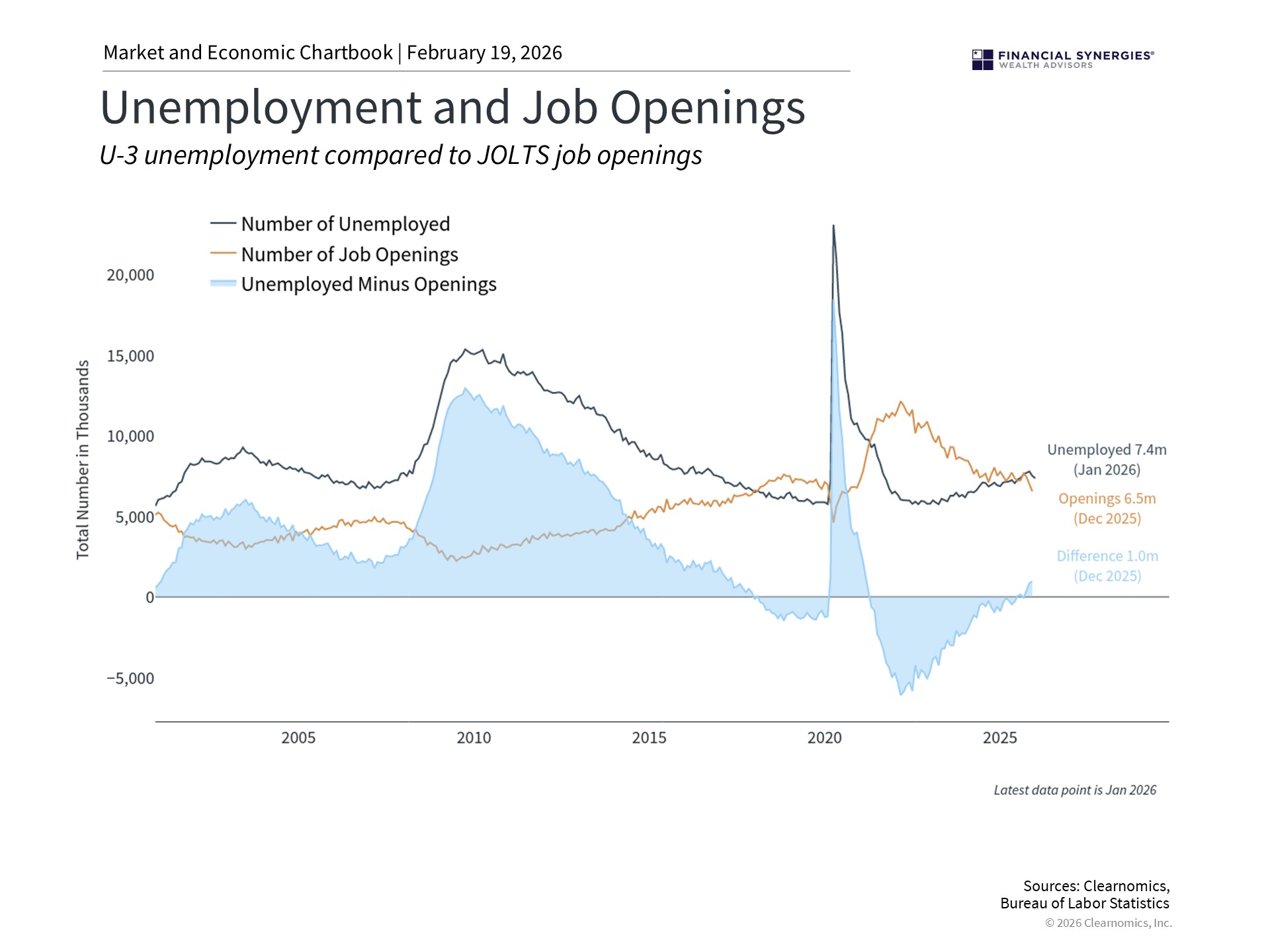
Understanding the labor market has been challenging over the past several months due to government shutdowns that delayed data, bad weather, and other factors. For individuals, perhaps the biggest shift is in the balance between job seekers and job openings.
As the accompanying chart above shows, the post-pandemic period experienced several years in which there were more openings than unemployed individuals. This ratio was above one from mid-2021 until last summer, reaching as high as two positions per job seeker in 2022. Today, there are about 7.4 million unemployed Americans but only 6.5 million job openings, the fewest unfilled positions since late 2020.
Still, the January jobs report offered good news by showing that the economy added 130,000 jobs that month, nearly double what economists had expected. Many of these jobs were concentrated in the health care, social assistance, and construction sectors. The unemployment rate ticked down to 4.3% from 4.4% and remains near historically low levels. On its own, this could suggest that the labor market is rebounding.
While these numbers are positive, the broader trend has been challenging. Specifically, the Bureau of Labor Statistics published their annual revisions which are based on more accurate data than was available at the time of each monthly report. It showed that the number of jobs created over 2025 was only 181,000, or about 15,000 per month, the weakest annual total since 2020. For context, healthy job gains are typically measured in the millions per year, prior to these revisions.
Why has the overall unemployment rate stayed relatively low despite slower hiring? Part of the answer lies in demographics and immigration. The Census Bureau recently reported a historic decline in net international migration, which fell from a peak of roughly 2.7 million in 2024 to about 1.3 million in 2025, with further declines expected.
Additionally, an aging population and lower labor force participation mean there are simply fewer people entering the workforce. In other words, both the supply and demand sides of the labor market are cooling, which has helped keep the unemployment rate from rising.
Jobs, inflation, and the broader economy
Investors tend to watch the labor market closely because it is tangible in a way that many other economic indicators are not. Specifically, jobs directly affect household income, consumer confidence, and spending decisions. Consumer spending makes up more than two-thirds of the U.S. GDP, so what happens in the labor market eventually flows through to the broader economy.
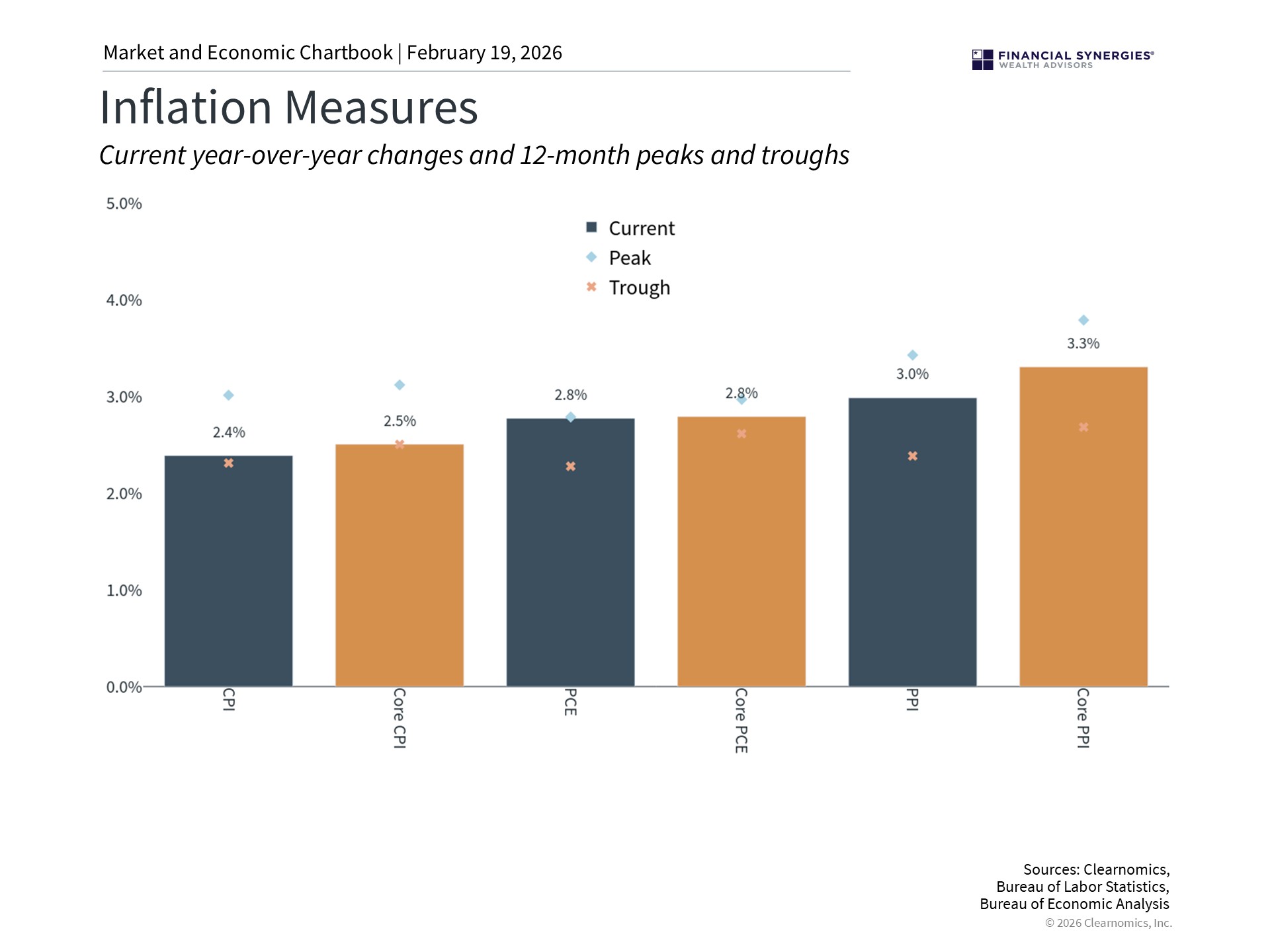
However, jobs are only one part of the equation. Other data, including inflation, provide the perspective that the glass might be half full. This is because, until recently, inflation was the biggest challenge for investors and policymakers alike. The latest data show that the Consumer Price Index rose just 2.4% over the past year, while core inflation, which excludes food and energy prices, decelerated to 2.5%, the lowest level in nearly five years. One measure of “supercore” inflation, which also excludes shelter, rose only 2.1% over the past twelve months.
This steady deceleration brings the Fed closer to its 2% target and suggests that the inflationary pressures continue to fade. Of course, high prices remain a challenge for many households and retirees since slower inflation doesn’t mean prices will actually come down. Still, the fact that price pressures have been contained is positive for the economy and for portfolios, since inflation can be problematic for both stocks and bonds.
What the economic picture means for portfolios
For portfolios, today’s economic environment can be perceived as cautiously positive. The combination of steady growth, cooling inflation, and a softening labor market can create a “Goldilocks” environment that is neither too hot nor too cold. This can benefit both stocks and bonds, especially if it helps to keep interest rates low. The market reaction to the latest employment and inflation data has been a decline in interest rates across the yield curve, with the 10-year Treasury yield just above 4%.
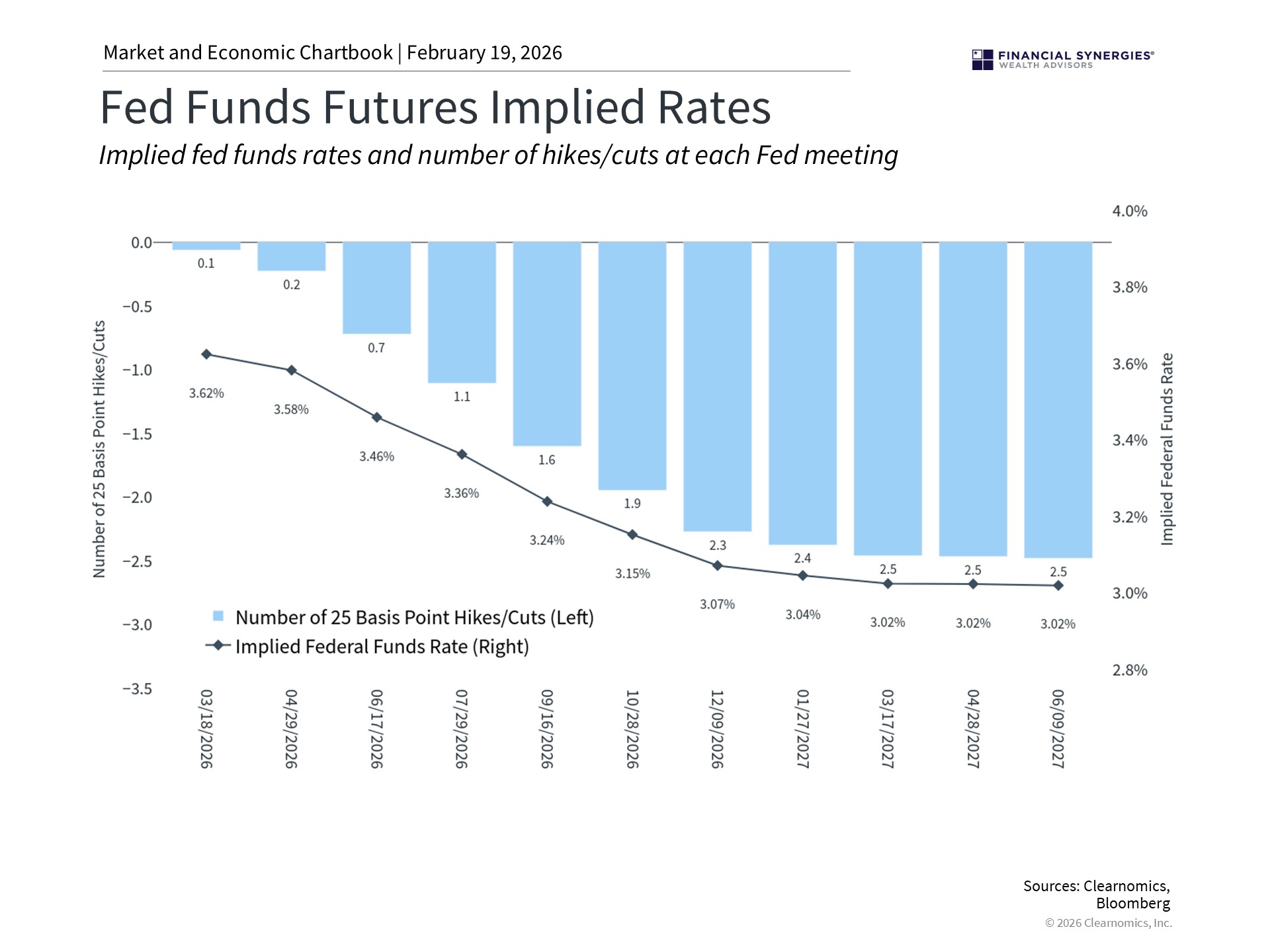
These reports also impact Fed expectations and increase the likelihood of policy cuts later this year. At the moment, market-based measures imply at least two rate cuts this year, and the prospect of a new Fed chair, appointed by President Trump, adds to this possibility.
Lower rates, if they continue, help portfolios because they reduce borrowing costs for businesses and make future corporate earnings more valuable in today’s dollars. Existing bonds also tend to become more valuable when interest rates fall. Even if rates don’t fall further, bonds continue to offer attractive yields and can provide a cushion for long-term investors. Meanwhile, corporate earnings continue to grow, one of the primary factors supporting the broader market over the past year.
The bottom line? The labor market is cooling but the broader economy is healthy. For investors, this mixed backdrop supports a balanced approach and reinforces the importance of long-term thinking when it comes to portfolios and financial plans.
Concerns or questions about how your investment portfolio will hold up in the current market environment? Contact Financial Synergies today.
We are a boutique, financial advisory and total wealth management firm with over 35 years helping clients navigate turbulent markets. To learn more about our approach to investment management please reach out to us. One of our seasoned advisors would be happy to help you build a custom financial plan to help ensure you accomplish your financial goals and objectives. Schedule a conversation with us today.
More relevant articles by Financial Synergies:
Blog Disclosures
This content, which contains security-related opinions and/or information, is provided for informational purposes only and should not be relied upon in any manner as professional advice, or an endorsement of any practices, products or services. There can be no guarantees or assurances that the views expressed here will be applicable for any particular facts or circumstances, and should not be relied upon in any manner. You should consult your own financial advisors as to legal, business, tax, and other related matters concerning any investment.
The commentary in this “post” (including any related blogs, videos, and social media) reflects the personal opinions, viewpoints, and analyses of the Financial Synergies Wealth Advisors, Inc. employees providing such comments, and should not be regarded as the views of Financial Synergies Wealth Advisors, Inc. or its respective affiliates or as a description of advisory services provided by Financial Synergies Wealth Advisors, Inc. or performance returns of any Financial Synergies Wealth Advisors, Inc. client.
Any opinions expressed herein do not constitute or imply endorsement, sponsorship, or recommendation by Financial Synergies Wealth Advisors, Inc. or its employees. The views reflected in the commentary are subject to change at any time without notice.
Nothing on this website constitutes investment or financial planning advice, performance data or any recommendation that any particular security, portfolio of securities, transaction or investment strategy is suitable for any specific person. It also should not be construed as an offer soliciting the purchase or sale of any security mentioned. Nor should it be construed as an offer to provide investment advisory services by Financial Synergies Wealth Advisors, Inc.
Any mention of a particular security and related performance data is not a recommendation to buy or sell that security. Financial Synergies Wealth Advisors, Inc. manages its clients’ accounts using a variety of investment techniques and strategies, which are not necessarily discussed in the commentary. Investments in securities involve the risk of loss. Past performance is no guarantee of future results.
Any charts provided here or on any related Financial Synergies Wealth Advisors, Inc. personnel content outlets are for informational purposes only, and should also not be relied upon when making any investment decision. Any indices referenced for comparison are unmanaged and cannot be invested into directly. As always please remember investing involves risk and possible loss of principal capital; please seek advice from a licensed professional. Any projections, estimates, forecasts, targets, prospects and/or opinions expressed in these materials are subject to change without notice and may differ or be contrary to opinions expressed by others. Information in charts have been obtained from third-party sources and data, and may include those from portfolio securities of funds managed by Financial Synergies Wealth Advisors, Inc. While taken from sources believed to be reliable, Financial Synergies Wealth Advisors, Inc. has not independently verified such information and makes no representations about the enduring accuracy of the information or its appropriateness for a given situation. All content speaks only as of the date indicated.
Financial Synergies Wealth Advisors, Inc. is a registered investment adviser. Advisory services are only offered to clients or prospective clients where Financial Synergies Wealth Advisors, Inc. and its representatives are properly licensed or exempt from licensure. Investments in securities involve the risk of loss. Past performance is no guarantee of future results.
See Full Disclosures Page Here
 Skip to content


Is the Economy Healthy? Jobs, Inflation, and Growth
The health of the economy is important to long-term investors because it helps drive our portfolios and financial plans. Recent economic data points have sent mixed signals, leaving some investors unsure of what to make of the current environment.
However, just as a doctor doesn’t diagnose a patient based on a single number, investors should avoid drawing conclusions from any one set of data. After all, blood pressure, heart rate, and other measures all tell part of the story, and what counts as healthy can vary from one person to the next. Similarly, payrolls, inflation, and GDP are all vital signs that together provide a full economic assessment. This not only shifts through the course of the business cycle, but different environments can all support portfolios and financial goals.
Today’s headline numbers are largely healthy: GDP growth is stronger than expected, inflation is slowing, and unemployment remains low by historical standards.
However, the labor market tells a more complicated story. While the latest monthly figures were encouraging, hiring over the past year was far weaker than previously believed. For long-term investors, the key is understanding how the data fits together to form a broader perspective, rather than reacting to any single report.
The labor market is at an inflection point
Understanding the labor market has been challenging over the past several months due to government shutdowns that delayed data, bad weather, and other factors. For individuals, perhaps the biggest shift is in the balance between job seekers and job openings.
As the accompanying chart above shows, the post-pandemic period experienced several years in which there were more openings than unemployed individuals. This ratio was above one from mid-2021 until last summer, reaching as high as two positions per job seeker in 2022. Today, there are about 7.4 million unemployed Americans but only 6.5 million job openings, the fewest unfilled positions since late 2020.
Still, the January jobs report offered good news by showing that the economy added 130,000 jobs that month, nearly double what economists had expected. Many of these jobs were concentrated in the health care, social assistance, and construction sectors. The unemployment rate ticked down to 4.3% from 4.4% and remains near historically low levels. On its own, this could suggest that the labor market is rebounding.
While these numbers are positive, the broader trend has been challenging. Specifically, the Bureau of Labor Statistics published their annual revisions which are based on more accurate data than was available at the time of each monthly report. It showed that the number of jobs created over 2025 was only 181,000, or about 15,000 per month, the weakest annual total since 2020. For context, healthy job gains are typically measured in the millions per year, prior to these revisions.
Why has the overall unemployment rate stayed relatively low despite slower hiring? Part of the answer lies in demographics and immigration. The Census Bureau recently reported a historic decline in net international migration, which fell from a peak of roughly 2.7 million in 2024 to about 1.3 million in 2025, with further declines expected.
Additionally, an aging population and lower labor force participation mean there are simply fewer people entering the workforce. In other words, both the supply and demand sides of the labor market are cooling, which has helped keep the unemployment rate from rising.
Jobs, inflation, and the broader economy
Investors tend to watch the labor market closely because it is tangible in a way that many other economic indicators are not. Specifically, jobs directly affect household income, consumer confidence, and spending decisions. Consumer spending makes up more than two-thirds of the U.S. GDP, so what happens in the labor market eventually flows through to the broader economy.
However, jobs are only one part of the equation. Other data, including inflation, provide the perspective that the glass might be half full. This is because, until recently, inflation was the biggest challenge for investors and policymakers alike. The latest data show that the Consumer Price Index rose just 2.4% over the past year, while core inflation, which excludes food and energy prices, decelerated to 2.5%, the lowest level in nearly five years. One measure of “supercore” inflation, which also excludes shelter, rose only 2.1% over the past twelve months.
This steady deceleration brings the Fed closer to its 2% target and suggests that the inflationary pressures continue to fade. Of course, high prices remain a challenge for many households and retirees since slower inflation doesn’t mean prices will actually come down. Still, the fact that price pressures have been contained is positive for the economy and for portfolios, since inflation can be problematic for both stocks and bonds.
What the economic picture means for portfolios
For portfolios, today’s economic environment can be perceived as cautiously positive. The combination of steady growth, cooling inflation, and a softening labor market can create a “Goldilocks” environment that is neither too hot nor too cold. This can benefit both stocks and bonds, especially if it helps to keep interest rates low. The market reaction to the latest employment and inflation data has been a decline in interest rates across the yield curve, with the 10-year Treasury yield just above 4%.
These reports also impact Fed expectations and increase the likelihood of policy cuts later this year. At the moment, market-based measures imply at least two rate cuts this year, and the prospect of a new Fed chair, appointed by President Trump, adds to this possibility.
Lower rates, if they continue, help portfolios because they reduce borrowing costs for businesses and make future corporate earnings more valuable in today’s dollars. Existing bonds also tend to become more valuable when interest rates fall. Even if rates don’t fall further, bonds continue to offer attractive yields and can provide a cushion for long-term investors. Meanwhile, corporate earnings continue to grow, one of the primary factors supporting the broader market over the past year.
The bottom line? The labor market is cooling but the broader economy is healthy. For investors, this mixed backdrop supports a balanced approach and reinforces the importance of long-term thinking when it comes to portfolios and financial plans.
Concerns or questions about how your investment portfolio will hold up in the current market environment? Contact Financial Synergies today.
We are a boutique, financial advisory and total wealth management firm with over 35 years helping clients navigate turbulent markets. To learn more about our approach to investment management please reach out to us. One of our seasoned advisors would be happy to help you build a custom financial plan to help ensure you accomplish your financial goals and objectives. Schedule a conversation with us today.
More relevant articles by Financial Synergies:
Blog Disclosures
This content, which contains security-related opinions and/or information, is provided for informational purposes only and should not be relied upon in any manner as professional advice, or an endorsement of any practices, products or services. There can be no guarantees or assurances that the views expressed here will be applicable for any particular facts or circumstances, and should not be relied upon in any manner. You should consult your own financial advisors as to legal, business, tax, and other related matters concerning any investment.
The commentary in this “post” (including any related blogs, videos, and social media) reflects the personal opinions, viewpoints, and analyses of the Financial Synergies Wealth Advisors, Inc. employees providing such comments, and should not be regarded as the views of Financial Synergies Wealth Advisors, Inc. or its respective affiliates or as a description of advisory services provided by Financial Synergies Wealth Advisors, Inc. or performance returns of any Financial Synergies Wealth Advisors, Inc. client.
Any opinions expressed herein do not constitute or imply endorsement, sponsorship, or recommendation by Financial Synergies Wealth Advisors, Inc. or its employees. The views reflected in the commentary are subject to change at any time without notice.
Nothing on this website constitutes investment or financial planning advice, performance data or any recommendation that any particular security, portfolio of securities, transaction or investment strategy is suitable for any specific person. It also should not be construed as an offer soliciting the purchase or sale of any security mentioned. Nor should it be construed as an offer to provide investment advisory services by Financial Synergies Wealth Advisors, Inc.
Any mention of a particular security and related performance data is not a recommendation to buy or sell that security. Financial Synergies Wealth Advisors, Inc. manages its clients’ accounts using a variety of investment techniques and strategies, which are not necessarily discussed in the commentary. Investments in securities involve the risk of loss. Past performance is no guarantee of future results.
Any charts provided here or on any related Financial Synergies Wealth Advisors, Inc. personnel content outlets are for informational purposes only, and should also not be relied upon when making any investment decision. Any indices referenced for comparison are unmanaged and cannot be invested into directly. As always please remember investing involves risk and possible loss of principal capital; please seek advice from a licensed professional. Any projections, estimates, forecasts, targets, prospects and/or opinions expressed in these materials are subject to change without notice and may differ or be contrary to opinions expressed by others. Information in charts have been obtained from third-party sources and data, and may include those from portfolio securities of funds managed by Financial Synergies Wealth Advisors, Inc. While taken from sources believed to be reliable, Financial Synergies Wealth Advisors, Inc. has not independently verified such information and makes no representations about the enduring accuracy of the information or its appropriateness for a given situation. All content speaks only as of the date indicated.
Financial Synergies Wealth Advisors, Inc. is a registered investment adviser. Advisory services are only offered to clients or prospective clients where Financial Synergies Wealth Advisors, Inc. and its representatives are properly licensed or exempt from licensure. Investments in securities involve the risk of loss. Past performance is no guarantee of future results.
See Full Disclosures Page Here
Recent Posts
Happy Birthday to the Bull Market 🎉
Quarterly Webinar: Q4 2026 Market and Economic Themes
Medicare Open Enrollment 2026: What to Know
Subscribe to Our Blog
Chief Investment Officer | Managing Partner