When investors think about the stock market, they tend to focus on broad indices like the S&P 500 or Dow Jones Industrial Average. While this is a natural starting point, it’s often helpful to look one level deeper at the sectors within each index. For instance, the 11 sectors that make up the S&P 500 each have unique characteristics and can behave differently based on economic conditions and geopolitical developments. Understanding these dynamics is important for portfolio construction, diversification, and long-term financial planning.
In today’s environment, the difference between the best and worst performing sectors has widened to over 40 percentage points this year. This is a significant development driven by the ongoing conflict in the Middle East, oil prices swings, and the evolving narrative around AI.
At the moment, the S&P 500 also experienced its first pullback of more than 5% from its all-time high, even though 6 of the 11 sectors are positive so far this year. This is possible because the S&P 500 index does not weigh all sectors equally, with Technology currently making up nearly one-third of the index, compared to Energy and Utilities at just 3.5% and 2.5% respectively. Of course, while the past is no guarantee of the future, history also shows that conditions can change quickly and the market can recover, often when it’s least expected.
While the market dynamics of the past few months are impactful, the reality is that there is unique sector-level behavior every year. Taking a longer-term view, many sectors have performed well over the past few years, often in ways that surprised investors. This is a reminder that maintaining balance across sectors matters as much as doing so across asset classes. So, what perspective is needed to understand the recent sector rotation and market pullback?
The energy sector has surged amid geopolitical uncertainty
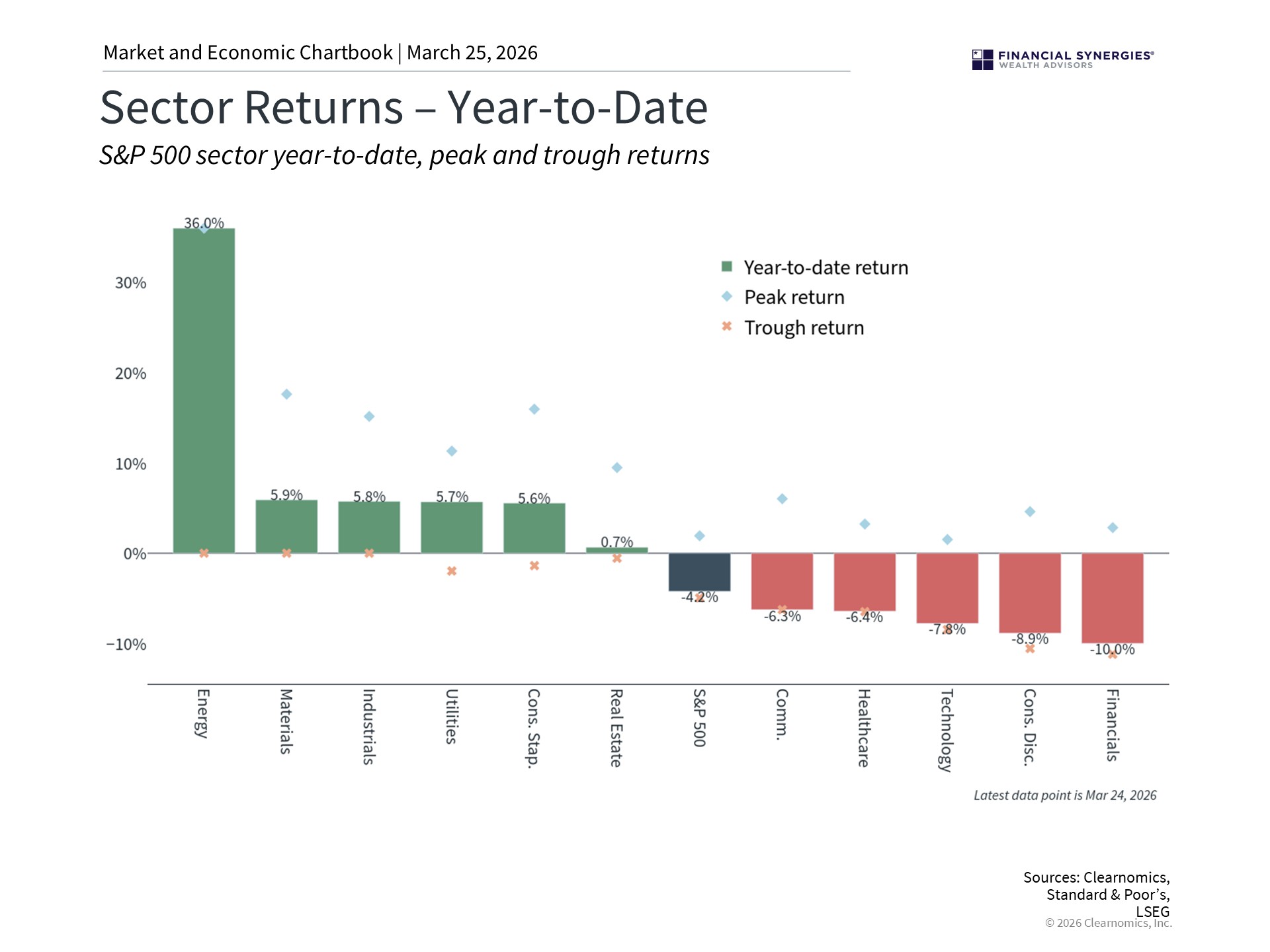
The energy sector has benefited from geopolitical risk so far in 2026, gaining around 36% year-to-date. This outperformance has been driven by a sharp rise in oil prices, with Brent crude hovering above $100 per barrel following escalating tensions in the Middle East. The story is still evolving, which could continue to drive market swings. Still, this has pushed energy stocks higher, something that has occurred throughout historical periods of geopolitical conflict.
For instance, in 2022 when Russia invaded Ukraine, the energy sector gained 65.7% for the full year while the broader S&P 500 declined 18%. The year before that, energy returned 54.6% as the economy rebounded from the pandemic. While the broad market did rebound from these historic episodes, they demonstrate how energy stocks have served as a counterweight during times of global uncertainty.
While prices originally rose this year due to the blockage of the Strait of Hormuz, which forced many Middle East countries to scale back oil and gas production, recent attacks have targeted energy production infrastructure. Higher oil prices directly benefit producers by boosting revenues and encouraging further investment and exploration.
However, they also act as a headwind for the broader economy in the short run by raising costs for consumers, businesses, and many other sectors. This is why the same shock that supports energy stocks can weigh on transportation, consumer spending, and corporate profit margins elsewhere.
In the long run, there are reasons not to be overly pessimistic about higher oil prices. Between 2011 and 2014, oil prices sustained levels near $100 per barrel, and the economy still grew while the stock market continued its bull run. Economists often view these types of “supply-side shocks” as temporary, since eventually production will be restored and other suppliers will step in.
Specifically, the U.S. has been the world’s largest oil producer for six consecutive years, with output now exceeding 13.7 million barrels per day. The U.S. is often viewed as a “swing producer” since increased production can help offset shortages elsewhere. This can help moderate prices over time and reduce the economy’s vulnerability to foreign supply disruptions.
AI has raised new questions about technology companies
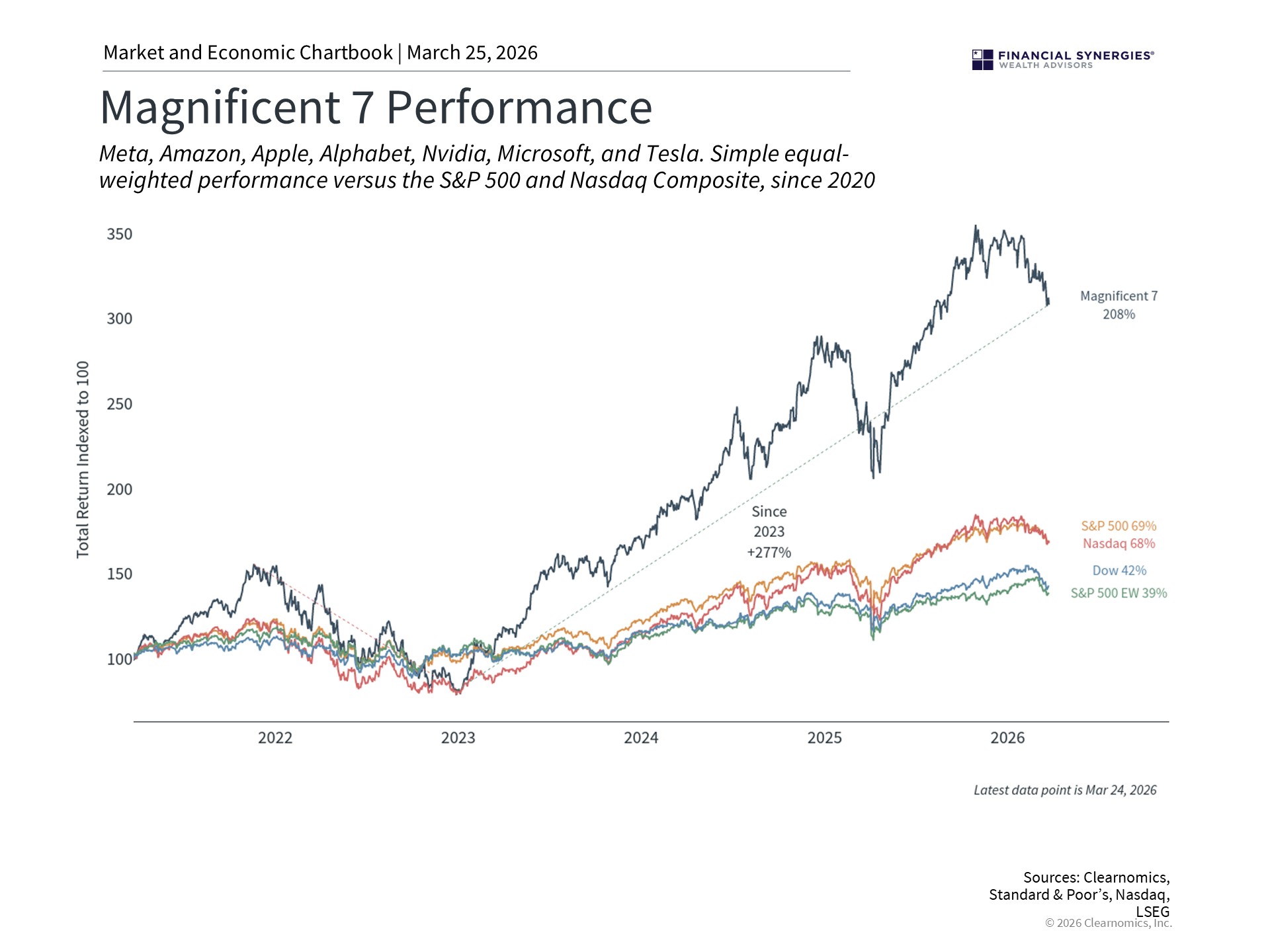
Over the past several years, AI stocks have led the market, driving significant gains across sectors like Information Technology, Communication Services, and Consumer Discretionary. The outperformance of these sectors, including the so-called Magnificent 7, has resulted in greater market concentration and sensitivity to just a handful of companies.
More recently, however, the narrative has shifted. While these companies continue to post strong earnings, other sectors have performed well over the past year, including Energy, Industrials, Utilities, Materials, and Consumer Staples. Some of these groups are perceived as more “defensive” and have benefited in this year’s market environment.
Part of the evolving story around technology stocks reflects growing questions about how AI will affect existing software business models. Some have dubbed this the “SaaS-pocalypse,” or the idea that AI tools could disrupt traditional software-as-a-service (SaaS) companies. This is an ongoing debate and whether or not these fears prove justified, they have already contributed to a reassessment of technology valuations.
This rotation doesn’t mean technology stocks are no longer important. Rather, it highlights how quickly market leadership can shift. This is why investors should be cautious about becoming overly concentrated in any single sector, no matter how compelling the growth story may seem at the time. After all, the purpose of a portfolio is not to chase the best performing index, sector, or stocks, but to generate healthy returns across market cycles that support financial plans.
Defensive sectors and broader diversification have supported portfolios
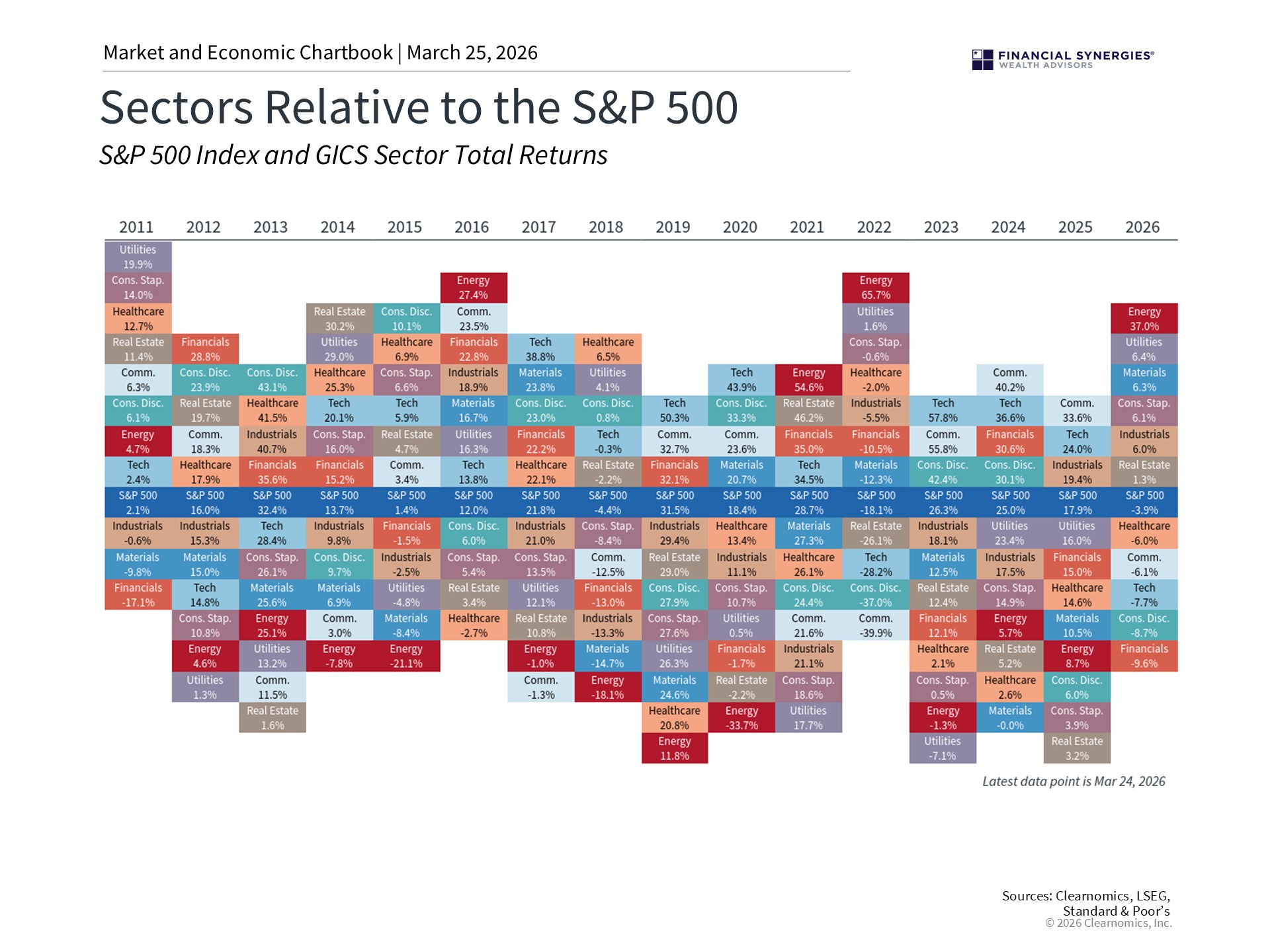
As uncertainty jumped over the past months, markets turned to traditionally defensive sectors such as Utilities, Consumer Staples, and to a lesser extent Health Care. This defensive leadership had been building before the recent escalation in the Middle East, suggesting that investors were already positioning for a more cautious environment amid AI concerns.
Defensive sectors tend to outperform when uncertainty and market volatility rise. This is not because these companies are suddenly posting exceptional financial results, but because their cash flows are generally more stable and less dependent on a strong economic cycle. Utilities still collect payments, consumers still buy groceries, and healthcare remains essential regardless of geopolitical developments. They also pay higher dividend yields, on average. This relative predictability is what makes them more attractive when markets start worrying about growth or inflation.
A related term that has been used for stocks that are less sensitive to AI concerns is “heavy assets, low obsolescence,” or HALO. These are companies that are often defensive in nature and produce goods or rely on manufacturing that is not easily disrupted by new technology developments.
Just as with asset classes, it is extremely difficult to predict which sector will lead or lag in any given year. The sector that tops the leaderboard one year often finds itself near the bottom the next. For example, technology’s recent struggles come after an extended period of market leadership. This unpredictability is why maintaining broad sector exposure is so important.
A well-diversified portfolio that includes cyclical sectors like energy, growth-oriented sectors like technology, and defensive sectors like utilities and consumer staples is better positioned to weather different market environments. Rather than trying to time sector rotations, which is just as counterproductive as timing the overall market, investors benefit from holding a balanced portfolio that can participate in gains across different parts of the economy while managing risk.
Concerns or questions about how your investment portfolio will hold up in the current market environment? Contact Financial Synergies today.
We are a boutique, financial advisory and total wealth management firm with over 35 years helping clients navigate turbulent markets. To learn more about our approach to investment management please reach out to us. One of our seasoned advisors would be happy to help you build a custom financial plan to help ensure you accomplish your financial goals and objectives. Schedule a conversation with us today.
More relevant articles by Financial Synergies:
Blog Disclosures
This content, which contains security-related opinions and/or information, is provided for informational purposes only and should not be relied upon in any manner as professional advice, or an endorsement of any practices, products or services. There can be no guarantees or assurances that the views expressed here will be applicable for any particular facts or circumstances, and should not be relied upon in any manner. You should consult your own financial advisors as to legal, business, tax, and other related matters concerning any investment.
The commentary in this “post” (including any related blogs, videos, and social media) reflects the personal opinions, viewpoints, and analyses of the Financial Synergies Wealth Advisors, Inc. employees providing such comments, and should not be regarded as the views of Financial Synergies Wealth Advisors, Inc. or its respective affiliates or as a description of advisory services provided by Financial Synergies Wealth Advisors, Inc. or performance returns of any Financial Synergies Wealth Advisors, Inc. client.
Any opinions expressed herein do not constitute or imply endorsement, sponsorship, or recommendation by Financial Synergies Wealth Advisors, Inc. or its employees. The views reflected in the commentary are subject to change at any time without notice.
Nothing on this website constitutes investment or financial planning advice, performance data or any recommendation that any particular security, portfolio of securities, transaction or investment strategy is suitable for any specific person. It also should not be construed as an offer soliciting the purchase or sale of any security mentioned. Nor should it be construed as an offer to provide investment advisory services by Financial Synergies Wealth Advisors, Inc.
Any mention of a particular security and related performance data is not a recommendation to buy or sell that security. Financial Synergies Wealth Advisors, Inc. manages its clients’ accounts using a variety of investment techniques and strategies, which are not necessarily discussed in the commentary. Investments in securities involve the risk of loss. Past performance is no guarantee of future results.
Any charts provided here or on any related Financial Synergies Wealth Advisors, Inc. personnel content outlets are for informational purposes only, and should also not be relied upon when making any investment decision. Any indices referenced for comparison are unmanaged and cannot be invested into directly. As always please remember investing involves risk and possible loss of principal capital; please seek advice from a licensed professional. Any projections, estimates, forecasts, targets, prospects and/or opinions expressed in these materials are subject to change without notice and may differ or be contrary to opinions expressed by others. Information in charts have been obtained from third-party sources and data, and may include those from portfolio securities of funds managed by Financial Synergies Wealth Advisors, Inc. While taken from sources believed to be reliable, Financial Synergies Wealth Advisors, Inc. has not independently verified such information and makes no representations about the enduring accuracy of the information or its appropriateness for a given situation. All content speaks only as of the date indicated.
Financial Synergies Wealth Advisors, Inc. is a registered investment adviser. Advisory services are only offered to clients or prospective clients where Financial Synergies Wealth Advisors, Inc. and its representatives are properly licensed or exempt from licensure. Investments in securities involve the risk of loss. Past performance is no guarantee of future results.
See Full Disclosures Page Here
 Skip to content


How Oil and AI Are Impacting Stock Market Sectors
When investors think about the stock market, they tend to focus on broad indices like the S&P 500 or Dow Jones Industrial Average. While this is a natural starting point, it’s often helpful to look one level deeper at the sectors within each index. For instance, the 11 sectors that make up the S&P 500 each have unique characteristics and can behave differently based on economic conditions and geopolitical developments. Understanding these dynamics is important for portfolio construction, diversification, and long-term financial planning.
In today’s environment, the difference between the best and worst performing sectors has widened to over 40 percentage points this year. This is a significant development driven by the ongoing conflict in the Middle East, oil prices swings, and the evolving narrative around AI.
At the moment, the S&P 500 also experienced its first pullback of more than 5% from its all-time high, even though 6 of the 11 sectors are positive so far this year. This is possible because the S&P 500 index does not weigh all sectors equally, with Technology currently making up nearly one-third of the index, compared to Energy and Utilities at just 3.5% and 2.5% respectively. Of course, while the past is no guarantee of the future, history also shows that conditions can change quickly and the market can recover, often when it’s least expected.
While the market dynamics of the past few months are impactful, the reality is that there is unique sector-level behavior every year. Taking a longer-term view, many sectors have performed well over the past few years, often in ways that surprised investors. This is a reminder that maintaining balance across sectors matters as much as doing so across asset classes. So, what perspective is needed to understand the recent sector rotation and market pullback?
The energy sector has surged amid geopolitical uncertainty
The energy sector has benefited from geopolitical risk so far in 2026, gaining around 36% year-to-date. This outperformance has been driven by a sharp rise in oil prices, with Brent crude hovering above $100 per barrel following escalating tensions in the Middle East. The story is still evolving, which could continue to drive market swings. Still, this has pushed energy stocks higher, something that has occurred throughout historical periods of geopolitical conflict.
For instance, in 2022 when Russia invaded Ukraine, the energy sector gained 65.7% for the full year while the broader S&P 500 declined 18%. The year before that, energy returned 54.6% as the economy rebounded from the pandemic. While the broad market did rebound from these historic episodes, they demonstrate how energy stocks have served as a counterweight during times of global uncertainty.
While prices originally rose this year due to the blockage of the Strait of Hormuz, which forced many Middle East countries to scale back oil and gas production, recent attacks have targeted energy production infrastructure. Higher oil prices directly benefit producers by boosting revenues and encouraging further investment and exploration.
However, they also act as a headwind for the broader economy in the short run by raising costs for consumers, businesses, and many other sectors. This is why the same shock that supports energy stocks can weigh on transportation, consumer spending, and corporate profit margins elsewhere.
In the long run, there are reasons not to be overly pessimistic about higher oil prices. Between 2011 and 2014, oil prices sustained levels near $100 per barrel, and the economy still grew while the stock market continued its bull run. Economists often view these types of “supply-side shocks” as temporary, since eventually production will be restored and other suppliers will step in.
Specifically, the U.S. has been the world’s largest oil producer for six consecutive years, with output now exceeding 13.7 million barrels per day. The U.S. is often viewed as a “swing producer” since increased production can help offset shortages elsewhere. This can help moderate prices over time and reduce the economy’s vulnerability to foreign supply disruptions.
AI has raised new questions about technology companies
Over the past several years, AI stocks have led the market, driving significant gains across sectors like Information Technology, Communication Services, and Consumer Discretionary. The outperformance of these sectors, including the so-called Magnificent 7, has resulted in greater market concentration and sensitivity to just a handful of companies.
More recently, however, the narrative has shifted. While these companies continue to post strong earnings, other sectors have performed well over the past year, including Energy, Industrials, Utilities, Materials, and Consumer Staples. Some of these groups are perceived as more “defensive” and have benefited in this year’s market environment.
Part of the evolving story around technology stocks reflects growing questions about how AI will affect existing software business models. Some have dubbed this the “SaaS-pocalypse,” or the idea that AI tools could disrupt traditional software-as-a-service (SaaS) companies. This is an ongoing debate and whether or not these fears prove justified, they have already contributed to a reassessment of technology valuations.
This rotation doesn’t mean technology stocks are no longer important. Rather, it highlights how quickly market leadership can shift. This is why investors should be cautious about becoming overly concentrated in any single sector, no matter how compelling the growth story may seem at the time. After all, the purpose of a portfolio is not to chase the best performing index, sector, or stocks, but to generate healthy returns across market cycles that support financial plans.
Defensive sectors and broader diversification have supported portfolios
As uncertainty jumped over the past months, markets turned to traditionally defensive sectors such as Utilities, Consumer Staples, and to a lesser extent Health Care. This defensive leadership had been building before the recent escalation in the Middle East, suggesting that investors were already positioning for a more cautious environment amid AI concerns.
Defensive sectors tend to outperform when uncertainty and market volatility rise. This is not because these companies are suddenly posting exceptional financial results, but because their cash flows are generally more stable and less dependent on a strong economic cycle. Utilities still collect payments, consumers still buy groceries, and healthcare remains essential regardless of geopolitical developments. They also pay higher dividend yields, on average. This relative predictability is what makes them more attractive when markets start worrying about growth or inflation.
A related term that has been used for stocks that are less sensitive to AI concerns is “heavy assets, low obsolescence,” or HALO. These are companies that are often defensive in nature and produce goods or rely on manufacturing that is not easily disrupted by new technology developments.
Just as with asset classes, it is extremely difficult to predict which sector will lead or lag in any given year. The sector that tops the leaderboard one year often finds itself near the bottom the next. For example, technology’s recent struggles come after an extended period of market leadership. This unpredictability is why maintaining broad sector exposure is so important.
A well-diversified portfolio that includes cyclical sectors like energy, growth-oriented sectors like technology, and defensive sectors like utilities and consumer staples is better positioned to weather different market environments. Rather than trying to time sector rotations, which is just as counterproductive as timing the overall market, investors benefit from holding a balanced portfolio that can participate in gains across different parts of the economy while managing risk.
Concerns or questions about how your investment portfolio will hold up in the current market environment? Contact Financial Synergies today.
We are a boutique, financial advisory and total wealth management firm with over 35 years helping clients navigate turbulent markets. To learn more about our approach to investment management please reach out to us. One of our seasoned advisors would be happy to help you build a custom financial plan to help ensure you accomplish your financial goals and objectives. Schedule a conversation with us today.
More relevant articles by Financial Synergies:
Blog Disclosures
This content, which contains security-related opinions and/or information, is provided for informational purposes only and should not be relied upon in any manner as professional advice, or an endorsement of any practices, products or services. There can be no guarantees or assurances that the views expressed here will be applicable for any particular facts or circumstances, and should not be relied upon in any manner. You should consult your own financial advisors as to legal, business, tax, and other related matters concerning any investment.
The commentary in this “post” (including any related blogs, videos, and social media) reflects the personal opinions, viewpoints, and analyses of the Financial Synergies Wealth Advisors, Inc. employees providing such comments, and should not be regarded as the views of Financial Synergies Wealth Advisors, Inc. or its respective affiliates or as a description of advisory services provided by Financial Synergies Wealth Advisors, Inc. or performance returns of any Financial Synergies Wealth Advisors, Inc. client.
Any opinions expressed herein do not constitute or imply endorsement, sponsorship, or recommendation by Financial Synergies Wealth Advisors, Inc. or its employees. The views reflected in the commentary are subject to change at any time without notice.
Nothing on this website constitutes investment or financial planning advice, performance data or any recommendation that any particular security, portfolio of securities, transaction or investment strategy is suitable for any specific person. It also should not be construed as an offer soliciting the purchase or sale of any security mentioned. Nor should it be construed as an offer to provide investment advisory services by Financial Synergies Wealth Advisors, Inc.
Any mention of a particular security and related performance data is not a recommendation to buy or sell that security. Financial Synergies Wealth Advisors, Inc. manages its clients’ accounts using a variety of investment techniques and strategies, which are not necessarily discussed in the commentary. Investments in securities involve the risk of loss. Past performance is no guarantee of future results.
Any charts provided here or on any related Financial Synergies Wealth Advisors, Inc. personnel content outlets are for informational purposes only, and should also not be relied upon when making any investment decision. Any indices referenced for comparison are unmanaged and cannot be invested into directly. As always please remember investing involves risk and possible loss of principal capital; please seek advice from a licensed professional. Any projections, estimates, forecasts, targets, prospects and/or opinions expressed in these materials are subject to change without notice and may differ or be contrary to opinions expressed by others. Information in charts have been obtained from third-party sources and data, and may include those from portfolio securities of funds managed by Financial Synergies Wealth Advisors, Inc. While taken from sources believed to be reliable, Financial Synergies Wealth Advisors, Inc. has not independently verified such information and makes no representations about the enduring accuracy of the information or its appropriateness for a given situation. All content speaks only as of the date indicated.
Financial Synergies Wealth Advisors, Inc. is a registered investment adviser. Advisory services are only offered to clients or prospective clients where Financial Synergies Wealth Advisors, Inc. and its representatives are properly licensed or exempt from licensure. Investments in securities involve the risk of loss. Past performance is no guarantee of future results.
See Full Disclosures Page Here
Recent Posts
Happy Birthday to the Bull Market 🎉
Quarterly Webinar: Q4 2026 Market and Economic Themes
Medicare Open Enrollment 2026: What to Know
Subscribe to Our Blog
Chief Investment Officer | Managing Partner