Top Client Questions: AI Disruption, Gold, Silver, and Bitcoin
What’s causing all the recent volatility in the stock market?
You may have seen recent headlines on the stock market’s volatility related to new AI tools. Specifically, the AI company Anthropic unveiled new capabilities, affecting the price of some stocks that provide these services. This is another milestone in AI development and highlights the importance of risk management while maintaining a balanced, long-term investment approach.
I want to provide perspective on what these developments mean for your portfolio and financial plan. The key takeaway is that while AI represents a transformative technology, short-term market reactions don’t change the fundamentals of sound investing. In fact, your portfolio is positioned to benefit from the growth of technology while also managing risks.
The impact of AI is still evolving
As computer scientist Roy Amara famously observed, “we tend to overestimate the impact of technology in the short run and underestimate it in the long run.”
Over the past few years, many AI companies predicted the development of “artificial general intelligence,” or systems that would match or exceed human capabilities across all domains. This has not yet materialized as technical improvements have slowed somewhat over the past year. Still, there’s no doubt that AI is already supporting knowledge workers in meaningful ways.
The challenge for investors is that we are still in the early innings. The exact path of AI adoption, which companies will benefit most, and which business models might be disrupted all remain difficult to predict. This uncertainty naturally creates market volatility as investors adjust their expectations.
In theory, AI should boost productivity across the economy by automating routine tasks and augmenting human decision-making. Higher productivity would support economic growth and corporate profitability over time, benefiting long-term investors. However, there is limited hard evidence of widespread productivity improvements so far.
This lag between technological capability and measurable economic impact is not unusual. Previous technological revolutions, from electricity to personal computers, took many years to show up in productivity statistics. The benefits often materialize gradually as businesses learn to reorganize work processes around new tools.
For investors, this means patience is required. This is similar to the internet boom of the 1990s, which took decades to fully play out. Just as many businesses were disrupted with the advent of the web, software-as-a-service, mobile apps, and more, so too will there be “creative destruction” as the world develops and adopts new AI-powered applications. The current market reaction shows that this might not happen all at once, but gradually as new uses are created.
Valuations and the question of an “AI bubble”
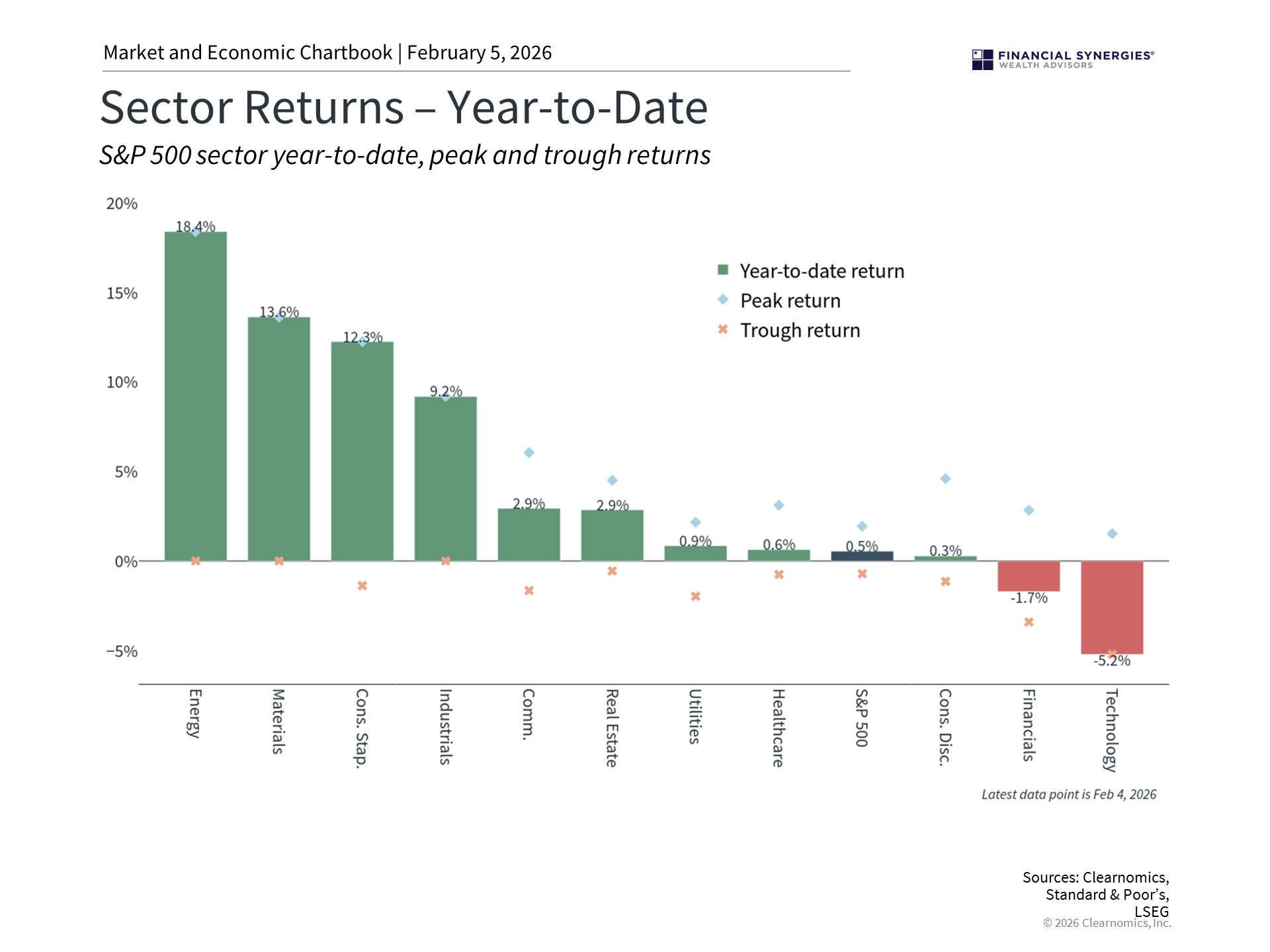
For markets, the real question has been whether there is an “AI bubble.” Technology-related sectors have been significant drivers of broad market returns in recent years, with some individual stocks trading at historically elevated price-to-earnings ratios. These high valuations reflect optimism about AI’s potential, but they also increase the risk of sharp corrections when expectations aren’t immediately met.
It’s worth remembering that brief pullbacks and sector rotations are normal parts of market cycles. Technology-related sectors are known to be quite volatile. In 2022, for example, the Information Technology sector fell 28% as the economy slowed and interest rates rose. Yet, over a longer time horizon, tech stocks have also delivered some of the strongest long-term returns.
The key is having a properly constructed portfolio that captures the upside potential of technology and other growth sectors while managing the inevitable volatility through exposure to more stable areas of the market. This year, we’re seeing healthy rotation as other sectors have performed well while Information Technology has lagged. This rotation demonstrates the value of diversification: when one area of the market struggles, others can provide balance.
What this means for your portfolio
These developments don’t change our core investment strategy or financial planning. While technology stocks may experience periods of volatility, they remain an important component of a well-balanced portfolio.
If you have questions about how AI developments might affect your portfolio, or if your personal financial situation has changed, please don’t hesitate to reach out. Otherwise, the best course of action is to stay focused on your long-term goals and maintain the investment discipline that has served you well.
What’s up with gold, silver, and bitcoin?
You may have seen recent news coverage about the volatility in gold, silver, and bitcoin – for my most recent detailed article on this topic, click here.
Although we do not generally recommend these assets as a necessary position for most investment portfolios, I want to take this opportunity to discuss them and the behavioral lessons they offer.
To be clear, your portfolio is well positioned for your financial goals. However, when many of these investments are in the headlines, it can naturally create investor interest and raise questions. The key is to understand how to think about these investments, balance risk, and benefit from compound returns.
An Update on Gold, Silver, and Bitcoin
Gold, silver, and other precious metals rallied over the past two years, capturing investor attention. However, as we’ve seen in recent weeks, they can also add unforeseen risk to portfolios. It is our job to help educate you on the merits of different assets and, most importantly, how they fit or don’t fit, in a portfolio that aligns with your long-term financial goals.
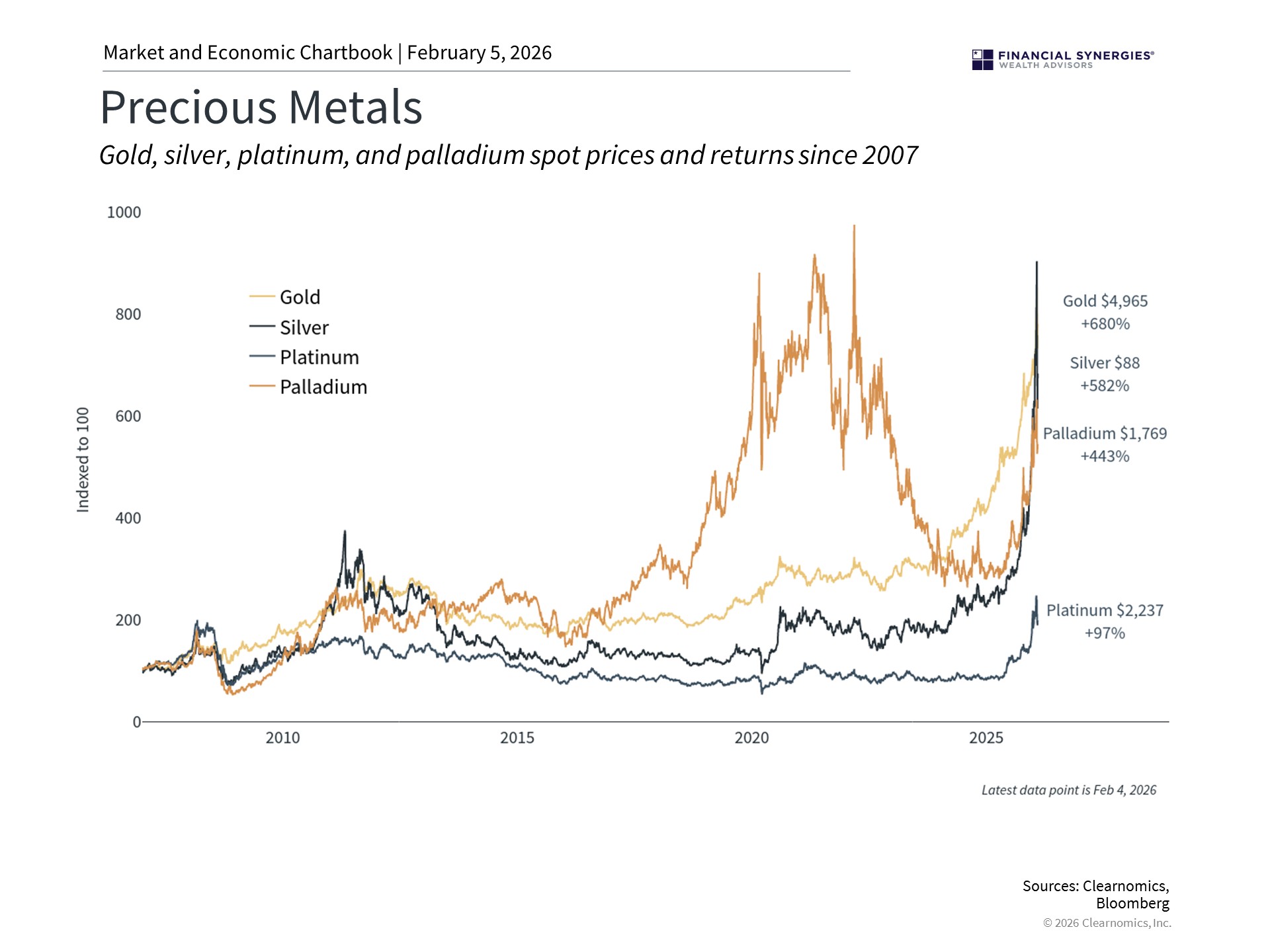
At their recent peaks, gold briefly surpassed $5,500 per ounce while silver rose above $120 per ounce before experiencing their largest drops in decades. Bitcoin has also faced similar volatility, falling by more than 40% from the high of over $126,000 in October last year.
Prices rose due to concerns around Federal Reserve independence and the buying of gold by central banks as they diversify away from dollar-denominated assets. The announcement of a nominee for Fed chair on January 30, which was seen as providing clarity and a smoother leadership transition, then led to a selloff in these assets.
As with all investments, it’s important to maintain a broader perspective to understand their history and how they fit into a well-constructed portfolio. While many investors often turn to precious metals as “safe haven” investments, these and other commodities are prone to boom and bust cycles.
Gold, silver, and bitcoin also carry important limitations. Most notably, they generate no income, unlike most bonds which receive interest payments and many stocks which receive dividends. This lack of income also makes these assets difficult to value, which is another reason they are more prone to booms and busts.
Practical Behavioral Lessons
Assets that experience boom and bust cycles require investors to align their expectations when it comes to long-term financial goals. This is because investing and financial planning occur through all parts of the cycle, in both good and bad markets. It’s also not simply about picking a single asset based on past performance. So, while benefiting from investment opportunities and managing risk are important, it’s just as critical to set proper expectations that are grounded in history, analysis, and tailored financial plans.
Over 50 years of research tells us that people can be prone to both cognitive and emotional biases that often lead to suboptimal outcomes. There is perhaps nothing that gets investors’ attention more than assets that rise in value quickly, even if history shows that this can be short-lived. This is related to effects known as “recency bias” and “herd mentality.” When markets are rising, the fear of missing out can drive investors to abandon their carefully constructed plans.
What separates successful long-term investing is not the ability to eliminate these biases entirely, but rather to follow systems and frameworks which ensure you make productive decisions in spite of them. History shows that investor sentiment comes and goes, so what’s important is to not get caught up in any individual wave.
What This Means for Your Financial Plan
Achieving your financial goals requires staying invested and disciplined through the ups and downs. At the same time, after several years of strong market performance, it’s important for investors to maintain realistic expectations. Your portfolio is invested across asset classes, sectors, and geographies designed to navigate periods of uncertainty without requiring reactions to the latest volatility.
As always, we’re here to discuss how these developments might affect your specific situation. If you have questions or concerns in light of recent events, please don’t hesitate to reach out.
Concerns or questions about how your investment portfolio will hold up in the current market environment? Contact Financial Synergies today.
We are a boutique, financial advisory and total wealth management firm with over 35 years helping clients navigate turbulent markets. To learn more about our approach to investment management please reach out to us. One of our seasoned advisors would be happy to help you build a custom financial plan to help ensure you accomplish your financial goals and objectives. Schedule a conversation with us today.
More relevant articles by Financial Synergies:
Blog Disclosures
This content, which contains security-related opinions and/or information, is provided for informational purposes only and should not be relied upon in any manner as professional advice, or an endorsement of any practices, products or services. There can be no guarantees or assurances that the views expressed here will be applicable for any particular facts or circumstances, and should not be relied upon in any manner. You should consult your own financial advisors as to legal, business, tax, and other related matters concerning any investment.
The commentary in this “post” (including any related blogs, videos, and social media) reflects the personal opinions, viewpoints, and analyses of the Financial Synergies Wealth Advisors, Inc. employees providing such comments, and should not be regarded as the views of Financial Synergies Wealth Advisors, Inc. or its respective affiliates or as a description of advisory services provided by Financial Synergies Wealth Advisors, Inc. or performance returns of any Financial Synergies Wealth Advisors, Inc. client.
Any opinions expressed herein do not constitute or imply endorsement, sponsorship, or recommendation by Financial Synergies Wealth Advisors, Inc. or its employees. The views reflected in the commentary are subject to change at any time without notice.
Nothing on this website constitutes investment or financial planning advice, performance data or any recommendation that any particular security, portfolio of securities, transaction or investment strategy is suitable for any specific person. It also should not be construed as an offer soliciting the purchase or sale of any security mentioned. Nor should it be construed as an offer to provide investment advisory services by Financial Synergies Wealth Advisors, Inc.
Any mention of a particular security and related performance data is not a recommendation to buy or sell that security. Financial Synergies Wealth Advisors, Inc. manages its clients’ accounts using a variety of investment techniques and strategies, which are not necessarily discussed in the commentary. Investments in securities involve the risk of loss. Past performance is no guarantee of future results.
Any charts provided here or on any related Financial Synergies Wealth Advisors, Inc. personnel content outlets are for informational purposes only, and should also not be relied upon when making any investment decision. Any indices referenced for comparison are unmanaged and cannot be invested into directly. As always please remember investing involves risk and possible loss of principal capital; please seek advice from a licensed professional. Any projections, estimates, forecasts, targets, prospects and/or opinions expressed in these materials are subject to change without notice and may differ or be contrary to opinions expressed by others. Information in charts have been obtained from third-party sources and data, and may include those from portfolio securities of funds managed by Financial Synergies Wealth Advisors, Inc. While taken from sources believed to be reliable, Financial Synergies Wealth Advisors, Inc. has not independently verified such information and makes no representations about the enduring accuracy of the information or its appropriateness for a given situation. All content speaks only as of the date indicated.
Financial Synergies Wealth Advisors, Inc. is a registered investment adviser. Advisory services are only offered to clients or prospective clients where Financial Synergies Wealth Advisors, Inc. and its representatives are properly licensed or exempt from licensure. Investments in securities involve the risk of loss. Past performance is no guarantee of future results.
See Full Disclosures Page Here
 Skip to content


Top Client Questions: AI Disruption, Gold, Silver, and Bitcoin
Top Client Questions: AI Disruption, Gold, Silver, and Bitcoin
What’s causing all the recent volatility in the stock market?
You may have seen recent headlines on the stock market’s volatility related to new AI tools. Specifically, the AI company Anthropic unveiled new capabilities, affecting the price of some stocks that provide these services. This is another milestone in AI development and highlights the importance of risk management while maintaining a balanced, long-term investment approach.
I want to provide perspective on what these developments mean for your portfolio and financial plan. The key takeaway is that while AI represents a transformative technology, short-term market reactions don’t change the fundamentals of sound investing. In fact, your portfolio is positioned to benefit from the growth of technology while also managing risks.
The impact of AI is still evolving
As computer scientist Roy Amara famously observed, “we tend to overestimate the impact of technology in the short run and underestimate it in the long run.”
Over the past few years, many AI companies predicted the development of “artificial general intelligence,” or systems that would match or exceed human capabilities across all domains. This has not yet materialized as technical improvements have slowed somewhat over the past year. Still, there’s no doubt that AI is already supporting knowledge workers in meaningful ways.
The challenge for investors is that we are still in the early innings. The exact path of AI adoption, which companies will benefit most, and which business models might be disrupted all remain difficult to predict. This uncertainty naturally creates market volatility as investors adjust their expectations.
In theory, AI should boost productivity across the economy by automating routine tasks and augmenting human decision-making. Higher productivity would support economic growth and corporate profitability over time, benefiting long-term investors. However, there is limited hard evidence of widespread productivity improvements so far.
This lag between technological capability and measurable economic impact is not unusual. Previous technological revolutions, from electricity to personal computers, took many years to show up in productivity statistics. The benefits often materialize gradually as businesses learn to reorganize work processes around new tools.
For investors, this means patience is required. This is similar to the internet boom of the 1990s, which took decades to fully play out. Just as many businesses were disrupted with the advent of the web, software-as-a-service, mobile apps, and more, so too will there be “creative destruction” as the world develops and adopts new AI-powered applications. The current market reaction shows that this might not happen all at once, but gradually as new uses are created.
Valuations and the question of an “AI bubble”
For markets, the real question has been whether there is an “AI bubble.” Technology-related sectors have been significant drivers of broad market returns in recent years, with some individual stocks trading at historically elevated price-to-earnings ratios. These high valuations reflect optimism about AI’s potential, but they also increase the risk of sharp corrections when expectations aren’t immediately met.
It’s worth remembering that brief pullbacks and sector rotations are normal parts of market cycles. Technology-related sectors are known to be quite volatile. In 2022, for example, the Information Technology sector fell 28% as the economy slowed and interest rates rose. Yet, over a longer time horizon, tech stocks have also delivered some of the strongest long-term returns.
The key is having a properly constructed portfolio that captures the upside potential of technology and other growth sectors while managing the inevitable volatility through exposure to more stable areas of the market. This year, we’re seeing healthy rotation as other sectors have performed well while Information Technology has lagged. This rotation demonstrates the value of diversification: when one area of the market struggles, others can provide balance.
What this means for your portfolio
These developments don’t change our core investment strategy or financial planning. While technology stocks may experience periods of volatility, they remain an important component of a well-balanced portfolio.
If you have questions about how AI developments might affect your portfolio, or if your personal financial situation has changed, please don’t hesitate to reach out. Otherwise, the best course of action is to stay focused on your long-term goals and maintain the investment discipline that has served you well.
What’s up with gold, silver, and bitcoin?
You may have seen recent news coverage about the volatility in gold, silver, and bitcoin – for my most recent detailed article on this topic, click here.
Although we do not generally recommend these assets as a necessary position for most investment portfolios, I want to take this opportunity to discuss them and the behavioral lessons they offer.
To be clear, your portfolio is well positioned for your financial goals. However, when many of these investments are in the headlines, it can naturally create investor interest and raise questions. The key is to understand how to think about these investments, balance risk, and benefit from compound returns.
An Update on Gold, Silver, and Bitcoin
Gold, silver, and other precious metals rallied over the past two years, capturing investor attention. However, as we’ve seen in recent weeks, they can also add unforeseen risk to portfolios. It is our job to help educate you on the merits of different assets and, most importantly, how they fit or don’t fit, in a portfolio that aligns with your long-term financial goals.
At their recent peaks, gold briefly surpassed $5,500 per ounce while silver rose above $120 per ounce before experiencing their largest drops in decades. Bitcoin has also faced similar volatility, falling by more than 40% from the high of over $126,000 in October last year.
Prices rose due to concerns around Federal Reserve independence and the buying of gold by central banks as they diversify away from dollar-denominated assets. The announcement of a nominee for Fed chair on January 30, which was seen as providing clarity and a smoother leadership transition, then led to a selloff in these assets.
As with all investments, it’s important to maintain a broader perspective to understand their history and how they fit into a well-constructed portfolio. While many investors often turn to precious metals as “safe haven” investments, these and other commodities are prone to boom and bust cycles.
Gold, silver, and bitcoin also carry important limitations. Most notably, they generate no income, unlike most bonds which receive interest payments and many stocks which receive dividends. This lack of income also makes these assets difficult to value, which is another reason they are more prone to booms and busts.
Practical Behavioral Lessons
Assets that experience boom and bust cycles require investors to align their expectations when it comes to long-term financial goals. This is because investing and financial planning occur through all parts of the cycle, in both good and bad markets. It’s also not simply about picking a single asset based on past performance. So, while benefiting from investment opportunities and managing risk are important, it’s just as critical to set proper expectations that are grounded in history, analysis, and tailored financial plans.
Over 50 years of research tells us that people can be prone to both cognitive and emotional biases that often lead to suboptimal outcomes. There is perhaps nothing that gets investors’ attention more than assets that rise in value quickly, even if history shows that this can be short-lived. This is related to effects known as “recency bias” and “herd mentality.” When markets are rising, the fear of missing out can drive investors to abandon their carefully constructed plans.
What separates successful long-term investing is not the ability to eliminate these biases entirely, but rather to follow systems and frameworks which ensure you make productive decisions in spite of them. History shows that investor sentiment comes and goes, so what’s important is to not get caught up in any individual wave.
What This Means for Your Financial Plan
Achieving your financial goals requires staying invested and disciplined through the ups and downs. At the same time, after several years of strong market performance, it’s important for investors to maintain realistic expectations. Your portfolio is invested across asset classes, sectors, and geographies designed to navigate periods of uncertainty without requiring reactions to the latest volatility.
As always, we’re here to discuss how these developments might affect your specific situation. If you have questions or concerns in light of recent events, please don’t hesitate to reach out.
Concerns or questions about how your investment portfolio will hold up in the current market environment? Contact Financial Synergies today.
We are a boutique, financial advisory and total wealth management firm with over 35 years helping clients navigate turbulent markets. To learn more about our approach to investment management please reach out to us. One of our seasoned advisors would be happy to help you build a custom financial plan to help ensure you accomplish your financial goals and objectives. Schedule a conversation with us today.
More relevant articles by Financial Synergies:
Blog Disclosures
This content, which contains security-related opinions and/or information, is provided for informational purposes only and should not be relied upon in any manner as professional advice, or an endorsement of any practices, products or services. There can be no guarantees or assurances that the views expressed here will be applicable for any particular facts or circumstances, and should not be relied upon in any manner. You should consult your own financial advisors as to legal, business, tax, and other related matters concerning any investment.
The commentary in this “post” (including any related blogs, videos, and social media) reflects the personal opinions, viewpoints, and analyses of the Financial Synergies Wealth Advisors, Inc. employees providing such comments, and should not be regarded as the views of Financial Synergies Wealth Advisors, Inc. or its respective affiliates or as a description of advisory services provided by Financial Synergies Wealth Advisors, Inc. or performance returns of any Financial Synergies Wealth Advisors, Inc. client.
Any opinions expressed herein do not constitute or imply endorsement, sponsorship, or recommendation by Financial Synergies Wealth Advisors, Inc. or its employees. The views reflected in the commentary are subject to change at any time without notice.
Nothing on this website constitutes investment or financial planning advice, performance data or any recommendation that any particular security, portfolio of securities, transaction or investment strategy is suitable for any specific person. It also should not be construed as an offer soliciting the purchase or sale of any security mentioned. Nor should it be construed as an offer to provide investment advisory services by Financial Synergies Wealth Advisors, Inc.
Any mention of a particular security and related performance data is not a recommendation to buy or sell that security. Financial Synergies Wealth Advisors, Inc. manages its clients’ accounts using a variety of investment techniques and strategies, which are not necessarily discussed in the commentary. Investments in securities involve the risk of loss. Past performance is no guarantee of future results.
Any charts provided here or on any related Financial Synergies Wealth Advisors, Inc. personnel content outlets are for informational purposes only, and should also not be relied upon when making any investment decision. Any indices referenced for comparison are unmanaged and cannot be invested into directly. As always please remember investing involves risk and possible loss of principal capital; please seek advice from a licensed professional. Any projections, estimates, forecasts, targets, prospects and/or opinions expressed in these materials are subject to change without notice and may differ or be contrary to opinions expressed by others. Information in charts have been obtained from third-party sources and data, and may include those from portfolio securities of funds managed by Financial Synergies Wealth Advisors, Inc. While taken from sources believed to be reliable, Financial Synergies Wealth Advisors, Inc. has not independently verified such information and makes no representations about the enduring accuracy of the information or its appropriateness for a given situation. All content speaks only as of the date indicated.
Financial Synergies Wealth Advisors, Inc. is a registered investment adviser. Advisory services are only offered to clients or prospective clients where Financial Synergies Wealth Advisors, Inc. and its representatives are properly licensed or exempt from licensure. Investments in securities involve the risk of loss. Past performance is no guarantee of future results.
See Full Disclosures Page Here
Recent Posts
Retirement Income Risks: Planning for a Longer Life
What 7% Mortgages Mean for Housing and the Economy
Financial Synergies Named One of the Fastest Growing Private Companies in Houston
Subscribe to Our Blog
Chief Investment Officer | Managing Partner