The ongoing conflict in Iran and the effective closure of the Strait of Hormuz have pushed oil prices sharply higher. Both Brent crude and WTI have jumped from around $70 per barrel to a high of around $100 in just a few days, approaching levels last seen in 2022 when Russia invaded Ukraine. Fortunately, oil is hovering around $80 per barrel as of this writing. All this has driven significant uncertainty across global markets, with headlines mentioning a “global economic downturn,” “stagflation,” and more.
The safety of civilians and our troops is the most important consideration in this conflict. Still, for investors, history suggests that maintaining a longer-term perspective is the best way to achieve financial success when faced with significant uncertainty. A quote often attributed to Winston Churchill is “the farther back you can look, the farther forward you are likely to see.”
The same could be said of energy price shocks, which have occurred every decade or so. While each situation is unique, there is a clear pattern of oil prices surging in response to geopolitical conflict, the resulting market volatility, and the subsequent calm and recovery.
The situation is unfolding in real time, and there are no guarantees as to when there will be stability in the region or in financial markets. Events over the past few years, including other Middle East conflicts, inflation, trade wars, and Venezuela earlier this year, all provide important context and perspective. What should investors keep in mind in the coming weeks?
Why did oil climb to $100?
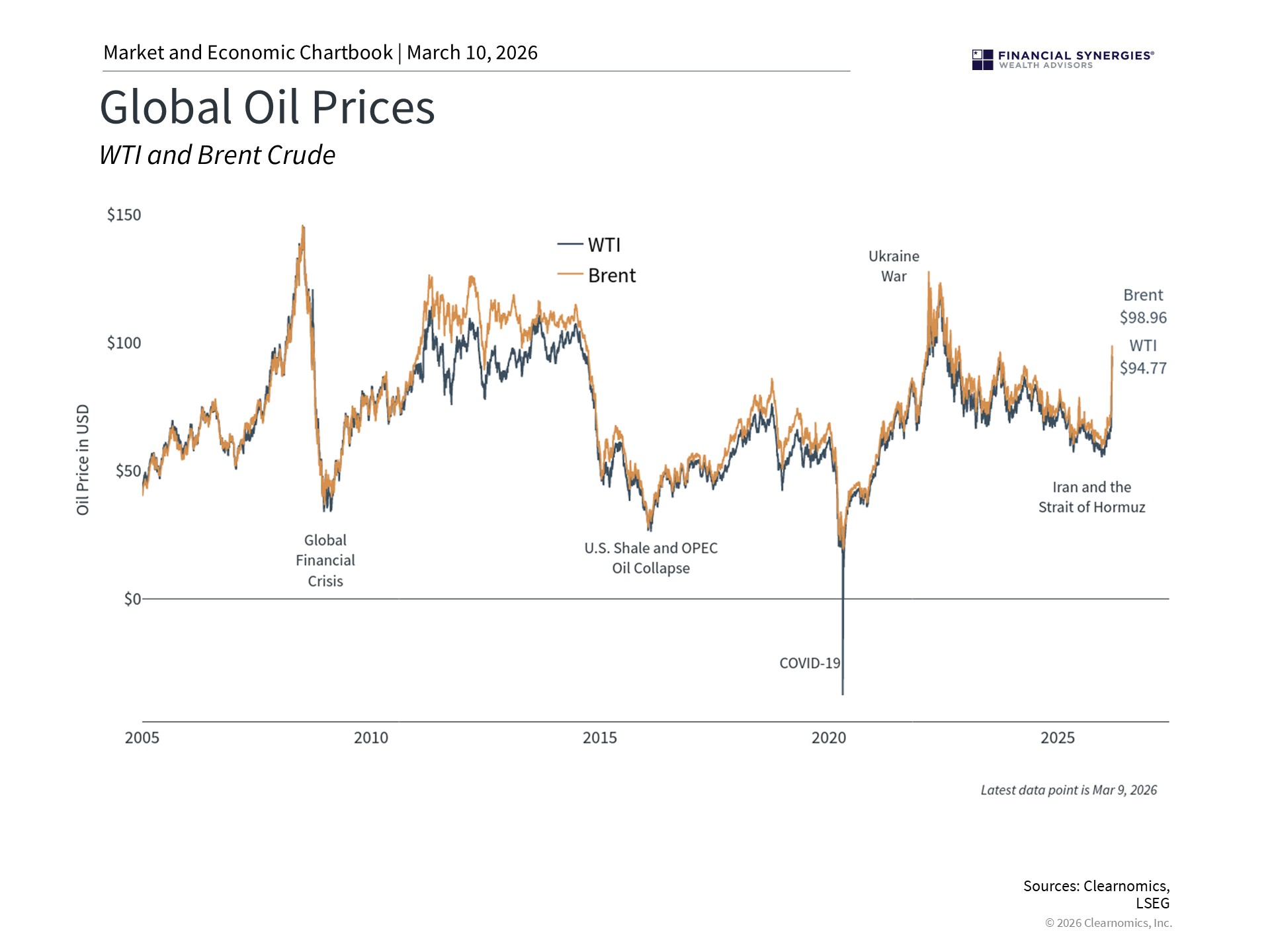
For investors, energy prices are primarily how geopolitical events affect the broader economy and financial markets. The impact of each conflict is different, depending on how it changes supply and demand. At the moment, higher oil prices are due to the transportation of oil, storage capacity, and production cuts by major oil producers across the Middle East. The potential duration of the war is also a factor as Iran appoints a new supreme leader.
The epicenter of the current jump in oil is the Strait of Hormuz, a narrow waterway that connects the Persian Gulf to the rest of the world. Roughly 20% of global oil shipments and a significant share of natural gas pass through this chokepoint each year. While Iran cannot technically close the strait, attacks on tankers and safety concerns have been enough to halt traffic. Major shipping and logistics companies have restricted or suspended bookings through the region, and hundreds of oil tankers are at a standstill inside the strait.
This has a domino effect on the energy market. Without tanker transportation through the Strait of Hormuz, large Middle East oil producers have had to store oil instead. As storage facilities fill up, countries including Saudi Arabia, Iraq, Kuwait, Qatar, and the UAE have been forced to cut production. Unlike the typical OPEC production cuts to boost prices, these emergency measures are involuntary. This chain of events is why oil prices have risen so much in such a short amount of time.
It is often thought that when oil prices rise above $100, the economy starts to falter, affecting household budgets and inflation. Yet, it’s important to keep these moves in perspective. While oil prices have been quite low over the past few years, they have experienced swings throughout history. When Russia invaded Ukraine in early 2022, Brent crude surged to nearly $128 per barrel, pushing average gasoline prices in the U.S. above $5 per gallon. Before that, the mid-2000s saw oil reach record highs driven by rapid global economic growth ahead of the 2008 financial crisis. In each case, prices eventually settled as supply and demand adjusted.
How higher oil prices affect consumers and businesses
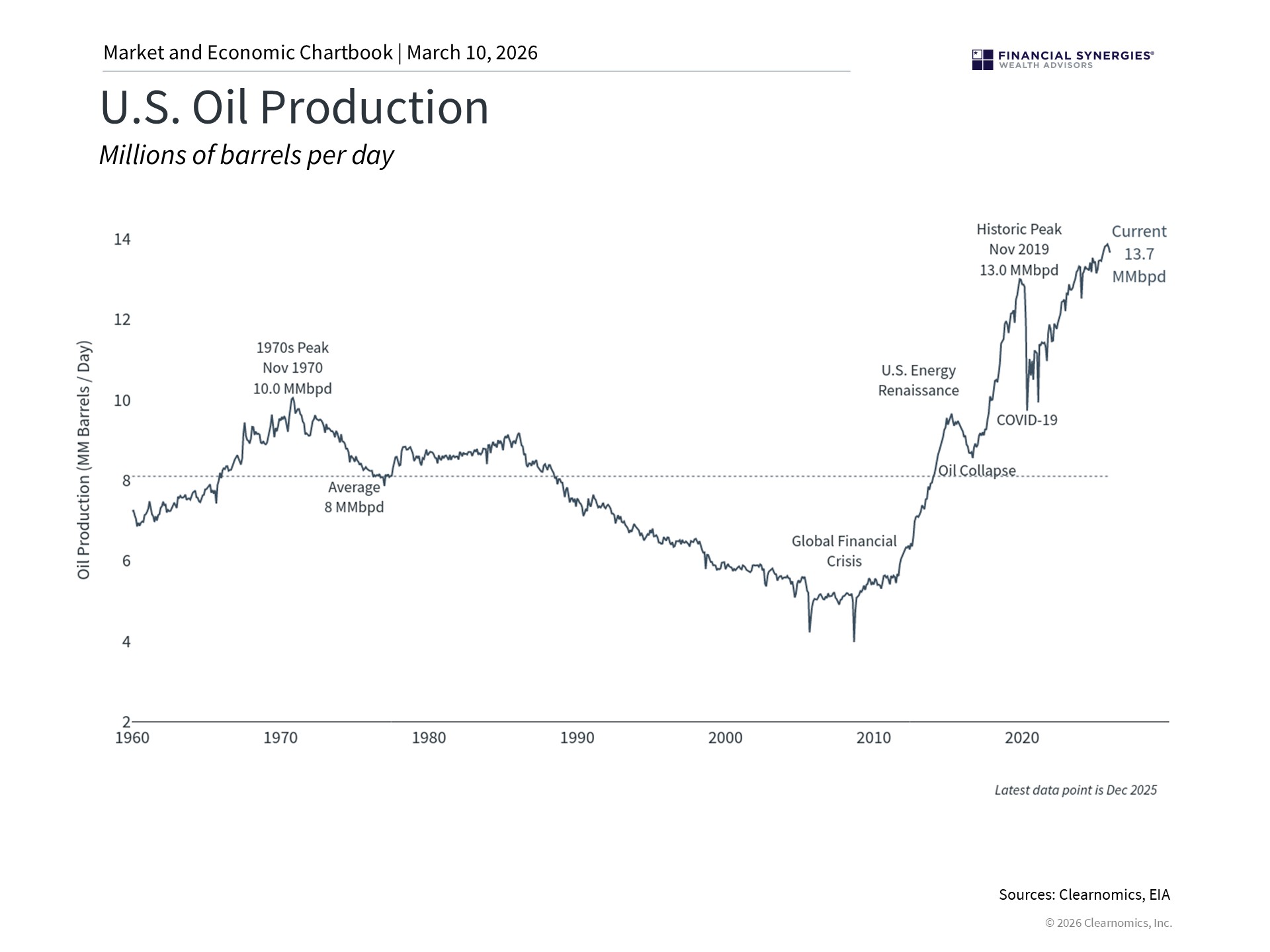
The U.S. is in a stronger position today than during previous oil crises due to the shale revolution. As the world’s largest producer of both oil and natural gas, the U.S. benefits from energy independence that did not exist during other historical oil shocks. While oil is a globally-priced commodity and the U.S. still imports some types of crude, this helps to insulate the domestic economy more than others in Asia and Europe. In fact, the U.S. is seen as a “swing producer,” meaning it can ramp up production when oil prices are high.
Still, higher oil prices do affect every corner of economic activity. For consumers, the most visible impact is at the gasoline pump, since this directly eats into household budgets. At the moment, gasoline prices have risen back toward $3.50 per gallon across the country, and could climb further. While higher, this is still well below the $5 per gallon price experienced four years ago.
Of course, there are many more indirect effects on consumer prices. Rising energy prices raise the cost of transporting goods, manufacturing products, and powering businesses. In this way, higher oil prices function as an effective tax on the economy by raising the costs of all goods and services, reducing disposable incomes.
This is what economists sometimes refer to as “cost-push inflation.” When the cost of oil rises sharply, businesses face higher production costs that are eventually passed on to consumers. This is different from demand-driven inflation, where prices rise because consumers are spending more, such as when government stimulus checks are issued.
This distinction matters because supply shocks tend to be viewed by economists and investors as “transitory,” meaning the effects will eventually fade. This could be because the situation stabilizes after some time and oil prices fall, or because the economy adapts to higher oil prices. So while sudden jumps in energy prices are challenging, history suggests that they do not derail the economy permanently.
Markets can weather higher oil prices
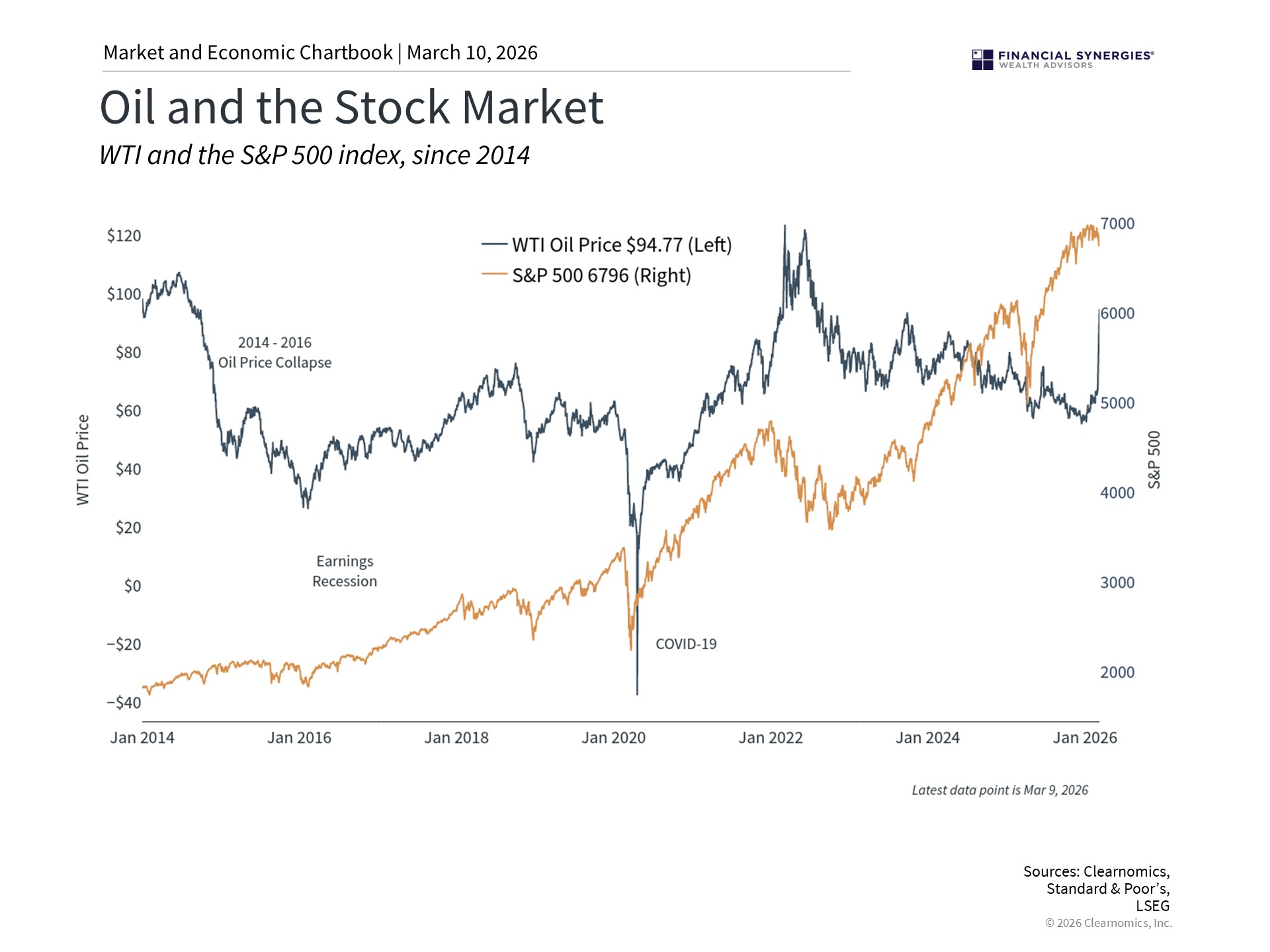
Despite these historical lessons, the reality is that financial markets can react to oil price shocks in the short run. The S&P 500 is basically flat year-to-date, but many headlines are highlighting the South Korean KOSPI index’s decline of 17%, Japan’s Nikkei index’s 10% fall, and others since the end of February. What they don’t emphasize is that the KOSPI and Nikkei are still up over 104% and 40%, respectively, over the past year, even with these recent declines. Markets never move up in a straight line, so it’s important to maintain this broader perspective.
At the same time, energy companies benefit from higher prices. The energy sector has gained about 25% year-to-date and leads the market, just as it did in 2021 and 2022. Similarly, the commodities asset class has risen over 20% this year, driven both by energy and precious metals. This is not to say that investors should focus only on energy, but is a reminder of the benefits that holding different asset classes and sectors can have on portfolios.
Recent events do create uncertainty on what the Fed may do next. If inflation rises due to higher oil prices, the Fed may need to keep rates higher than currently expected. At the moment, market-based measures expect at least one rate cut this year in September, and possibly two by the end of the year. However, if the supply disruption proves temporary, even if it lasts for months, its impact on monetary policy may be limited, just as it has been across history.
Of course, this doesn’t mean markets won’t continue to experience daily swings. Instead, it’s a reminder that properly-constructed asset allocations and financial plans are designed precisely to handle these types of risks. Making dramatic portfolio changes in response to headlines is often counterproductive. Successful investing is more often achieved by maintaining balanced portfolios and staying focused on long-term financial plans.
Concerns or questions about how your investment portfolio will hold up in the current market environment? Contact Financial Synergies today.
We are a boutique, financial advisory and total wealth management firm with over 35 years helping clients navigate turbulent markets. To learn more about our approach to investment management please reach out to us. One of our seasoned advisors would be happy to help you build a custom financial plan to help ensure you accomplish your financial goals and objectives. Schedule a conversation with us today.
More relevant articles by Financial Synergies:
Blog Disclosures
This content, which contains security-related opinions and/or information, is provided for informational purposes only and should not be relied upon in any manner as professional advice, or an endorsement of any practices, products or services. There can be no guarantees or assurances that the views expressed here will be applicable for any particular facts or circumstances, and should not be relied upon in any manner. You should consult your own financial advisors as to legal, business, tax, and other related matters concerning any investment.
The commentary in this “post” (including any related blogs, videos, and social media) reflects the personal opinions, viewpoints, and analyses of the Financial Synergies Wealth Advisors, Inc. employees providing such comments, and should not be regarded as the views of Financial Synergies Wealth Advisors, Inc. or its respective affiliates or as a description of advisory services provided by Financial Synergies Wealth Advisors, Inc. or performance returns of any Financial Synergies Wealth Advisors, Inc. client.
Any opinions expressed herein do not constitute or imply endorsement, sponsorship, or recommendation by Financial Synergies Wealth Advisors, Inc. or its employees. The views reflected in the commentary are subject to change at any time without notice.
Nothing on this website constitutes investment or financial planning advice, performance data or any recommendation that any particular security, portfolio of securities, transaction or investment strategy is suitable for any specific person. It also should not be construed as an offer soliciting the purchase or sale of any security mentioned. Nor should it be construed as an offer to provide investment advisory services by Financial Synergies Wealth Advisors, Inc.
Any mention of a particular security and related performance data is not a recommendation to buy or sell that security. Financial Synergies Wealth Advisors, Inc. manages its clients’ accounts using a variety of investment techniques and strategies, which are not necessarily discussed in the commentary. Investments in securities involve the risk of loss. Past performance is no guarantee of future results.
Any charts provided here or on any related Financial Synergies Wealth Advisors, Inc. personnel content outlets are for informational purposes only, and should also not be relied upon when making any investment decision. Any indices referenced for comparison are unmanaged and cannot be invested into directly. As always please remember investing involves risk and possible loss of principal capital; please seek advice from a licensed professional. Any projections, estimates, forecasts, targets, prospects and/or opinions expressed in these materials are subject to change without notice and may differ or be contrary to opinions expressed by others. Information in charts have been obtained from third-party sources and data, and may include those from portfolio securities of funds managed by Financial Synergies Wealth Advisors, Inc. While taken from sources believed to be reliable, Financial Synergies Wealth Advisors, Inc. has not independently verified such information and makes no representations about the enduring accuracy of the information or its appropriateness for a given situation. All content speaks only as of the date indicated.
Financial Synergies Wealth Advisors, Inc. is a registered investment adviser. Advisory services are only offered to clients or prospective clients where Financial Synergies Wealth Advisors, Inc. and its representatives are properly licensed or exempt from licensure. Investments in securities involve the risk of loss. Past performance is no guarantee of future results.
See Full Disclosures Page Here
 Skip to content


$100 Oil and the Markets
The ongoing conflict in Iran and the effective closure of the Strait of Hormuz have pushed oil prices sharply higher. Both Brent crude and WTI have jumped from around $70 per barrel to a high of around $100 in just a few days, approaching levels last seen in 2022 when Russia invaded Ukraine. Fortunately, oil is hovering around $80 per barrel as of this writing. All this has driven significant uncertainty across global markets, with headlines mentioning a “global economic downturn,” “stagflation,” and more.
The safety of civilians and our troops is the most important consideration in this conflict. Still, for investors, history suggests that maintaining a longer-term perspective is the best way to achieve financial success when faced with significant uncertainty. A quote often attributed to Winston Churchill is “the farther back you can look, the farther forward you are likely to see.”
The same could be said of energy price shocks, which have occurred every decade or so. While each situation is unique, there is a clear pattern of oil prices surging in response to geopolitical conflict, the resulting market volatility, and the subsequent calm and recovery.
The situation is unfolding in real time, and there are no guarantees as to when there will be stability in the region or in financial markets. Events over the past few years, including other Middle East conflicts, inflation, trade wars, and Venezuela earlier this year, all provide important context and perspective. What should investors keep in mind in the coming weeks?
Why did oil climb to $100?
For investors, energy prices are primarily how geopolitical events affect the broader economy and financial markets. The impact of each conflict is different, depending on how it changes supply and demand. At the moment, higher oil prices are due to the transportation of oil, storage capacity, and production cuts by major oil producers across the Middle East. The potential duration of the war is also a factor as Iran appoints a new supreme leader.
The epicenter of the current jump in oil is the Strait of Hormuz, a narrow waterway that connects the Persian Gulf to the rest of the world. Roughly 20% of global oil shipments and a significant share of natural gas pass through this chokepoint each year. While Iran cannot technically close the strait, attacks on tankers and safety concerns have been enough to halt traffic. Major shipping and logistics companies have restricted or suspended bookings through the region, and hundreds of oil tankers are at a standstill inside the strait.
This has a domino effect on the energy market. Without tanker transportation through the Strait of Hormuz, large Middle East oil producers have had to store oil instead. As storage facilities fill up, countries including Saudi Arabia, Iraq, Kuwait, Qatar, and the UAE have been forced to cut production. Unlike the typical OPEC production cuts to boost prices, these emergency measures are involuntary. This chain of events is why oil prices have risen so much in such a short amount of time.
It is often thought that when oil prices rise above $100, the economy starts to falter, affecting household budgets and inflation. Yet, it’s important to keep these moves in perspective. While oil prices have been quite low over the past few years, they have experienced swings throughout history. When Russia invaded Ukraine in early 2022, Brent crude surged to nearly $128 per barrel, pushing average gasoline prices in the U.S. above $5 per gallon. Before that, the mid-2000s saw oil reach record highs driven by rapid global economic growth ahead of the 2008 financial crisis. In each case, prices eventually settled as supply and demand adjusted.
How higher oil prices affect consumers and businesses
The U.S. is in a stronger position today than during previous oil crises due to the shale revolution. As the world’s largest producer of both oil and natural gas, the U.S. benefits from energy independence that did not exist during other historical oil shocks. While oil is a globally-priced commodity and the U.S. still imports some types of crude, this helps to insulate the domestic economy more than others in Asia and Europe. In fact, the U.S. is seen as a “swing producer,” meaning it can ramp up production when oil prices are high.
Still, higher oil prices do affect every corner of economic activity. For consumers, the most visible impact is at the gasoline pump, since this directly eats into household budgets. At the moment, gasoline prices have risen back toward $3.50 per gallon across the country, and could climb further. While higher, this is still well below the $5 per gallon price experienced four years ago.
Of course, there are many more indirect effects on consumer prices. Rising energy prices raise the cost of transporting goods, manufacturing products, and powering businesses. In this way, higher oil prices function as an effective tax on the economy by raising the costs of all goods and services, reducing disposable incomes.
This is what economists sometimes refer to as “cost-push inflation.” When the cost of oil rises sharply, businesses face higher production costs that are eventually passed on to consumers. This is different from demand-driven inflation, where prices rise because consumers are spending more, such as when government stimulus checks are issued.
This distinction matters because supply shocks tend to be viewed by economists and investors as “transitory,” meaning the effects will eventually fade. This could be because the situation stabilizes after some time and oil prices fall, or because the economy adapts to higher oil prices. So while sudden jumps in energy prices are challenging, history suggests that they do not derail the economy permanently.
Markets can weather higher oil prices
Despite these historical lessons, the reality is that financial markets can react to oil price shocks in the short run. The S&P 500 is basically flat year-to-date, but many headlines are highlighting the South Korean KOSPI index’s decline of 17%, Japan’s Nikkei index’s 10% fall, and others since the end of February. What they don’t emphasize is that the KOSPI and Nikkei are still up over 104% and 40%, respectively, over the past year, even with these recent declines. Markets never move up in a straight line, so it’s important to maintain this broader perspective.
At the same time, energy companies benefit from higher prices. The energy sector has gained about 25% year-to-date and leads the market, just as it did in 2021 and 2022. Similarly, the commodities asset class has risen over 20% this year, driven both by energy and precious metals. This is not to say that investors should focus only on energy, but is a reminder of the benefits that holding different asset classes and sectors can have on portfolios.
Recent events do create uncertainty on what the Fed may do next. If inflation rises due to higher oil prices, the Fed may need to keep rates higher than currently expected. At the moment, market-based measures expect at least one rate cut this year in September, and possibly two by the end of the year. However, if the supply disruption proves temporary, even if it lasts for months, its impact on monetary policy may be limited, just as it has been across history.
Of course, this doesn’t mean markets won’t continue to experience daily swings. Instead, it’s a reminder that properly-constructed asset allocations and financial plans are designed precisely to handle these types of risks. Making dramatic portfolio changes in response to headlines is often counterproductive. Successful investing is more often achieved by maintaining balanced portfolios and staying focused on long-term financial plans.
Concerns or questions about how your investment portfolio will hold up in the current market environment? Contact Financial Synergies today.
We are a boutique, financial advisory and total wealth management firm with over 35 years helping clients navigate turbulent markets. To learn more about our approach to investment management please reach out to us. One of our seasoned advisors would be happy to help you build a custom financial plan to help ensure you accomplish your financial goals and objectives. Schedule a conversation with us today.
More relevant articles by Financial Synergies:
Blog Disclosures
This content, which contains security-related opinions and/or information, is provided for informational purposes only and should not be relied upon in any manner as professional advice, or an endorsement of any practices, products or services. There can be no guarantees or assurances that the views expressed here will be applicable for any particular facts or circumstances, and should not be relied upon in any manner. You should consult your own financial advisors as to legal, business, tax, and other related matters concerning any investment.
The commentary in this “post” (including any related blogs, videos, and social media) reflects the personal opinions, viewpoints, and analyses of the Financial Synergies Wealth Advisors, Inc. employees providing such comments, and should not be regarded as the views of Financial Synergies Wealth Advisors, Inc. or its respective affiliates or as a description of advisory services provided by Financial Synergies Wealth Advisors, Inc. or performance returns of any Financial Synergies Wealth Advisors, Inc. client.
Any opinions expressed herein do not constitute or imply endorsement, sponsorship, or recommendation by Financial Synergies Wealth Advisors, Inc. or its employees. The views reflected in the commentary are subject to change at any time without notice.
Nothing on this website constitutes investment or financial planning advice, performance data or any recommendation that any particular security, portfolio of securities, transaction or investment strategy is suitable for any specific person. It also should not be construed as an offer soliciting the purchase or sale of any security mentioned. Nor should it be construed as an offer to provide investment advisory services by Financial Synergies Wealth Advisors, Inc.
Any mention of a particular security and related performance data is not a recommendation to buy or sell that security. Financial Synergies Wealth Advisors, Inc. manages its clients’ accounts using a variety of investment techniques and strategies, which are not necessarily discussed in the commentary. Investments in securities involve the risk of loss. Past performance is no guarantee of future results.
Any charts provided here or on any related Financial Synergies Wealth Advisors, Inc. personnel content outlets are for informational purposes only, and should also not be relied upon when making any investment decision. Any indices referenced for comparison are unmanaged and cannot be invested into directly. As always please remember investing involves risk and possible loss of principal capital; please seek advice from a licensed professional. Any projections, estimates, forecasts, targets, prospects and/or opinions expressed in these materials are subject to change without notice and may differ or be contrary to opinions expressed by others. Information in charts have been obtained from third-party sources and data, and may include those from portfolio securities of funds managed by Financial Synergies Wealth Advisors, Inc. While taken from sources believed to be reliable, Financial Synergies Wealth Advisors, Inc. has not independently verified such information and makes no representations about the enduring accuracy of the information or its appropriateness for a given situation. All content speaks only as of the date indicated.
Financial Synergies Wealth Advisors, Inc. is a registered investment adviser. Advisory services are only offered to clients or prospective clients where Financial Synergies Wealth Advisors, Inc. and its representatives are properly licensed or exempt from licensure. Investments in securities involve the risk of loss. Past performance is no guarantee of future results.
See Full Disclosures Page Here
Recent Posts
Retirement Income Risks: Planning for a Longer Life
What 7% Mortgages Mean for Housing and the Economy
Financial Synergies Named One of the Fastest Growing Private Companies in Houston
Subscribe to Our Blog
Chief Investment Officer | Managing Partner