We should anticipate near-term volatility, including periods of market declines. As is often the case during significant geopolitical events, initial market reactions tend to be unsettled as investors assess potential outcomes and recalibrate expectations. While this turbulence can be uncomfortable, markets have historically demonstrated resilience and an ability to endure through such episodes. WE WILL GET THROUGH THIS.
Iran and the Markets
As you have seen in the news, the U.S. and Israel have launched military strikes against Iran, targeting its leadership, military assets, and nuclear infrastructure. Iran’s Supreme Leader is confirmed to have been killed, and Iran has retaliated with missile and drone attacks across the Middle East. President Trump has stated that the goal of the operation, dubbed “Operation Epic Fury,” is regime change in Tehran, with strikes expected to continue for weeks and a number of U.S. troop casualties already reported.
The situation is evolving rapidly, and the safety of civilians in the region and our troops are the most important consideration. Without taking away from the severity of these events, investors will naturally have questions about what this means for markets, oil prices, and their portfolios.
President Dwight D. Eisenhower once said that “plans are worthless, but planning is everything.” Applied to today, the lesson is that specific geopolitical events are unpredictable, but the fact that they occur regularly is not. The process of structuring a portfolio and making financial plans is designed precisely to deal with this uncertainty. While each event is unique, financial markets have navigated countless wars, crises, and regional conflicts, including the U.S. operation in Venezuela earlier this year.
The key for long-term investors is to separate geopolitical headlines from portfolio decisions. What should investors keep in mind as events unfold in the coming weeks?
These strikes are the latest chapter in an ongoing story
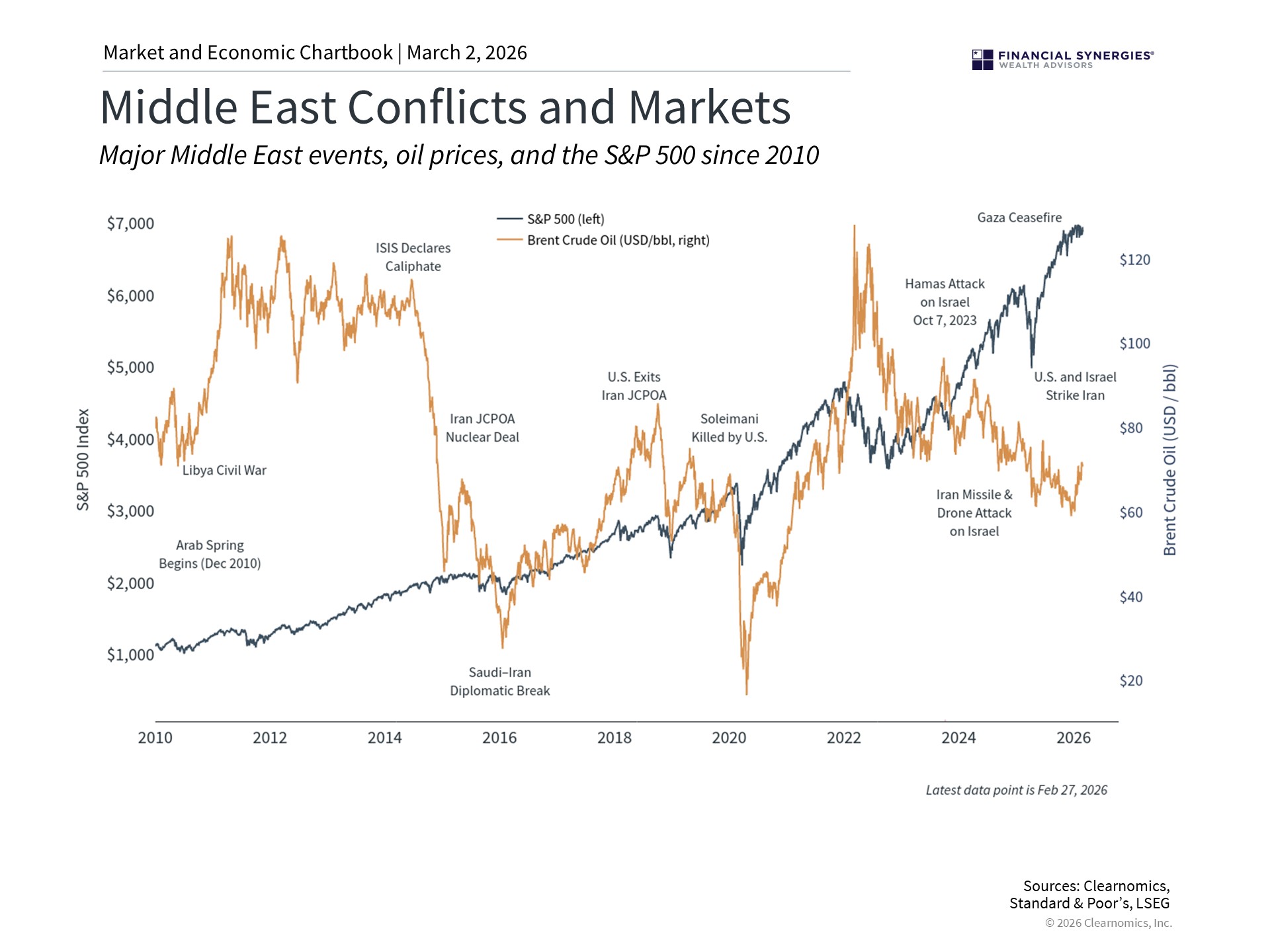
While the scale of the current strikes is significant, tensions between the U.S., Israel, and Iran have been escalating for some time. This latest development follows a monthlong U.S. military buildup in the region, negotiations over Iran’s nuclear program that failed to produce an agreement, and President Trump’s pledge to support Iranian protesters who challenged the regime earlier this year.
To understand how we arrived at this moment, it helps to consider the broader timeline of events:
- Tensions between Iran and the West stretch back decades, including the Iranian regime’s longstanding support for Hezbollah and Hamas, which have been at the center of conflicts throughout the Middle East.
- In 2019, Iran launched drone strikes against Saudi Arabia’s oil infrastructure, temporarily disrupting global oil production and raising fears of a wider regional war.
- Hamas’s October 2023 attack on Israel reignited conflict in the region, eventually drawing in Hezbollah and escalating tensions with Iran.
- Last summer, Israel conducted a 12-day military campaign against Iran, targeting nuclear and ballistic missile programs in what was the most direct confrontation between the two countries in decades.
- Earlier this year, Iranian protesters challenged the regime, with President Trump pledging U.S. support.
- Negotiations over Iran’s nuclear program failed to produce an agreement. In recent weeks, a significant U.S. military buildup in the region signaled that a broader operation was being planned, culminating in the current strikes.
The scope of the latest strikes, including the targeting of Iran’s senior leadership, is broader than previous engagements. However, history also makes it clear that these conflicts themselves are not always a catalyst for market movements.
Oil and the Strait of Hormuz
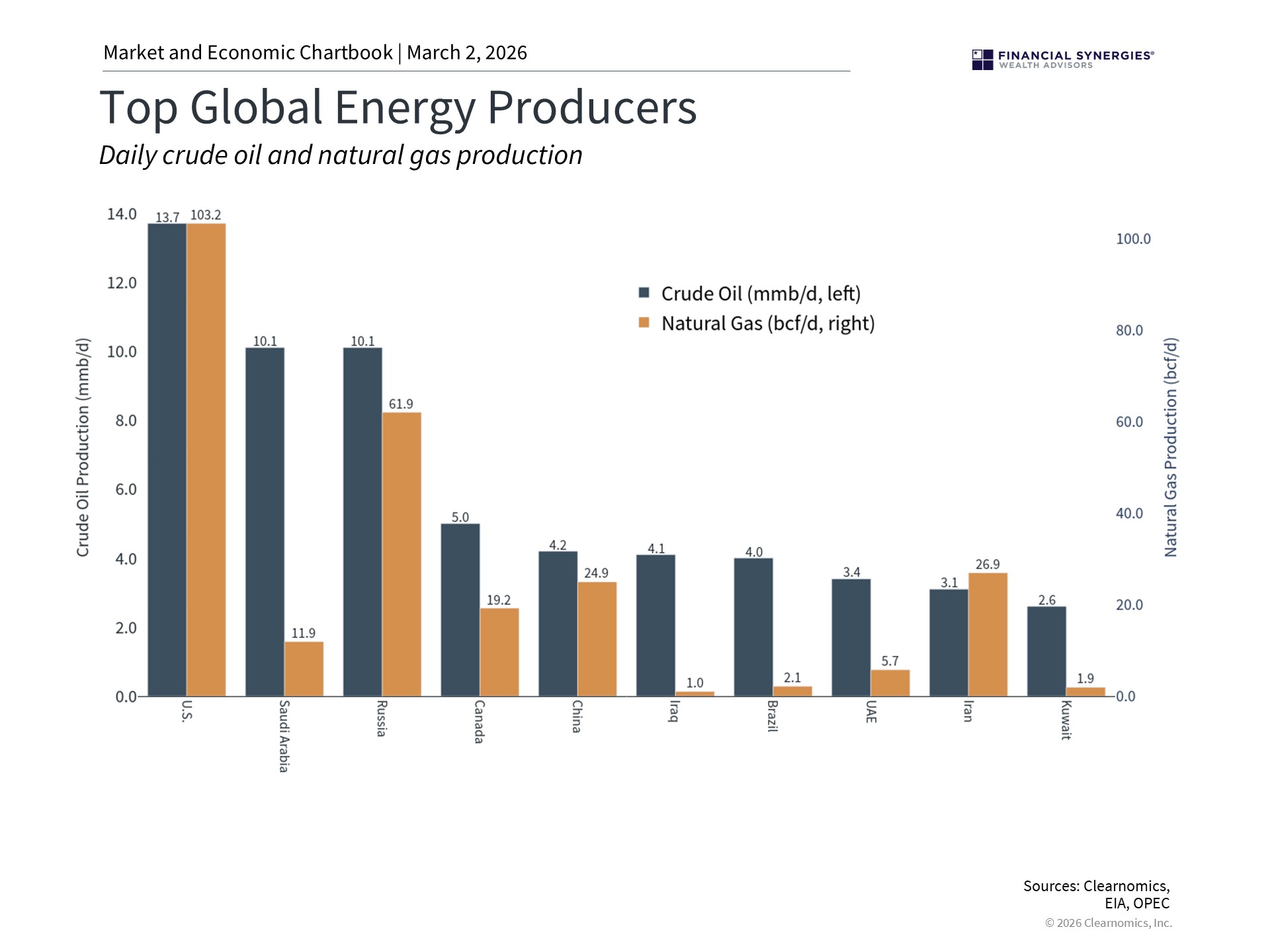
For investors, the most direct way that Middle East conflicts affect financial markets is through global energy prices. Iran is a member of OPEC and produces around 3 million barrels per day of oil, and 27 billion cubic feet per day of natural gas. The country also sits along the Strait of Hormuz, which is the world’s most critical energy waterway. According to the U.S. Energy Information Administration, approximately one-third of all seaborne oil exports and one-fifth of natural gas passes through this region. Even the threat of disruption to this critical waterway could have implications for global energy markets.
Oil prices had already been rising in anticipation of the strikes. The immediate reaction to the strikes has been a further jump in oil, to the low $70s for WTI and just under $80 for Brent crude (as of March 2nd). While western countries do not directly import oil from Iran, the fact that the market is global and oil is fungible means that any disruption to supply can raise prices.
However, some perspective is needed. Current oil prices remain well below the 2022 peak of nearly $128 per barrel when Russia invaded Ukraine. Today’s environment is quite different. In 2018, the U.S. also became the world’s largest producer of oil and natural gas, with current domestic production exceeding other major producers such as Saudi Arabia and Russia. While the U.S. still relies on global energy markets, this level of production helps to insulate the domestic economy from supply disruptions.
It’s also worth remembering that oil prices are hard to predict. When Russia invaded Ukraine, many expected prices to remain elevated indefinitely. Instead, prices stabilized and declined far sooner than projected. Similarly, the U.S. operation in Venezuela this past January led to a brief move in oil prices, but had little longer-term effect.
Staying invested through geopolitical uncertainty

For long-term investors, the most important lesson from past geopolitical conflicts is the value of staying invested. It’s natural to feel uneasy when headlines describe military strikes, retaliatory attacks, and the possibility of a wider regional war. These events involve real human consequences and are unlike the typical flow of market news about earnings, valuations, and economic data.
The accompanying chart makes clear that markets have navigated even the most serious global events. From World War II to the Gulf War to the wars in Iraq and Afghanistan, markets experienced short-term volatility but were driven by economic fundamentals over the long run. More recently, the conflicts between Russia and Ukraine, and between Israel and Hamas, created uncertainty but did not derail the broader market trajectory.
It’s also important to note that Iran plays a minimal direct role in investment portfolios. Iran has been under heavy sanctions for years and its economy has been experiencing hyperinflation, with its currency, the Rial, collapsing. So, very few investors have direct exposure to the country in their asset allocations.
Markets will experience volatility in the coming days and weeks as the situation unfolds. Oil prices could rise further, and uncertainty could weigh on investor sentiment. But trying to time these moves has historically been counterproductive. Historically, markets have shown that they can rebound unexpectedly, and missing even a few of the best trading days can significantly reduce long-term returns.
The bottom line? The U.S. and Israeli strikes on Iran represent an important geopolitical development. However, history shows that investors who maintain diversified portfolios aligned with their long-term financial goals are best positioned to navigate periods of uncertainty.
Concerns or questions about how your investment portfolio will hold up in the current market environment? Contact Financial Synergies today.
We are a boutique, financial advisory and total wealth management firm with over 35 years helping clients navigate turbulent markets. To learn more about our approach to investment management please reach out to us. One of our seasoned advisors would be happy to help you build a custom financial plan to help ensure you accomplish your financial goals and objectives. Schedule a conversation with us today.
More relevant articles by Financial Synergies:
Blog Disclosures
This content, which contains security-related opinions and/or information, is provided for informational purposes only and should not be relied upon in any manner as professional advice, or an endorsement of any practices, products or services. There can be no guarantees or assurances that the views expressed here will be applicable for any particular facts or circumstances, and should not be relied upon in any manner. You should consult your own financial advisors as to legal, business, tax, and other related matters concerning any investment.
The commentary in this “post” (including any related blogs, videos, and social media) reflects the personal opinions, viewpoints, and analyses of the Financial Synergies Wealth Advisors, Inc. employees providing such comments, and should not be regarded as the views of Financial Synergies Wealth Advisors, Inc. or its respective affiliates or as a description of advisory services provided by Financial Synergies Wealth Advisors, Inc. or performance returns of any Financial Synergies Wealth Advisors, Inc. client.
Any opinions expressed herein do not constitute or imply endorsement, sponsorship, or recommendation by Financial Synergies Wealth Advisors, Inc. or its employees. The views reflected in the commentary are subject to change at any time without notice.
Nothing on this website constitutes investment or financial planning advice, performance data or any recommendation that any particular security, portfolio of securities, transaction or investment strategy is suitable for any specific person. It also should not be construed as an offer soliciting the purchase or sale of any security mentioned. Nor should it be construed as an offer to provide investment advisory services by Financial Synergies Wealth Advisors, Inc.
Any mention of a particular security and related performance data is not a recommendation to buy or sell that security. Financial Synergies Wealth Advisors, Inc. manages its clients’ accounts using a variety of investment techniques and strategies, which are not necessarily discussed in the commentary. Investments in securities involve the risk of loss. Past performance is no guarantee of future results.
Any charts provided here or on any related Financial Synergies Wealth Advisors, Inc. personnel content outlets are for informational purposes only, and should also not be relied upon when making any investment decision. Any indices referenced for comparison are unmanaged and cannot be invested into directly. As always please remember investing involves risk and possible loss of principal capital; please seek advice from a licensed professional. Any projections, estimates, forecasts, targets, prospects and/or opinions expressed in these materials are subject to change without notice and may differ or be contrary to opinions expressed by others. Information in charts have been obtained from third-party sources and data, and may include those from portfolio securities of funds managed by Financial Synergies Wealth Advisors, Inc. While taken from sources believed to be reliable, Financial Synergies Wealth Advisors, Inc. has not independently verified such information and makes no representations about the enduring accuracy of the information or its appropriateness for a given situation. All content speaks only as of the date indicated.
Financial Synergies Wealth Advisors, Inc. is a registered investment adviser. Advisory services are only offered to clients or prospective clients where Financial Synergies Wealth Advisors, Inc. and its representatives are properly licensed or exempt from licensure. Investments in securities involve the risk of loss. Past performance is no guarantee of future results.
See Full Disclosures Page Here
 Skip to content


Special Update: Iran and the Markets
We should anticipate near-term volatility, including periods of market declines. As is often the case during significant geopolitical events, initial market reactions tend to be unsettled as investors assess potential outcomes and recalibrate expectations. While this turbulence can be uncomfortable, markets have historically demonstrated resilience and an ability to endure through such episodes. WE WILL GET THROUGH THIS.
Iran and the Markets
As you have seen in the news, the U.S. and Israel have launched military strikes against Iran, targeting its leadership, military assets, and nuclear infrastructure. Iran’s Supreme Leader is confirmed to have been killed, and Iran has retaliated with missile and drone attacks across the Middle East. President Trump has stated that the goal of the operation, dubbed “Operation Epic Fury,” is regime change in Tehran, with strikes expected to continue for weeks and a number of U.S. troop casualties already reported.
The situation is evolving rapidly, and the safety of civilians in the region and our troops are the most important consideration. Without taking away from the severity of these events, investors will naturally have questions about what this means for markets, oil prices, and their portfolios.
President Dwight D. Eisenhower once said that “plans are worthless, but planning is everything.” Applied to today, the lesson is that specific geopolitical events are unpredictable, but the fact that they occur regularly is not. The process of structuring a portfolio and making financial plans is designed precisely to deal with this uncertainty. While each event is unique, financial markets have navigated countless wars, crises, and regional conflicts, including the U.S. operation in Venezuela earlier this year.
The key for long-term investors is to separate geopolitical headlines from portfolio decisions. What should investors keep in mind as events unfold in the coming weeks?
These strikes are the latest chapter in an ongoing story
While the scale of the current strikes is significant, tensions between the U.S., Israel, and Iran have been escalating for some time. This latest development follows a monthlong U.S. military buildup in the region, negotiations over Iran’s nuclear program that failed to produce an agreement, and President Trump’s pledge to support Iranian protesters who challenged the regime earlier this year.
To understand how we arrived at this moment, it helps to consider the broader timeline of events:
The scope of the latest strikes, including the targeting of Iran’s senior leadership, is broader than previous engagements. However, history also makes it clear that these conflicts themselves are not always a catalyst for market movements.
Oil and the Strait of Hormuz
For investors, the most direct way that Middle East conflicts affect financial markets is through global energy prices. Iran is a member of OPEC and produces around 3 million barrels per day of oil, and 27 billion cubic feet per day of natural gas. The country also sits along the Strait of Hormuz, which is the world’s most critical energy waterway. According to the U.S. Energy Information Administration, approximately one-third of all seaborne oil exports and one-fifth of natural gas passes through this region. Even the threat of disruption to this critical waterway could have implications for global energy markets.
Oil prices had already been rising in anticipation of the strikes. The immediate reaction to the strikes has been a further jump in oil, to the low $70s for WTI and just under $80 for Brent crude (as of March 2nd). While western countries do not directly import oil from Iran, the fact that the market is global and oil is fungible means that any disruption to supply can raise prices.
However, some perspective is needed. Current oil prices remain well below the 2022 peak of nearly $128 per barrel when Russia invaded Ukraine. Today’s environment is quite different. In 2018, the U.S. also became the world’s largest producer of oil and natural gas, with current domestic production exceeding other major producers such as Saudi Arabia and Russia. While the U.S. still relies on global energy markets, this level of production helps to insulate the domestic economy from supply disruptions.
It’s also worth remembering that oil prices are hard to predict. When Russia invaded Ukraine, many expected prices to remain elevated indefinitely. Instead, prices stabilized and declined far sooner than projected. Similarly, the U.S. operation in Venezuela this past January led to a brief move in oil prices, but had little longer-term effect.
Staying invested through geopolitical uncertainty
For long-term investors, the most important lesson from past geopolitical conflicts is the value of staying invested. It’s natural to feel uneasy when headlines describe military strikes, retaliatory attacks, and the possibility of a wider regional war. These events involve real human consequences and are unlike the typical flow of market news about earnings, valuations, and economic data.
The accompanying chart makes clear that markets have navigated even the most serious global events. From World War II to the Gulf War to the wars in Iraq and Afghanistan, markets experienced short-term volatility but were driven by economic fundamentals over the long run. More recently, the conflicts between Russia and Ukraine, and between Israel and Hamas, created uncertainty but did not derail the broader market trajectory.
It’s also important to note that Iran plays a minimal direct role in investment portfolios. Iran has been under heavy sanctions for years and its economy has been experiencing hyperinflation, with its currency, the Rial, collapsing. So, very few investors have direct exposure to the country in their asset allocations.
Markets will experience volatility in the coming days and weeks as the situation unfolds. Oil prices could rise further, and uncertainty could weigh on investor sentiment. But trying to time these moves has historically been counterproductive. Historically, markets have shown that they can rebound unexpectedly, and missing even a few of the best trading days can significantly reduce long-term returns.
The bottom line? The U.S. and Israeli strikes on Iran represent an important geopolitical development. However, history shows that investors who maintain diversified portfolios aligned with their long-term financial goals are best positioned to navigate periods of uncertainty.
Concerns or questions about how your investment portfolio will hold up in the current market environment? Contact Financial Synergies today.
We are a boutique, financial advisory and total wealth management firm with over 35 years helping clients navigate turbulent markets. To learn more about our approach to investment management please reach out to us. One of our seasoned advisors would be happy to help you build a custom financial plan to help ensure you accomplish your financial goals and objectives. Schedule a conversation with us today.
More relevant articles by Financial Synergies:
Blog Disclosures
This content, which contains security-related opinions and/or information, is provided for informational purposes only and should not be relied upon in any manner as professional advice, or an endorsement of any practices, products or services. There can be no guarantees or assurances that the views expressed here will be applicable for any particular facts or circumstances, and should not be relied upon in any manner. You should consult your own financial advisors as to legal, business, tax, and other related matters concerning any investment.
The commentary in this “post” (including any related blogs, videos, and social media) reflects the personal opinions, viewpoints, and analyses of the Financial Synergies Wealth Advisors, Inc. employees providing such comments, and should not be regarded as the views of Financial Synergies Wealth Advisors, Inc. or its respective affiliates or as a description of advisory services provided by Financial Synergies Wealth Advisors, Inc. or performance returns of any Financial Synergies Wealth Advisors, Inc. client.
Any opinions expressed herein do not constitute or imply endorsement, sponsorship, or recommendation by Financial Synergies Wealth Advisors, Inc. or its employees. The views reflected in the commentary are subject to change at any time without notice.
Nothing on this website constitutes investment or financial planning advice, performance data or any recommendation that any particular security, portfolio of securities, transaction or investment strategy is suitable for any specific person. It also should not be construed as an offer soliciting the purchase or sale of any security mentioned. Nor should it be construed as an offer to provide investment advisory services by Financial Synergies Wealth Advisors, Inc.
Any mention of a particular security and related performance data is not a recommendation to buy or sell that security. Financial Synergies Wealth Advisors, Inc. manages its clients’ accounts using a variety of investment techniques and strategies, which are not necessarily discussed in the commentary. Investments in securities involve the risk of loss. Past performance is no guarantee of future results.
Any charts provided here or on any related Financial Synergies Wealth Advisors, Inc. personnel content outlets are for informational purposes only, and should also not be relied upon when making any investment decision. Any indices referenced for comparison are unmanaged and cannot be invested into directly. As always please remember investing involves risk and possible loss of principal capital; please seek advice from a licensed professional. Any projections, estimates, forecasts, targets, prospects and/or opinions expressed in these materials are subject to change without notice and may differ or be contrary to opinions expressed by others. Information in charts have been obtained from third-party sources and data, and may include those from portfolio securities of funds managed by Financial Synergies Wealth Advisors, Inc. While taken from sources believed to be reliable, Financial Synergies Wealth Advisors, Inc. has not independently verified such information and makes no representations about the enduring accuracy of the information or its appropriateness for a given situation. All content speaks only as of the date indicated.
Financial Synergies Wealth Advisors, Inc. is a registered investment adviser. Advisory services are only offered to clients or prospective clients where Financial Synergies Wealth Advisors, Inc. and its representatives are properly licensed or exempt from licensure. Investments in securities involve the risk of loss. Past performance is no guarantee of future results.
See Full Disclosures Page Here
Recent Posts
Happy Birthday to the Bull Market 🎉
Quarterly Webinar: Q4 2026 Market and Economic Themes
Medicare Open Enrollment 2026: What to Know
Subscribe to Our Blog
Chief Investment Officer | Managing Partner