Fifteen years ago, venture capitalist Marc Andreessen famously wrote that “software is eating the world.” What he meant was that any service that could be written and automated as software, would be. This has proved accurate as cloud computing, software-as-a-service, and digital platforms have reshaped both entire industries and how consumers buy goods and services. As investors, this has important implications and is a major source of recent market volatility.
Today, AI represents the next phase of this transformation, and as with every major technological shift, markets are trying to assess what it means for specific sectors and the overall economy. For long-term investors, maintaining perspective on how these cycles have unfolded in the past can provide helpful clarity.
Innovation and disruption are two sides of the same coin, and the recent broad sell-off and quick bounce back in technology stocks shows how difficult it can be to predict how these trends play out. The release of new automation tools from Anthropic, a major AI company, demonstrated the ability to perform tasks previously handled by specialized software in areas like legal and financial research. This sparked a reassessment of traditional software business models. The stocks of some large technology companies also struggled after reporting over a hundred billion dollars in quarterly capital expenditures on AI infrastructure, raising questions about whether this spending will pay off.
Ironically, this occurred almost exactly one year after the “DeepSeek moment” in January 2025, when a Chinese AI company purportedly showed that AI models could be built at a fraction of the cost. In both cases, markets re-evaluated the winners and losers of technological change but also rebounded quickly once the dust settled. For investors, this is a reminder that maintaining a long-term perspective is important as the market shifts between the opportunities from innovation and the challenges of disruption.
Technological disruption follows familiar patterns
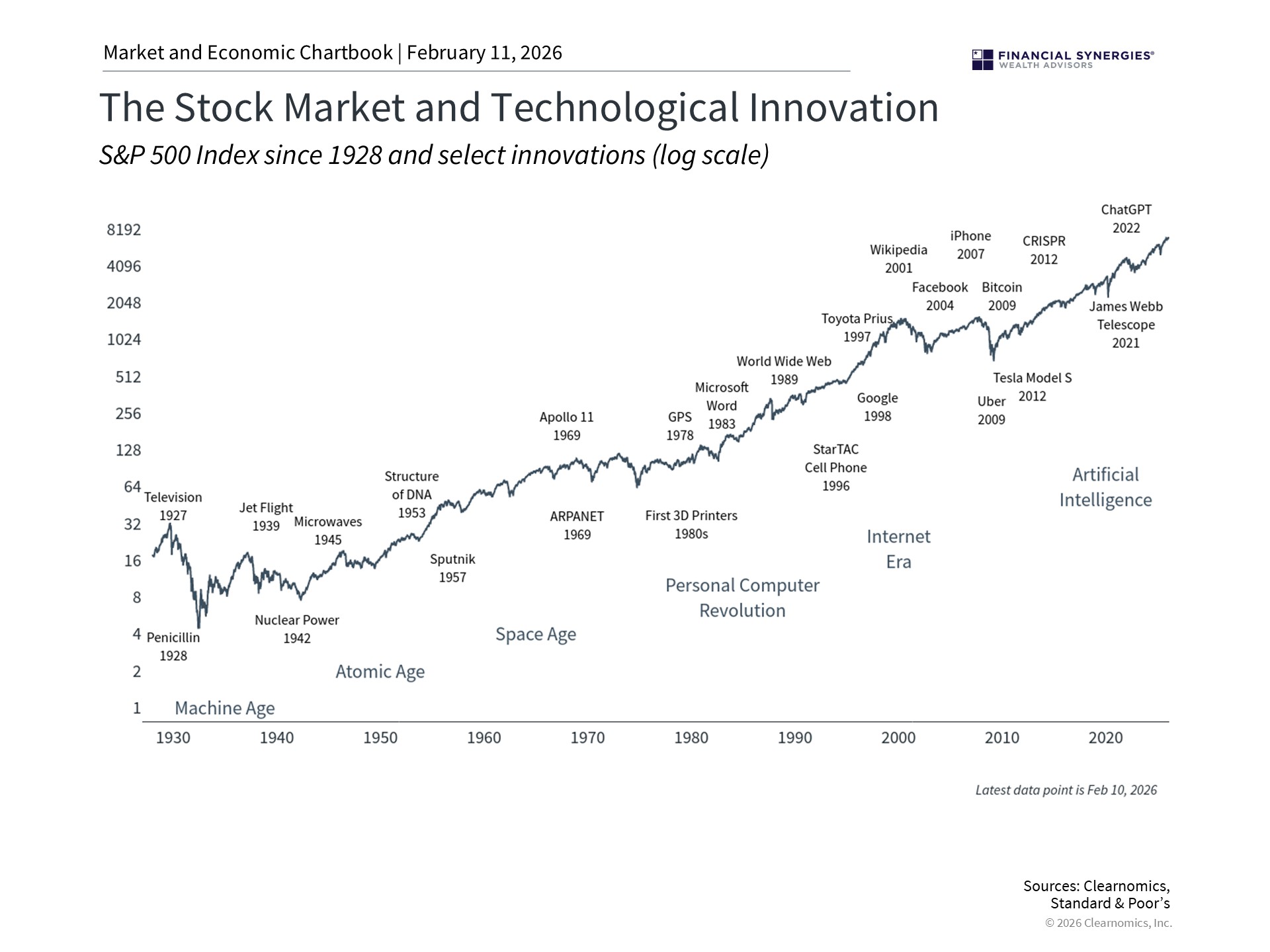
The current uncertainty around AI may feel unprecedented, but history shows that technological disruptions follow similar patterns. Consider how much our use of software has changed over the past few decades, evolving from something purchased in a cardboard box and installed on a single computer, to internet-enabled mobile devices, to the foundation of how we work, communicate, shop, bank, and entertain ourselves today. In every wave of innovation, there is an “old economy” and a “new economy,” and markets must determine which companies fall into each category.
AI has the potential to change how services are actually created, continuing the trend of traditional processes being replaced by software. However, it’s worth remembering that even the most transformative technologies don’t eliminate the need for specialized expertise and services. AI systems, no matter how capable, will still require access to the best data, the most reliable platforms, and unique domain knowledge. Similarly, consumers will continue to value trust, personalization, and quality outcomes.
Which companies are most competitive in delivering these services may change over time, but the underlying fundamental needs will likely remain the same. Just as you wouldn’t build a car yourself, or rebuild it every time you needed to drive to the grocery store, AI applications will still rely on existing infrastructure and specialized services. Over time, this dynamic tends to benefit consumers through smarter products, lower costs, and more accessible services.
It’s also important to maintain realistic expectations about the pace of change. While AI companies have predicted the arrival of “artificial general intelligence” or “artificial super intelligence” over the past several years, recent evidence suggests that progress in AI training has slowed somewhat. That said, what current AI systems can accomplish is already remarkable and is clearly enough to reshape investor expectations.
The labor market adds to economic uncertainty
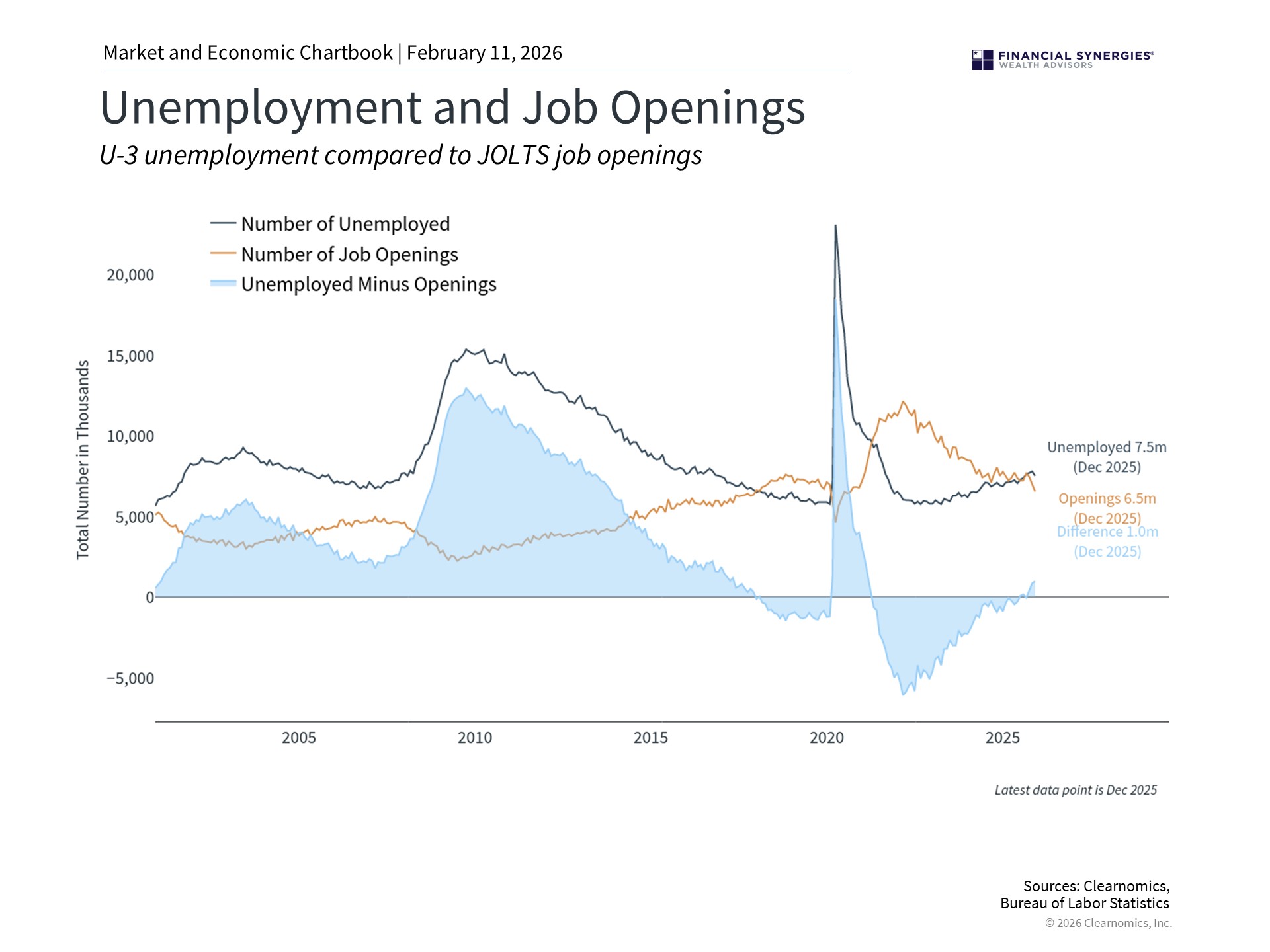
Adding to investor concerns is a labor market that has weakened since the middle of 2025. The latest data published by the Bureau of Labor Statistics showed that job openings fell to their lowest level since 2020 in December. At its peak, there were more than two job openings per job seeker, but now the ratio is less than one, with about 6.5 million openings for 7.5 million unemployed individuals. Meanwhile, a report by Challenger, Gray & Christmas showed that job cuts soared to 108,435 in January, a 118% year-over-year jump and the highest level for the month since 2009.
There is no direct evidence yet that these job cuts are AI-related, but these trends affect the broad economic outlook nonetheless. In the long run, every major technological wave, from the Industrial Revolution to the Information Technology Revolution, has eventually created more jobs than it replaced, but the transition periods as workers are retrained can be difficult for both individuals and society.
In the meantime, a weaker job market has raised concerns among some investors after years of better-than-expected economic growth. This also has implications for the broader outlook and the path of Federal Reserve policy. It’s important to keep in mind that other economic data remain healthy, including ongoing consumer spending driven by household wealth near record levels and inflation which has held steady below 3%. So, while there are some economic challenges, there is also reason to believe the economy could continue to grow at a healthy pace.
What these trends mean for portfolios
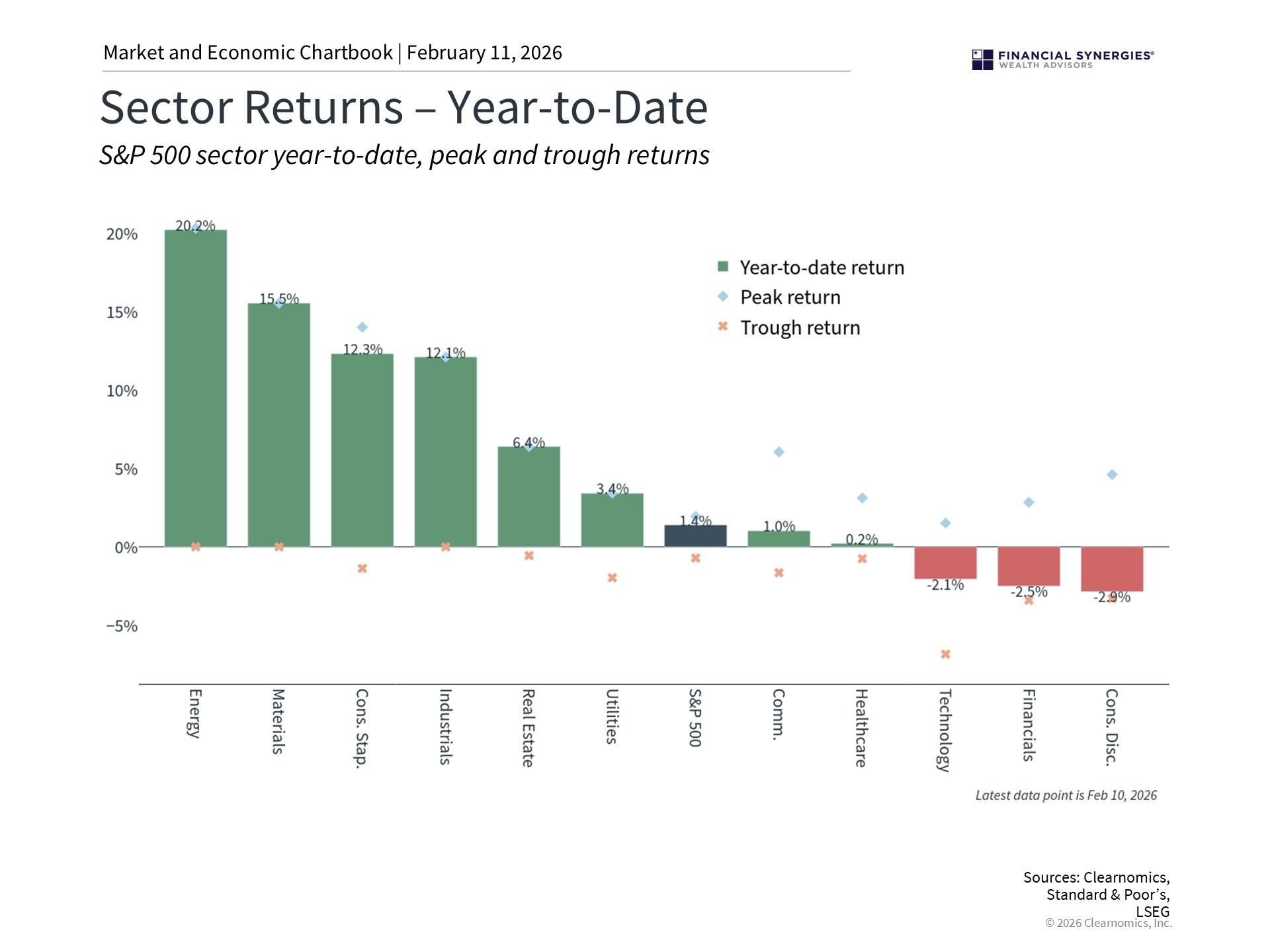
For investors, recent volatility underscores the principle that asset allocation matters more than any single trend or headline. The Information Technology and Communication Services sectors, while delivering strong returns in recent years, are also known to experience swings as expectations shift. These sectors are sensitive to long-term factors such as interest rates, and are thus affected by uncertainty around the Fed. So, while groups like the Magnificent 7 have performed well over the past several years, they can struggle in periods like 2022 just as they have over the past two months.
Perhaps the biggest question is around stock market valuations. With the S&P 500’s price-to-earnings ratio near historically elevated levels, investors have been rotating into other sectors such as Consumer Staples, Energy, Materials, and Industrials. This possibly reflects markets becoming more selective and focusing on opportunities beyond AI. After all, just because AI is the trend capturing investor attention does not mean there are not attractive opportunities across other parts of the market.
It’s worth noting that cryptocurrencies have also experienced a significant pullback in recent months, with Bitcoin falling 50% to just above $60,000 before rebounding somewhat. This is a reminder that, from a portfolio perspective, cryptocurrencies remain highly volatile assets that can be sensitive to shifts in sentiment that often don’t have a simple explanation. For those interested in these assets, deciding how they fit into a balanced portfolio is far more important than trying to time the market.
Ultimately, today’s AI trends should be viewed in a broader context along with other changes to the market and economic landscape. If past cycles are any indication, markets will likely over- and underreact to these trends in the short run. History shows that those who can stay patient and properly invested will be best positioned to achieve their financial goals.
While AI is leading to a reassessment of specific stocks and sectors, the principles of long-term investing remain unchanged. Maintaining a portfolio aligned with your financial goals is still the best way to navigate periods of rapid change.
Concerns or questions about how your investment portfolio will hold up in the current market environment? Contact Financial Synergies today.
We are a boutique, financial advisory and total wealth management firm with over 35 years helping clients navigate turbulent markets. To learn more about our approach to investment management please reach out to us. One of our seasoned advisors would be happy to help you build a custom financial plan to help ensure you accomplish your financial goals and objectives. Schedule a conversation with us today.
More relevant articles by Financial Synergies:
Blog Disclosures
This content, which contains security-related opinions and/or information, is provided for informational purposes only and should not be relied upon in any manner as professional advice, or an endorsement of any practices, products or services. There can be no guarantees or assurances that the views expressed here will be applicable for any particular facts or circumstances, and should not be relied upon in any manner. You should consult your own financial advisors as to legal, business, tax, and other related matters concerning any investment.
The commentary in this “post” (including any related blogs, videos, and social media) reflects the personal opinions, viewpoints, and analyses of the Financial Synergies Wealth Advisors, Inc. employees providing such comments, and should not be regarded as the views of Financial Synergies Wealth Advisors, Inc. or its respective affiliates or as a description of advisory services provided by Financial Synergies Wealth Advisors, Inc. or performance returns of any Financial Synergies Wealth Advisors, Inc. client.
Any opinions expressed herein do not constitute or imply endorsement, sponsorship, or recommendation by Financial Synergies Wealth Advisors, Inc. or its employees. The views reflected in the commentary are subject to change at any time without notice.
Nothing on this website constitutes investment or financial planning advice, performance data or any recommendation that any particular security, portfolio of securities, transaction or investment strategy is suitable for any specific person. It also should not be construed as an offer soliciting the purchase or sale of any security mentioned. Nor should it be construed as an offer to provide investment advisory services by Financial Synergies Wealth Advisors, Inc.
Any mention of a particular security and related performance data is not a recommendation to buy or sell that security. Financial Synergies Wealth Advisors, Inc. manages its clients’ accounts using a variety of investment techniques and strategies, which are not necessarily discussed in the commentary. Investments in securities involve the risk of loss. Past performance is no guarantee of future results.
Any charts provided here or on any related Financial Synergies Wealth Advisors, Inc. personnel content outlets are for informational purposes only, and should also not be relied upon when making any investment decision. Any indices referenced for comparison are unmanaged and cannot be invested into directly. As always please remember investing involves risk and possible loss of principal capital; please seek advice from a licensed professional. Any projections, estimates, forecasts, targets, prospects and/or opinions expressed in these materials are subject to change without notice and may differ or be contrary to opinions expressed by others. Information in charts have been obtained from third-party sources and data, and may include those from portfolio securities of funds managed by Financial Synergies Wealth Advisors, Inc. While taken from sources believed to be reliable, Financial Synergies Wealth Advisors, Inc. has not independently verified such information and makes no representations about the enduring accuracy of the information or its appropriateness for a given situation. All content speaks only as of the date indicated.
Financial Synergies Wealth Advisors, Inc. is a registered investment adviser. Advisory services are only offered to clients or prospective clients where Financial Synergies Wealth Advisors, Inc. and its representatives are properly licensed or exempt from licensure. Investments in securities involve the risk of loss. Past performance is no guarantee of future results.
See Full Disclosures Page Here
 Skip to content


Is AI Eating the World? A Portfolio Perspective
Fifteen years ago, venture capitalist Marc Andreessen famously wrote that “software is eating the world.” What he meant was that any service that could be written and automated as software, would be. This has proved accurate as cloud computing, software-as-a-service, and digital platforms have reshaped both entire industries and how consumers buy goods and services. As investors, this has important implications and is a major source of recent market volatility.
Today, AI represents the next phase of this transformation, and as with every major technological shift, markets are trying to assess what it means for specific sectors and the overall economy. For long-term investors, maintaining perspective on how these cycles have unfolded in the past can provide helpful clarity.
Innovation and disruption are two sides of the same coin, and the recent broad sell-off and quick bounce back in technology stocks shows how difficult it can be to predict how these trends play out. The release of new automation tools from Anthropic, a major AI company, demonstrated the ability to perform tasks previously handled by specialized software in areas like legal and financial research. This sparked a reassessment of traditional software business models. The stocks of some large technology companies also struggled after reporting over a hundred billion dollars in quarterly capital expenditures on AI infrastructure, raising questions about whether this spending will pay off.
Ironically, this occurred almost exactly one year after the “DeepSeek moment” in January 2025, when a Chinese AI company purportedly showed that AI models could be built at a fraction of the cost. In both cases, markets re-evaluated the winners and losers of technological change but also rebounded quickly once the dust settled. For investors, this is a reminder that maintaining a long-term perspective is important as the market shifts between the opportunities from innovation and the challenges of disruption.
Technological disruption follows familiar patterns
The current uncertainty around AI may feel unprecedented, but history shows that technological disruptions follow similar patterns. Consider how much our use of software has changed over the past few decades, evolving from something purchased in a cardboard box and installed on a single computer, to internet-enabled mobile devices, to the foundation of how we work, communicate, shop, bank, and entertain ourselves today. In every wave of innovation, there is an “old economy” and a “new economy,” and markets must determine which companies fall into each category.
AI has the potential to change how services are actually created, continuing the trend of traditional processes being replaced by software. However, it’s worth remembering that even the most transformative technologies don’t eliminate the need for specialized expertise and services. AI systems, no matter how capable, will still require access to the best data, the most reliable platforms, and unique domain knowledge. Similarly, consumers will continue to value trust, personalization, and quality outcomes.
Which companies are most competitive in delivering these services may change over time, but the underlying fundamental needs will likely remain the same. Just as you wouldn’t build a car yourself, or rebuild it every time you needed to drive to the grocery store, AI applications will still rely on existing infrastructure and specialized services. Over time, this dynamic tends to benefit consumers through smarter products, lower costs, and more accessible services.
It’s also important to maintain realistic expectations about the pace of change. While AI companies have predicted the arrival of “artificial general intelligence” or “artificial super intelligence” over the past several years, recent evidence suggests that progress in AI training has slowed somewhat. That said, what current AI systems can accomplish is already remarkable and is clearly enough to reshape investor expectations.
The labor market adds to economic uncertainty
Adding to investor concerns is a labor market that has weakened since the middle of 2025. The latest data published by the Bureau of Labor Statistics showed that job openings fell to their lowest level since 2020 in December. At its peak, there were more than two job openings per job seeker, but now the ratio is less than one, with about 6.5 million openings for 7.5 million unemployed individuals. Meanwhile, a report by Challenger, Gray & Christmas showed that job cuts soared to 108,435 in January, a 118% year-over-year jump and the highest level for the month since 2009.
There is no direct evidence yet that these job cuts are AI-related, but these trends affect the broad economic outlook nonetheless. In the long run, every major technological wave, from the Industrial Revolution to the Information Technology Revolution, has eventually created more jobs than it replaced, but the transition periods as workers are retrained can be difficult for both individuals and society.
In the meantime, a weaker job market has raised concerns among some investors after years of better-than-expected economic growth. This also has implications for the broader outlook and the path of Federal Reserve policy. It’s important to keep in mind that other economic data remain healthy, including ongoing consumer spending driven by household wealth near record levels and inflation which has held steady below 3%. So, while there are some economic challenges, there is also reason to believe the economy could continue to grow at a healthy pace.
What these trends mean for portfolios
For investors, recent volatility underscores the principle that asset allocation matters more than any single trend or headline. The Information Technology and Communication Services sectors, while delivering strong returns in recent years, are also known to experience swings as expectations shift. These sectors are sensitive to long-term factors such as interest rates, and are thus affected by uncertainty around the Fed. So, while groups like the Magnificent 7 have performed well over the past several years, they can struggle in periods like 2022 just as they have over the past two months.
Perhaps the biggest question is around stock market valuations. With the S&P 500’s price-to-earnings ratio near historically elevated levels, investors have been rotating into other sectors such as Consumer Staples, Energy, Materials, and Industrials. This possibly reflects markets becoming more selective and focusing on opportunities beyond AI. After all, just because AI is the trend capturing investor attention does not mean there are not attractive opportunities across other parts of the market.
It’s worth noting that cryptocurrencies have also experienced a significant pullback in recent months, with Bitcoin falling 50% to just above $60,000 before rebounding somewhat. This is a reminder that, from a portfolio perspective, cryptocurrencies remain highly volatile assets that can be sensitive to shifts in sentiment that often don’t have a simple explanation. For those interested in these assets, deciding how they fit into a balanced portfolio is far more important than trying to time the market.
Ultimately, today’s AI trends should be viewed in a broader context along with other changes to the market and economic landscape. If past cycles are any indication, markets will likely over- and underreact to these trends in the short run. History shows that those who can stay patient and properly invested will be best positioned to achieve their financial goals.
While AI is leading to a reassessment of specific stocks and sectors, the principles of long-term investing remain unchanged. Maintaining a portfolio aligned with your financial goals is still the best way to navigate periods of rapid change.
Concerns or questions about how your investment portfolio will hold up in the current market environment? Contact Financial Synergies today.
We are a boutique, financial advisory and total wealth management firm with over 35 years helping clients navigate turbulent markets. To learn more about our approach to investment management please reach out to us. One of our seasoned advisors would be happy to help you build a custom financial plan to help ensure you accomplish your financial goals and objectives. Schedule a conversation with us today.
More relevant articles by Financial Synergies:
Blog Disclosures
This content, which contains security-related opinions and/or information, is provided for informational purposes only and should not be relied upon in any manner as professional advice, or an endorsement of any practices, products or services. There can be no guarantees or assurances that the views expressed here will be applicable for any particular facts or circumstances, and should not be relied upon in any manner. You should consult your own financial advisors as to legal, business, tax, and other related matters concerning any investment.
The commentary in this “post” (including any related blogs, videos, and social media) reflects the personal opinions, viewpoints, and analyses of the Financial Synergies Wealth Advisors, Inc. employees providing such comments, and should not be regarded as the views of Financial Synergies Wealth Advisors, Inc. or its respective affiliates or as a description of advisory services provided by Financial Synergies Wealth Advisors, Inc. or performance returns of any Financial Synergies Wealth Advisors, Inc. client.
Any opinions expressed herein do not constitute or imply endorsement, sponsorship, or recommendation by Financial Synergies Wealth Advisors, Inc. or its employees. The views reflected in the commentary are subject to change at any time without notice.
Nothing on this website constitutes investment or financial planning advice, performance data or any recommendation that any particular security, portfolio of securities, transaction or investment strategy is suitable for any specific person. It also should not be construed as an offer soliciting the purchase or sale of any security mentioned. Nor should it be construed as an offer to provide investment advisory services by Financial Synergies Wealth Advisors, Inc.
Any mention of a particular security and related performance data is not a recommendation to buy or sell that security. Financial Synergies Wealth Advisors, Inc. manages its clients’ accounts using a variety of investment techniques and strategies, which are not necessarily discussed in the commentary. Investments in securities involve the risk of loss. Past performance is no guarantee of future results.
Any charts provided here or on any related Financial Synergies Wealth Advisors, Inc. personnel content outlets are for informational purposes only, and should also not be relied upon when making any investment decision. Any indices referenced for comparison are unmanaged and cannot be invested into directly. As always please remember investing involves risk and possible loss of principal capital; please seek advice from a licensed professional. Any projections, estimates, forecasts, targets, prospects and/or opinions expressed in these materials are subject to change without notice and may differ or be contrary to opinions expressed by others. Information in charts have been obtained from third-party sources and data, and may include those from portfolio securities of funds managed by Financial Synergies Wealth Advisors, Inc. While taken from sources believed to be reliable, Financial Synergies Wealth Advisors, Inc. has not independently verified such information and makes no representations about the enduring accuracy of the information or its appropriateness for a given situation. All content speaks only as of the date indicated.
Financial Synergies Wealth Advisors, Inc. is a registered investment adviser. Advisory services are only offered to clients or prospective clients where Financial Synergies Wealth Advisors, Inc. and its representatives are properly licensed or exempt from licensure. Investments in securities involve the risk of loss. Past performance is no guarantee of future results.
See Full Disclosures Page Here
Recent Posts
Putting This Week’s Market Volatility in Perspective
The Midterms Changed Congress, Not the Fundamentals
Monthly Market Update: Market Leadership Rotates as Investors Reassess the AI Trade
Subscribe to Our Blog
Chief Investment Officer | Managing Partner