For most of us, “the market” still conjures images of ticker symbols scrolling across a screen — Apple, Microsoft, the S&P 500 closing bell. That mental model isn’t wrong, but it has become increasingly incomplete. A growing share of the world’s most consequential businesses — the ones generating real revenue, employing real people, and reshaping real industries — never appear on those tickers at all. They are privately held, often for years or even decades, and they represent an opportunity set that has become difficult for any serious long-term investor to ignore.
For many of you reading this, private equity is already a component of your portfolio with us. This article isn’t meant to introduce a brand-new concept so much as to provide a fuller picture of why we believe in this asset class, how it fits alongside everything else we do, and where the opportunity is heading from here.
What Private Equity Actually Is
At its core, private equity is straightforward: it is ownership in companies whose shares are not traded on a public exchange. Those companies span an enormous range — from early-stage businesses still finding product-market fit, to mature, cash-generative enterprises with billions in revenue and global footprints.
Private equity itself is not monolithic. It’s better understood as a spectrum of strategies, each suited to a different stage of a company’s life and a different return profile:
- Buyout strategies acquire controlling stakes in established companies, with the goal of improving operations and growing earnings over a multi-year hold period. This is the largest segment of the asset class.
- Growth equity provides capital to companies that have moved past the startup phase but need additional resources to scale — typically profitable or near-profitable businesses at an inflection point.
- Venture capital funds earlier-stage, higher-risk companies developing new products, technologies, or business models.
- Secondaries involve purchasing existing private equity fund interests from investors seeking liquidity, often at a discount to stated value — offering more visibility into underlying assets than a traditional “blind pool” commitment.
- Hybrid capital blends private equity and private credit, offering equity-like upside with structural features designed to mitigate downside risk.
Each of these has its own role in a portfolio. What unites them is a longer time horizon, active engagement with the underlying business, and the absence of daily mark-to-market pricing.
Why the Opportunity Set Matters Today
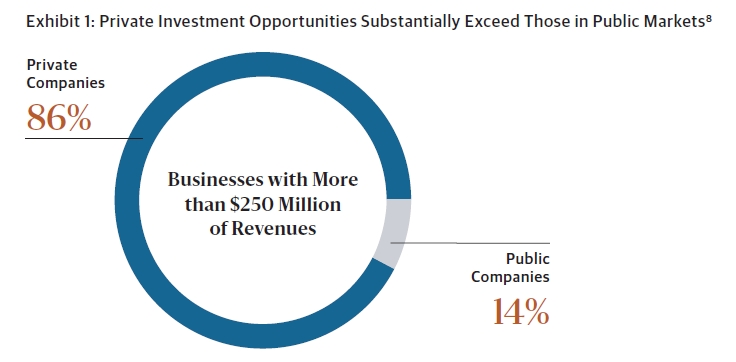
Here’s a statistic worth sitting with: of all companies globally with more than $250 million in annual revenue, roughly 86% are privately held.1
In other words, an investor who limits themselves to publicly traded equities will have no exposure to the vast majority of large enterprises operating in the real economy.
 The shift becomes even more striking when you look at how the US public market itself has evolved. The number of US-listed public companies has fallen by roughly half since the mid-1990s — from about 8,000 to closer to 4,000 today.2 Meanwhile, the companies that remain public have become increasingly concentrated. As of the most recent data, the ten largest constituents of the S&P 500 account for roughly 40% of its market capitalization.3
We want to be careful here. None of this is an argument against public equities — they remain, and will continue to be, the foundational holding in virtually every portfolio we manage. The point is more nuanced: the public market alone no longer reflects the breadth of investable businesses the way it once did. Companies are staying private longer, growing larger before going public (if they go public at all), and creating more of their value out of view of public investors. Including private equity is, in our view, one of the most direct ways to participate in a fuller slice of the global economy.
The Case for Inclusion in a Diversified Portfolio
Private equity has historically offered several characteristics that complement traditional public-market holdings.
The most discussed is long-term return potential. Industry research from Cambridge Associates, comparing private equity to a public-equivalent benchmark over the past two decades, has shown private equity outperforming public equities by roughly 500 basis points annualized.4 As an illustration, a hypothetical $100,000 invested in the Cambridge Private Equity Index in 2007 would have grown to approximately $796,000 by mid-2025, versus roughly $386,000 in the comparable public benchmark.
We share that figure with appropriate care: it reflects a specific index methodology, a specific time window, and is net of fees. Past performance does not predict future results, manager dispersion within the asset class is wide, and the comparison itself relies on a public market equivalent (PME) calculation that has its own methodological limitations. Still, the directional point — that disciplined private equity managers have historically delivered meaningful excess return over long periods — is consistent with what institutional investors have observed for decades.
Closely related is the illiquidity premium — the additional return investors can reasonably expect for accepting a longer holding period and limited ability to access capital. This is one of the few persistent sources of excess return in financial markets, and it exists precisely because most capital is unwilling to be locked up. Investors who can be patient have historically been rewarded for that patience.
A subtler benefit is lower mark-to-market volatility. Because private equity holdings are valued periodically — typically monthly or quarterly — rather than continuously, portfolios that include private equity tend to experience less day-to-day price noise. This is partly an accounting reality rather than a true reduction in business risk, but it has a real behavioral benefit: investors are less likely to react emotionally to short-term swings, and that discipline itself tends to improve long-term outcomes.
Finally, private equity provides diversification — not in the textbook sense of low correlation (since the underlying businesses ultimately participate in the same economy), but in the practical sense of broadening exposure to industries, geographies, and business models that are underrepresented in public indices.
How Private Equity Managers Create Value
The defining feature of private equity, and what distinguishes it most clearly from passive public equity ownership, is active engagement with the businesses being owned. When a strong private equity manager acquires a company, they are not buying a ticker — they are taking responsibility for improving operations over a holding period that often spans five to seven years or more.
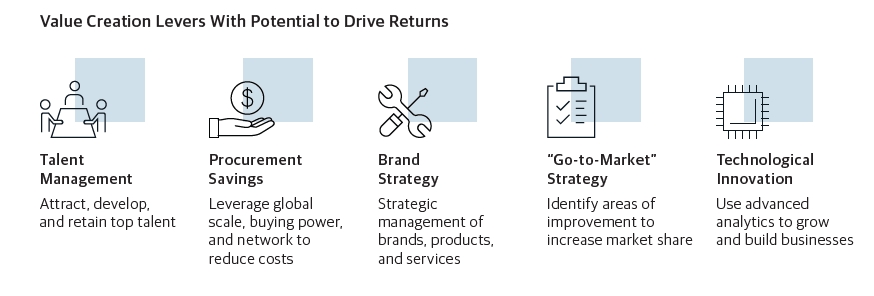
The levers they pull tend to be similar across strategies:
- Talent and leadership. Recruiting and retaining management teams, often using a network and reach that mid-size companies couldn’t access on their own.
- Operational improvement. Streamlining processes, integrating systems, improving margins, and using scale to negotiate better pricing with suppliers.
- Go-to-market strategy. Expanding into new geographies, refining pricing, sharpening sales execution, and building distribution.
- Technology and analytics. Modernizing legacy systems and using data to drive better decisions.
- Brand and product strategy. Repositioning offerings to capture more of the customer’s wallet or address new segments.
None of these levers are unique to private equity in concept — public-company management teams pursue the same things. The difference is structural: a private owner can take a multi-year view, make decisions that depress short-term earnings in service of long-term value, and avoid the quarterly reporting cycle that often constrains public companies. That patient, hands-on ownership model is the engine behind private equity’s historical return profile.
How Institutions and Individuals Have Allocated to Private Equity
One of the most telling data points in this whole discussion is how differently sophisticated institutional allocators and individual investors have historically treated this asset class.
Industry surveys consistently show:
- US family offices allocate roughly 27% of their portfolios to private equity.5
- US university endowments allocate approximately 21%.6
- US public and private pension plans allocate around 14%.7
- Individual investors, by comparison, have allocated less than 3%.8
That gap isn’t because institutions have access to better information about returns — the data is largely the same. It exists because, historically, the structures used to access private equity (long lockups, large minimums, capital call mechanics, accredited investor and qualified purchaser thresholds) were designed for institutions. Individuals were structurally underexposed, not because they shouldn’t have been participating, but because they often couldn’t.
That picture is now changing.
How Access to Private Equity Is Evolving

Over the last several years, a new generation of fund structures has meaningfully expanded private market access for individual investors. Evergreen and semi-liquid funds — sometimes called perpetual funds — replace the traditional 10-year closed-end model with vehicles that accept ongoing subscriptions, offer periodic redemptions (typically quarterly, with limits), and provide more straightforward tax reporting. They are not as liquid as a mutual fund, and they shouldn’t be. But they bridge a meaningful gap between the highly illiquid traditional structures and the fully liquid public markets — making private equity practically usable inside a diversified individual portfolio.
In our portfolios, we use these structures where appropriate and where the underlying manager and strategy meet our standards. They are not a free lunch — the periodic liquidity comes with redemption gates and structural considerations — but they have made it possible to size private equity sensibly within client portfolios in a way that simply wasn’t feasible a decade ago.
Important Considerations
Private equity is genuinely different from public equities, and those differences deserve to be taken seriously rather than glossed over.
Liquidity. Capital committed to private equity should be capital you don’t need to access for years. Even with evergreen structures, redemption windows can be limited, especially during periods of market stress.
Time horizon. Evergreen structures, which are what we prefer, meaningfully reduce the early-year drag associated with traditional private equity drawdown funds, since investors enter into a seasoned, already-deployed portfolio rather than waiting for capital to be called and put to work. That said, the underlying source of return — operational value creation inside portfolio companies — still requires multi-year hold periods to materialize. A long-term mindset remains essential.
Manager dispersion. The gap between top-quartile and bottom-quartile private equity managers is significantly wider than in public equities. This is the single most important practical consequence: selection matters. The asset class average is interesting, but the realized return depends heavily on the manager. We spend a great deal of time on due diligence for exactly this reason.
Position sizing. Private equity should be sized in proportion to total portfolio liquidity needs, time horizon, and goals — not as a standalone bet. For most clients, that means a meaningful but modest allocation, not a maximalist one.
Our Approach
At Financial Synergies, we view private equity as one component of a thoughtfully diversified portfolio — complementing, not replacing, public equities and fixed income. Public markets remain efficient, low-cost, and indispensable. Fixed income continues to do important work as a source of stability and income, particularly in the current rate environment. Private equity sits alongside these, offering exposure to a different segment of the economy, a different return profile, and a different set of value drivers.
Our role is to identify managers with the scale, staying power, and track record to navigate the asset class well; to select fund structures appropriate to each client’s circumstances; and to size the allocation in a way that respects each household’s liquidity needs, time horizon, and goals. Private equity isn’t right for every situation, and even where it is, the right exposure varies considerably from client to client.
What we do believe, and what motivates our continued use of the asset class, is that private equity has earned its place in the conversation. The companies it touches, the breadth of the opportunity set, and the long-term return characteristics make it, in our view, an asset class worth understanding and, for many of our clients, worth owning.
As always, if you have questions about how private equity fits into your specific portfolio, or about the structures we use, we welcome the conversation.
A Truly Unique Wealth Management Experience
Let’s create a financial plan and investment strategy that allows you to live the life of your dreams. Schedule your free consultation today to explore tailored financial strategies designed to secure your future!
Are We Right for You?
Footnotes
- Capital IQ, as of June 2024. Share of public and private companies in North America, Europe, and Asia reporting more than $250 million in annual revenue.
- World Federation of Exchanges, December 2024.
- S&P 500 Factsheet, as of December 31, 2025.
- Cambridge Associates, as of June 30, 2025. Private equity represented by the blended Cambridge Private Equity Index (buyout and growth equity funds); public equities represented by the Cambridge Modified Public Market Equivalent (PME) analysis of the MSCI World Index. Past performance does not predict future returns.
- UBS Global Family Office Report, 2025.
- Preqin, as of June 30, 2025.
- American Investment Council Retirement Security Report, 2025.
- Cerulli Associates, “U.S. Wealth Management and Alternative Product Trends,” 2024.
Concerns or questions about how your investment portfolio will hold up in the current market environment? Contact Financial Synergies today.
We are a boutique, financial advisory and total wealth management firm with over 35 years helping clients navigate turbulent markets. To learn more about our approach to investment management please reach out to us. One of our seasoned advisors would be happy to help you build a custom financial plan to help ensure you accomplish your financial goals and objectives. Schedule a conversation with us today.
More relevant articles by Financial Synergies:
Disclosure
This article is provided for educational and informational purposes only and does not constitute investment, legal, tax, or accounting advice. The views expressed are those of Financial Synergies Wealth Advisors as of the date of publication and are subject to change without notice. Nothing herein should be construed as an offer to sell, or a solicitation of an offer to buy, any security or investment product.
Past performance is not indicative of future results. Any references to historical returns, index data, or hypothetical growth figures (including comparisons between private equity and public market indices) are presented for illustrative purposes only and reflect specific methodologies, time periods, and assumptions that may not be representative of future market conditions. Index comparisons, including public market equivalent (PME) analyses, have inherent limitations and should not be relied upon as predictions of future performance.
Investments in private equity involve risk and are suitable only for investors who can bear significant losses. Private equity investments are illiquid, have limited or no secondary market, may involve significant fees and expenses, and typically require long holding periods. Even evergreen and semi-liquid fund structures impose restrictions on redemptions, including periodic liquidity windows, redemption gates, and the possibility that redemption requests may be limited or suspended during periods of market stress. Valuations of private equity holdings are typically performed periodically and may not reflect realizable values. There can be no assurance that any private equity strategy will achieve its objectives or avoid losses.
Diversification does not ensure a profit or protect against loss in declining markets. Manager selection is a critical component of private equity investing given the wide dispersion of returns among managers, and there can be no assurance that any selected manager will achieve results comparable to historical industry averages.
Private equity investments are generally available only to accredited investors and qualified purchasers as defined under federal securities laws. The suitability of any investment depends on each client’s individual financial circumstances, liquidity needs, time horizon, and goals. Clients should consult with their advisor before making any investment decision.
Financial Synergies Wealth Advisors is an SEC-registered investment adviser. Registration does not imply any particular level of skill or training. Additional information about our firm, including our investment strategies, fees, and potential conflicts of interest, is available in our Form ADV Part 2A, which is available upon request or at adviserinfo.sec.gov.
Certain data referenced in this article has been obtained from third-party sources believed to be reliable, including Cambridge Associates, Capital IQ, UBS, Preqin, the American Investment Council, Cerulli Associates, and the World Federation of Exchanges. Financial Synergies has not independently verified this information and makes no representation as to its accuracy or completeness.
 Skip to content


Private Equity: Investing Beyond Public Companies
For most of us, “the market” still conjures images of ticker symbols scrolling across a screen — Apple, Microsoft, the S&P 500 closing bell. That mental model isn’t wrong, but it has become increasingly incomplete. A growing share of the world’s most consequential businesses — the ones generating real revenue, employing real people, and reshaping real industries — never appear on those tickers at all. They are privately held, often for years or even decades, and they represent an opportunity set that has become difficult for any serious long-term investor to ignore.
For many of you reading this, private equity is already a component of your portfolio with us. This article isn’t meant to introduce a brand-new concept so much as to provide a fuller picture of why we believe in this asset class, how it fits alongside everything else we do, and where the opportunity is heading from here.
What Private Equity Actually Is
At its core, private equity is straightforward: it is ownership in companies whose shares are not traded on a public exchange. Those companies span an enormous range — from early-stage businesses still finding product-market fit, to mature, cash-generative enterprises with billions in revenue and global footprints.
Private equity itself is not monolithic. It’s better understood as a spectrum of strategies, each suited to a different stage of a company’s life and a different return profile:
Each of these has its own role in a portfolio. What unites them is a longer time horizon, active engagement with the underlying business, and the absence of daily mark-to-market pricing.
Why the Opportunity Set Matters Today
Here’s a statistic worth sitting with: of all companies globally with more than $250 million in annual revenue, roughly 86% are privately held.1
In other words, an investor who limits themselves to publicly traded equities will have no exposure to the vast majority of large enterprises operating in the real economy.
We want to be careful here. None of this is an argument against public equities — they remain, and will continue to be, the foundational holding in virtually every portfolio we manage. The point is more nuanced: the public market alone no longer reflects the breadth of investable businesses the way it once did. Companies are staying private longer, growing larger before going public (if they go public at all), and creating more of their value out of view of public investors. Including private equity is, in our view, one of the most direct ways to participate in a fuller slice of the global economy.
The Case for Inclusion in a Diversified Portfolio
Private equity has historically offered several characteristics that complement traditional public-market holdings.
The most discussed is long-term return potential. Industry research from Cambridge Associates, comparing private equity to a public-equivalent benchmark over the past two decades, has shown private equity outperforming public equities by roughly 500 basis points annualized.4 As an illustration, a hypothetical $100,000 invested in the Cambridge Private Equity Index in 2007 would have grown to approximately $796,000 by mid-2025, versus roughly $386,000 in the comparable public benchmark.
We share that figure with appropriate care: it reflects a specific index methodology, a specific time window, and is net of fees. Past performance does not predict future results, manager dispersion within the asset class is wide, and the comparison itself relies on a public market equivalent (PME) calculation that has its own methodological limitations. Still, the directional point — that disciplined private equity managers have historically delivered meaningful excess return over long periods — is consistent with what institutional investors have observed for decades.
Closely related is the illiquidity premium — the additional return investors can reasonably expect for accepting a longer holding period and limited ability to access capital. This is one of the few persistent sources of excess return in financial markets, and it exists precisely because most capital is unwilling to be locked up. Investors who can be patient have historically been rewarded for that patience.
A subtler benefit is lower mark-to-market volatility. Because private equity holdings are valued periodically — typically monthly or quarterly — rather than continuously, portfolios that include private equity tend to experience less day-to-day price noise. This is partly an accounting reality rather than a true reduction in business risk, but it has a real behavioral benefit: investors are less likely to react emotionally to short-term swings, and that discipline itself tends to improve long-term outcomes.
Finally, private equity provides diversification — not in the textbook sense of low correlation (since the underlying businesses ultimately participate in the same economy), but in the practical sense of broadening exposure to industries, geographies, and business models that are underrepresented in public indices.
How Private Equity Managers Create Value
The defining feature of private equity, and what distinguishes it most clearly from passive public equity ownership, is active engagement with the businesses being owned. When a strong private equity manager acquires a company, they are not buying a ticker — they are taking responsibility for improving operations over a holding period that often spans five to seven years or more.
The levers they pull tend to be similar across strategies:
None of these levers are unique to private equity in concept — public-company management teams pursue the same things. The difference is structural: a private owner can take a multi-year view, make decisions that depress short-term earnings in service of long-term value, and avoid the quarterly reporting cycle that often constrains public companies. That patient, hands-on ownership model is the engine behind private equity’s historical return profile.
How Institutions and Individuals Have Allocated to Private Equity
One of the most telling data points in this whole discussion is how differently sophisticated institutional allocators and individual investors have historically treated this asset class.
Industry surveys consistently show:
That gap isn’t because institutions have access to better information about returns — the data is largely the same. It exists because, historically, the structures used to access private equity (long lockups, large minimums, capital call mechanics, accredited investor and qualified purchaser thresholds) were designed for institutions. Individuals were structurally underexposed, not because they shouldn’t have been participating, but because they often couldn’t.
That picture is now changing.
How Access to Private Equity Is Evolving
Over the last several years, a new generation of fund structures has meaningfully expanded private market access for individual investors. Evergreen and semi-liquid funds — sometimes called perpetual funds — replace the traditional 10-year closed-end model with vehicles that accept ongoing subscriptions, offer periodic redemptions (typically quarterly, with limits), and provide more straightforward tax reporting. They are not as liquid as a mutual fund, and they shouldn’t be. But they bridge a meaningful gap between the highly illiquid traditional structures and the fully liquid public markets — making private equity practically usable inside a diversified individual portfolio.
In our portfolios, we use these structures where appropriate and where the underlying manager and strategy meet our standards. They are not a free lunch — the periodic liquidity comes with redemption gates and structural considerations — but they have made it possible to size private equity sensibly within client portfolios in a way that simply wasn’t feasible a decade ago.
Important Considerations
Private equity is genuinely different from public equities, and those differences deserve to be taken seriously rather than glossed over.
Liquidity. Capital committed to private equity should be capital you don’t need to access for years. Even with evergreen structures, redemption windows can be limited, especially during periods of market stress.
Time horizon. Evergreen structures, which are what we prefer, meaningfully reduce the early-year drag associated with traditional private equity drawdown funds, since investors enter into a seasoned, already-deployed portfolio rather than waiting for capital to be called and put to work. That said, the underlying source of return — operational value creation inside portfolio companies — still requires multi-year hold periods to materialize. A long-term mindset remains essential.
Manager dispersion. The gap between top-quartile and bottom-quartile private equity managers is significantly wider than in public equities. This is the single most important practical consequence: selection matters. The asset class average is interesting, but the realized return depends heavily on the manager. We spend a great deal of time on due diligence for exactly this reason.
Position sizing. Private equity should be sized in proportion to total portfolio liquidity needs, time horizon, and goals — not as a standalone bet. For most clients, that means a meaningful but modest allocation, not a maximalist one.
Our Approach
At Financial Synergies, we view private equity as one component of a thoughtfully diversified portfolio — complementing, not replacing, public equities and fixed income. Public markets remain efficient, low-cost, and indispensable. Fixed income continues to do important work as a source of stability and income, particularly in the current rate environment. Private equity sits alongside these, offering exposure to a different segment of the economy, a different return profile, and a different set of value drivers.
Our role is to identify managers with the scale, staying power, and track record to navigate the asset class well; to select fund structures appropriate to each client’s circumstances; and to size the allocation in a way that respects each household’s liquidity needs, time horizon, and goals. Private equity isn’t right for every situation, and even where it is, the right exposure varies considerably from client to client.
What we do believe, and what motivates our continued use of the asset class, is that private equity has earned its place in the conversation. The companies it touches, the breadth of the opportunity set, and the long-term return characteristics make it, in our view, an asset class worth understanding and, for many of our clients, worth owning.
As always, if you have questions about how private equity fits into your specific portfolio, or about the structures we use, we welcome the conversation.
A Truly Unique Wealth Management Experience
Let’s create a financial plan and investment strategy that allows you to live the life of your dreams. Schedule your free consultation today to explore tailored financial strategies designed to secure your future!
Footnotes
Concerns or questions about how your investment portfolio will hold up in the current market environment? Contact Financial Synergies today.
We are a boutique, financial advisory and total wealth management firm with over 35 years helping clients navigate turbulent markets. To learn more about our approach to investment management please reach out to us. One of our seasoned advisors would be happy to help you build a custom financial plan to help ensure you accomplish your financial goals and objectives. Schedule a conversation with us today.
More relevant articles by Financial Synergies:
Disclosure
This article is provided for educational and informational purposes only and does not constitute investment, legal, tax, or accounting advice. The views expressed are those of Financial Synergies Wealth Advisors as of the date of publication and are subject to change without notice. Nothing herein should be construed as an offer to sell, or a solicitation of an offer to buy, any security or investment product.
Past performance is not indicative of future results. Any references to historical returns, index data, or hypothetical growth figures (including comparisons between private equity and public market indices) are presented for illustrative purposes only and reflect specific methodologies, time periods, and assumptions that may not be representative of future market conditions. Index comparisons, including public market equivalent (PME) analyses, have inherent limitations and should not be relied upon as predictions of future performance.
Investments in private equity involve risk and are suitable only for investors who can bear significant losses. Private equity investments are illiquid, have limited or no secondary market, may involve significant fees and expenses, and typically require long holding periods. Even evergreen and semi-liquid fund structures impose restrictions on redemptions, including periodic liquidity windows, redemption gates, and the possibility that redemption requests may be limited or suspended during periods of market stress. Valuations of private equity holdings are typically performed periodically and may not reflect realizable values. There can be no assurance that any private equity strategy will achieve its objectives or avoid losses.
Diversification does not ensure a profit or protect against loss in declining markets. Manager selection is a critical component of private equity investing given the wide dispersion of returns among managers, and there can be no assurance that any selected manager will achieve results comparable to historical industry averages.
Private equity investments are generally available only to accredited investors and qualified purchasers as defined under federal securities laws. The suitability of any investment depends on each client’s individual financial circumstances, liquidity needs, time horizon, and goals. Clients should consult with their advisor before making any investment decision.
Financial Synergies Wealth Advisors is an SEC-registered investment adviser. Registration does not imply any particular level of skill or training. Additional information about our firm, including our investment strategies, fees, and potential conflicts of interest, is available in our Form ADV Part 2A, which is available upon request or at adviserinfo.sec.gov.
Certain data referenced in this article has been obtained from third-party sources believed to be reliable, including Cambridge Associates, Capital IQ, UBS, Preqin, the American Investment Council, Cerulli Associates, and the World Federation of Exchanges. Financial Synergies has not independently verified this information and makes no representation as to its accuracy or completeness.
Recent Posts
Happy Birthday to the Bull Market 🎉
Quarterly Webinar: Q4 2026 Market and Economic Themes
Medicare Open Enrollment 2026: What to Know
Subscribe to Our Blog
Chief Investment Officer | Managing Partner