The ongoing conflict in Iran and rising oil prices have been the primary drivers of stock market swings in recent weeks. Brent crude oil has climbed back above $100 per barrel, raising questions about whether higher energy costs could slow economic growth while also pushing inflation higher. This adds to existing concerns such as the impact of artificial intelligence on existing companies, broad market valuations, and the path of Federal Reserve policy. For investors, this can naturally create questions about the health of their portfolios.
The author Alfred A. Montapert once wrote “do not confuse motion and progress.” With markets experiencing daily swings due to global headlines, there can be a tendency to believe that portfolios and financial plans should be adjusted frequently. However, a key principle of proper planning is that by the time uncertainty strikes, the hard work has already been done. A well-constructed portfolio is one that holds an appropriate mix of complementary asset classes and is aligned to financial goals. This is designed to weather different types of market environments without the need for constant adjustment.
Still, markets that lack a clear direction can feel uncomfortable. In times like these, maintaining a level-headed perspective is critical when there is so much negativity in the news. It’s more important than ever to not lose sight of long-term goals, especially because saving and investing properly are still the best ways to grow wealth over time. What should investors keep in mind as uncertainty continues?
Market pullbacks are an unavoidable part of investing
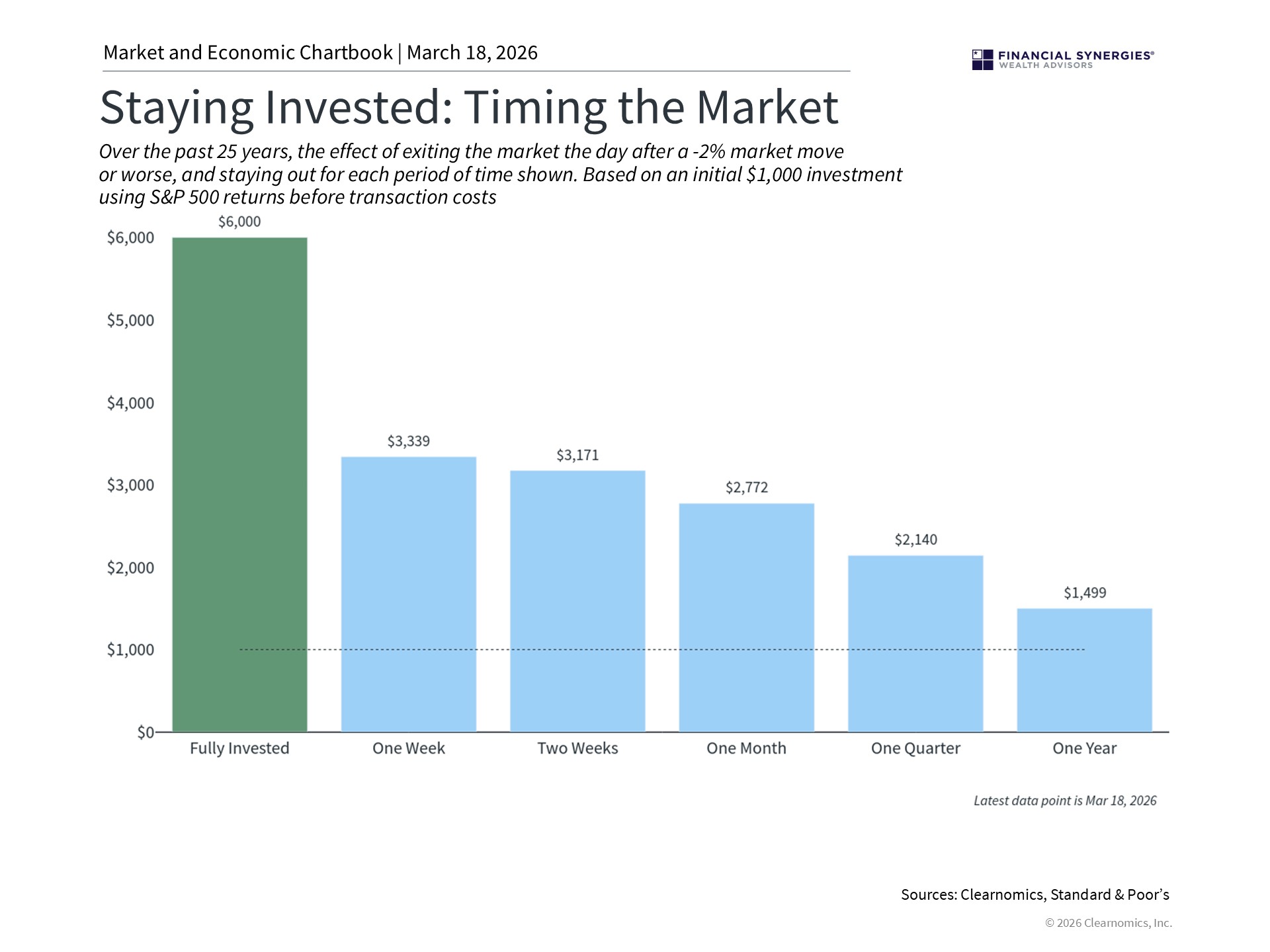
The stock market has been choppy this year, with the S&P 500 sitting just about 5% below its all-time high reached back in January, as of mid-March. While some investors may feel unsettled by recent market moves, pullbacks around this size are completely normal. In fact, the average year experiences several declines of 5% or more over the course of weeks or months, before rebounding. In 2025, for example, there were six such pullbacks for the S&P 500 driven primarily by tariffs, yet the market still generated a total return of 18% for the year.
This is the foundation of why staying invested has historically been the best approach for long-term investors. Some may be tempted to time the market, but the challenge is not just knowing when to get out, but also when to get back in. The accompanying chart illustrates that even missing a single week after volatile days has historically been negative for investment outcomes. While there are no guarantees, this is historically because the market’s best days have occurred shortly after its worst days. Investors who stepped to the sidelines missed the very rebounds they were waiting for.
This is not to say that pullbacks are insignificant, or that markets always rebound quickly. Rather, it is that they are a recurring feature of investing that should be planned for, not reacted to.
Bond yields are attractive amid recent volatility
While the stock market gets most of the headlines, the bond market is just as important. The possibility of inflation is one of the key drivers of bonds, and higher oil prices have raised new questions in recent weeks. Adding to the uncertainty is the upcoming transition to a new Fed chair in May and questions about whether the central bank may adjust its rate path. At the moment, market-based measures expect only one rate cut by the end of this year.
Bonds are a core holding that often provide a counterbalance against stock market volatility. However, the conflict in the Middle East has also affected bonds, with the Bloomberg U.S. Aggregate Bond Index roughly flat year-to-date. The 10-year U.S. Treasury yield has jumped back above 4.2% after falling as low as 3.9% when the conflict in Iran began.
Perspective is needed since bonds have contributed positively after their historic pullback in 2022, when inflation and interest rates rose swiftly, generating strong returns from 2023 to 2025. Since the bottom in October 2022, the broad bond market has generated roughly 20% in total returns, with some individual sectors performing even better.
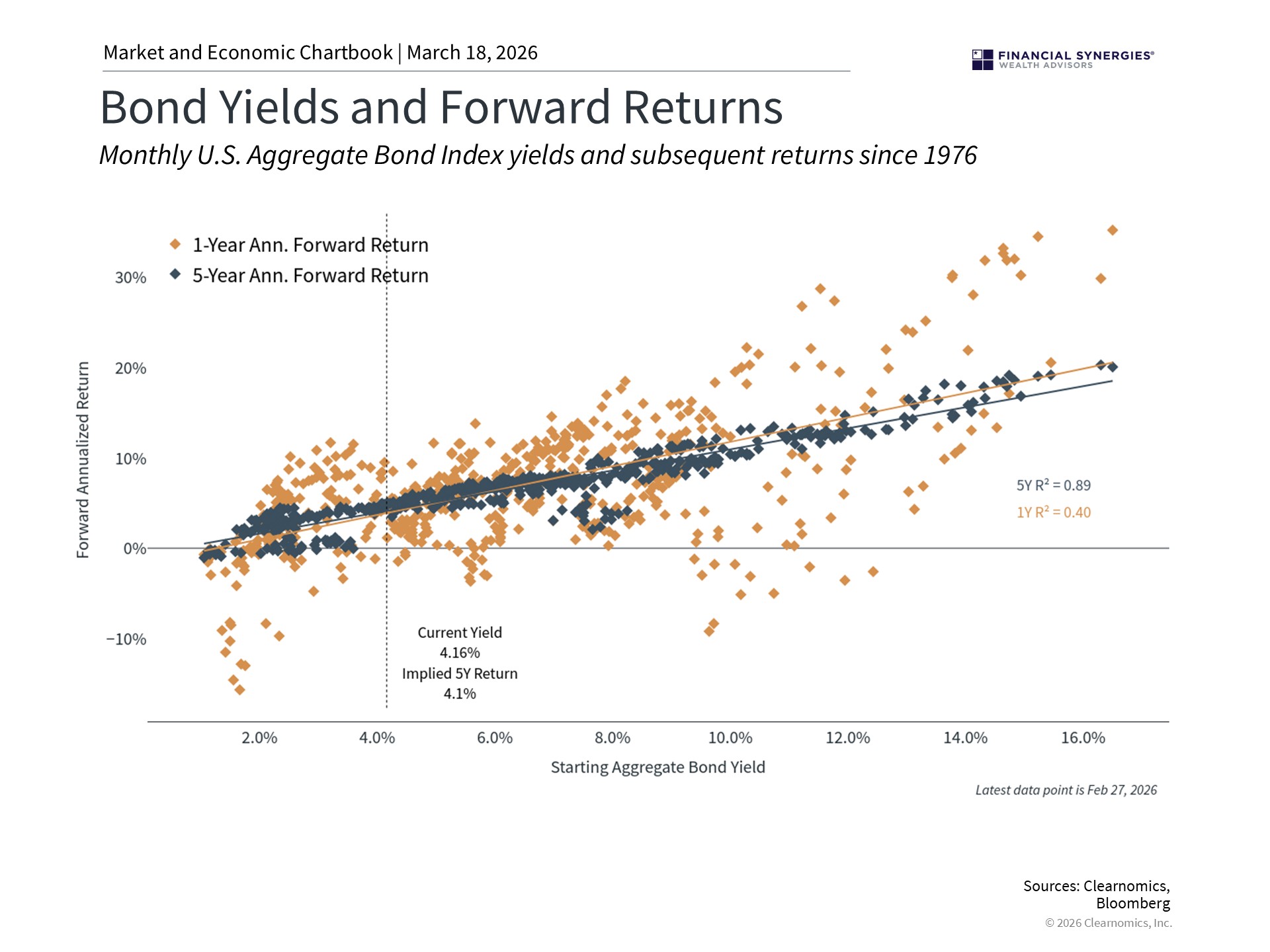
Bond yields remain attractive compared to the previous decade. Current bond yields offer meaningful income potential that was simply unavailable during much of the past decade. Specifically, the yield on the U.S. Aggregate Bond Index is 4.5%, well above the 2.9% average since 2009. Investing when yields are attractive is also historically correlated with healthy total returns, as shown in the accompanying chart.
This is especially true when compared to cash, where yields are still negative after adjusting for inflation. On average, $10,000 invested in certificates of deposit yields about $155 a year, which is still well below inflation of between 2.5% to 3%. For those in or near retirement, the applicable inflation rates may be even higher due to medical expenses and insurance. So, while cash may feel safe, a proper allocation to bonds is still the best way to generate income and support long-run growth.
It is also worth noting that there is growing concern around private credit, with reports of rising redemption requests and some larger funds limiting withdrawals. At its core, private credit is an asset class consisting of non-bank loans to companies. The sector has grown significantly in recent years and is tied to areas of market uncertainty such as technology and energy. Unlike public bonds, private credit is structured to be a long-term investment precisely because of this type of uncertainty. So, just like any other asset class, what matters for investors who hold private credit is whether it is appropriate for their portfolios and how it balances with other assets.
Having a portfolio perspective continues to benefit investors
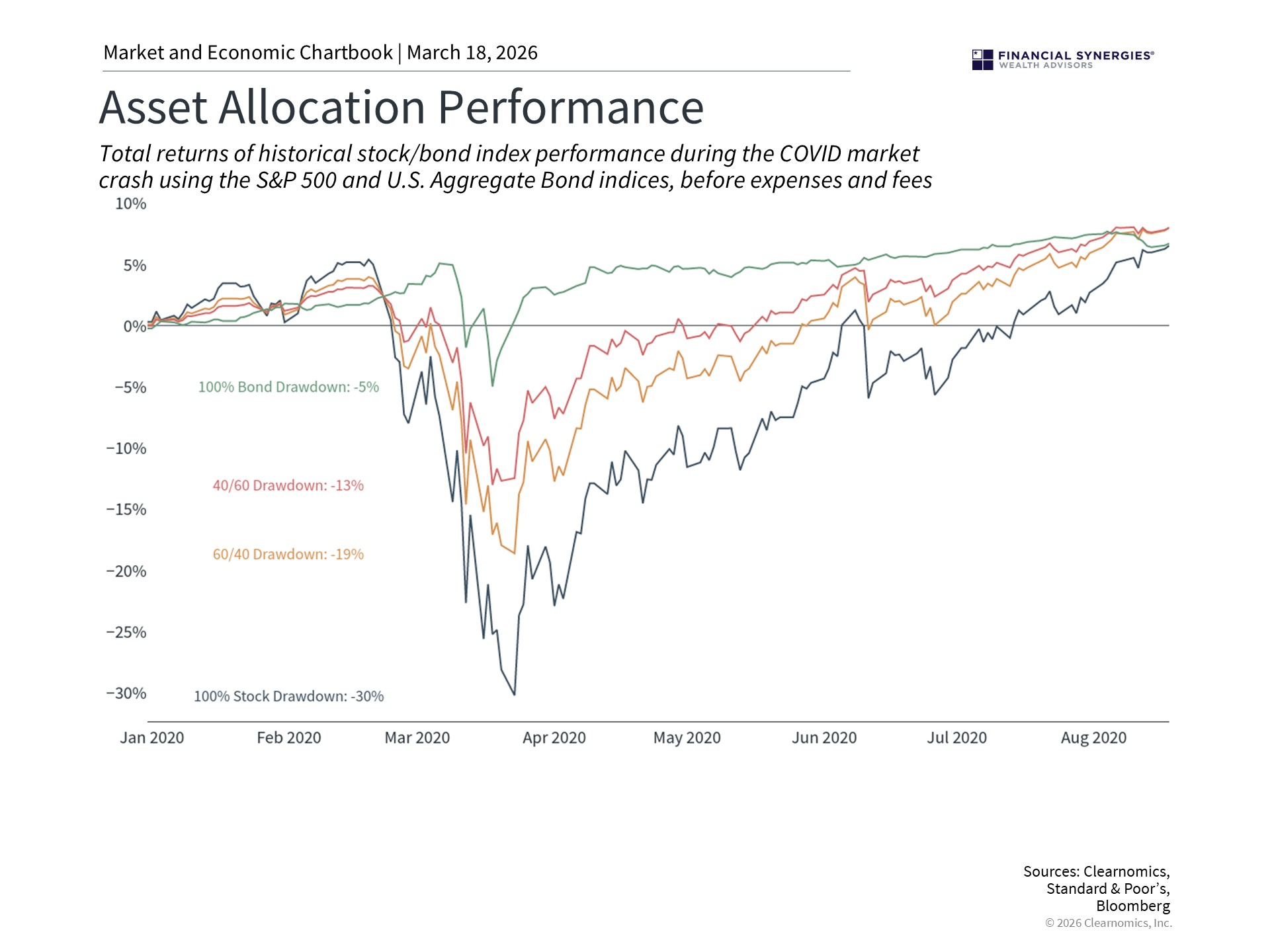
While there are considerations across each asset class, the past few weeks highlight the power of properly constructed portfolios. Holding different types of investments, whether they are asset classes, specific sectors, or investing across different parts of the world, helps to smooth out portfolio performance during choppy periods, reducing the temptation to make sudden changes that can derail financial plans.
The accompanying chart highlights one of the most volatile periods in history during the pandemic in 2020. Different asset allocations behaved in unique ways, with those that were more balanced across asset classes experiencing smaller swings. While these portfolios all ended around the same level after this period, the real issue is whether investors would have overreacted when the stock market was down 20% or 30%.
Today, assets like commodities are leading the way due to energy and precious metals. However, this is not about trying to guess which asset class will outperform next and concentrating a portfolio in that area. Instead, it is about benefiting from the full range of market movements. When one part of a portfolio struggles, another may provide balance. Over time, this approach has allowed investors to participate in growth while managing risk, which is ultimately what achieving long-term financial goals requires.
Concerns or questions about how your investment portfolio will hold up in the current market environment? Contact Financial Synergies today.
We are a boutique, financial advisory and total wealth management firm with over 35 years helping clients navigate turbulent markets. To learn more about our approach to investment management please reach out to us. One of our seasoned advisors would be happy to help you build a custom financial plan to help ensure you accomplish your financial goals and objectives. Schedule a conversation with us today.
More relevant articles by Financial Synergies:
Blog Disclosures
This content, which contains security-related opinions and/or information, is provided for informational purposes only and should not be relied upon in any manner as professional advice, or an endorsement of any practices, products or services. There can be no guarantees or assurances that the views expressed here will be applicable for any particular facts or circumstances, and should not be relied upon in any manner. You should consult your own financial advisors as to legal, business, tax, and other related matters concerning any investment.
The commentary in this “post” (including any related blogs, videos, and social media) reflects the personal opinions, viewpoints, and analyses of the Financial Synergies Wealth Advisors, Inc. employees providing such comments, and should not be regarded as the views of Financial Synergies Wealth Advisors, Inc. or its respective affiliates or as a description of advisory services provided by Financial Synergies Wealth Advisors, Inc. or performance returns of any Financial Synergies Wealth Advisors, Inc. client.
Any opinions expressed herein do not constitute or imply endorsement, sponsorship, or recommendation by Financial Synergies Wealth Advisors, Inc. or its employees. The views reflected in the commentary are subject to change at any time without notice.
Nothing on this website constitutes investment or financial planning advice, performance data or any recommendation that any particular security, portfolio of securities, transaction or investment strategy is suitable for any specific person. It also should not be construed as an offer soliciting the purchase or sale of any security mentioned. Nor should it be construed as an offer to provide investment advisory services by Financial Synergies Wealth Advisors, Inc.
Any mention of a particular security and related performance data is not a recommendation to buy or sell that security. Financial Synergies Wealth Advisors, Inc. manages its clients’ accounts using a variety of investment techniques and strategies, which are not necessarily discussed in the commentary. Investments in securities involve the risk of loss. Past performance is no guarantee of future results.
Any charts provided here or on any related Financial Synergies Wealth Advisors, Inc. personnel content outlets are for informational purposes only, and should also not be relied upon when making any investment decision. Any indices referenced for comparison are unmanaged and cannot be invested into directly. As always please remember investing involves risk and possible loss of principal capital; please seek advice from a licensed professional. Any projections, estimates, forecasts, targets, prospects and/or opinions expressed in these materials are subject to change without notice and may differ or be contrary to opinions expressed by others. Information in charts have been obtained from third-party sources and data, and may include those from portfolio securities of funds managed by Financial Synergies Wealth Advisors, Inc. While taken from sources believed to be reliable, Financial Synergies Wealth Advisors, Inc. has not independently verified such information and makes no representations about the enduring accuracy of the information or its appropriateness for a given situation. All content speaks only as of the date indicated.
Financial Synergies Wealth Advisors, Inc. is a registered investment adviser. Advisory services are only offered to clients or prospective clients where Financial Synergies Wealth Advisors, Inc. and its representatives are properly licensed or exempt from licensure. Investments in securities involve the risk of loss. Past performance is no guarantee of future results.
See Full Disclosures Page Here
 Skip to content


Market Pullbacks and Portfolio Balance
The ongoing conflict in Iran and rising oil prices have been the primary drivers of stock market swings in recent weeks. Brent crude oil has climbed back above $100 per barrel, raising questions about whether higher energy costs could slow economic growth while also pushing inflation higher. This adds to existing concerns such as the impact of artificial intelligence on existing companies, broad market valuations, and the path of Federal Reserve policy. For investors, this can naturally create questions about the health of their portfolios.
The author Alfred A. Montapert once wrote “do not confuse motion and progress.” With markets experiencing daily swings due to global headlines, there can be a tendency to believe that portfolios and financial plans should be adjusted frequently. However, a key principle of proper planning is that by the time uncertainty strikes, the hard work has already been done. A well-constructed portfolio is one that holds an appropriate mix of complementary asset classes and is aligned to financial goals. This is designed to weather different types of market environments without the need for constant adjustment.
Still, markets that lack a clear direction can feel uncomfortable. In times like these, maintaining a level-headed perspective is critical when there is so much negativity in the news. It’s more important than ever to not lose sight of long-term goals, especially because saving and investing properly are still the best ways to grow wealth over time. What should investors keep in mind as uncertainty continues?
Market pullbacks are an unavoidable part of investing
The stock market has been choppy this year, with the S&P 500 sitting just about 5% below its all-time high reached back in January, as of mid-March. While some investors may feel unsettled by recent market moves, pullbacks around this size are completely normal. In fact, the average year experiences several declines of 5% or more over the course of weeks or months, before rebounding. In 2025, for example, there were six such pullbacks for the S&P 500 driven primarily by tariffs, yet the market still generated a total return of 18% for the year.
This is the foundation of why staying invested has historically been the best approach for long-term investors. Some may be tempted to time the market, but the challenge is not just knowing when to get out, but also when to get back in. The accompanying chart illustrates that even missing a single week after volatile days has historically been negative for investment outcomes. While there are no guarantees, this is historically because the market’s best days have occurred shortly after its worst days. Investors who stepped to the sidelines missed the very rebounds they were waiting for.
This is not to say that pullbacks are insignificant, or that markets always rebound quickly. Rather, it is that they are a recurring feature of investing that should be planned for, not reacted to.
Bond yields are attractive amid recent volatility
While the stock market gets most of the headlines, the bond market is just as important. The possibility of inflation is one of the key drivers of bonds, and higher oil prices have raised new questions in recent weeks. Adding to the uncertainty is the upcoming transition to a new Fed chair in May and questions about whether the central bank may adjust its rate path. At the moment, market-based measures expect only one rate cut by the end of this year.
Bonds are a core holding that often provide a counterbalance against stock market volatility. However, the conflict in the Middle East has also affected bonds, with the Bloomberg U.S. Aggregate Bond Index roughly flat year-to-date. The 10-year U.S. Treasury yield has jumped back above 4.2% after falling as low as 3.9% when the conflict in Iran began.
Perspective is needed since bonds have contributed positively after their historic pullback in 2022, when inflation and interest rates rose swiftly, generating strong returns from 2023 to 2025. Since the bottom in October 2022, the broad bond market has generated roughly 20% in total returns, with some individual sectors performing even better.
Bond yields remain attractive compared to the previous decade. Current bond yields offer meaningful income potential that was simply unavailable during much of the past decade. Specifically, the yield on the U.S. Aggregate Bond Index is 4.5%, well above the 2.9% average since 2009. Investing when yields are attractive is also historically correlated with healthy total returns, as shown in the accompanying chart.
This is especially true when compared to cash, where yields are still negative after adjusting for inflation. On average, $10,000 invested in certificates of deposit yields about $155 a year, which is still well below inflation of between 2.5% to 3%. For those in or near retirement, the applicable inflation rates may be even higher due to medical expenses and insurance. So, while cash may feel safe, a proper allocation to bonds is still the best way to generate income and support long-run growth.
It is also worth noting that there is growing concern around private credit, with reports of rising redemption requests and some larger funds limiting withdrawals. At its core, private credit is an asset class consisting of non-bank loans to companies. The sector has grown significantly in recent years and is tied to areas of market uncertainty such as technology and energy. Unlike public bonds, private credit is structured to be a long-term investment precisely because of this type of uncertainty. So, just like any other asset class, what matters for investors who hold private credit is whether it is appropriate for their portfolios and how it balances with other assets.
Having a portfolio perspective continues to benefit investors
While there are considerations across each asset class, the past few weeks highlight the power of properly constructed portfolios. Holding different types of investments, whether they are asset classes, specific sectors, or investing across different parts of the world, helps to smooth out portfolio performance during choppy periods, reducing the temptation to make sudden changes that can derail financial plans.
The accompanying chart highlights one of the most volatile periods in history during the pandemic in 2020. Different asset allocations behaved in unique ways, with those that were more balanced across asset classes experiencing smaller swings. While these portfolios all ended around the same level after this period, the real issue is whether investors would have overreacted when the stock market was down 20% or 30%.
Today, assets like commodities are leading the way due to energy and precious metals. However, this is not about trying to guess which asset class will outperform next and concentrating a portfolio in that area. Instead, it is about benefiting from the full range of market movements. When one part of a portfolio struggles, another may provide balance. Over time, this approach has allowed investors to participate in growth while managing risk, which is ultimately what achieving long-term financial goals requires.
Concerns or questions about how your investment portfolio will hold up in the current market environment? Contact Financial Synergies today.
We are a boutique, financial advisory and total wealth management firm with over 35 years helping clients navigate turbulent markets. To learn more about our approach to investment management please reach out to us. One of our seasoned advisors would be happy to help you build a custom financial plan to help ensure you accomplish your financial goals and objectives. Schedule a conversation with us today.
More relevant articles by Financial Synergies:
Blog Disclosures
This content, which contains security-related opinions and/or information, is provided for informational purposes only and should not be relied upon in any manner as professional advice, or an endorsement of any practices, products or services. There can be no guarantees or assurances that the views expressed here will be applicable for any particular facts or circumstances, and should not be relied upon in any manner. You should consult your own financial advisors as to legal, business, tax, and other related matters concerning any investment.
The commentary in this “post” (including any related blogs, videos, and social media) reflects the personal opinions, viewpoints, and analyses of the Financial Synergies Wealth Advisors, Inc. employees providing such comments, and should not be regarded as the views of Financial Synergies Wealth Advisors, Inc. or its respective affiliates or as a description of advisory services provided by Financial Synergies Wealth Advisors, Inc. or performance returns of any Financial Synergies Wealth Advisors, Inc. client.
Any opinions expressed herein do not constitute or imply endorsement, sponsorship, or recommendation by Financial Synergies Wealth Advisors, Inc. or its employees. The views reflected in the commentary are subject to change at any time without notice.
Nothing on this website constitutes investment or financial planning advice, performance data or any recommendation that any particular security, portfolio of securities, transaction or investment strategy is suitable for any specific person. It also should not be construed as an offer soliciting the purchase or sale of any security mentioned. Nor should it be construed as an offer to provide investment advisory services by Financial Synergies Wealth Advisors, Inc.
Any mention of a particular security and related performance data is not a recommendation to buy or sell that security. Financial Synergies Wealth Advisors, Inc. manages its clients’ accounts using a variety of investment techniques and strategies, which are not necessarily discussed in the commentary. Investments in securities involve the risk of loss. Past performance is no guarantee of future results.
Any charts provided here or on any related Financial Synergies Wealth Advisors, Inc. personnel content outlets are for informational purposes only, and should also not be relied upon when making any investment decision. Any indices referenced for comparison are unmanaged and cannot be invested into directly. As always please remember investing involves risk and possible loss of principal capital; please seek advice from a licensed professional. Any projections, estimates, forecasts, targets, prospects and/or opinions expressed in these materials are subject to change without notice and may differ or be contrary to opinions expressed by others. Information in charts have been obtained from third-party sources and data, and may include those from portfolio securities of funds managed by Financial Synergies Wealth Advisors, Inc. While taken from sources believed to be reliable, Financial Synergies Wealth Advisors, Inc. has not independently verified such information and makes no representations about the enduring accuracy of the information or its appropriateness for a given situation. All content speaks only as of the date indicated.
Financial Synergies Wealth Advisors, Inc. is a registered investment adviser. Advisory services are only offered to clients or prospective clients where Financial Synergies Wealth Advisors, Inc. and its representatives are properly licensed or exempt from licensure. Investments in securities involve the risk of loss. Past performance is no guarantee of future results.
See Full Disclosures Page Here
Recent Posts
Happy Birthday to the Bull Market 🎉
Quarterly Webinar: Q4 2026 Market and Economic Themes
Medicare Open Enrollment 2026: What to Know
Subscribe to Our Blog
Chief Investment Officer | Managing Partner