Private Infrastructure: The fifth installment in our series on private markets
There is a category of assets so woven into daily life that most people never think about it — until it stops working. The data center that streams your evening movie. The transmission lines that carry power to your home. The pipeline that heats it. The port that lands the goods on your shelves. The fiber that connects a video call across three continents. These are the physical systems that keep a modern economy running, and collectively they form one of the largest and fastest-growing asset classes available to long-term investors.
For some of our clients, private infrastructure is already a familiar part of the portfolios we manage. For others, it is an allocation we may recommend as circumstances warrant. This article is written for both — a closer look at an asset class some of you already hold and others soon may, and why we believe it belongs alongside public equities, high-quality bonds, and the other private markets strategies we use.
What Private Infrastructure Is

At its simplest, infrastructure means the physical assets that provide or support essential services — the things an economy cannot function without. What distinguishes infrastructure as an investment is not just the assets themselves but the business models attached to them. These assets typically operate under long-term contracts or government regulation, which means their revenues are often set years in advance and are relatively insulated from the ups and downs of the economic cycle.
A toll road collects fees whether the economy is expanding or contracting. A regulated utility earns a return set by its regulator. A data center operates under a multi-year lease with a creditworthy tenant. We refer to these as contracted or regulated cash flows — income streams that are contractually or legally defined rather than left to the mercy of the market.
That stability is the heart of the asset class. Because demand for essential services tends to be steady — people need power, water, connectivity, and transportation in good times and bad — infrastructure cash flows have historically been far less sensitive to recessions than the earnings of a typical operating company.
Why, then, “beyond public utilities”? Because the listed utility sector, familiar to most investors through their public stock portfolios, captures only a narrow slice of this opportunity. Public utilities are largely mature, heavily regulated, and slow-growing. Private ownership opens the door to a much broader and faster-moving universe: digital infrastructure, renewable power, transportation networks, and midstream energy — much of which never appears on a public exchange at all.
What It Includes
Private infrastructure is usually organized into four broad sectors.
Digital infrastructure is the newest and, in our view, the most dynamic — the data centers that house the world’s computing power, the cell towers that carry wireless traffic, and the fiber-optic cables that move information between them. This is the plumbing of the digital economy, and we will return to it below, because the demand story behind it is unlike anything the sector has seen.
Energy infrastructure spans the generation and delivery of power: regulated utilities and transmission networks, pipelines that transport fuel, and the growing build-out of renewable generation. As electricity demand rises, a trend we expect to continue, this sector sits squarely in its path.
Transportation infrastructure is the machinery of moving people and goods: roads, ports, airports, and railroads. These are often long-duration assets with durable competitive positions; a major airport or deep-water port is not easily replicated.
Water and waste infrastructure covers the systems that supply clean water and manage sewage and solid waste — perhaps the most essential services of all, and among the most stable.
Across all four, the common thread is the same: physical, hard-to-replace assets delivering services that society cannot do without.
Why We Allocate
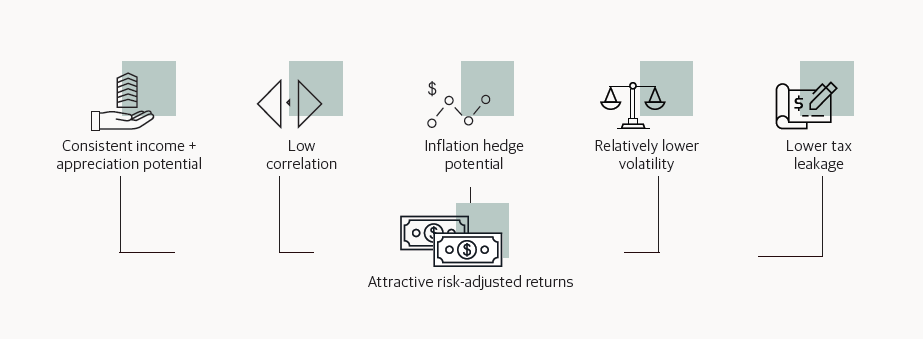
We allocate to private infrastructure for four related reasons: returns, diversification benefits, inflation protection, and income.
On returns, the long-term record has been compelling. From 2004 through mid-2025, a hypothetical $100,000 invested in private infrastructure grew to roughly $723,000 — an annualized return of about 10% — compared with roughly $597,000, or about 9%, for global public equities over the same period, and it did so with lower volatility along the way.¹ These figures are historical and illustrative only; past performance does not predict future results, and infrastructure carries risks, including illiquidity, that public equities do not. But the pattern, equity-like returns with less turbulence, is one of the reasons the asset class has drawn institutional capital for decades.
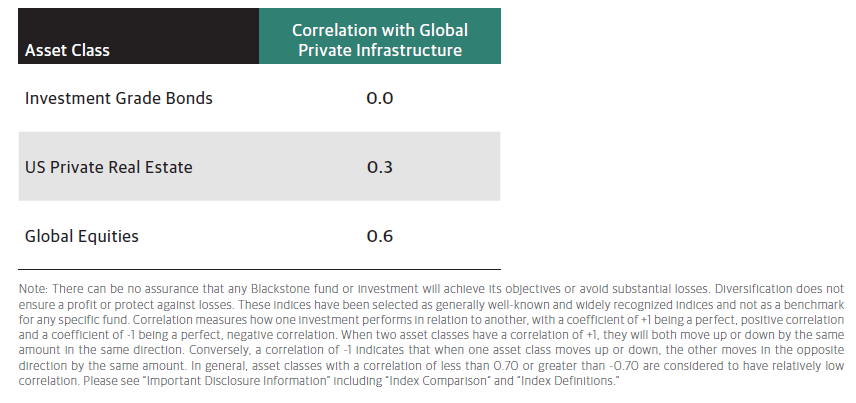
Diversification may be the more powerful argument. Over that same period, private infrastructure showed essentially no correlation (0.0) to investment-grade bonds, low correlation (0.3) to private real estate, and moderate correlation (0.6) to global equities.² That near-zero relationship with high-quality bonds is genuinely unusual and genuinely valuable: it means infrastructure has tended to move on its own rhythm, independent of the fixed income that anchors most client portfolios. Assets that behave differently from one another are the raw material of a resilient portfolio.
Inflation protection comes built into many infrastructure business models. Contracts are frequently indexed to inflation or contain embedded escalators — provisions that raise prices automatically as costs rise — which can help preserve profitability when inflation runs hot. During the 2022–2023 inflationary spike, this feature was not theoretical; it was one of the ways the asset class earned its keep.
Finally, those same long-term contracts tend to produce steady income, which can be an attractive complement to the yield generated elsewhere in a portfolio.
The AI and Data-Center Demand Story

If there is a single force reshaping infrastructure today, it is the explosion of data — and the physical capacity required to create, move, and store it. Consider the scale: by one widely cited estimate, more data was created in the three years from 2021 to 2024 than in all of prior history combined, and the total volume of data created, consumed, and stored is projected to grow nearly 200-fold between 2010 and 2028.³
The first wave of that growth came from cloud computing and digital content. The second — and, we believe, the more powerful — is artificial intelligence. Training and running AI models requires enormous computing power, which requires data centers, which in turn require staggering amounts of electricity. This is where the digital and energy sectors converge: the AI build-out is not only a data-center story but a power story, driving demand for generation, transmission, and grid capacity that did not exist a few years ago.
We believe this secular tailwind has the potential to support demand for digital and energy infrastructure for years to come. It is, of course, a forward-looking view rather than a certainty — technologies evolve, and today’s expectations may not materialize as anticipated. But the direction of travel is hard to ignore, and it is one of the reasons we find the asset class particularly compelling at this moment.
How It Fits Alongside the Rest of the Portfolio
It is worth being clear about how private infrastructure fits with the rest of a portfolio, because its role is easy to misunderstand.
Infrastructure is not a substitute for high-quality bonds. Traditional fixed income does something infrastructure cannot: it provides daily liquidity, principal stability, and reliable ballast during equity market stress. Those qualities remain essential, and nothing about an infrastructure allocation changes that.
Rather, infrastructure earns its place alongside bonds, and this is precisely where the near-zero correlation we noted earlier becomes so useful. Because infrastructure has tended to move independently of investment-grade bonds, adding it does not simply pile on more of the same risk; it introduces a genuinely different return stream. The result, at the total-portfolio level, can be a smoother ride than either asset held alone.
Correlation Metrics of Private Infrastructure
The same logic applies relative to equities. Infrastructure has historically delivered equity-like long-term returns but with lower volatility and only moderate correlation to public stocks, which makes it a useful complement to — not a replacement for — the growth engine of a portfolio. In the portfolios we manage, we think of private infrastructure as one of several building blocks, each doing a distinct job, rather than as a swap for any single traditional holding.
How Clients Access It
Private infrastructure has long been a staple of large institutional portfolios — pensions, endowments, and sovereign wealth funds — where total institutional assets have grown from roughly $0.8 trillion in 2019 to about $1.4 trillion in 2024, with projections approaching $2.3 trillion by 2029, and where average target allocations have climbed from around 4% toward 7%.⁴ Individual investors have historically been markedly under-allocated by comparison, largely because the asset class was just to difficult to reach. That has changed.
We invest exclusively through perpetual, or evergreen, fund structures — vehicles designed to be owned on an ongoing basis rather than wound down on a fixed schedule. These structures have two practical advantages worth understanding. First, capital is put to work immediately upon investment, rather than sitting idle waiting to be called. Second, investors can add to or redeem from the fund periodically at its net asset value, or NAV — the fund’s per-share value based on the appraised worth of its underlying assets — subject to certain limits.
That last phrase deserves candor. These funds offer periodic, not daily, liquidity. Subscriptions happen in windows, redemptions are typically capped at a percentage of the fund each quarter, and in periods of stress those limits can bind. Meaning you may not be able to redeem as much as you want exactly when you want. This is a feature, not a flaw: part of the return infrastructure has historically offered is compensation for accepting reduced liquidity, what investors call the illiquidity premium — the extra return earned for giving up the ability to sell at a moment’s notice. We size these allocations with that trade-off firmly in mind, which brings us to what we watch most closely.
What We Watch
Private infrastructure rewards discipline, and a few risks warrant particular attention.
The first is manager selection. Dispersion between the best and worst managers in this asset class is wide, and not every product labeled “infrastructure” is the real thing. Some managers stretch the definition to include “infrastructure-like” businesses that lack the essential-service characteristics and contracted cash flows that give the asset class its defensive qualities. We look for managers with the scale, staying power, and sourcing ability to own genuine, hard-asset infrastructure.
The second is leverage and interest-rate sensitivity. Infrastructure assets are typically financed with a meaningful amount of debt, which magnifies both returns and risks; a sharp rise in rates can pressure valuations and cash flows. We pay close attention to how much leverage a manager uses and how it is structured.
The third is liquidity — not at the level of any single fund, but across the whole portfolio. Because these vehicles offer only periodic liquidity, we manage each client’s overall exposure to less-liquid assets so that near-term spending needs are always met from more liquid holdings.
Closing
None of this changes our core conviction: private infrastructure is additive, not a replacement. It is meant to work alongside the stocks, bonds, and other strategies in a well-constructed portfolio, each contributing something the others cannot. For clients who already hold it, we hope this offers a clearer view of why. For those who do not yet, it is a conversation we welcome. Infrastructure is the newest of the four pillars in our private markets framework — joining private equity, private credit, and private real estate — and, in our view, one of the most compelling additions available to long-term investors today.
A Truly Unique Wealth Management Experience
Let’s create a financial plan and investment strategy that allows you to live the life of your dreams. Schedule your free consultation today to explore tailored financial strategies designed to secure your future!
Are We Right for You?
Concerns or questions about how your investment portfolio will hold up in the current market environment? Contact Financial Synergies today.
We are a boutique, financial advisory and total wealth management firm with over 35 years helping clients navigate turbulent markets. To learn more about our approach to investment management please reach out to us. One of our seasoned advisors would be happy to help you build a custom financial plan to help ensure you accomplish your financial goals and objectives. Schedule a conversation with us today.
More relevant articles by Financial Synergies:
Footnotes
¹ Cambridge Associates and Morningstar Direct, based on quarterly returns from January 1, 2004 to June 30, 2025; Global Private Infrastructure represented by the Cambridge Private Infrastructure Index and Global Public Equity by the MSCI ACWI Index on a modified public-market-equivalent (PME) basis — as referenced in Blackstone, Essentials of Private Infrastructure (Blackstone, 2025). Historical and illustrative only; past performance does not predict future results.
² Morningstar Direct, based on quarterly returns from January 1, 2004 to June 30, 2025; Investment Grade Bonds (Bloomberg US Aggregate Bond Index), US Private Real Estate (NCREIF ODCE), and Global Equities (MSCI ACWI) — as referenced in Blackstone, Essentials of Private Infrastructure (Blackstone, 2025). Diversification does not ensure a profit or protect against losses.
³ International Data Corporation (IDC), as of May 2024; figures for 2024–2028 are year-end estimates — as referenced in Blackstone, Essentials of Private Infrastructure (Blackstone, 2025). There is no guarantee that these trends will continue.
⁴ Preqin, 2025 Global Report: Infrastructure, and Infrastructure Investor, Investor Report Full Year 2024 (2019 and 2024 figures), with the 2029 estimate from IFM Investors (November 2024) — as referenced in Blackstone, Essentials of Private Infrastructure (Blackstone, 2025). Projected figures are estimates and are not guaranteed.
Disclosures
This article is provided for educational and informational purposes only and does not constitute investment, legal, tax, or accounting advice. The views expressed are those of Financial Synergies Wealth Advisors as of the date of publication and are subject to change without notice. Nothing herein should be construed as an offer to sell, or a solicitation of an offer to buy, any security or investment product.
Past performance is not indicative of future results. Any references to historical returns, growth-of-investment illustrations, index data, or correlation and volatility figures are presented for illustrative purposes only and reflect specific methodologies, time periods, and assumptions that may not be representative of future market conditions. Index comparisons — including those referencing the Cambridge Private Infrastructure Index, the MSCI ACWI Index, the Bloomberg U.S. Aggregate Bond Index, and the NCREIF ODCE Index — have inherent limitations, employ different guidelines and risk profiles than any private fund, are not subject to fees or expenses, and cannot be invested in directly. Comparisons of private and public market performance, including public market equivalent (PME) analyses, depend on adjustments for the timing of cash flows and should not be relied upon as predictions of future performance.
Investments in private infrastructure involve a high degree of risk and are suitable only for investors who can bear the potential for loss. Private infrastructure investments are illiquid, have limited or no secondary market, may involve significant fees and expenses, and are intended for long-term investment. The perpetual and semi-liquid fund structures through which these investments are typically accessed offer only periodic liquidity and impose restrictions on redemptions, including subscription windows, redemption limits or gates, and the possibility that redemption requests may be reduced, delayed, or suspended during periods of market stress. Valuations are generally based on periodic appraisals of underlying assets, may rely on imperfect information, and may not reflect the price at which those assets could actually be sold. Infrastructure assets are frequently financed with leverage, which magnifies gains and losses and increases sensitivity to rising interest rates, and many are subject to regulatory, political, environmental, and operational risks. There can be no assurance that any infrastructure strategy will achieve its objectives, generate income, effectively mitigate inflation, or avoid losses.
Diversification does not ensure a profit or protect against loss in declining markets. Manager selection is a critical component of private infrastructure investing given the wide dispersion of returns among managers, and there can be no assurance that any selected manager will achieve results comparable to historical industry averages. Certain managers may include “infrastructure-like” investments that do not exhibit the essential-service characteristics or contracted cash flows typically associated with the asset class.
Private infrastructure investments are generally available only to accredited investors and qualified purchasers as defined under federal securities laws. The suitability of any investment depends on each client’s individual financial circumstances, liquidity needs, time horizon, and goals. Clients should consult with their Financial Synergies advisor before making any investment decision.
Financial Synergies Wealth Advisors is an SEC-registered investment adviser. Registration does not imply any particular level of skill or training. Additional information about our firm, including our investment strategies, fees, and potential conflicts of interest, is available in our Form ADV Part 2A, which is available upon request or at adviserinfo.sec.gov.
Certain data referenced in this article has been obtained from third-party sources believed to be reliable, including Cambridge Associates, Morningstar Direct, Preqin, Infrastructure Investor, IFM Investors, and International Data Corporation (IDC), as compiled in Blackstone University’s Essentials of Private Infrastructure. Financial Synergies has not independently verified this information and makes no representation as to its accuracy or completeness.
 Skip to content


Private Infrastructure: The Essential Assets Behind Everyday Life
Private Infrastructure: The fifth installment in our series on private markets
There is a category of assets so woven into daily life that most people never think about it — until it stops working. The data center that streams your evening movie. The transmission lines that carry power to your home. The pipeline that heats it. The port that lands the goods on your shelves. The fiber that connects a video call across three continents. These are the physical systems that keep a modern economy running, and collectively they form one of the largest and fastest-growing asset classes available to long-term investors.
For some of our clients, private infrastructure is already a familiar part of the portfolios we manage. For others, it is an allocation we may recommend as circumstances warrant. This article is written for both — a closer look at an asset class some of you already hold and others soon may, and why we believe it belongs alongside public equities, high-quality bonds, and the other private markets strategies we use.
What Private Infrastructure Is
At its simplest, infrastructure means the physical assets that provide or support essential services — the things an economy cannot function without. What distinguishes infrastructure as an investment is not just the assets themselves but the business models attached to them. These assets typically operate under long-term contracts or government regulation, which means their revenues are often set years in advance and are relatively insulated from the ups and downs of the economic cycle.
A toll road collects fees whether the economy is expanding or contracting. A regulated utility earns a return set by its regulator. A data center operates under a multi-year lease with a creditworthy tenant. We refer to these as contracted or regulated cash flows — income streams that are contractually or legally defined rather than left to the mercy of the market.
That stability is the heart of the asset class. Because demand for essential services tends to be steady — people need power, water, connectivity, and transportation in good times and bad — infrastructure cash flows have historically been far less sensitive to recessions than the earnings of a typical operating company.
Why, then, “beyond public utilities”? Because the listed utility sector, familiar to most investors through their public stock portfolios, captures only a narrow slice of this opportunity. Public utilities are largely mature, heavily regulated, and slow-growing. Private ownership opens the door to a much broader and faster-moving universe: digital infrastructure, renewable power, transportation networks, and midstream energy — much of which never appears on a public exchange at all.
What It Includes
Private infrastructure is usually organized into four broad sectors.
Digital infrastructure is the newest and, in our view, the most dynamic — the data centers that house the world’s computing power, the cell towers that carry wireless traffic, and the fiber-optic cables that move information between them. This is the plumbing of the digital economy, and we will return to it below, because the demand story behind it is unlike anything the sector has seen.
Energy infrastructure spans the generation and delivery of power: regulated utilities and transmission networks, pipelines that transport fuel, and the growing build-out of renewable generation. As electricity demand rises, a trend we expect to continue, this sector sits squarely in its path.
Transportation infrastructure is the machinery of moving people and goods: roads, ports, airports, and railroads. These are often long-duration assets with durable competitive positions; a major airport or deep-water port is not easily replicated.
Water and waste infrastructure covers the systems that supply clean water and manage sewage and solid waste — perhaps the most essential services of all, and among the most stable.
Across all four, the common thread is the same: physical, hard-to-replace assets delivering services that society cannot do without.
Why We Allocate
We allocate to private infrastructure for four related reasons: returns, diversification benefits, inflation protection, and income.
On returns, the long-term record has been compelling. From 2004 through mid-2025, a hypothetical $100,000 invested in private infrastructure grew to roughly $723,000 — an annualized return of about 10% — compared with roughly $597,000, or about 9%, for global public equities over the same period, and it did so with lower volatility along the way.¹ These figures are historical and illustrative only; past performance does not predict future results, and infrastructure carries risks, including illiquidity, that public equities do not. But the pattern, equity-like returns with less turbulence, is one of the reasons the asset class has drawn institutional capital for decades.
Diversification may be the more powerful argument. Over that same period, private infrastructure showed essentially no correlation (0.0) to investment-grade bonds, low correlation (0.3) to private real estate, and moderate correlation (0.6) to global equities.² That near-zero relationship with high-quality bonds is genuinely unusual and genuinely valuable: it means infrastructure has tended to move on its own rhythm, independent of the fixed income that anchors most client portfolios. Assets that behave differently from one another are the raw material of a resilient portfolio.
Inflation protection comes built into many infrastructure business models. Contracts are frequently indexed to inflation or contain embedded escalators — provisions that raise prices automatically as costs rise — which can help preserve profitability when inflation runs hot. During the 2022–2023 inflationary spike, this feature was not theoretical; it was one of the ways the asset class earned its keep.
Finally, those same long-term contracts tend to produce steady income, which can be an attractive complement to the yield generated elsewhere in a portfolio.
The AI and Data-Center Demand Story
If there is a single force reshaping infrastructure today, it is the explosion of data — and the physical capacity required to create, move, and store it. Consider the scale: by one widely cited estimate, more data was created in the three years from 2021 to 2024 than in all of prior history combined, and the total volume of data created, consumed, and stored is projected to grow nearly 200-fold between 2010 and 2028.³
The first wave of that growth came from cloud computing and digital content. The second — and, we believe, the more powerful — is artificial intelligence. Training and running AI models requires enormous computing power, which requires data centers, which in turn require staggering amounts of electricity. This is where the digital and energy sectors converge: the AI build-out is not only a data-center story but a power story, driving demand for generation, transmission, and grid capacity that did not exist a few years ago.
We believe this secular tailwind has the potential to support demand for digital and energy infrastructure for years to come. It is, of course, a forward-looking view rather than a certainty — technologies evolve, and today’s expectations may not materialize as anticipated. But the direction of travel is hard to ignore, and it is one of the reasons we find the asset class particularly compelling at this moment.
How It Fits Alongside the Rest of the Portfolio
It is worth being clear about how private infrastructure fits with the rest of a portfolio, because its role is easy to misunderstand.
Infrastructure is not a substitute for high-quality bonds. Traditional fixed income does something infrastructure cannot: it provides daily liquidity, principal stability, and reliable ballast during equity market stress. Those qualities remain essential, and nothing about an infrastructure allocation changes that.
Rather, infrastructure earns its place alongside bonds, and this is precisely where the near-zero correlation we noted earlier becomes so useful. Because infrastructure has tended to move independently of investment-grade bonds, adding it does not simply pile on more of the same risk; it introduces a genuinely different return stream. The result, at the total-portfolio level, can be a smoother ride than either asset held alone.
Correlation Metrics of Private Infrastructure
The same logic applies relative to equities. Infrastructure has historically delivered equity-like long-term returns but with lower volatility and only moderate correlation to public stocks, which makes it a useful complement to — not a replacement for — the growth engine of a portfolio. In the portfolios we manage, we think of private infrastructure as one of several building blocks, each doing a distinct job, rather than as a swap for any single traditional holding.
How Clients Access It
Private infrastructure has long been a staple of large institutional portfolios — pensions, endowments, and sovereign wealth funds — where total institutional assets have grown from roughly $0.8 trillion in 2019 to about $1.4 trillion in 2024, with projections approaching $2.3 trillion by 2029, and where average target allocations have climbed from around 4% toward 7%.⁴ Individual investors have historically been markedly under-allocated by comparison, largely because the asset class was just to difficult to reach. That has changed.
We invest exclusively through perpetual, or evergreen, fund structures — vehicles designed to be owned on an ongoing basis rather than wound down on a fixed schedule. These structures have two practical advantages worth understanding. First, capital is put to work immediately upon investment, rather than sitting idle waiting to be called. Second, investors can add to or redeem from the fund periodically at its net asset value, or NAV — the fund’s per-share value based on the appraised worth of its underlying assets — subject to certain limits.
That last phrase deserves candor. These funds offer periodic, not daily, liquidity. Subscriptions happen in windows, redemptions are typically capped at a percentage of the fund each quarter, and in periods of stress those limits can bind. Meaning you may not be able to redeem as much as you want exactly when you want. This is a feature, not a flaw: part of the return infrastructure has historically offered is compensation for accepting reduced liquidity, what investors call the illiquidity premium — the extra return earned for giving up the ability to sell at a moment’s notice. We size these allocations with that trade-off firmly in mind, which brings us to what we watch most closely.
What We Watch
Private infrastructure rewards discipline, and a few risks warrant particular attention.
The first is manager selection. Dispersion between the best and worst managers in this asset class is wide, and not every product labeled “infrastructure” is the real thing. Some managers stretch the definition to include “infrastructure-like” businesses that lack the essential-service characteristics and contracted cash flows that give the asset class its defensive qualities. We look for managers with the scale, staying power, and sourcing ability to own genuine, hard-asset infrastructure.
The second is leverage and interest-rate sensitivity. Infrastructure assets are typically financed with a meaningful amount of debt, which magnifies both returns and risks; a sharp rise in rates can pressure valuations and cash flows. We pay close attention to how much leverage a manager uses and how it is structured.
The third is liquidity — not at the level of any single fund, but across the whole portfolio. Because these vehicles offer only periodic liquidity, we manage each client’s overall exposure to less-liquid assets so that near-term spending needs are always met from more liquid holdings.
Closing
None of this changes our core conviction: private infrastructure is additive, not a replacement. It is meant to work alongside the stocks, bonds, and other strategies in a well-constructed portfolio, each contributing something the others cannot. For clients who already hold it, we hope this offers a clearer view of why. For those who do not yet, it is a conversation we welcome. Infrastructure is the newest of the four pillars in our private markets framework — joining private equity, private credit, and private real estate — and, in our view, one of the most compelling additions available to long-term investors today.
A Truly Unique Wealth Management Experience
Let’s create a financial plan and investment strategy that allows you to live the life of your dreams. Schedule your free consultation today to explore tailored financial strategies designed to secure your future!
Concerns or questions about how your investment portfolio will hold up in the current market environment? Contact Financial Synergies today.
We are a boutique, financial advisory and total wealth management firm with over 35 years helping clients navigate turbulent markets. To learn more about our approach to investment management please reach out to us. One of our seasoned advisors would be happy to help you build a custom financial plan to help ensure you accomplish your financial goals and objectives. Schedule a conversation with us today.
More relevant articles by Financial Synergies:
Footnotes
¹ Cambridge Associates and Morningstar Direct, based on quarterly returns from January 1, 2004 to June 30, 2025; Global Private Infrastructure represented by the Cambridge Private Infrastructure Index and Global Public Equity by the MSCI ACWI Index on a modified public-market-equivalent (PME) basis — as referenced in Blackstone, Essentials of Private Infrastructure (Blackstone, 2025). Historical and illustrative only; past performance does not predict future results.
² Morningstar Direct, based on quarterly returns from January 1, 2004 to June 30, 2025; Investment Grade Bonds (Bloomberg US Aggregate Bond Index), US Private Real Estate (NCREIF ODCE), and Global Equities (MSCI ACWI) — as referenced in Blackstone, Essentials of Private Infrastructure (Blackstone, 2025). Diversification does not ensure a profit or protect against losses.
³ International Data Corporation (IDC), as of May 2024; figures for 2024–2028 are year-end estimates — as referenced in Blackstone, Essentials of Private Infrastructure (Blackstone, 2025). There is no guarantee that these trends will continue.
⁴ Preqin, 2025 Global Report: Infrastructure, and Infrastructure Investor, Investor Report Full Year 2024 (2019 and 2024 figures), with the 2029 estimate from IFM Investors (November 2024) — as referenced in Blackstone, Essentials of Private Infrastructure (Blackstone, 2025). Projected figures are estimates and are not guaranteed.
Disclosures
This article is provided for educational and informational purposes only and does not constitute investment, legal, tax, or accounting advice. The views expressed are those of Financial Synergies Wealth Advisors as of the date of publication and are subject to change without notice. Nothing herein should be construed as an offer to sell, or a solicitation of an offer to buy, any security or investment product.
Past performance is not indicative of future results. Any references to historical returns, growth-of-investment illustrations, index data, or correlation and volatility figures are presented for illustrative purposes only and reflect specific methodologies, time periods, and assumptions that may not be representative of future market conditions. Index comparisons — including those referencing the Cambridge Private Infrastructure Index, the MSCI ACWI Index, the Bloomberg U.S. Aggregate Bond Index, and the NCREIF ODCE Index — have inherent limitations, employ different guidelines and risk profiles than any private fund, are not subject to fees or expenses, and cannot be invested in directly. Comparisons of private and public market performance, including public market equivalent (PME) analyses, depend on adjustments for the timing of cash flows and should not be relied upon as predictions of future performance.
Investments in private infrastructure involve a high degree of risk and are suitable only for investors who can bear the potential for loss. Private infrastructure investments are illiquid, have limited or no secondary market, may involve significant fees and expenses, and are intended for long-term investment. The perpetual and semi-liquid fund structures through which these investments are typically accessed offer only periodic liquidity and impose restrictions on redemptions, including subscription windows, redemption limits or gates, and the possibility that redemption requests may be reduced, delayed, or suspended during periods of market stress. Valuations are generally based on periodic appraisals of underlying assets, may rely on imperfect information, and may not reflect the price at which those assets could actually be sold. Infrastructure assets are frequently financed with leverage, which magnifies gains and losses and increases sensitivity to rising interest rates, and many are subject to regulatory, political, environmental, and operational risks. There can be no assurance that any infrastructure strategy will achieve its objectives, generate income, effectively mitigate inflation, or avoid losses.
Diversification does not ensure a profit or protect against loss in declining markets. Manager selection is a critical component of private infrastructure investing given the wide dispersion of returns among managers, and there can be no assurance that any selected manager will achieve results comparable to historical industry averages. Certain managers may include “infrastructure-like” investments that do not exhibit the essential-service characteristics or contracted cash flows typically associated with the asset class.
Private infrastructure investments are generally available only to accredited investors and qualified purchasers as defined under federal securities laws. The suitability of any investment depends on each client’s individual financial circumstances, liquidity needs, time horizon, and goals. Clients should consult with their Financial Synergies advisor before making any investment decision.
Financial Synergies Wealth Advisors is an SEC-registered investment adviser. Registration does not imply any particular level of skill or training. Additional information about our firm, including our investment strategies, fees, and potential conflicts of interest, is available in our Form ADV Part 2A, which is available upon request or at adviserinfo.sec.gov.
Certain data referenced in this article has been obtained from third-party sources believed to be reliable, including Cambridge Associates, Morningstar Direct, Preqin, Infrastructure Investor, IFM Investors, and International Data Corporation (IDC), as compiled in Blackstone University’s Essentials of Private Infrastructure. Financial Synergies has not independently verified this information and makes no representation as to its accuracy or completeness.
Recent Posts
Chart of the Month | Stocks vs. Bonds: More Choices for Investors as Bond Yields Rise
Weekly Market Recap – September Inflation & Retail Sales Data, AI Financing, & Bank Earnings
Happy Birthday to the Bull Market
Subscribe to Our Blog
Chief Investment Officer | Managing Partner