Private real estate has earned a place in many of the portfolios we manage, though not yet in all of them. For clients who already have an allocation, our aim here is to take you a layer deeper — to explain what you actually own when you own private real estate, why we believe it belongs alongside your stocks and bonds, and how we think about it in an environment that has handed the asset class some genuine challenges.
For clients who don’t yet have exposure, consider this a clear-eyed look at one of the largest asset classes in the world, and an honest account of both what it offers and what it asks of you.
We’ll be candid about the headlines, too. You have almost certainly read about stress in commercial real estate, about office towers sitting half-empty, and about some private real estate funds limiting how quickly investors can withdraw their money. None of that is a reason to look away. It is a reason to understand the asset class properly.
What is Private Real Estate

When most people picture real estate as an investment, they think of one of two things: the home they live in, or a publicly traded REIT they can buy in a brokerage account. Private real estate is neither.
It is direct ownership of commercial, income-producing property — the industrial warehouses that fulfill online orders, the apartment communities where families rent, and, selectively, other property types such as data centers, medical offices, and student housing. It deliberately excludes the for-sale residential market: we are not talking about flipping houses or building subdivisions to sell. We are talking about owning durable, cash-generating buildings and collecting the rent that flows from them. Commercial real estate, taken as a whole, is the third-largest asset class in the world, behind only equities and fixed income.¹
The distinction from public REITs is worth pausing on, because it shapes nearly everything that follows. A REIT gives you real estate exposure through a share that trades on a stock exchange. That means its price moves every day with the mood of the market, and historically, public REITs have traded in fairly close step with equities, rising and falling with sentiment that often has little to do with the buildings themselves. Private real estate is owned directly, valued periodically based on the underlying properties and the income they produce, and priced off that net asset value rather than off a ticker. The bricks and mortar are similar; the experience of owning them is quite different.
Why Private Real Estate Earns a Place in Select Portfolios
The reason we use private real estate is not exotic. It does two things a well-constructed portfolio tends to want.
First, it generates income. Over the twenty years through 2023, private real estate delivered an annual income yield above 4% in sixteen of those years — a steady stream of cash flow that comes from tenants paying rent, not from the hope of selling at a higher price later.²
Second, it offers the potential for both that income and the value of the properties themselves to grow over time, particularly when a manager improves a building, raises occupancy, or owns in a market where demand is outrunning supply.
That income stream also has a useful relationship with inflation. Rents reset, leases reprice, and the cost of constructing competing buildings climbs, so historically, private real estate income has tended to keep pace with, and at times outrun, rising prices.³ That is a meaningfully different profile from a traditional bond, whose fixed coupon quietly loses purchasing power as inflation erodes it. We don’t position real estate as a replacement for high-quality bonds, which still do essential work in a portfolio. We position it as something that behaves differently, and that difference is the point.
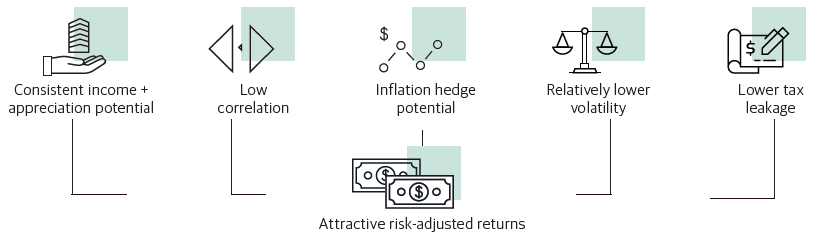
Which brings us to the benefit we care about most as portfolio builders: diversification. Private real estate’s returns have historically shown very low correlation to both stocks and bonds — close to zero against equities and modestly negative against investment-grade and municipal bonds over the past two decades.⁴ In plain terms, it has tended not to move in lockstep with the rest of what you own. It has also historically exhibited lower volatility than either public REITs or the broad equity market, which is part of why it can make an overall portfolio steadier rather than more jittery.⁵
A note of full transparency on that smoothness: part of the reason private real estate looks less volatile than public REITs is that it isn’t repriced every second of every trading day. Appraised values move more slowly than market prices. That smoothing is real and has genuine portfolio benefits, but it is not magic, and we’ll come back to what it means in practice.
The Scale-and-Access Story
Here is something that surprises many clients. The commercial real estate market in the United States is roughly $24 trillion in size, and more than 90% of it is held privately — owned directly by institutions, funds, and individuals rather than packaged into publicly traded REITs.⁶ The public market that most investors can easily reach, in other words, represents only a small slice of the actual opportunity set.
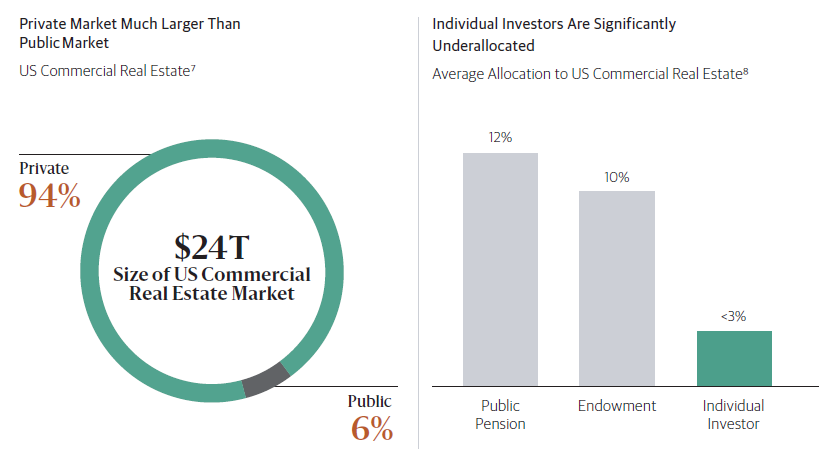
For decades, that left individual investors at a structural disadvantage. Large institutions — pensions, endowments, university funds — have long held meaningful allocations to private real estate, often in the range of 10% to 12% of their portfolios. The typical individual investor, by contrast, has historically held less than 3%, not because the asset class wasn’t worth owning, but because access was genuinely difficult.⁷ Direct private real estate funds were largely the province of institutions and the very wealthy, with high minimums and long lock-ups.
That gap has narrowed considerably, and the reason is structural. A newer generation of fund vehicles — open-end, perpetual, semi-liquid structures, has made the asset class accessible to a far broader set of investors. These funds are built to be held indefinitely rather than wound down on a fixed schedule. Investors can typically subscribe and request redemptions at regular intervals, subject to limits set out in the fund’s documents. Capital goes to work immediately rather than being called in unpredictable pieces, and minimums are far lower than the institutional funds of the past. This is the structure through which we access the asset class for clients, and it is a genuine improvement over the way private real estate used to be owned, with one important caveat we’ll address head-on below.
Where You Invest is Everything
If there is a single idea we want clients to take from this article, it is this: in private real estate, which properties you own matters enormously. This is not an asset class where blanket exposure does the job.
The last several years have made that point vividly. Look at how different property sectors performed cumulatively from 2008 through 2023, and the dispersion is staggering. Industrial and logistics property, the warehouses behind e-commerce, gained well over 100%. Apartments gained roughly 40%. Office, meanwhile, declined by around 20%, and regional malls fared even worse.⁸ Same broad asset class, wildly different outcomes, depending entirely on what you owned.
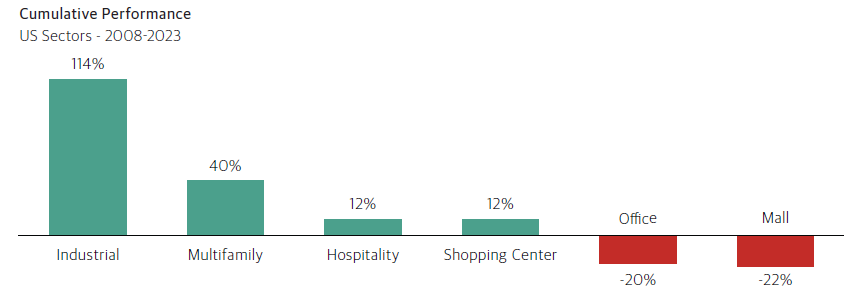
That dispersion is exactly why we favor a thoughtful, actively managed, sector-selective approach rather than buying “real estate” as an undifferentiated block. The properties we want exposure to are the ones riding durable, long-term tailwinds. Three stand out.
- The first is the chronic undersupply of housing in the United States, which has underpinned demand for rental apartments.
- The second is the continued growth of e-commerce and logistics, which keeps demand for modern warehouse and distribution space high.
- The third — and increasingly the one clients ask about — is data centers, where the explosion of cloud computing and artificial intelligence has driven extraordinary growth in the need for the physical infrastructure that stores and processes data. The volume of data created in just the last few years exceeds all of prior history combined, and that data has to live somewhere.⁹
When we talk about owning private real estate “the right way,” this is what we mean: concentrating in the sectors with structural demand behind them, and being equally deliberate about what we avoid.
The Recent Environment, Candidly
You have read the unflattering headlines, and we won’t pretend they don’t exist. The sharp rise in interest rates from 2022 through 2024 was a real shock to commercial real estate. Higher rates raise borrowing costs and pressure property values across the board. Office property, in particular, has faced a genuine structural challenge as hybrid work reduced demand for space. And several large semi-liquid real estate funds, when faced with a wave of redemption requests, limited how much investors could withdraw in a given quarter. These things happened. They matter. Here is how we think about each.
On valuation, the slower repricing of private real estate cuts both ways, and intellectual honesty requires acknowledging both edges. On the way up, appraised values lag market enthusiasm. On the way down, as in 2022–2024, they also lag, which means private real estate marks can stay elevated for a time even as public markets have already repriced lower. We don’t treat that lag as a feature that makes the asset class “safer.” We treat it as a characteristic to understand: NAV-based pricing trades the daily liquidity and transparency of a publicly traded REIT for a smoother, appraisal-based value that may not reflect where a property would trade today. Neither approach is inherently superior; they are different tools, and clients deserve to know which one they’re holding.
On redemption limits, the mechanism that generated those headlines is, perhaps counterintuitively, a protective one. Semi-liquid funds own illiquid buildings but offer periodic liquidity to investors. To bridge that gap responsibly, they cap how much can be redeemed in any single period — commonly a percentage of fund assets per quarter. When more investors ask to exit than the cap allows, the fund limits withdrawals. That can be frustrating, and we don’t minimize it. But the alternative, selling quality buildings into a weak market at fire-sale prices to meet redemptions, would harm the very investors who stayed. The gate exists precisely so that one investor’s desire to leave doesn’t damage everyone who remains. The right response is not to be surprised by it, but to size an allocation appropriately in the first place, holding private real estate with capital you don’t expect to need on short notice. That is a conversation we have with every client before they own a dollar of it.
How We Think About Private Real Estate for our Clients
Private real estate is also worth a brief word on taxes. The asset class has historically carried attractive tax characteristics — depreciation can shelter a portion of the income it generates, and certain structures offer elements of tax deferral. The specifics depend heavily on the vehicle and on your individual situation, so we’d rather discuss your particular circumstances directly than make sweeping claims here.
Pulling it together: we use private real estate because it brings income, inflation sensitivity, and low correlation to a portfolio, with a historically steadier ride than public real estate. We access it through modern semi-liquid structures that have finally made it available to individual investors on reasonable terms.
We are selective about sectors, because the gap between owning the right buildings and the wrong ones has rarely been wider. And we are clear-eyed about the trade-offs — the appraisal lag, the liquidity limits, the rate sensitivity — because an allocation built on a full understanding of those trade-offs is far more durable than one built on a headline, in either direction.
If you already own private real estate with us, we hope this gives you a clearer view of why it’s there. If you don’t, and you’d like to talk through whether it belongs in your portfolio, we’d welcome the conversation.
A Truly Unique Wealth Management Experience
Let’s create a financial plan and investment strategy that allows you to live the life of your dreams. Schedule your free consultation today to explore tailored financial strategies designed to secure your future!
Are We Right for You?
Concerns or questions about how your investment portfolio will hold up in the current market environment? Contact Financial Synergies today.
We are a boutique, financial advisory and total wealth management firm with over 35 years helping clients navigate turbulent markets. To learn more about our approach to investment management please reach out to us. One of our seasoned advisors would be happy to help you build a custom financial plan to help ensure you accomplish your financial goals and objectives. Schedule a conversation with us today.
More relevant articles by Financial Synergies:
Footnotes
¹ Commercial real estate as the third-largest asset class, behind equities and fixed income. As referenced in Blackstone, Essentials of Private Real Estate (Blackstone University, 2024).
² Private real estate delivered an annual income yield above 4% in 16 of the 20 years ending December 31, 2023. Source: NCREIF, reflecting the NFI-ODCE Index, as referenced in Blackstone, Essentials of Private Real Estate (Blackstone University, 2024). Past performance does not predict future returns.
³ Private real estate income has historically kept pace with or outpaced inflation. Source: Morningstar Direct and NCREIF, 20-year period ending December 31, 2023, with inflation represented by the U.S. Consumer Price Index (U.S. Bureau of Labor Statistics), as referenced in Blackstone, Essentials of Private Real Estate (Blackstone University, 2024). Net operating income may not be correlated to or keep pace with inflation.
⁴ Correlations over the 20 years ending December 31, 2023: private real estate to equities approximately 0.0; to investment-grade bonds approximately −0.3; to municipal bonds approximately −0.3. Private real estate represented by the NFI-ODCE Index; equities by the S&P 500 Index; investment-grade bonds by the Bloomberg U.S. Aggregate Bond Index; municipal bonds by the Bloomberg U.S. Municipal Index. Source: Morningstar Direct and NCREIF, as referenced in Blackstone, Essentials of Private Real Estate (Blackstone University, 2024). Index comparisons are for illustrative purposes only; it is not possible to invest directly in an index.
⁵ Private real estate has historically exhibited lower volatility (standard deviation) than public REITs and equities over the 20 years ending December 31, 2023. Public REITs represented by the MSCI U.S. REIT Index; equities by the S&P 500 Index. Source: Morningstar Direct and NCREIF, as referenced in Blackstone, Essentials of Private Real Estate (Blackstone University, 2024). Past performance does not predict future returns.
⁶ The U.S. commercial real estate market is approximately $24 trillion in size, with more than 90% held privately. Source: Federal Reserve, as of June 30, 2023, as referenced in Blackstone, Essentials of Private Real Estate (Blackstone University, 2024).
⁷ Representative average allocations to U.S. commercial real estate: individual investors less than 3%; endowments approximately 10%; public pensions approximately 12%. Individual-investor figure reflects Bain & Company data as of December 31, 2022 (latest available and inclusive of all alternatives, of which real estate is one component); endowment and public-pension figures reflect Hodes Weill & Associates and Cornell Baker Program in Real Estate data as of December 31, 2023. As referenced in Blackstone, Essentials of Private Real Estate (Blackstone University, 2024).
⁸ Cumulative U.S. commercial real estate performance by sector, January 1, 2008 to December 31, 2023: industrial approximately +114%; multifamily approximately +40%; hospitality approximately +12%; shopping center approximately +12%; office approximately −20%; mall approximately −22%. Source: Green Street Advisors, based on the Green Street Commercial Property Price Index. Past performance does not predict future returns.
⁹ Growth in data created, consumed, and stored, with the volume produced in recent years exceeding all of prior history. Source: International Data Corporation (IDC); recent-year figures include estimates, as referenced in Blackstone, Essentials of Private Real Estate (Blackstone University, 2024).
Disclosures
This article is provided for educational and informational purposes only and does not constitute investment, legal, tax, or accounting advice. The views expressed are those of Financial Synergies Wealth Advisors as of the date of publication and are subject to change without notice. Nothing herein should be construed as an offer to sell, or a solicitation of an offer to buy, any security or investment product.
Past performance is not indicative of future results. Any references to historical returns, income yields, index data, or correlation and volatility figures are presented for illustrative purposes only and reflect specific methodologies, time periods, and assumptions that may not be representative of future market conditions. Index comparisons — including those referencing the NFI-ODCE Index, the MSCI U.S. REIT Index, the S&P 500 Index, the Bloomberg U.S. Aggregate Bond Index, and the Bloomberg U.S. Municipal Index — have inherent limitations, employ different guidelines and risk profiles than any private fund, are not subject to fees or expenses, and cannot be invested in directly. They should not be relied upon as predictions of future performance.
Investments in private real estate involve risk and are suitable only for investors who can bear the loss of all or a substantial portion of their investment. Private real estate investments are illiquid, have limited or no secondary market, may involve significant fees and expenses, and typically require medium- to long-term holding periods. Even evergreen and semi-liquid (open-end, perpetual) fund structures impose restrictions on redemptions, including periodic liquidity windows, redemption limits or gates, and the possibility that redemption requests may be limited, suspended, or fulfilled only in part during periods of market stress. Valuations of private real estate holdings are generally based on periodic appraisals, may rely on estimates and imperfect information, and may not reflect realizable values or the prices at which properties could actually be sold. Property values are sensitive to changes in interest rates, financing availability, economic and market conditions, tenant credit and occupancy levels, and the use of leverage. There can be no assurance that any private real estate strategy will achieve its objectives or avoid losses.
Diversification does not ensure a profit or protect against loss in declining markets. Sector, market, and manager selection are critical components of private real estate investing given the wide dispersion of outcomes across property types and managers, and there can be no assurance that any selected sector, strategy, or manager will achieve results comparable to historical industry averages.
References to the tax characteristics of private real estate — including depreciation and any features that may defer or reduce taxable income — are general in nature. The tax treatment of any investment depends on the specific fund or vehicle and on each client’s individual circumstances.
Private real estate investments are generally available only to accredited investors and qualified purchasers as defined under federal securities laws. The suitability of any investment depends on each client’s individual financial circumstances, liquidity needs, time horizon, and goals. Clients should consult with their Financial Synergies advisor before making any investment decision.
Financial Synergies Wealth Advisors is an SEC-registered investment adviser. Registration does not imply any particular level of skill or training. Additional information about our firm, including our investment strategies, fees, and potential conflicts of interest, is available in our Form ADV Part 2A, which is available upon request or at adviserinfo.sec.gov.
Certain data referenced in this article has been obtained from third-party sources believed to be reliable, including Blackstone, NCREIF, Green Street Advisors, Morningstar, Bloomberg, the Federal Reserve, Bain & Company, Hodes Weill & Associates, the Cornell Baker Program in Real Estate, International Data Corporation (IDC), and the U.S. Bureau of Labor Statistics. Financial Synergies has not independently verified this information and makes no representation as to its accuracy or completeness.
 Skip to content


Private Real Estate: Investing Beyond Public REITs
Private real estate has earned a place in many of the portfolios we manage, though not yet in all of them. For clients who already have an allocation, our aim here is to take you a layer deeper — to explain what you actually own when you own private real estate, why we believe it belongs alongside your stocks and bonds, and how we think about it in an environment that has handed the asset class some genuine challenges.
For clients who don’t yet have exposure, consider this a clear-eyed look at one of the largest asset classes in the world, and an honest account of both what it offers and what it asks of you.
We’ll be candid about the headlines, too. You have almost certainly read about stress in commercial real estate, about office towers sitting half-empty, and about some private real estate funds limiting how quickly investors can withdraw their money. None of that is a reason to look away. It is a reason to understand the asset class properly.
What is Private Real Estate
When most people picture real estate as an investment, they think of one of two things: the home they live in, or a publicly traded REIT they can buy in a brokerage account. Private real estate is neither.
It is direct ownership of commercial, income-producing property — the industrial warehouses that fulfill online orders, the apartment communities where families rent, and, selectively, other property types such as data centers, medical offices, and student housing. It deliberately excludes the for-sale residential market: we are not talking about flipping houses or building subdivisions to sell. We are talking about owning durable, cash-generating buildings and collecting the rent that flows from them. Commercial real estate, taken as a whole, is the third-largest asset class in the world, behind only equities and fixed income.¹
The distinction from public REITs is worth pausing on, because it shapes nearly everything that follows. A REIT gives you real estate exposure through a share that trades on a stock exchange. That means its price moves every day with the mood of the market, and historically, public REITs have traded in fairly close step with equities, rising and falling with sentiment that often has little to do with the buildings themselves. Private real estate is owned directly, valued periodically based on the underlying properties and the income they produce, and priced off that net asset value rather than off a ticker. The bricks and mortar are similar; the experience of owning them is quite different.
Why Private Real Estate Earns a Place in Select Portfolios
The reason we use private real estate is not exotic. It does two things a well-constructed portfolio tends to want.
First, it generates income. Over the twenty years through 2023, private real estate delivered an annual income yield above 4% in sixteen of those years — a steady stream of cash flow that comes from tenants paying rent, not from the hope of selling at a higher price later.²
Second, it offers the potential for both that income and the value of the properties themselves to grow over time, particularly when a manager improves a building, raises occupancy, or owns in a market where demand is outrunning supply.
That income stream also has a useful relationship with inflation. Rents reset, leases reprice, and the cost of constructing competing buildings climbs, so historically, private real estate income has tended to keep pace with, and at times outrun, rising prices.³ That is a meaningfully different profile from a traditional bond, whose fixed coupon quietly loses purchasing power as inflation erodes it. We don’t position real estate as a replacement for high-quality bonds, which still do essential work in a portfolio. We position it as something that behaves differently, and that difference is the point.
Which brings us to the benefit we care about most as portfolio builders: diversification. Private real estate’s returns have historically shown very low correlation to both stocks and bonds — close to zero against equities and modestly negative against investment-grade and municipal bonds over the past two decades.⁴ In plain terms, it has tended not to move in lockstep with the rest of what you own. It has also historically exhibited lower volatility than either public REITs or the broad equity market, which is part of why it can make an overall portfolio steadier rather than more jittery.⁵
A note of full transparency on that smoothness: part of the reason private real estate looks less volatile than public REITs is that it isn’t repriced every second of every trading day. Appraised values move more slowly than market prices. That smoothing is real and has genuine portfolio benefits, but it is not magic, and we’ll come back to what it means in practice.
The Scale-and-Access Story
Here is something that surprises many clients. The commercial real estate market in the United States is roughly $24 trillion in size, and more than 90% of it is held privately — owned directly by institutions, funds, and individuals rather than packaged into publicly traded REITs.⁶ The public market that most investors can easily reach, in other words, represents only a small slice of the actual opportunity set.
For decades, that left individual investors at a structural disadvantage. Large institutions — pensions, endowments, university funds — have long held meaningful allocations to private real estate, often in the range of 10% to 12% of their portfolios. The typical individual investor, by contrast, has historically held less than 3%, not because the asset class wasn’t worth owning, but because access was genuinely difficult.⁷ Direct private real estate funds were largely the province of institutions and the very wealthy, with high minimums and long lock-ups.
That gap has narrowed considerably, and the reason is structural. A newer generation of fund vehicles — open-end, perpetual, semi-liquid structures, has made the asset class accessible to a far broader set of investors. These funds are built to be held indefinitely rather than wound down on a fixed schedule. Investors can typically subscribe and request redemptions at regular intervals, subject to limits set out in the fund’s documents. Capital goes to work immediately rather than being called in unpredictable pieces, and minimums are far lower than the institutional funds of the past. This is the structure through which we access the asset class for clients, and it is a genuine improvement over the way private real estate used to be owned, with one important caveat we’ll address head-on below.
Where You Invest is Everything
If there is a single idea we want clients to take from this article, it is this: in private real estate, which properties you own matters enormously. This is not an asset class where blanket exposure does the job.
The last several years have made that point vividly. Look at how different property sectors performed cumulatively from 2008 through 2023, and the dispersion is staggering. Industrial and logistics property, the warehouses behind e-commerce, gained well over 100%. Apartments gained roughly 40%. Office, meanwhile, declined by around 20%, and regional malls fared even worse.⁸ Same broad asset class, wildly different outcomes, depending entirely on what you owned.
That dispersion is exactly why we favor a thoughtful, actively managed, sector-selective approach rather than buying “real estate” as an undifferentiated block. The properties we want exposure to are the ones riding durable, long-term tailwinds. Three stand out.
When we talk about owning private real estate “the right way,” this is what we mean: concentrating in the sectors with structural demand behind them, and being equally deliberate about what we avoid.
The Recent Environment, Candidly
You have read the unflattering headlines, and we won’t pretend they don’t exist. The sharp rise in interest rates from 2022 through 2024 was a real shock to commercial real estate. Higher rates raise borrowing costs and pressure property values across the board. Office property, in particular, has faced a genuine structural challenge as hybrid work reduced demand for space. And several large semi-liquid real estate funds, when faced with a wave of redemption requests, limited how much investors could withdraw in a given quarter. These things happened. They matter. Here is how we think about each.
On valuation, the slower repricing of private real estate cuts both ways, and intellectual honesty requires acknowledging both edges. On the way up, appraised values lag market enthusiasm. On the way down, as in 2022–2024, they also lag, which means private real estate marks can stay elevated for a time even as public markets have already repriced lower. We don’t treat that lag as a feature that makes the asset class “safer.” We treat it as a characteristic to understand: NAV-based pricing trades the daily liquidity and transparency of a publicly traded REIT for a smoother, appraisal-based value that may not reflect where a property would trade today. Neither approach is inherently superior; they are different tools, and clients deserve to know which one they’re holding.
On redemption limits, the mechanism that generated those headlines is, perhaps counterintuitively, a protective one. Semi-liquid funds own illiquid buildings but offer periodic liquidity to investors. To bridge that gap responsibly, they cap how much can be redeemed in any single period — commonly a percentage of fund assets per quarter. When more investors ask to exit than the cap allows, the fund limits withdrawals. That can be frustrating, and we don’t minimize it. But the alternative, selling quality buildings into a weak market at fire-sale prices to meet redemptions, would harm the very investors who stayed. The gate exists precisely so that one investor’s desire to leave doesn’t damage everyone who remains. The right response is not to be surprised by it, but to size an allocation appropriately in the first place, holding private real estate with capital you don’t expect to need on short notice. That is a conversation we have with every client before they own a dollar of it.
How We Think About Private Real Estate for our Clients
Private real estate is also worth a brief word on taxes. The asset class has historically carried attractive tax characteristics — depreciation can shelter a portion of the income it generates, and certain structures offer elements of tax deferral. The specifics depend heavily on the vehicle and on your individual situation, so we’d rather discuss your particular circumstances directly than make sweeping claims here.
Pulling it together: we use private real estate because it brings income, inflation sensitivity, and low correlation to a portfolio, with a historically steadier ride than public real estate. We access it through modern semi-liquid structures that have finally made it available to individual investors on reasonable terms.
We are selective about sectors, because the gap between owning the right buildings and the wrong ones has rarely been wider. And we are clear-eyed about the trade-offs — the appraisal lag, the liquidity limits, the rate sensitivity — because an allocation built on a full understanding of those trade-offs is far more durable than one built on a headline, in either direction.
If you already own private real estate with us, we hope this gives you a clearer view of why it’s there. If you don’t, and you’d like to talk through whether it belongs in your portfolio, we’d welcome the conversation.
A Truly Unique Wealth Management Experience
Let’s create a financial plan and investment strategy that allows you to live the life of your dreams. Schedule your free consultation today to explore tailored financial strategies designed to secure your future!
Concerns or questions about how your investment portfolio will hold up in the current market environment? Contact Financial Synergies today.
We are a boutique, financial advisory and total wealth management firm with over 35 years helping clients navigate turbulent markets. To learn more about our approach to investment management please reach out to us. One of our seasoned advisors would be happy to help you build a custom financial plan to help ensure you accomplish your financial goals and objectives. Schedule a conversation with us today.
More relevant articles by Financial Synergies:
Footnotes
¹ Commercial real estate as the third-largest asset class, behind equities and fixed income. As referenced in Blackstone, Essentials of Private Real Estate (Blackstone University, 2024).
² Private real estate delivered an annual income yield above 4% in 16 of the 20 years ending December 31, 2023. Source: NCREIF, reflecting the NFI-ODCE Index, as referenced in Blackstone, Essentials of Private Real Estate (Blackstone University, 2024). Past performance does not predict future returns.
³ Private real estate income has historically kept pace with or outpaced inflation. Source: Morningstar Direct and NCREIF, 20-year period ending December 31, 2023, with inflation represented by the U.S. Consumer Price Index (U.S. Bureau of Labor Statistics), as referenced in Blackstone, Essentials of Private Real Estate (Blackstone University, 2024). Net operating income may not be correlated to or keep pace with inflation.
⁴ Correlations over the 20 years ending December 31, 2023: private real estate to equities approximately 0.0; to investment-grade bonds approximately −0.3; to municipal bonds approximately −0.3. Private real estate represented by the NFI-ODCE Index; equities by the S&P 500 Index; investment-grade bonds by the Bloomberg U.S. Aggregate Bond Index; municipal bonds by the Bloomberg U.S. Municipal Index. Source: Morningstar Direct and NCREIF, as referenced in Blackstone, Essentials of Private Real Estate (Blackstone University, 2024). Index comparisons are for illustrative purposes only; it is not possible to invest directly in an index.
⁵ Private real estate has historically exhibited lower volatility (standard deviation) than public REITs and equities over the 20 years ending December 31, 2023. Public REITs represented by the MSCI U.S. REIT Index; equities by the S&P 500 Index. Source: Morningstar Direct and NCREIF, as referenced in Blackstone, Essentials of Private Real Estate (Blackstone University, 2024). Past performance does not predict future returns.
⁶ The U.S. commercial real estate market is approximately $24 trillion in size, with more than 90% held privately. Source: Federal Reserve, as of June 30, 2023, as referenced in Blackstone, Essentials of Private Real Estate (Blackstone University, 2024).
⁷ Representative average allocations to U.S. commercial real estate: individual investors less than 3%; endowments approximately 10%; public pensions approximately 12%. Individual-investor figure reflects Bain & Company data as of December 31, 2022 (latest available and inclusive of all alternatives, of which real estate is one component); endowment and public-pension figures reflect Hodes Weill & Associates and Cornell Baker Program in Real Estate data as of December 31, 2023. As referenced in Blackstone, Essentials of Private Real Estate (Blackstone University, 2024).
⁸ Cumulative U.S. commercial real estate performance by sector, January 1, 2008 to December 31, 2023: industrial approximately +114%; multifamily approximately +40%; hospitality approximately +12%; shopping center approximately +12%; office approximately −20%; mall approximately −22%. Source: Green Street Advisors, based on the Green Street Commercial Property Price Index. Past performance does not predict future returns.
⁹ Growth in data created, consumed, and stored, with the volume produced in recent years exceeding all of prior history. Source: International Data Corporation (IDC); recent-year figures include estimates, as referenced in Blackstone, Essentials of Private Real Estate (Blackstone University, 2024).
Disclosures
This article is provided for educational and informational purposes only and does not constitute investment, legal, tax, or accounting advice. The views expressed are those of Financial Synergies Wealth Advisors as of the date of publication and are subject to change without notice. Nothing herein should be construed as an offer to sell, or a solicitation of an offer to buy, any security or investment product.
Past performance is not indicative of future results. Any references to historical returns, income yields, index data, or correlation and volatility figures are presented for illustrative purposes only and reflect specific methodologies, time periods, and assumptions that may not be representative of future market conditions. Index comparisons — including those referencing the NFI-ODCE Index, the MSCI U.S. REIT Index, the S&P 500 Index, the Bloomberg U.S. Aggregate Bond Index, and the Bloomberg U.S. Municipal Index — have inherent limitations, employ different guidelines and risk profiles than any private fund, are not subject to fees or expenses, and cannot be invested in directly. They should not be relied upon as predictions of future performance.
Investments in private real estate involve risk and are suitable only for investors who can bear the loss of all or a substantial portion of their investment. Private real estate investments are illiquid, have limited or no secondary market, may involve significant fees and expenses, and typically require medium- to long-term holding periods. Even evergreen and semi-liquid (open-end, perpetual) fund structures impose restrictions on redemptions, including periodic liquidity windows, redemption limits or gates, and the possibility that redemption requests may be limited, suspended, or fulfilled only in part during periods of market stress. Valuations of private real estate holdings are generally based on periodic appraisals, may rely on estimates and imperfect information, and may not reflect realizable values or the prices at which properties could actually be sold. Property values are sensitive to changes in interest rates, financing availability, economic and market conditions, tenant credit and occupancy levels, and the use of leverage. There can be no assurance that any private real estate strategy will achieve its objectives or avoid losses.
Diversification does not ensure a profit or protect against loss in declining markets. Sector, market, and manager selection are critical components of private real estate investing given the wide dispersion of outcomes across property types and managers, and there can be no assurance that any selected sector, strategy, or manager will achieve results comparable to historical industry averages.
References to the tax characteristics of private real estate — including depreciation and any features that may defer or reduce taxable income — are general in nature. The tax treatment of any investment depends on the specific fund or vehicle and on each client’s individual circumstances.
Private real estate investments are generally available only to accredited investors and qualified purchasers as defined under federal securities laws. The suitability of any investment depends on each client’s individual financial circumstances, liquidity needs, time horizon, and goals. Clients should consult with their Financial Synergies advisor before making any investment decision.
Financial Synergies Wealth Advisors is an SEC-registered investment adviser. Registration does not imply any particular level of skill or training. Additional information about our firm, including our investment strategies, fees, and potential conflicts of interest, is available in our Form ADV Part 2A, which is available upon request or at adviserinfo.sec.gov.
Certain data referenced in this article has been obtained from third-party sources believed to be reliable, including Blackstone, NCREIF, Green Street Advisors, Morningstar, Bloomberg, the Federal Reserve, Bain & Company, Hodes Weill & Associates, the Cornell Baker Program in Real Estate, International Data Corporation (IDC), and the U.S. Bureau of Labor Statistics. Financial Synergies has not independently verified this information and makes no representation as to its accuracy or completeness.
Recent Posts
Weekly Market Recap – September Inflation & Retail Sales Data, AI Financing, & Bank Earnings
Happy Birthday to the Bull Market
Quarterly Webinar: Q4 2026 Market and Economic Themes
Subscribe to Our Blog
Chief Investment Officer | Managing Partner