Global events have been at the center of financial market activity, with high oil prices, geopolitics, and new tariff rules capturing investor attention. Behind many of these trends, however, is the level of the U.S. dollar. While currency movements have received less attention in recent weeks, they continue to have important effects on portfolios by influencing international investments, commodities like gold, and the broader economic environment.
One of the key developments over the past few years has been the decline of the dollar from its 2022 peak. More recently, however, the dollar has partially rebounded, reflecting its role as a safe-haven asset during periods of geopolitical stress.
So, what does this mean for investors, and how does it connect to the performance of other assets like international stocks and precious metals? Understanding this can help us maintain perspective and keep portfolios positioned to achieve financial goals.
Three facts investors should know about the dollar
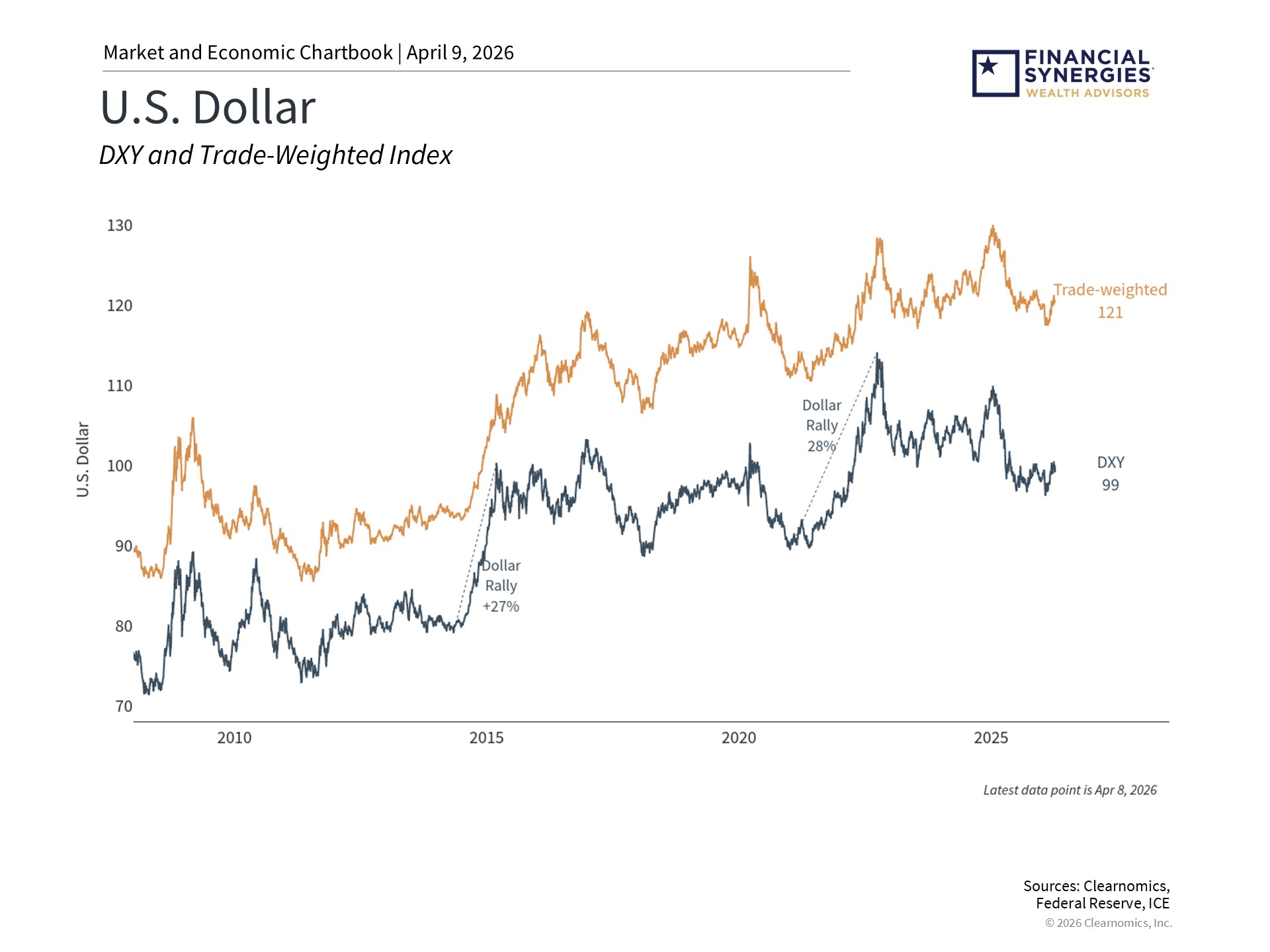
After reaching its 2022 peak around 114 based on the dollar index (DXY), the dollar weakened as global growth stabilized and investors began looking beyond U.S. assets for opportunities. This trend accelerated last year when tariffs pushed the dollar below 100 for the first time in three years. The dollar has rebounded somewhat this year as geopolitical concerns have driven investors toward safe-haven assets. Taking a longer-term perspective, it’s also easy to see that the dollar is stronger than it has been historically, even if it is below its all-time high.
There are three important facts to understand about the dollar in the current market environment. First, a stronger dollar is not always ideal. From the perspective of everyday consumers, it’s natural to prefer a favorable exchange rate since this makes imported goods and international travel more affordable. However, this is only one side of the equation.
A strong dollar can also create challenges for businesses that compete globally, since their products become more expensive for overseas buyers. This is one reason many countries have historically been accused of keeping their currencies artificially weak, since doing so provides a competitive advantage for their goods and services relative to those of other countries. So, the ideal currency level is one that reflects a balance between the needs of consumers, businesses, and the broader economy.
Second, from a macroeconomic perspective, the value of the dollar is based on many global factors including differences in interest rates, trade, fiscal policy, and more. These factors have changed considerably over the past few years as the Fed shifted from aggressive rate hikes to cuts and now to a pause, alongside the implementation of new tariffs.
Interestingly, last year’s tariffs did not strengthen the dollar in a way that would be predicted by economic theory, but did the opposite. This is partly due to the so-called “debasement trade,” or the idea that the government might implement policies that weaken the economic position of the dollar over time. This includes persistent fiscal deficits that will likely come back into focus later this year due to ongoing budget talks in Washington and the November midterm election.
Third, since late January, the dollar has risen from its lows as geopolitical tensions have encouraged investors to seek safety in dollar-denominated assets. The currency’s recent rebound is a reminder that during periods of global stress, the dollar and U.S. Treasuries tend to attract capital. This reflects the fact that the dollar is still the world’s most important currency, especially during uncertain periods.
The dollar still accounts for most global currency reserves and is used in a large share of international transactions. While there are always concerns about the dollar losing its reserve currency status, this is nothing new. Similar questions arose during Japan’s rise in the 1980s, after the introduction of the euro in the early 2000s, the rapid growth of China’s economy, and more recently amid the growth of digital currencies. And while this may slowly change over time, investors still often return to the dollar in challenging periods.
A weaker dollar has supported international stock returns
One of the effects of the dollar’s decline over the past year has been its impact on international stock market returns. In 2025, both developed and emerging market equities delivered strong performance, with the MSCI EAFE index returning 31.9% and the MSCI EM index returning 34.4% in U.S. dollar terms. These were both well ahead of the S&P 500, highlighting the importance of diversifying internationally.
To understand why currencies matter, it helps to consider how international investments work for a U.S.-based investor. When you invest in international stocks, those assets are priced in local currencies, which means that you are essentially holding those currencies. If the dollar weakens, the same amount of those currencies converts back into more dollars. So, currency movements are an important component of international returns, in addition to the returns of the underlying assets.
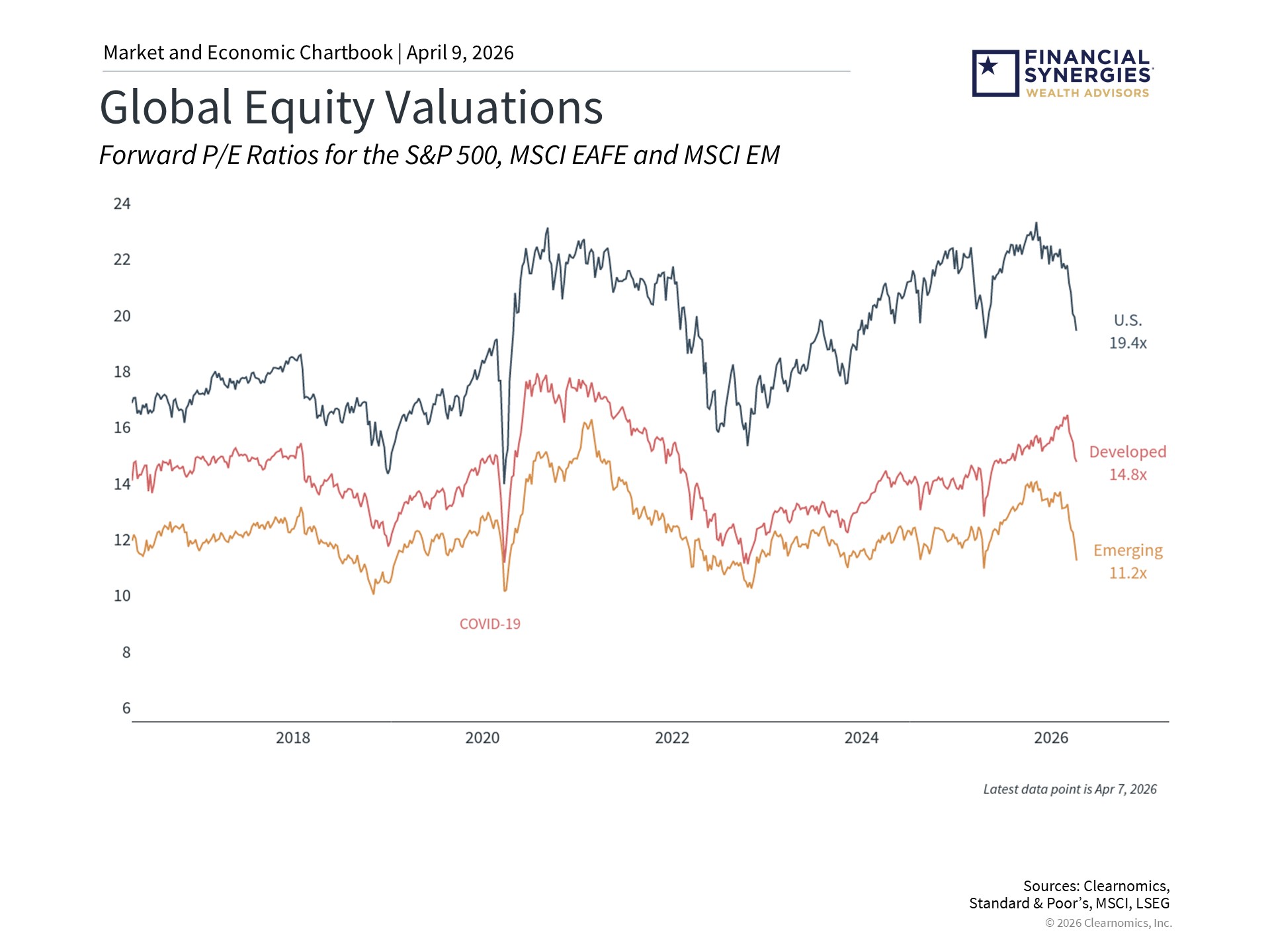
Beyond currency effects, valuations also play an important role. International markets have traded at a meaningful discount to U.S. equities for some time, with developed markets trading with a price-to-earnings ratio of 14.9x and emerging markets 11.8x, compared to 19.9x for the S&P 500. This does not predict returns over the short run and is thus not a timing indicator. Instead, this difference in valuations is an important input into constructing balanced portfolios when deciding how to weigh different assets.
So far in 2026, international markets have continued to modestly outperform the S&P 500, even as the dollar has partially recovered. Both developed and emerging markets are up slightly on the year, whereas U.S. indices are somewhat negative. While the current market situation is still evolving, this is a meaningful change after years in which U.S. equities consistently led global markets, leading some investors to question the value of international diversification. For long-term investors, this reinforces the idea that asset class leadership rotates over time and that maintaining global exposure can improve the consistency of portfolio outcomes.
Gold has pulled back alongside other asset classes
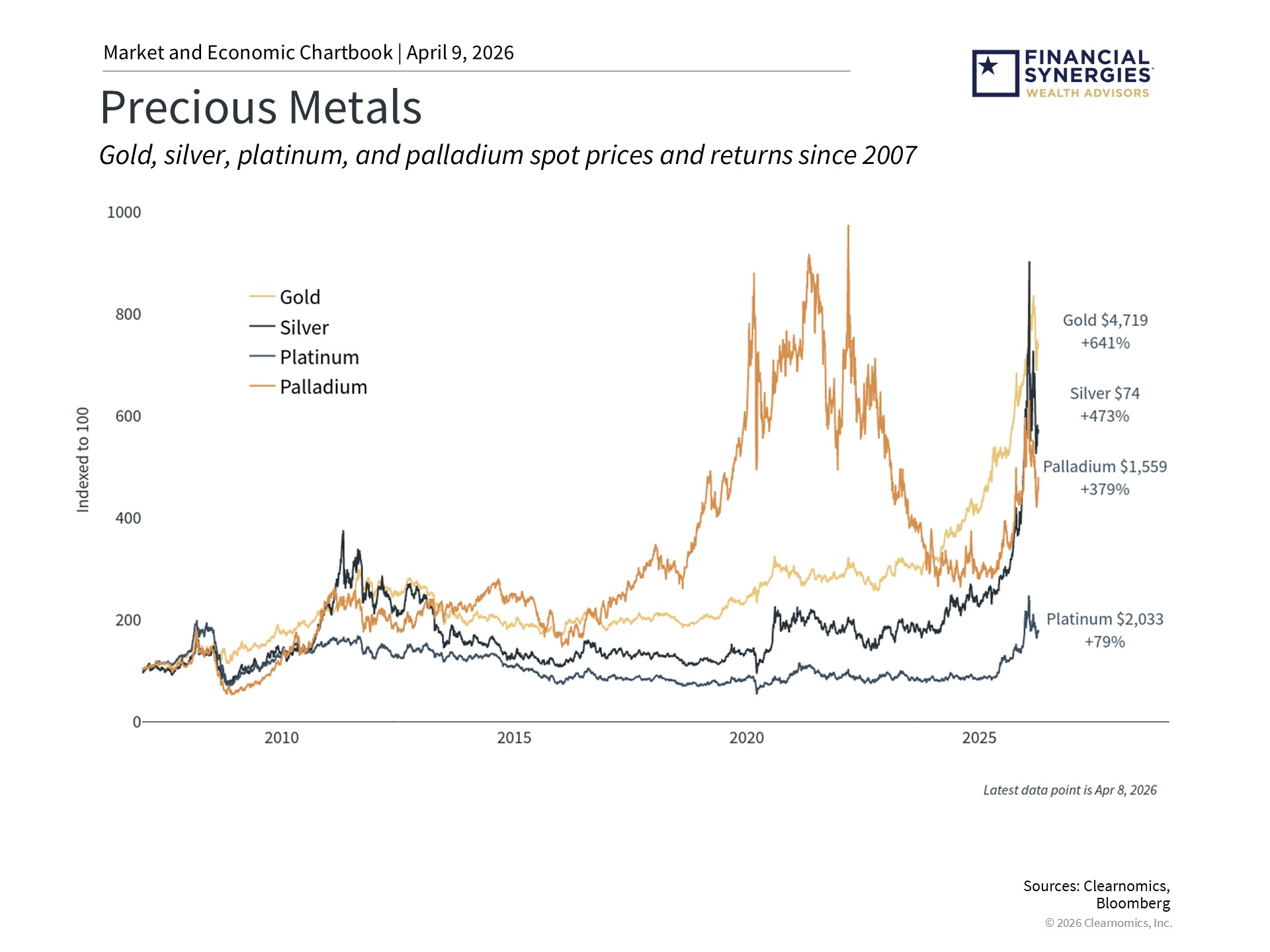
Gold has understandably been one of the most discussed assets over the past few years. Rising fiscal deficits, easing monetary policy, geopolitical tensions, and concerns about currency debasement all fit the narrative for gold. These factors contributed to a strong multi-year rally that pushed prices to all-time highs as recently as late January when gold reached $5,417 per ounce.
Since then, gold has declined roughly 14% from that peak, even as geopolitical uncertainty has remained elevated and many other factors remain in place. This might seem puzzling to investors who hold gold specifically as a safe-haven asset.
Part of the explanation is that gold had already attracted significant investor interest during its latest rally. As more investors buy gold in anticipation of continued gains, it’s natural for its price movements to correlate more closely with other assets. For example, when markets experience stress, gold may be sold alongside stocks rather than behaving independently, especially as investors have shifted back to the dollar. This is one reason the decline in gold has coincided with strength in the dollar.
This is not the first time gold has behaved this way. Between 2011 and 2020, gold was essentially flat, even as the Federal Reserve maintained accommodative monetary policy for much of that period and financial markets experienced several bouts of significant uncertainty. It was also relatively flat during the inflationary period from 2022 to early 2024, which would have normally been considered positive for gold. However, the Fed raised rates rapidly, increasing the attractiveness of cash and other short-term assets.
As always, the more useful lens is to view the dollar, international investments, and gold as parts of an overall portfolio rather than as standalone investments. The value of these assets is in the fact that they behave differently than stocks and bonds, and thus help to stabilize portfolios over time.
Concerns or questions about how your investment portfolio will hold up in the current market environment? Contact Financial Synergies today.
We are a boutique, financial advisory and total wealth management firm with over 35 years helping clients navigate turbulent markets. To learn more about our approach to investment management please reach out to us. One of our seasoned advisors would be happy to help you build a custom financial plan to help ensure you accomplish your financial goals and objectives. Schedule a conversation with us today.
More relevant articles by Financial Synergies:
Blog Disclosures
This content, which may contain security-related opinions and/or information, is provided for informational purposes only and should not be relied upon in any manner as professional advice, or an endorsement of any practices, products or services. There can be no guarantees or assurances that the views expressed here will be applicable for any particular facts or circumstances, and should not be relied upon in any manner. You should consult your own financial advisors as to legal, business, tax, and other related matters concerning any investment.
The commentary in this “post” (including any related blogs, videos, and social media) reflects the personal opinions, viewpoints, and analyses of the Financial Synergies Wealth Advisors, Inc. employees providing such comments, and should not be regarded as the views of Financial Synergies Wealth Advisors, Inc. or its respective affiliates or as a description of advisory services provided by Financial Synergies Wealth Advisors, Inc. or performance returns of any Financial Synergies Wealth Advisors, Inc. client.
Any opinions expressed herein do not constitute or imply endorsement, sponsorship, or recommendation by Financial Synergies Wealth Advisors, Inc. or its employees. The views reflected in the commentary are subject to change at any time without notice.
Nothing on this website or Blog constitutes investment or financial planning advice, performance data or any recommendation that any particular security, portfolio of securities, transaction or investment strategy is suitable for any specific person. It also should not be construed as an offer soliciting the purchase or sale of any security mentioned. Nor should it be construed as an offer to provide investment advisory services by Financial Synergies Wealth Advisors, Inc.
Any mention of a particular security and related performance data is not a recommendation to buy or sell that security. Financial Synergies Wealth Advisors, Inc. manages its clients’ accounts using a variety of investment techniques and strategies, which are not necessarily discussed in the commentary. Investments in securities involve the risk of loss. Past performance is no guarantee of future results.
Any charts provided here or on any related Financial Synergies Wealth Advisors, Inc. personnel content outlets are for informational purposes only, and should also not be relied upon when making any investment decision. Any indices referenced for comparison are unmanaged and cannot be invested into directly. As always please remember investing involves risk and possible loss of principal capital; please seek advice from a licensed professional. Any projections, estimates, forecasts, targets, prospects and/or opinions expressed in these materials are subject to change without notice and may differ or be contrary to opinions expressed by others. Information in charts have been obtained from third-party sources and data, and may include those from portfolio securities of funds managed by Financial Synergies Wealth Advisors, Inc. While taken from sources believed to be reliable, Financial Synergies Wealth Advisors, Inc. has not independently verified such information and makes no representations about the enduring accuracy of the information or its appropriateness for a given situation. All content speaks only as of the date indicated.
Financial Synergies Wealth Advisors, Inc. is a registered investment adviser. Advisory services are only offered to clients or prospective clients where Financial Synergies Wealth Advisors, Inc. and its representatives are properly licensed or exempt from licensure. Investments in securities involve the risk of loss. Past performance is no guarantee of future results.
See Full Disclosures Page Here
 Skip to content


Global Portfolio Perspectives on the Dollar, Gold, and International Stocks
Global events have been at the center of financial market activity, with high oil prices, geopolitics, and new tariff rules capturing investor attention. Behind many of these trends, however, is the level of the U.S. dollar. While currency movements have received less attention in recent weeks, they continue to have important effects on portfolios by influencing international investments, commodities like gold, and the broader economic environment.
One of the key developments over the past few years has been the decline of the dollar from its 2022 peak. More recently, however, the dollar has partially rebounded, reflecting its role as a safe-haven asset during periods of geopolitical stress.
So, what does this mean for investors, and how does it connect to the performance of other assets like international stocks and precious metals? Understanding this can help us maintain perspective and keep portfolios positioned to achieve financial goals.
Three facts investors should know about the dollar
After reaching its 2022 peak around 114 based on the dollar index (DXY), the dollar weakened as global growth stabilized and investors began looking beyond U.S. assets for opportunities. This trend accelerated last year when tariffs pushed the dollar below 100 for the first time in three years. The dollar has rebounded somewhat this year as geopolitical concerns have driven investors toward safe-haven assets. Taking a longer-term perspective, it’s also easy to see that the dollar is stronger than it has been historically, even if it is below its all-time high.
There are three important facts to understand about the dollar in the current market environment. First, a stronger dollar is not always ideal. From the perspective of everyday consumers, it’s natural to prefer a favorable exchange rate since this makes imported goods and international travel more affordable. However, this is only one side of the equation.
A strong dollar can also create challenges for businesses that compete globally, since their products become more expensive for overseas buyers. This is one reason many countries have historically been accused of keeping their currencies artificially weak, since doing so provides a competitive advantage for their goods and services relative to those of other countries. So, the ideal currency level is one that reflects a balance between the needs of consumers, businesses, and the broader economy.
Second, from a macroeconomic perspective, the value of the dollar is based on many global factors including differences in interest rates, trade, fiscal policy, and more. These factors have changed considerably over the past few years as the Fed shifted from aggressive rate hikes to cuts and now to a pause, alongside the implementation of new tariffs.
Interestingly, last year’s tariffs did not strengthen the dollar in a way that would be predicted by economic theory, but did the opposite. This is partly due to the so-called “debasement trade,” or the idea that the government might implement policies that weaken the economic position of the dollar over time. This includes persistent fiscal deficits that will likely come back into focus later this year due to ongoing budget talks in Washington and the November midterm election.
Third, since late January, the dollar has risen from its lows as geopolitical tensions have encouraged investors to seek safety in dollar-denominated assets. The currency’s recent rebound is a reminder that during periods of global stress, the dollar and U.S. Treasuries tend to attract capital. This reflects the fact that the dollar is still the world’s most important currency, especially during uncertain periods.
The dollar still accounts for most global currency reserves and is used in a large share of international transactions. While there are always concerns about the dollar losing its reserve currency status, this is nothing new. Similar questions arose during Japan’s rise in the 1980s, after the introduction of the euro in the early 2000s, the rapid growth of China’s economy, and more recently amid the growth of digital currencies. And while this may slowly change over time, investors still often return to the dollar in challenging periods.
A weaker dollar has supported international stock returns
One of the effects of the dollar’s decline over the past year has been its impact on international stock market returns. In 2025, both developed and emerging market equities delivered strong performance, with the MSCI EAFE index returning 31.9% and the MSCI EM index returning 34.4% in U.S. dollar terms. These were both well ahead of the S&P 500, highlighting the importance of diversifying internationally.
To understand why currencies matter, it helps to consider how international investments work for a U.S.-based investor. When you invest in international stocks, those assets are priced in local currencies, which means that you are essentially holding those currencies. If the dollar weakens, the same amount of those currencies converts back into more dollars. So, currency movements are an important component of international returns, in addition to the returns of the underlying assets.
Beyond currency effects, valuations also play an important role. International markets have traded at a meaningful discount to U.S. equities for some time, with developed markets trading with a price-to-earnings ratio of 14.9x and emerging markets 11.8x, compared to 19.9x for the S&P 500. This does not predict returns over the short run and is thus not a timing indicator. Instead, this difference in valuations is an important input into constructing balanced portfolios when deciding how to weigh different assets.
So far in 2026, international markets have continued to modestly outperform the S&P 500, even as the dollar has partially recovered. Both developed and emerging markets are up slightly on the year, whereas U.S. indices are somewhat negative. While the current market situation is still evolving, this is a meaningful change after years in which U.S. equities consistently led global markets, leading some investors to question the value of international diversification. For long-term investors, this reinforces the idea that asset class leadership rotates over time and that maintaining global exposure can improve the consistency of portfolio outcomes.
Gold has pulled back alongside other asset classes
Gold has understandably been one of the most discussed assets over the past few years. Rising fiscal deficits, easing monetary policy, geopolitical tensions, and concerns about currency debasement all fit the narrative for gold. These factors contributed to a strong multi-year rally that pushed prices to all-time highs as recently as late January when gold reached $5,417 per ounce.
Since then, gold has declined roughly 14% from that peak, even as geopolitical uncertainty has remained elevated and many other factors remain in place. This might seem puzzling to investors who hold gold specifically as a safe-haven asset.
Part of the explanation is that gold had already attracted significant investor interest during its latest rally. As more investors buy gold in anticipation of continued gains, it’s natural for its price movements to correlate more closely with other assets. For example, when markets experience stress, gold may be sold alongside stocks rather than behaving independently, especially as investors have shifted back to the dollar. This is one reason the decline in gold has coincided with strength in the dollar.
This is not the first time gold has behaved this way. Between 2011 and 2020, gold was essentially flat, even as the Federal Reserve maintained accommodative monetary policy for much of that period and financial markets experienced several bouts of significant uncertainty. It was also relatively flat during the inflationary period from 2022 to early 2024, which would have normally been considered positive for gold. However, the Fed raised rates rapidly, increasing the attractiveness of cash and other short-term assets.
As always, the more useful lens is to view the dollar, international investments, and gold as parts of an overall portfolio rather than as standalone investments. The value of these assets is in the fact that they behave differently than stocks and bonds, and thus help to stabilize portfolios over time.
Concerns or questions about how your investment portfolio will hold up in the current market environment? Contact Financial Synergies today.
We are a boutique, financial advisory and total wealth management firm with over 35 years helping clients navigate turbulent markets. To learn more about our approach to investment management please reach out to us. One of our seasoned advisors would be happy to help you build a custom financial plan to help ensure you accomplish your financial goals and objectives. Schedule a conversation with us today.
More relevant articles by Financial Synergies:
Blog Disclosures
This content, which may contain security-related opinions and/or information, is provided for informational purposes only and should not be relied upon in any manner as professional advice, or an endorsement of any practices, products or services. There can be no guarantees or assurances that the views expressed here will be applicable for any particular facts or circumstances, and should not be relied upon in any manner. You should consult your own financial advisors as to legal, business, tax, and other related matters concerning any investment.
The commentary in this “post” (including any related blogs, videos, and social media) reflects the personal opinions, viewpoints, and analyses of the Financial Synergies Wealth Advisors, Inc. employees providing such comments, and should not be regarded as the views of Financial Synergies Wealth Advisors, Inc. or its respective affiliates or as a description of advisory services provided by Financial Synergies Wealth Advisors, Inc. or performance returns of any Financial Synergies Wealth Advisors, Inc. client.
Any opinions expressed herein do not constitute or imply endorsement, sponsorship, or recommendation by Financial Synergies Wealth Advisors, Inc. or its employees. The views reflected in the commentary are subject to change at any time without notice.
Nothing on this website or Blog constitutes investment or financial planning advice, performance data or any recommendation that any particular security, portfolio of securities, transaction or investment strategy is suitable for any specific person. It also should not be construed as an offer soliciting the purchase or sale of any security mentioned. Nor should it be construed as an offer to provide investment advisory services by Financial Synergies Wealth Advisors, Inc.
Any mention of a particular security and related performance data is not a recommendation to buy or sell that security. Financial Synergies Wealth Advisors, Inc. manages its clients’ accounts using a variety of investment techniques and strategies, which are not necessarily discussed in the commentary. Investments in securities involve the risk of loss. Past performance is no guarantee of future results.
Any charts provided here or on any related Financial Synergies Wealth Advisors, Inc. personnel content outlets are for informational purposes only, and should also not be relied upon when making any investment decision. Any indices referenced for comparison are unmanaged and cannot be invested into directly. As always please remember investing involves risk and possible loss of principal capital; please seek advice from a licensed professional. Any projections, estimates, forecasts, targets, prospects and/or opinions expressed in these materials are subject to change without notice and may differ or be contrary to opinions expressed by others. Information in charts have been obtained from third-party sources and data, and may include those from portfolio securities of funds managed by Financial Synergies Wealth Advisors, Inc. While taken from sources believed to be reliable, Financial Synergies Wealth Advisors, Inc. has not independently verified such information and makes no representations about the enduring accuracy of the information or its appropriateness for a given situation. All content speaks only as of the date indicated.
Financial Synergies Wealth Advisors, Inc. is a registered investment adviser. Advisory services are only offered to clients or prospective clients where Financial Synergies Wealth Advisors, Inc. and its representatives are properly licensed or exempt from licensure. Investments in securities involve the risk of loss. Past performance is no guarantee of future results.
See Full Disclosures Page Here
Recent Posts
Happy Birthday to the Bull Market 🎉
Quarterly Webinar: Q4 2026 Market and Economic Themes
Medicare Open Enrollment 2026: What to Know
Subscribe to Our Blog
Chief Investment Officer | Managing Partner