It has now been more than three-and-a-half years since the bull market began in October 2022. At that time, inflation was rising at its fastest pace in fifty years, the Fed was hiking interest rates, and ChatGPT was still a month away from being released to the public. Since then, the S&P 500 has more than doubled in value and the Bloomberg U.S. Aggregate Bond index has fully recovered.
Although the world has changed since then, the fact that there are market concerns in the headlines has not. Each cycle brings new challenges and questions about whether the tried-and-true rules of investing are still relevant. The reality is that each cycle is unique, with catalysts, innovations, and sources of uncertainty that are never quite the same. And yet, the underlying principles of investing and financial planning have remained consistent across decades, and have continued to point investors in the right direction this year.
Bull markets climb a wall of worry

Even though geopolitics continue to impact markets, perhaps the more important consideration for long-term investors is the overall market cycle. With the market hovering near all-time highs, it’s natural for some investors to worry about market pullbacks and corrections. After all, these events can occur frequently, with the S&P 500 historically experiencing four or five pullbacks of 5% or worse each year, on average.1
While they are never pleasant, long-term investing depends much more on historical patterns over years and decades. This is one reason that overreacting to market swings can be counterproductive, since it may leave investors poorly positioned in the context of their long-term financial goals.
Investors often say that the market climbs a “wall of worry” on a regular basis. Over the past several years, markets have overcome high inflation, a banking crisis in 2023, geopolitical conflicts, the possibility of a Fed policy error, AI-related market concentration, tariff-driven volatility, and much more. None of these concerns are trivial and yet, through all of them, the market has performed well.
The chart above helps to illustrate this pattern starting from World War II. Over this 70-year period, bull markets have lasted far longer and generated larger gains than what’s lost in bear markets. Specifically, bear markets have typically lasted one to two years on average, whereas recent bull markets have run as long as ten years or longer. Even when market corrections occur during bull markets, the average decline is 14%, with the average recovery requiring just four months.2
For instance, the bull market cycle that followed the 2008 financial crisis lasted nearly eleven years. Despite this, it is often referred to as “the most unloved bull market” since there was a constant stream of market and economic concerns. In hindsight, it’s easy to see that even when these concerns were legitimate, such as around the state of the economic recovery or the size of the national debt, they didn’t justify changes to long-term portfolios.
Of course, the past is no guarantee of future results, and how quickly markets rebound depends on the specific circumstances. But the historical record makes it clear that trying to react to every market move has, more often than not, caused investors to miss much of the gains that eventually followed.
A growing economy is the foundation for long run returns
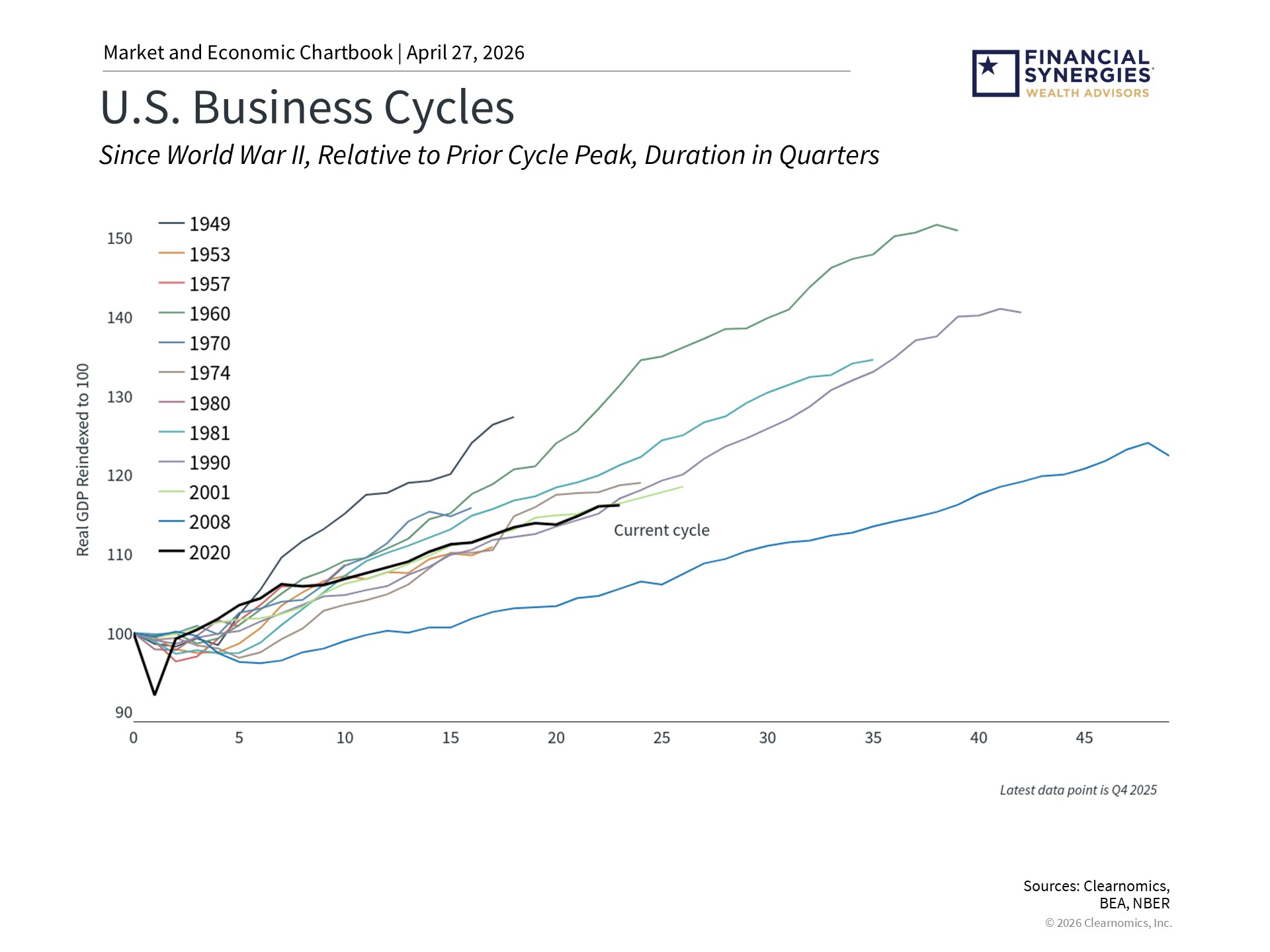
While the stock market and the economy are not the same thing, they are connected. Corporate earnings drive stock prices in the long run and ultimately depend on economic growth. This is why it is important to keep an eye on the broader economic cycle, even as markets move on a day-to-day basis for many other reasons.
The current business cycle has technically been running two-and-a-half years longer than the market cycle. The last official recession, as determined by the National Bureau of Economic Research, was the brief but sharp response to the pandemic in 2020. Since then, there have been quarters of slower growth and occasional predictions about recessions, none of which have taken shape.
Today, the economy is healthy by many measures despite three key areas that investors are watching carefully. First, oil prices above $100 per barrel, if sustained, could weigh on consumer spending and add to inflationary pressures. Second, the job market has slowed significantly, especially in areas such as technology. This raises questions about consumer spending, which has been robust over the past several years. Third, the size and scale of AI investments have raised questions about whether there is a “bubble.” This is understandable since many of today’s investors have lived through both the dot-com bust and the housing crisis.
Bubbles are notoriously difficult to identify in real time, and history shows that not every period of high valuations ends in a dramatic collapse. So far in this cycle, unlike in past periods, earnings growth has supported valuations and many companies are making outsized investments out of their profits. For long-term investors, the key consideration is staying balanced across different parts of the market to benefit from growth while managing risk.
Stocks and bonds continue to work together
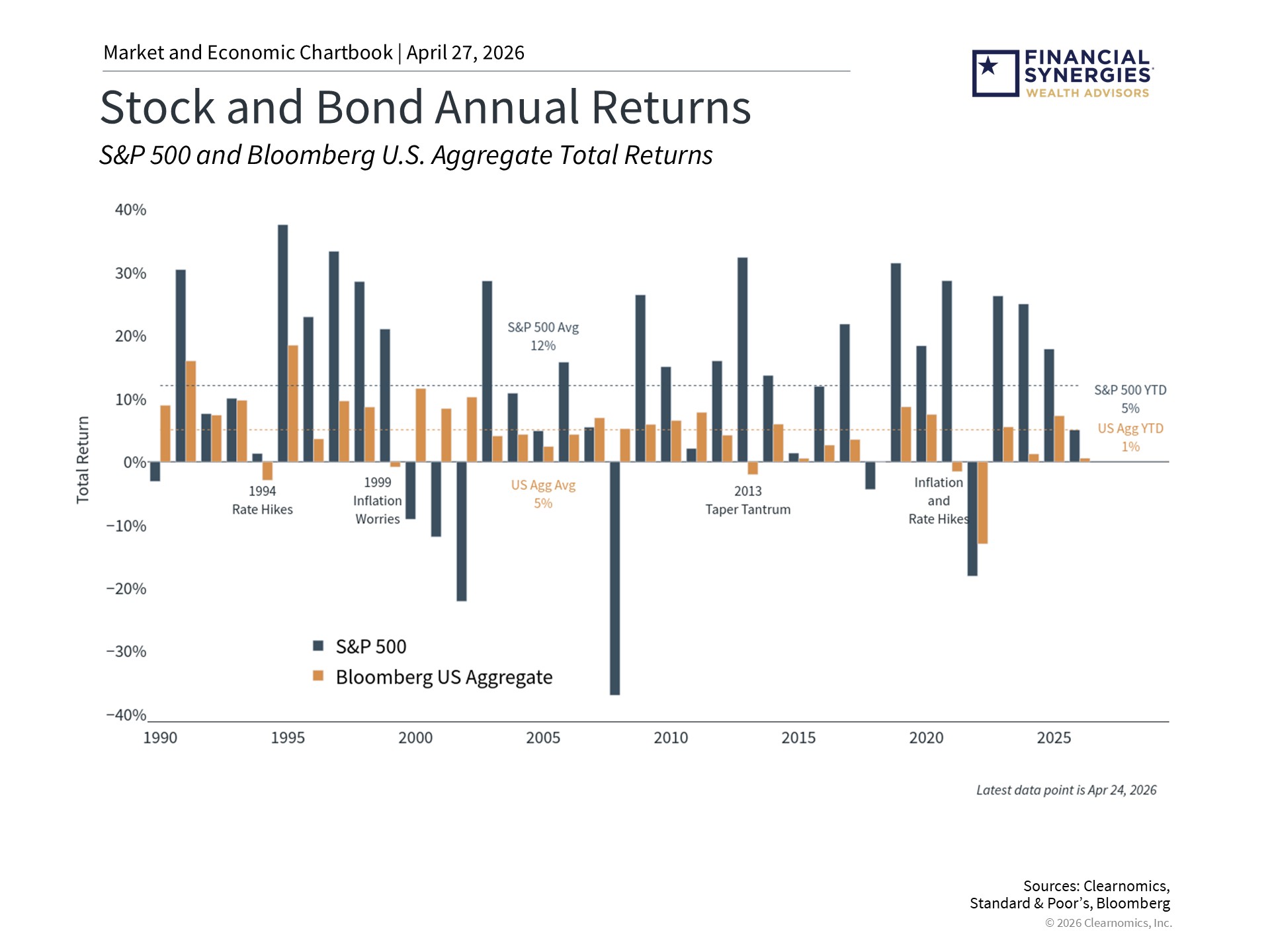
Every cycle naturally raises questions about whether traditional principles of portfolio management still apply. In 2022, when both stocks and bonds declined simultaneously due to rapidly rising inflation and interest rates, some investors wondered whether bonds still served a meaningful purpose in a diversified portfolio. This was true after the 2008 financial crisis as well, when bonds struggled due to historically low interest rates.
Over the past few years, bonds have not only recovered, but also provide meaningful income and portfolio balance. The Bloomberg U.S. Aggregate Bond Index has delivered positive returns in each of the past two years, helping to offset periods of equity volatility. International stocks and commodities have also contributed, providing additional diversification benefits.
This pattern is consistent with what history shows across cycles. Every period seems to raise the question of whether “this time is different” when it comes to the relationship between asset classes. In the 1970s, inflation challenged traditional portfolios. In the dot-com era, technology stocks became extremely popular, despite a lack of corporate profits, making other sectors appear boring. In 2022, rising rates created simultaneous pressure on both stocks and bonds. There are echoes of all of these challenges today.
Each time, focusing on the principles of diversification and long-term investing has proven to be the right approach. As uncertainty continues and new headlines cause markets to swing, it’s more important than ever to focus on the bigger picture.
More than three-and-a-half years into this bull market, the underlying principles of long-term investing remain as relevant as ever. Markets have consistently rewarded those who maintain balanced portfolios and stay focused on their long-term financial goals.
Footnotes
1. The number of pullbacks is based on S&P 500 index price returns since 1980.
2. The average size of corrections and recovery time are calculated from S&P 500 index total returns, since World War II.
Concerns or questions about how your investment portfolio will hold up in the current market environment? Contact Financial Synergies today.
We are a boutique, financial advisory and total wealth management firm with over 35 years helping clients navigate turbulent markets. To learn more about our approach to investment management please reach out to us. One of our seasoned advisors would be happy to help you build a custom financial plan to help ensure you accomplish your financial goals and objectives. Schedule a conversation with us today.
More relevant articles by Financial Synergies:
Blog Disclosures
This content, which may contain security-related opinions and/or information, is provided for informational purposes only and should not be relied upon in any manner as professional advice, or an endorsement of any practices, products or services. There can be no guarantees or assurances that the views expressed here will be applicable for any particular facts or circumstances, and should not be relied upon in any manner. You should consult your own financial advisors as to legal, business, tax, and other related matters concerning any investment.
The commentary in this “post” (including any related blogs, videos, and social media) reflects the personal opinions, viewpoints, and analyses of the Financial Synergies Wealth Advisors, Inc. employees providing such comments, and should not be regarded as the views of Financial Synergies Wealth Advisors, Inc. or its respective affiliates or as a description of advisory services provided by Financial Synergies Wealth Advisors, Inc. or performance returns of any Financial Synergies Wealth Advisors, Inc. client.
Any opinions expressed herein do not constitute or imply endorsement, sponsorship, or recommendation by Financial Synergies Wealth Advisors, Inc. or its employees. The views reflected in the commentary are subject to change at any time without notice.
Nothing on this website or Blog constitutes investment or financial planning advice, performance data or any recommendation that any particular security, portfolio of securities, transaction or investment strategy is suitable for any specific person. It also should not be construed as an offer soliciting the purchase or sale of any security mentioned. Nor should it be construed as an offer to provide investment advisory services by Financial Synergies Wealth Advisors, Inc.
Any mention of a particular security and related performance data is not a recommendation to buy or sell that security. Financial Synergies Wealth Advisors, Inc. manages its clients’ accounts using a variety of investment techniques and strategies, which are not necessarily discussed in the commentary. Investments in securities involve the risk of loss. Past performance is no guarantee of future results.
Any charts provided here or on any related Financial Synergies Wealth Advisors, Inc. personnel content outlets are for informational purposes only, and should also not be relied upon when making any investment decision. Any indices referenced for comparison are unmanaged and cannot be invested into directly. As always please remember investing involves risk and possible loss of principal capital; please seek advice from a licensed professional. Any projections, estimates, forecasts, targets, prospects and/or opinions expressed in these materials are subject to change without notice and may differ or be contrary to opinions expressed by others. Information in charts have been obtained from third-party sources and data, and may include those from portfolio securities of funds managed by Financial Synergies Wealth Advisors, Inc. While taken from sources believed to be reliable, Financial Synergies Wealth Advisors, Inc. has not independently verified such information and makes no representations about the enduring accuracy of the information or its appropriateness for a given situation. All content speaks only as of the date indicated.
Financial Synergies Wealth Advisors, Inc. is a registered investment adviser. Advisory services are only offered to clients or prospective clients where Financial Synergies Wealth Advisors, Inc. and its representatives are properly licensed or exempt from licensure. Investments in securities involve the risk of loss. Past performance is no guarantee of future results.
See Full Disclosures Page Here
 Skip to content


The Bull Market Cycle: Investment Lessons and the Wall of Worry
It has now been more than three-and-a-half years since the bull market began in October 2022. At that time, inflation was rising at its fastest pace in fifty years, the Fed was hiking interest rates, and ChatGPT was still a month away from being released to the public. Since then, the S&P 500 has more than doubled in value and the Bloomberg U.S. Aggregate Bond index has fully recovered.
Although the world has changed since then, the fact that there are market concerns in the headlines has not. Each cycle brings new challenges and questions about whether the tried-and-true rules of investing are still relevant. The reality is that each cycle is unique, with catalysts, innovations, and sources of uncertainty that are never quite the same. And yet, the underlying principles of investing and financial planning have remained consistent across decades, and have continued to point investors in the right direction this year.
Bull markets climb a wall of worry
Even though geopolitics continue to impact markets, perhaps the more important consideration for long-term investors is the overall market cycle. With the market hovering near all-time highs, it’s natural for some investors to worry about market pullbacks and corrections. After all, these events can occur frequently, with the S&P 500 historically experiencing four or five pullbacks of 5% or worse each year, on average.1
While they are never pleasant, long-term investing depends much more on historical patterns over years and decades. This is one reason that overreacting to market swings can be counterproductive, since it may leave investors poorly positioned in the context of their long-term financial goals.
Investors often say that the market climbs a “wall of worry” on a regular basis. Over the past several years, markets have overcome high inflation, a banking crisis in 2023, geopolitical conflicts, the possibility of a Fed policy error, AI-related market concentration, tariff-driven volatility, and much more. None of these concerns are trivial and yet, through all of them, the market has performed well.
The chart above helps to illustrate this pattern starting from World War II. Over this 70-year period, bull markets have lasted far longer and generated larger gains than what’s lost in bear markets. Specifically, bear markets have typically lasted one to two years on average, whereas recent bull markets have run as long as ten years or longer. Even when market corrections occur during bull markets, the average decline is 14%, with the average recovery requiring just four months.2
For instance, the bull market cycle that followed the 2008 financial crisis lasted nearly eleven years. Despite this, it is often referred to as “the most unloved bull market” since there was a constant stream of market and economic concerns. In hindsight, it’s easy to see that even when these concerns were legitimate, such as around the state of the economic recovery or the size of the national debt, they didn’t justify changes to long-term portfolios.
Of course, the past is no guarantee of future results, and how quickly markets rebound depends on the specific circumstances. But the historical record makes it clear that trying to react to every market move has, more often than not, caused investors to miss much of the gains that eventually followed.
A growing economy is the foundation for long run returns
While the stock market and the economy are not the same thing, they are connected. Corporate earnings drive stock prices in the long run and ultimately depend on economic growth. This is why it is important to keep an eye on the broader economic cycle, even as markets move on a day-to-day basis for many other reasons.
The current business cycle has technically been running two-and-a-half years longer than the market cycle. The last official recession, as determined by the National Bureau of Economic Research, was the brief but sharp response to the pandemic in 2020. Since then, there have been quarters of slower growth and occasional predictions about recessions, none of which have taken shape.
Today, the economy is healthy by many measures despite three key areas that investors are watching carefully. First, oil prices above $100 per barrel, if sustained, could weigh on consumer spending and add to inflationary pressures. Second, the job market has slowed significantly, especially in areas such as technology. This raises questions about consumer spending, which has been robust over the past several years. Third, the size and scale of AI investments have raised questions about whether there is a “bubble.” This is understandable since many of today’s investors have lived through both the dot-com bust and the housing crisis.
Bubbles are notoriously difficult to identify in real time, and history shows that not every period of high valuations ends in a dramatic collapse. So far in this cycle, unlike in past periods, earnings growth has supported valuations and many companies are making outsized investments out of their profits. For long-term investors, the key consideration is staying balanced across different parts of the market to benefit from growth while managing risk.
Stocks and bonds continue to work together
Every cycle naturally raises questions about whether traditional principles of portfolio management still apply. In 2022, when both stocks and bonds declined simultaneously due to rapidly rising inflation and interest rates, some investors wondered whether bonds still served a meaningful purpose in a diversified portfolio. This was true after the 2008 financial crisis as well, when bonds struggled due to historically low interest rates.
Over the past few years, bonds have not only recovered, but also provide meaningful income and portfolio balance. The Bloomberg U.S. Aggregate Bond Index has delivered positive returns in each of the past two years, helping to offset periods of equity volatility. International stocks and commodities have also contributed, providing additional diversification benefits.
This pattern is consistent with what history shows across cycles. Every period seems to raise the question of whether “this time is different” when it comes to the relationship between asset classes. In the 1970s, inflation challenged traditional portfolios. In the dot-com era, technology stocks became extremely popular, despite a lack of corporate profits, making other sectors appear boring. In 2022, rising rates created simultaneous pressure on both stocks and bonds. There are echoes of all of these challenges today.
Each time, focusing on the principles of diversification and long-term investing has proven to be the right approach. As uncertainty continues and new headlines cause markets to swing, it’s more important than ever to focus on the bigger picture.
More than three-and-a-half years into this bull market, the underlying principles of long-term investing remain as relevant as ever. Markets have consistently rewarded those who maintain balanced portfolios and stay focused on their long-term financial goals.
Footnotes
1. The number of pullbacks is based on S&P 500 index price returns since 1980.
2. The average size of corrections and recovery time are calculated from S&P 500 index total returns, since World War II.
Concerns or questions about how your investment portfolio will hold up in the current market environment? Contact Financial Synergies today.
We are a boutique, financial advisory and total wealth management firm with over 35 years helping clients navigate turbulent markets. To learn more about our approach to investment management please reach out to us. One of our seasoned advisors would be happy to help you build a custom financial plan to help ensure you accomplish your financial goals and objectives. Schedule a conversation with us today.
More relevant articles by Financial Synergies:
Blog Disclosures
This content, which may contain security-related opinions and/or information, is provided for informational purposes only and should not be relied upon in any manner as professional advice, or an endorsement of any practices, products or services. There can be no guarantees or assurances that the views expressed here will be applicable for any particular facts or circumstances, and should not be relied upon in any manner. You should consult your own financial advisors as to legal, business, tax, and other related matters concerning any investment.
The commentary in this “post” (including any related blogs, videos, and social media) reflects the personal opinions, viewpoints, and analyses of the Financial Synergies Wealth Advisors, Inc. employees providing such comments, and should not be regarded as the views of Financial Synergies Wealth Advisors, Inc. or its respective affiliates or as a description of advisory services provided by Financial Synergies Wealth Advisors, Inc. or performance returns of any Financial Synergies Wealth Advisors, Inc. client.
Any opinions expressed herein do not constitute or imply endorsement, sponsorship, or recommendation by Financial Synergies Wealth Advisors, Inc. or its employees. The views reflected in the commentary are subject to change at any time without notice.
Nothing on this website or Blog constitutes investment or financial planning advice, performance data or any recommendation that any particular security, portfolio of securities, transaction or investment strategy is suitable for any specific person. It also should not be construed as an offer soliciting the purchase or sale of any security mentioned. Nor should it be construed as an offer to provide investment advisory services by Financial Synergies Wealth Advisors, Inc.
Any mention of a particular security and related performance data is not a recommendation to buy or sell that security. Financial Synergies Wealth Advisors, Inc. manages its clients’ accounts using a variety of investment techniques and strategies, which are not necessarily discussed in the commentary. Investments in securities involve the risk of loss. Past performance is no guarantee of future results.
Any charts provided here or on any related Financial Synergies Wealth Advisors, Inc. personnel content outlets are for informational purposes only, and should also not be relied upon when making any investment decision. Any indices referenced for comparison are unmanaged and cannot be invested into directly. As always please remember investing involves risk and possible loss of principal capital; please seek advice from a licensed professional. Any projections, estimates, forecasts, targets, prospects and/or opinions expressed in these materials are subject to change without notice and may differ or be contrary to opinions expressed by others. Information in charts have been obtained from third-party sources and data, and may include those from portfolio securities of funds managed by Financial Synergies Wealth Advisors, Inc. While taken from sources believed to be reliable, Financial Synergies Wealth Advisors, Inc. has not independently verified such information and makes no representations about the enduring accuracy of the information or its appropriateness for a given situation. All content speaks only as of the date indicated.
Financial Synergies Wealth Advisors, Inc. is a registered investment adviser. Advisory services are only offered to clients or prospective clients where Financial Synergies Wealth Advisors, Inc. and its representatives are properly licensed or exempt from licensure. Investments in securities involve the risk of loss. Past performance is no guarantee of future results.
See Full Disclosures Page Here
Recent Posts
Happy Birthday to the Bull Market 🎉
Quarterly Webinar: Q4 2026 Market and Economic Themes
Medicare Open Enrollment 2026: What to Know
Subscribe to Our Blog
Chief Investment Officer | Managing Partner