The S&P 500 recently surpassed 7,500 for the first time, marking another milestone in a year that has seen many new all-time highs. This is positive for investors, especially because several sectors have contributed to this rally. These trends have also fueled enthusiasm for IPOs, particularly ones related to artificial intelligence, after years of relatively few companies going public.
This is occurring despite ongoing concerns over inflation, high oil prices, and hopes for a peace deal in Iran that has not yet materialized. In contrast to the stock market, these challenges have weighed on the bond market, pushing long-term interest rates higher. The 30-year U.S. Treasury yield, for instance, briefly reached a nearly 20-year high before settling back toward 5%. Since headlines like these can create uncertainty for markets, maintaining perspective and balance are more important than ever.
Technology stocks continue to support market performance
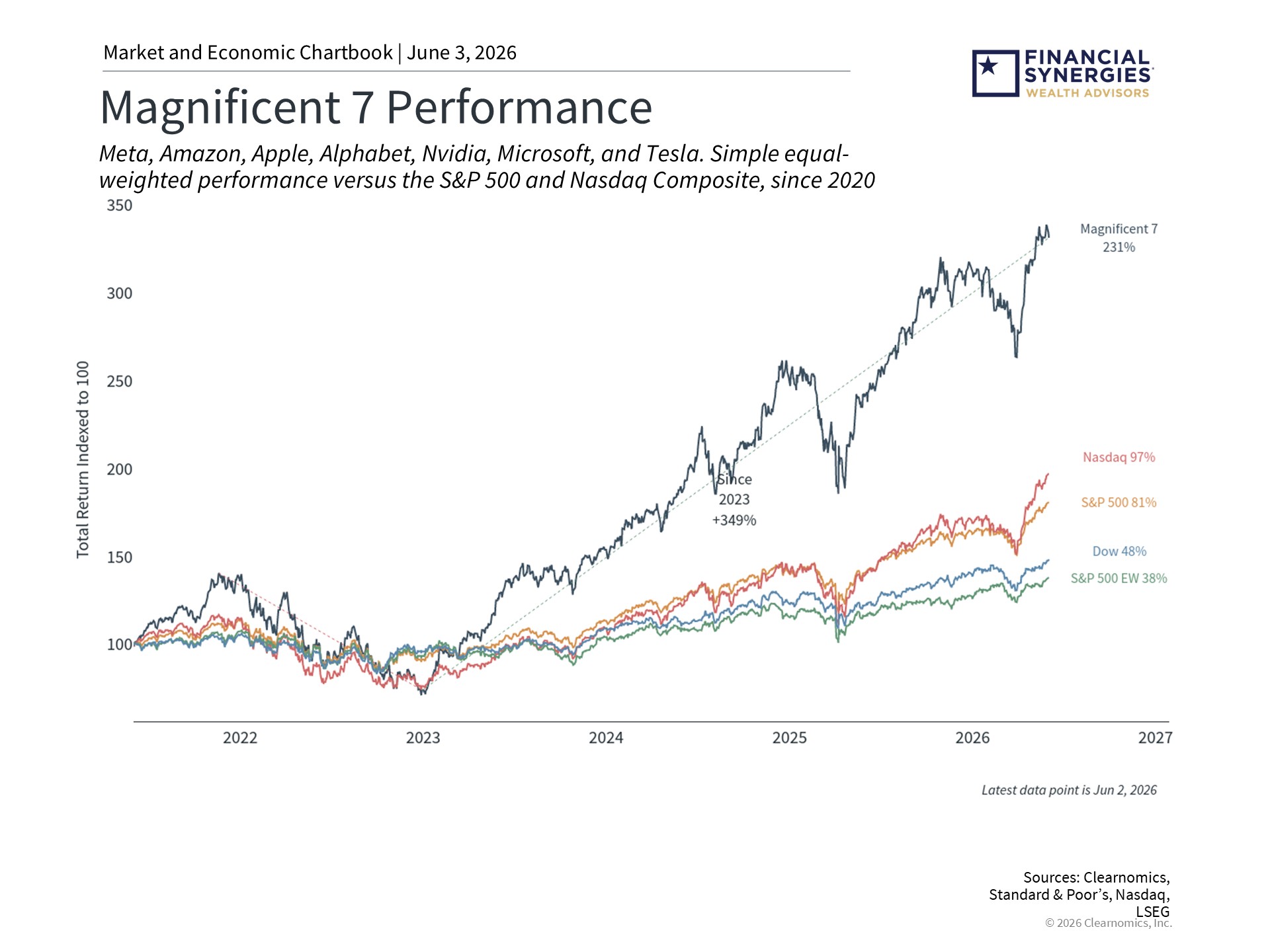
While the energy sector continues to lead the market, technology-related stocks have also contributed to portfolio returns this year. The Magnificent 7, which includes Apple, Microsoft, Nvidia, Amazon, Alphabet, Meta, and Tesla, now represents about 35% of the S&P 500. This emphasizes the importance of portfolio construction, since some investors may not realize how much exposure they may have to these individual companies today.
What has supported the market rally is not just positive sentiment, but also strong fundamentals. S&P 500 earnings growth has been running well above its historical average, and many of these large companies have continued to deliver positive earnings surprises. Current consensus earnings estimates suggest that the Information Technology and Communication Services sectors could grow earnings by 35.8% and 17.3%, respectively, over the next year.1 Other sectors, including Materials and Energy, are expected to experience above-average growth as well.
That said, valuations have also climbed alongside prices. The S&P 500 forward price-to-earnings ratio currently sits near 21x, above the historical average of 16x. Technology stocks specifically trade at a forward P/E around 24x.2 While elevated valuations do not predict short-term market moves, they are an important consideration for long-term investors thinking about asset allocation. Maintaining balance across sectors, sizes, and styles can help manage risk while also benefiting from market trends.
IPO activity is returning to public markets

The stock market is constantly evolving, since existing companies can be acquired, merged with others, or in some cases fail. At the same time, new companies can join major exchanges through a process known as an initial public offering, or IPO.
This is one reason why the opportunity set available to investors today looks different than it did even a decade ago. For example, while the FT Wilshire 5000 was originally designed to include roughly 5,000 publicly traded U.S. companies, today it contains only about 3,400 components.3 This reflects a long-term trend of companies staying private for longer.
Recently, headlines have focused on a number of high-profile companies that are reportedly considering public offerings, including SpaceX, Anthropic, OpenAI, and others.4 Many of these are large businesses that have grown primarily through venture capital and private investment rather than public markets. From that perspective, these potential IPOs are positive because they make shares of these companies available to a broader set of investors. Stock market indices automatically incorporate new public companies as they grow, meaning that long-term investors gain exposure to successful IPOs over time without needing to invest in them directly at the time of offering.
Of course, what captures the attention of many investors are the headlines and excitement surrounding IPOs. For some, it is natural to wonder whether participating in an IPO is an opportunity for early gains. However, this is not always the case. For instance, it’s often the institutional investors and company insiders that truly participate in the IPO itself, and many have often been invested for years before the public offering. Additionally, these company insiders are often subject to lock-up periods, commonly 180 days, during which they cannot sell their shares. When these periods expire, additional selling pressure can weigh on the stock price, sometimes catching investors by surprise.
IPO activity tends to come in waves, often occurring during strong economic periods when investment capital is plentiful and market enthusiasm is high. The dot-com boom of the late 1990s is perhaps the most famous example, but there are many other periods as well. For example, the post-pandemic market recovery experienced a jump in Special Purpose Acquisition Company (SPAC) activity, which is one way some companies can go public. This wave was relatively short-lived, demonstrating the importance of maintaining a longer-term perspective.
Long-term interest rates have remained elevated
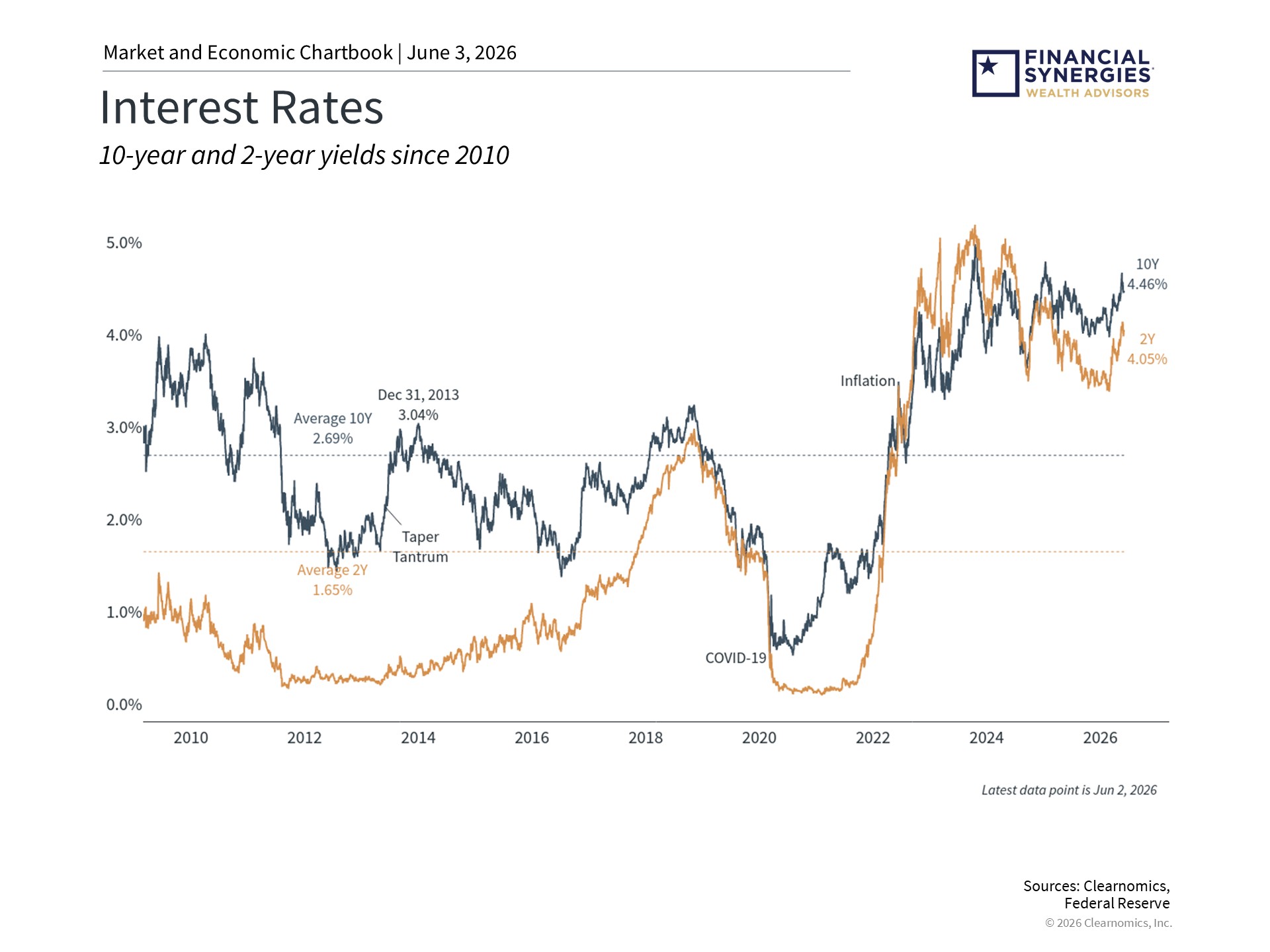
While the stock market has been climbing to new highs, long-term interest rates have also been rising. This is primarily due to inflation concerns, complicating the path of Fed policy over the next year. Technology stocks are typically sensitive to interest rates and inflation since they affect the value of their future cash flows. This is one reason these stocks struggled in 2022 as interest rates spiked, and then performed well as inflation moderated in the years since.
Beyond the technology sector, higher interest rates have implications across the economy and markets. Mortgage rates have moved up, with the 30-year fixed rate now around 6.5%, above the long-term average of 6.02% since 1990. This affects housing affordability and broader real estate activity. Higher rates also influence the cost of capital for businesses and the discount rate applied to future earnings, which can affect stock valuations, particularly for growth-oriented companies whose value depends heavily on future cash flows.
At the same time, higher interest rates mean that bonds are now offering more meaningful income than they have in many years. Investment grade corporate bonds yield 5.3%, compared to a long-term average of 3.8%. Treasurys yield 4.4%, well above their historical average of 2.2%.5 For investors, this creates more attractive opportunities in fixed income, which can play a more meaningful role in diversified portfolios going forward.
The bottom line? While the stock market has reached new milestones this year, rising interest rates serve as a reminder that the broader economic environment may present future challenges. For long-term investors, the best approach is to maintain a balanced portfolio that can benefit from market growth as well as higher interest rates.
References
1. Clearnomics research and LSEG data as of May 20, 2026
2. Ibid.
3. https://cdn.prod.website-files.com/63e3e50fdce0bcaff7861530/6965694be133b820fb1f390d_FT%20Wilshire%205000%20Index%20Series%20Factsheet%20v2%20-%20Dec%202025.pdf
4. https://www.wsj.com/topics/subject/initial-public-offerings-ipos
5. Bloomberg U.S. Corporate Investment Grade and Bloomberg U.S. Treasury Index yields, as of May 22, 2026
Concerns or questions about how your investment portfolio will hold up in the current market environment? Contact Financial Synergies today.
We are a boutique, financial advisory and total wealth management firm with over 35 years helping clients navigate turbulent markets. To learn more about our approach to investment management please reach out to us. One of our seasoned advisors would be happy to help you build a custom financial plan to help ensure you accomplish your financial goals and objectives. Schedule a conversation with us today.
More relevant articles by Financial Synergies:
Blog Disclosures
This content, which contains security-related opinions and/or information, is provided for informational purposes only and should not be relied upon in any manner as professional advice, or an endorsement of any practices, products or services. There can be no guarantees or assurances that the views expressed here will be applicable for any particular facts or circumstances, and should not be relied upon in any manner. You should consult your own financial advisors as to legal, business, tax, and other related matters concerning any investment.
The commentary in this “post” (including any related blogs, videos, and social media) reflects the personal opinions, viewpoints, and analyses of the Financial Synergies Wealth Advisors, Inc. employees providing such comments, and should not be regarded as the views of Financial Synergies Wealth Advisors, Inc. or its respective affiliates or as a description of advisory services provided by Financial Synergies Wealth Advisors, Inc. or performance returns of any Financial Synergies Wealth Advisors, Inc. client.
Any opinions expressed herein do not constitute or imply endorsement, sponsorship, or recommendation by Financial Synergies Wealth Advisors, Inc. or its employees. The views reflected in the commentary are subject to change at any time without notice.
Nothing on this website constitutes investment or financial planning advice, performance data or any recommendation that any particular security, portfolio of securities, transaction or investment strategy is suitable for any specific person. It also should not be construed as an offer soliciting the purchase or sale of any security mentioned. Nor should it be construed as an offer to provide investment advisory services by Financial Synergies Wealth Advisors, Inc.
Any mention of a particular security and related performance data is not a recommendation to buy or sell that security. Financial Synergies Wealth Advisors, Inc. manages its clients’ accounts using a variety of investment techniques and strategies, which are not necessarily discussed in the commentary. Investments in securities involve the risk of loss. Past performance is no guarantee of future results.
Any charts provided here or on any related Financial Synergies Wealth Advisors, Inc. personnel content outlets are for informational purposes only, and should also not be relied upon when making any investment decision. Any indices referenced for comparison are unmanaged and cannot be invested into directly. As always please remember investing involves risk and possible loss of principal capital; please seek advice from a licensed professional. Any projections, estimates, forecasts, targets, prospects and/or opinions expressed in these materials are subject to change without notice and may differ or be contrary to opinions expressed by others. Information in charts have been obtained from third-party sources and data, and may include those from portfolio securities of funds managed by Financial Synergies Wealth Advisors, Inc. While taken from sources believed to be reliable, Financial Synergies Wealth Advisors, Inc. has not independently verified such information and makes no representations about the enduring accuracy of the information or its appropriateness for a given situation. All content speaks only as of the date indicated.
Financial Synergies Wealth Advisors, Inc. is a registered investment adviser. Advisory services are only offered to clients or prospective clients where Financial Synergies Wealth Advisors, Inc. and its representatives are properly licensed or exempt from licensure. Investments in securities involve the risk of loss. Past performance is no guarantee of future results.
See Full Disclosures Page Here
 Skip to content


Tech Stocks, IPOs, and Higher Interest Rates
The S&P 500 recently surpassed 7,500 for the first time, marking another milestone in a year that has seen many new all-time highs. This is positive for investors, especially because several sectors have contributed to this rally. These trends have also fueled enthusiasm for IPOs, particularly ones related to artificial intelligence, after years of relatively few companies going public.
This is occurring despite ongoing concerns over inflation, high oil prices, and hopes for a peace deal in Iran that has not yet materialized. In contrast to the stock market, these challenges have weighed on the bond market, pushing long-term interest rates higher. The 30-year U.S. Treasury yield, for instance, briefly reached a nearly 20-year high before settling back toward 5%. Since headlines like these can create uncertainty for markets, maintaining perspective and balance are more important than ever.
Technology stocks continue to support market performance
While the energy sector continues to lead the market, technology-related stocks have also contributed to portfolio returns this year. The Magnificent 7, which includes Apple, Microsoft, Nvidia, Amazon, Alphabet, Meta, and Tesla, now represents about 35% of the S&P 500. This emphasizes the importance of portfolio construction, since some investors may not realize how much exposure they may have to these individual companies today.
What has supported the market rally is not just positive sentiment, but also strong fundamentals. S&P 500 earnings growth has been running well above its historical average, and many of these large companies have continued to deliver positive earnings surprises. Current consensus earnings estimates suggest that the Information Technology and Communication Services sectors could grow earnings by 35.8% and 17.3%, respectively, over the next year.1 Other sectors, including Materials and Energy, are expected to experience above-average growth as well.
That said, valuations have also climbed alongside prices. The S&P 500 forward price-to-earnings ratio currently sits near 21x, above the historical average of 16x. Technology stocks specifically trade at a forward P/E around 24x.2 While elevated valuations do not predict short-term market moves, they are an important consideration for long-term investors thinking about asset allocation. Maintaining balance across sectors, sizes, and styles can help manage risk while also benefiting from market trends.
IPO activity is returning to public markets
The stock market is constantly evolving, since existing companies can be acquired, merged with others, or in some cases fail. At the same time, new companies can join major exchanges through a process known as an initial public offering, or IPO.
This is one reason why the opportunity set available to investors today looks different than it did even a decade ago. For example, while the FT Wilshire 5000 was originally designed to include roughly 5,000 publicly traded U.S. companies, today it contains only about 3,400 components.3 This reflects a long-term trend of companies staying private for longer.
Recently, headlines have focused on a number of high-profile companies that are reportedly considering public offerings, including SpaceX, Anthropic, OpenAI, and others.4 Many of these are large businesses that have grown primarily through venture capital and private investment rather than public markets. From that perspective, these potential IPOs are positive because they make shares of these companies available to a broader set of investors. Stock market indices automatically incorporate new public companies as they grow, meaning that long-term investors gain exposure to successful IPOs over time without needing to invest in them directly at the time of offering.
Of course, what captures the attention of many investors are the headlines and excitement surrounding IPOs. For some, it is natural to wonder whether participating in an IPO is an opportunity for early gains. However, this is not always the case. For instance, it’s often the institutional investors and company insiders that truly participate in the IPO itself, and many have often been invested for years before the public offering. Additionally, these company insiders are often subject to lock-up periods, commonly 180 days, during which they cannot sell their shares. When these periods expire, additional selling pressure can weigh on the stock price, sometimes catching investors by surprise.
IPO activity tends to come in waves, often occurring during strong economic periods when investment capital is plentiful and market enthusiasm is high. The dot-com boom of the late 1990s is perhaps the most famous example, but there are many other periods as well. For example, the post-pandemic market recovery experienced a jump in Special Purpose Acquisition Company (SPAC) activity, which is one way some companies can go public. This wave was relatively short-lived, demonstrating the importance of maintaining a longer-term perspective.
Long-term interest rates have remained elevated
While the stock market has been climbing to new highs, long-term interest rates have also been rising. This is primarily due to inflation concerns, complicating the path of Fed policy over the next year. Technology stocks are typically sensitive to interest rates and inflation since they affect the value of their future cash flows. This is one reason these stocks struggled in 2022 as interest rates spiked, and then performed well as inflation moderated in the years since.
Beyond the technology sector, higher interest rates have implications across the economy and markets. Mortgage rates have moved up, with the 30-year fixed rate now around 6.5%, above the long-term average of 6.02% since 1990. This affects housing affordability and broader real estate activity. Higher rates also influence the cost of capital for businesses and the discount rate applied to future earnings, which can affect stock valuations, particularly for growth-oriented companies whose value depends heavily on future cash flows.
At the same time, higher interest rates mean that bonds are now offering more meaningful income than they have in many years. Investment grade corporate bonds yield 5.3%, compared to a long-term average of 3.8%. Treasurys yield 4.4%, well above their historical average of 2.2%.5 For investors, this creates more attractive opportunities in fixed income, which can play a more meaningful role in diversified portfolios going forward.
The bottom line? While the stock market has reached new milestones this year, rising interest rates serve as a reminder that the broader economic environment may present future challenges. For long-term investors, the best approach is to maintain a balanced portfolio that can benefit from market growth as well as higher interest rates.
References
1. Clearnomics research and LSEG data as of May 20, 2026
2. Ibid.
3. https://cdn.prod.website-files.com/63e3e50fdce0bcaff7861530/6965694be133b820fb1f390d_FT%20Wilshire%205000%20Index%20Series%20Factsheet%20v2%20-%20Dec%202025.pdf
4. https://www.wsj.com/topics/subject/initial-public-offerings-ipos
5. Bloomberg U.S. Corporate Investment Grade and Bloomberg U.S. Treasury Index yields, as of May 22, 2026
Concerns or questions about how your investment portfolio will hold up in the current market environment? Contact Financial Synergies today.
We are a boutique, financial advisory and total wealth management firm with over 35 years helping clients navigate turbulent markets. To learn more about our approach to investment management please reach out to us. One of our seasoned advisors would be happy to help you build a custom financial plan to help ensure you accomplish your financial goals and objectives. Schedule a conversation with us today.
More relevant articles by Financial Synergies:
Blog Disclosures
This content, which contains security-related opinions and/or information, is provided for informational purposes only and should not be relied upon in any manner as professional advice, or an endorsement of any practices, products or services. There can be no guarantees or assurances that the views expressed here will be applicable for any particular facts or circumstances, and should not be relied upon in any manner. You should consult your own financial advisors as to legal, business, tax, and other related matters concerning any investment.
The commentary in this “post” (including any related blogs, videos, and social media) reflects the personal opinions, viewpoints, and analyses of the Financial Synergies Wealth Advisors, Inc. employees providing such comments, and should not be regarded as the views of Financial Synergies Wealth Advisors, Inc. or its respective affiliates or as a description of advisory services provided by Financial Synergies Wealth Advisors, Inc. or performance returns of any Financial Synergies Wealth Advisors, Inc. client.
Any opinions expressed herein do not constitute or imply endorsement, sponsorship, or recommendation by Financial Synergies Wealth Advisors, Inc. or its employees. The views reflected in the commentary are subject to change at any time without notice.
Nothing on this website constitutes investment or financial planning advice, performance data or any recommendation that any particular security, portfolio of securities, transaction or investment strategy is suitable for any specific person. It also should not be construed as an offer soliciting the purchase or sale of any security mentioned. Nor should it be construed as an offer to provide investment advisory services by Financial Synergies Wealth Advisors, Inc.
Any mention of a particular security and related performance data is not a recommendation to buy or sell that security. Financial Synergies Wealth Advisors, Inc. manages its clients’ accounts using a variety of investment techniques and strategies, which are not necessarily discussed in the commentary. Investments in securities involve the risk of loss. Past performance is no guarantee of future results.
Any charts provided here or on any related Financial Synergies Wealth Advisors, Inc. personnel content outlets are for informational purposes only, and should also not be relied upon when making any investment decision. Any indices referenced for comparison are unmanaged and cannot be invested into directly. As always please remember investing involves risk and possible loss of principal capital; please seek advice from a licensed professional. Any projections, estimates, forecasts, targets, prospects and/or opinions expressed in these materials are subject to change without notice and may differ or be contrary to opinions expressed by others. Information in charts have been obtained from third-party sources and data, and may include those from portfolio securities of funds managed by Financial Synergies Wealth Advisors, Inc. While taken from sources believed to be reliable, Financial Synergies Wealth Advisors, Inc. has not independently verified such information and makes no representations about the enduring accuracy of the information or its appropriateness for a given situation. All content speaks only as of the date indicated.
Financial Synergies Wealth Advisors, Inc. is a registered investment adviser. Advisory services are only offered to clients or prospective clients where Financial Synergies Wealth Advisors, Inc. and its representatives are properly licensed or exempt from licensure. Investments in securities involve the risk of loss. Past performance is no guarantee of future results.
See Full Disclosures Page Here
Recent Posts
Happy Birthday to the Bull Market
Quarterly Webinar: Q4 2026 Market and Economic Themes
Medicare Open Enrollment 2026: What to Know
Subscribe to Our Blog
Chief Investment Officer | Managing Partner