It’s Groundhog Day, folks!  Washington is back in the headlines as the federal government faces a shutdown if policymakers can’t reach a new funding agreement. This adds to a year in which government policies around trade, taxes, immigration, and more have created uncertainty for the economy and markets.
For investors, it’s natural to wonder how politics might affect their portfolios, especially for those concerned about the size of the budget deficit and national debt. Understanding the historical patterns, and why markets generally look past them, can help investors maintain perspective during periods of political gridlock.
Political drama in Washington can create uncertainty, but history shows that government shutdowns typically have limited impact on financial markets. While the toll that shutdowns have on government workers can be real, their effect on financial markets has historically been minimal. For long-term investors, these episodes highlight the need to separate political views from financial plans. This is especially important when daily headlines focus on controversial topics that have not historically affected portfolios.
Government shutdowns have not historically affected markets or the economy
On an annual basis, the federal government must pass a budget for the next fiscal year, which begins on October 1. While the government passed the “One Big Beautiful Bill Act” earlier this year that lays out tax and spending policies, a budget is needed to allocate the actual dollars to different departments and agencies. Failure to do so by the deadline means that the government might face a shutdown, resulting in a lapse in government services and employees being furloughed.
It’s rare for Congress to pass budget bills on time. This may not be surprising given the increasingly polarized political environment in Washington, where compromise has become more difficult to achieve. Over nearly fifty years, Congress has managed to pass appropriations bills before the fiscal year deadline only a few times, making last-minute negotiations the norm rather than the exception.
One solution that Congress has used often is known as a “continuing resolution” which temporarily funds the government while lawmakers negotiate. Republicans are currently proposing a seven-week stopgap bill for this purpose.
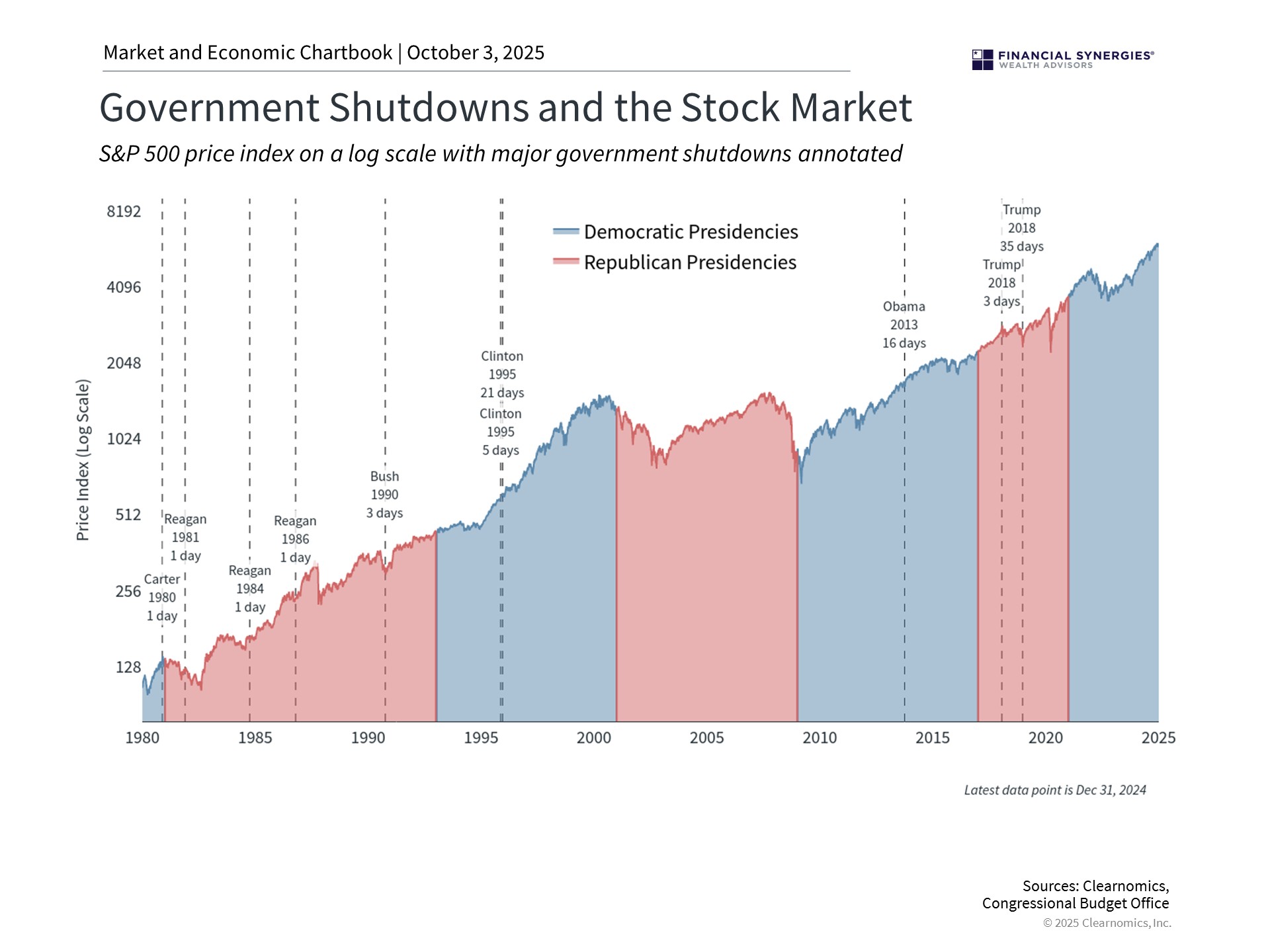
As the accompanying chart shows, government shutdowns have occurred regularly since 1980 under presidents of both parties, with minimal long-term impact on financial markets. The chart illustrates that this was true even during the most contentious shutdowns, including during the Reagan administration, Clinton’s 21-day shutdown in 1995, Obama’s 16-day shutdown in 2013, and Trump’s 35-day shutdown in late 2018 to early 2019. For investors, shutdowns have generally served as temporary disruptions rather than fundamental threats to economic growth.
Shutdowns reflect deeper political differences
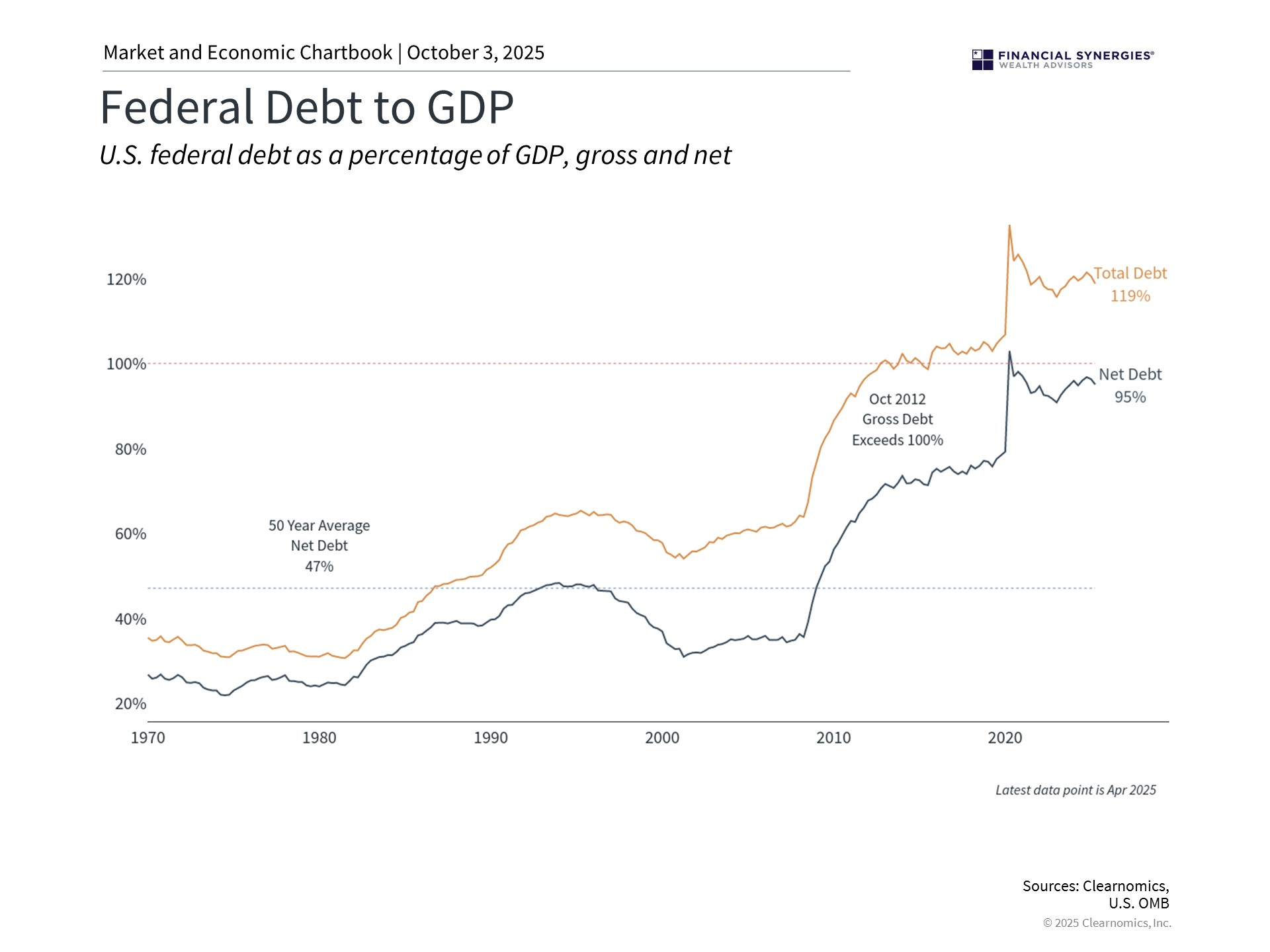
The current situation reflects disagreements over spending priorities, primarily around healthcare. While the immediate funding of the government is the focus, these budget battles reflect deeper differences around the role of government and fiscal responsibility. With federal debt now around 120% of GDP, many agree on the need for fiscal discipline but there is fundamental disagreement as to how this should occur.
What makes this situation unique is the administration’s directive for agencies to prepare permanent workforce reduction plans beyond typical temporary furloughs. This represents a departure from previous shutdown patterns and could create longer-lasting impacts on the job market and fiscal spending. Note that furloughed federal workers do automatically receive back pay once the shutdown ends, a policy that was enacted as part of the negotiations that ended the 2018 to 2019 shutdown.
For some investors, the threat of a government shutdown may blend in with other fiscal issues such as the debt ceiling. The debt ceiling becomes a problem when spending the government has already approved needs to be paid for, but the Treasury Department isn’t authorized to borrow above a certain limit. The only solution in these cases is for Congress to raise the debt limit, or else the government risks defaulting on its obligations.
All of these fiscal challenges are one reason the major credit rating agencies have downgraded the U.S. debt below AAA. Fortunately, the One Big Beautiful Bill Act also raised the debt ceiling by $5 trillion, so this problem can be avoided for some time.
Markets focus on fundamentals, not political headlines
So, while many investors have concerns over the fiscal trajectory of the country, government shutdowns have generally been uneventful for financial markets. The reason is straightforward: shutdowns are temporary disruptions that don’t change underlying economic fundamentals.
Shutdowns can affect economic data reporting, which may temporarily affect important data used by investors and economists such as the Bureau of Labor Statistics’ jobs report and Consumer Price Index. However, this typically only delays the data, with reporting resuming once the shutdown ends. They can also create modest headwinds for economic growth if they last long enough, as federal workers delay spending and government services are disrupted.
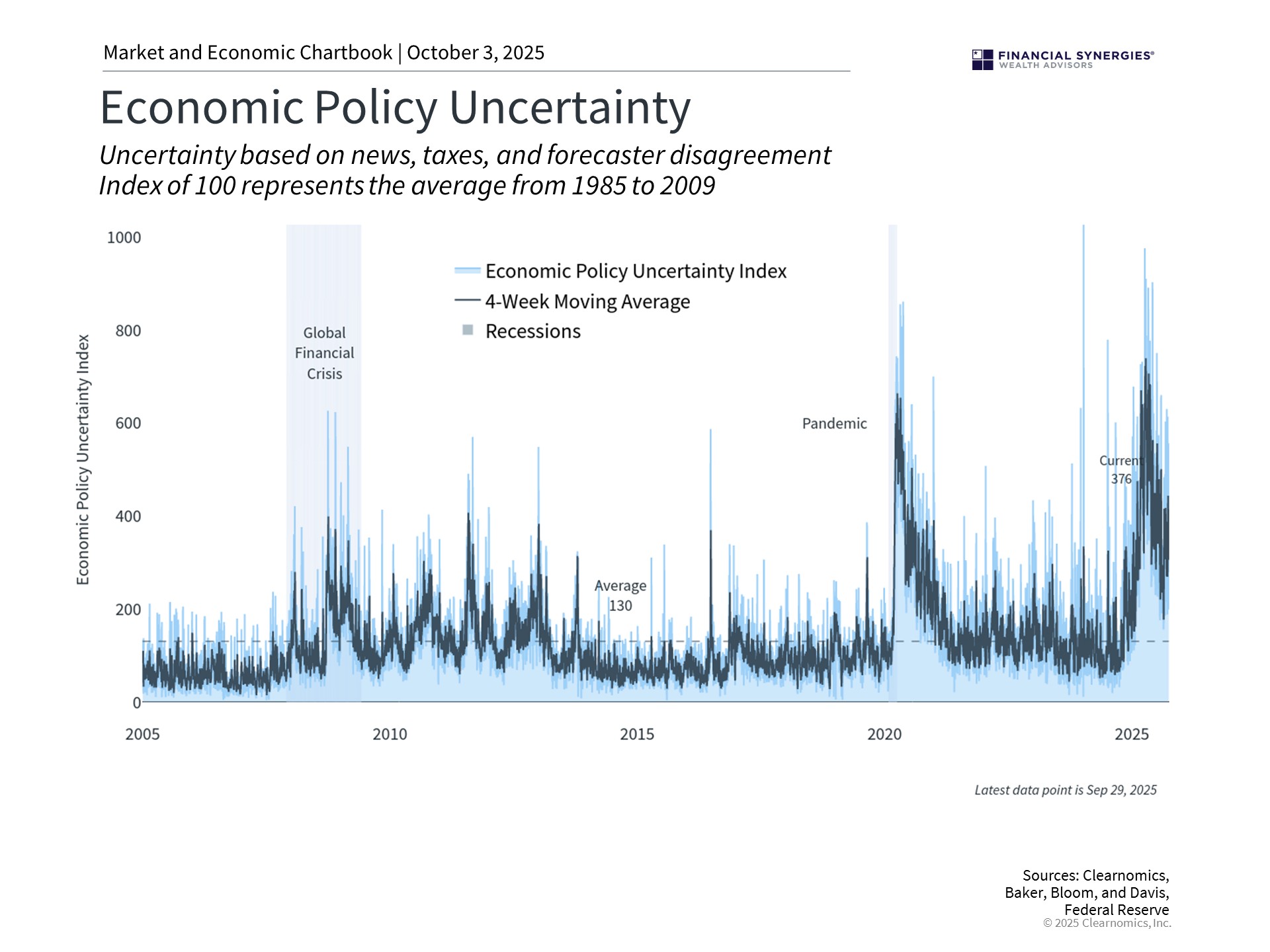
As the Economic Policy Uncertainty chart above demonstrates, tariffs and taxes earlier this year created significant challenges for investors. However, with recent clarity around both issues, this measure has fallen toward the longer run average. While a shutdown could always result in greater uncertainty, history shows that even longer government disruptions have not generally impacted investors.
The bottom line? Government shutdowns may dominate headlines, create challenges for federal workers, and disrupt important services, but they have historically had minimal impact on financial markets. Investors should continue to focus on their financial plans rather than daily events in Washington.
Concerns or questions about how your investment portfolio will hold up in the current market environment? Contact Financial Synergies today.
We are a boutique, financial advisory and total wealth management firm with over 35 years helping clients navigate turbulent markets. To learn more about our approach to investment management please reach out to us. One of our seasoned advisors would be happy to help you build a custom financial plan to help ensure you accomplish your financial goals and objectives. Schedule a conversation with us today.
More relevant articles by Financial Synergies:
Blog Disclosures
This content, which contains security-related opinions and/or information, is provided for informational purposes only and should not be relied upon in any manner as professional advice, or an endorsement of any practices, products or services. There can be no guarantees or assurances that the views expressed here will be applicable for any particular facts or circumstances, and should not be relied upon in any manner. You should consult your own financial advisors as to legal, business, tax, and other related matters concerning any investment.
The commentary in this “post” (including any related blogs, videos, and social media) reflects the personal opinions, viewpoints, and analyses of the Financial Synergies Wealth Advisors, Inc. employees providing such comments, and should not be regarded as the views of Financial Synergies Wealth Advisors, Inc. or its respective affiliates or as a description of advisory services provided by Financial Synergies Wealth Advisors, Inc. or performance returns of any Financial Synergies Wealth Advisors, Inc. client.
Any opinions expressed herein do not constitute or imply endorsement, sponsorship, or recommendation by Financial Synergies Wealth Advisors, Inc. or its employees. The views reflected in the commentary are subject to change at any time without notice.
Nothing on this website constitutes investment or financial planning advice, performance data or any recommendation that any particular security, portfolio of securities, transaction or investment strategy is suitable for any specific person. It also should not be construed as an offer soliciting the purchase or sale of any security mentioned. Nor should it be construed as an offer to provide investment advisory services by Financial Synergies Wealth Advisors, Inc.
Any mention of a particular security and related performance data is not a recommendation to buy or sell that security. Financial Synergies Wealth Advisors, Inc. manages its clients’ accounts using a variety of investment techniques and strategies, which are not necessarily discussed in the commentary. Investments in securities involve the risk of loss. Past performance is no guarantee of future results.
Any charts provided here or on any related Financial Synergies Wealth Advisors, Inc. personnel content outlets are for informational purposes only, and should also not be relied upon when making any investment decision. Any indices referenced for comparison are unmanaged and cannot be invested into directly. As always please remember investing involves risk and possible loss of principal capital; please seek advice from a licensed professional. Any projections, estimates, forecasts, targets, prospects and/or opinions expressed in these materials are subject to change without notice and may differ or be contrary to opinions expressed by others. Information in charts have been obtained from third-party sources and data, and may include those from portfolio securities of funds managed by Financial Synergies Wealth Advisors, Inc. While taken from sources believed to be reliable, Financial Synergies Wealth Advisors, Inc. has not independently verified such information and makes no representations about the enduring accuracy of the information or its appropriateness for a given situation. All content speaks only as of the date indicated.
Financial Synergies Wealth Advisors, Inc. is a registered investment adviser. Advisory services are only offered to clients or prospective clients where Financial Synergies Wealth Advisors, Inc. and its representatives are properly licensed or exempt from licensure. Investments in securities involve the risk of loss. Past performance is no guarantee of future results.
See Full Disclosures Page Here
 Skip to content


Yep, Another Government Shutdown
It’s Groundhog Day, folks! Washington is back in the headlines as the federal government faces a shutdown if policymakers can’t reach a new funding agreement. This adds to a year in which government policies around trade, taxes, immigration, and more have created uncertainty for the economy and markets.
For investors, it’s natural to wonder how politics might affect their portfolios, especially for those concerned about the size of the budget deficit and national debt. Understanding the historical patterns, and why markets generally look past them, can help investors maintain perspective during periods of political gridlock.
Political drama in Washington can create uncertainty, but history shows that government shutdowns typically have limited impact on financial markets. While the toll that shutdowns have on government workers can be real, their effect on financial markets has historically been minimal. For long-term investors, these episodes highlight the need to separate political views from financial plans. This is especially important when daily headlines focus on controversial topics that have not historically affected portfolios.
Government shutdowns have not historically affected markets or the economy
On an annual basis, the federal government must pass a budget for the next fiscal year, which begins on October 1. While the government passed the “One Big Beautiful Bill Act” earlier this year that lays out tax and spending policies, a budget is needed to allocate the actual dollars to different departments and agencies. Failure to do so by the deadline means that the government might face a shutdown, resulting in a lapse in government services and employees being furloughed.
It’s rare for Congress to pass budget bills on time. This may not be surprising given the increasingly polarized political environment in Washington, where compromise has become more difficult to achieve. Over nearly fifty years, Congress has managed to pass appropriations bills before the fiscal year deadline only a few times, making last-minute negotiations the norm rather than the exception.
One solution that Congress has used often is known as a “continuing resolution” which temporarily funds the government while lawmakers negotiate. Republicans are currently proposing a seven-week stopgap bill for this purpose.
As the accompanying chart shows, government shutdowns have occurred regularly since 1980 under presidents of both parties, with minimal long-term impact on financial markets. The chart illustrates that this was true even during the most contentious shutdowns, including during the Reagan administration, Clinton’s 21-day shutdown in 1995, Obama’s 16-day shutdown in 2013, and Trump’s 35-day shutdown in late 2018 to early 2019. For investors, shutdowns have generally served as temporary disruptions rather than fundamental threats to economic growth.
Shutdowns reflect deeper political differences
The current situation reflects disagreements over spending priorities, primarily around healthcare. While the immediate funding of the government is the focus, these budget battles reflect deeper differences around the role of government and fiscal responsibility. With federal debt now around 120% of GDP, many agree on the need for fiscal discipline but there is fundamental disagreement as to how this should occur.
What makes this situation unique is the administration’s directive for agencies to prepare permanent workforce reduction plans beyond typical temporary furloughs. This represents a departure from previous shutdown patterns and could create longer-lasting impacts on the job market and fiscal spending. Note that furloughed federal workers do automatically receive back pay once the shutdown ends, a policy that was enacted as part of the negotiations that ended the 2018 to 2019 shutdown.
For some investors, the threat of a government shutdown may blend in with other fiscal issues such as the debt ceiling. The debt ceiling becomes a problem when spending the government has already approved needs to be paid for, but the Treasury Department isn’t authorized to borrow above a certain limit. The only solution in these cases is for Congress to raise the debt limit, or else the government risks defaulting on its obligations.
All of these fiscal challenges are one reason the major credit rating agencies have downgraded the U.S. debt below AAA. Fortunately, the One Big Beautiful Bill Act also raised the debt ceiling by $5 trillion, so this problem can be avoided for some time.
Markets focus on fundamentals, not political headlines
So, while many investors have concerns over the fiscal trajectory of the country, government shutdowns have generally been uneventful for financial markets. The reason is straightforward: shutdowns are temporary disruptions that don’t change underlying economic fundamentals.
Shutdowns can affect economic data reporting, which may temporarily affect important data used by investors and economists such as the Bureau of Labor Statistics’ jobs report and Consumer Price Index. However, this typically only delays the data, with reporting resuming once the shutdown ends. They can also create modest headwinds for economic growth if they last long enough, as federal workers delay spending and government services are disrupted.
As the Economic Policy Uncertainty chart above demonstrates, tariffs and taxes earlier this year created significant challenges for investors. However, with recent clarity around both issues, this measure has fallen toward the longer run average. While a shutdown could always result in greater uncertainty, history shows that even longer government disruptions have not generally impacted investors.
The bottom line? Government shutdowns may dominate headlines, create challenges for federal workers, and disrupt important services, but they have historically had minimal impact on financial markets. Investors should continue to focus on their financial plans rather than daily events in Washington.
Concerns or questions about how your investment portfolio will hold up in the current market environment? Contact Financial Synergies today.
We are a boutique, financial advisory and total wealth management firm with over 35 years helping clients navigate turbulent markets. To learn more about our approach to investment management please reach out to us. One of our seasoned advisors would be happy to help you build a custom financial plan to help ensure you accomplish your financial goals and objectives. Schedule a conversation with us today.
More relevant articles by Financial Synergies:
Blog Disclosures
This content, which contains security-related opinions and/or information, is provided for informational purposes only and should not be relied upon in any manner as professional advice, or an endorsement of any practices, products or services. There can be no guarantees or assurances that the views expressed here will be applicable for any particular facts or circumstances, and should not be relied upon in any manner. You should consult your own financial advisors as to legal, business, tax, and other related matters concerning any investment.
The commentary in this “post” (including any related blogs, videos, and social media) reflects the personal opinions, viewpoints, and analyses of the Financial Synergies Wealth Advisors, Inc. employees providing such comments, and should not be regarded as the views of Financial Synergies Wealth Advisors, Inc. or its respective affiliates or as a description of advisory services provided by Financial Synergies Wealth Advisors, Inc. or performance returns of any Financial Synergies Wealth Advisors, Inc. client.
Any opinions expressed herein do not constitute or imply endorsement, sponsorship, or recommendation by Financial Synergies Wealth Advisors, Inc. or its employees. The views reflected in the commentary are subject to change at any time without notice.
Nothing on this website constitutes investment or financial planning advice, performance data or any recommendation that any particular security, portfolio of securities, transaction or investment strategy is suitable for any specific person. It also should not be construed as an offer soliciting the purchase or sale of any security mentioned. Nor should it be construed as an offer to provide investment advisory services by Financial Synergies Wealth Advisors, Inc.
Any mention of a particular security and related performance data is not a recommendation to buy or sell that security. Financial Synergies Wealth Advisors, Inc. manages its clients’ accounts using a variety of investment techniques and strategies, which are not necessarily discussed in the commentary. Investments in securities involve the risk of loss. Past performance is no guarantee of future results.
Any charts provided here or on any related Financial Synergies Wealth Advisors, Inc. personnel content outlets are for informational purposes only, and should also not be relied upon when making any investment decision. Any indices referenced for comparison are unmanaged and cannot be invested into directly. As always please remember investing involves risk and possible loss of principal capital; please seek advice from a licensed professional. Any projections, estimates, forecasts, targets, prospects and/or opinions expressed in these materials are subject to change without notice and may differ or be contrary to opinions expressed by others. Information in charts have been obtained from third-party sources and data, and may include those from portfolio securities of funds managed by Financial Synergies Wealth Advisors, Inc. While taken from sources believed to be reliable, Financial Synergies Wealth Advisors, Inc. has not independently verified such information and makes no representations about the enduring accuracy of the information or its appropriateness for a given situation. All content speaks only as of the date indicated.
Financial Synergies Wealth Advisors, Inc. is a registered investment adviser. Advisory services are only offered to clients or prospective clients where Financial Synergies Wealth Advisors, Inc. and its representatives are properly licensed or exempt from licensure. Investments in securities involve the risk of loss. Past performance is no guarantee of future results.
See Full Disclosures Page Here
Recent Posts
Chart of the Month | Stocks vs. Bonds: More Choices for Investors as Bond Yields Rise
Weekly Market Recap – September Inflation & Retail Sales Data, AI Financing, & Bank Earnings
Happy Birthday to the Bull Market
Subscribe to Our Blog
Chief Investment Officer | Managing Partner