As the holiday season begins, it’s the perfect time to pause and appreciate what we have, both in our personal and financial lives. This is particularly important since investors tend to focus on what could go wrong rather than what has gone right. At the moment, with markets performing well, it’s helpful to reflect on the past year to gain perspective as new opportunities and challenges emerge.
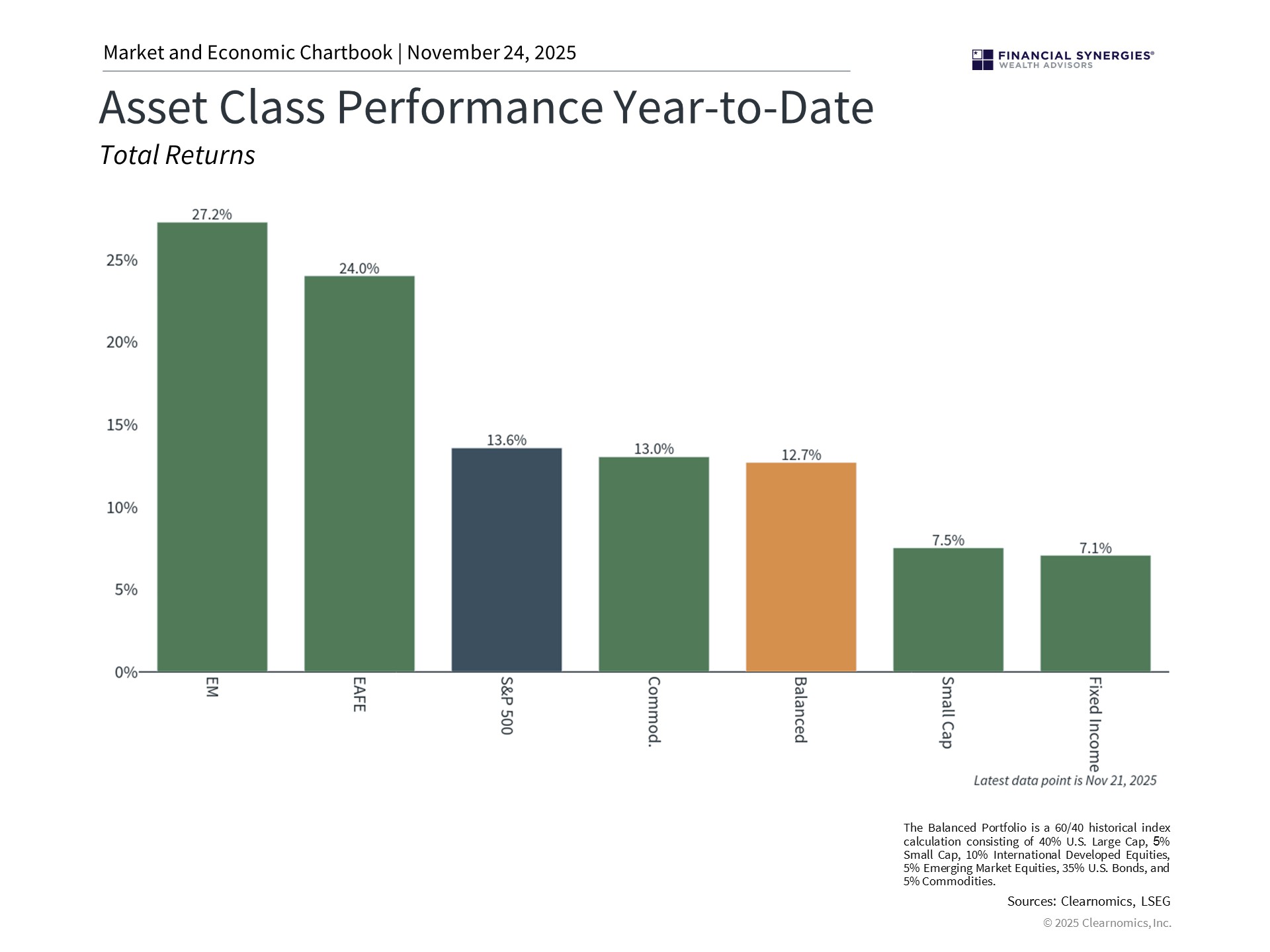
Financial markets have delivered strong returns over history, and this year has been no exception. The S&P 500 has gained over 14% with dividends year-to-date, while bonds have returned approximately 7% as measured by the Bloomberg U.S. Aggregate Bond Index.
International stocks have outperformed U.S. stocks for the first time in many years. Many diversified portfolios have benefited from this broad-based performance across asset classes. What can investors keep in mind as they prepare for the coming year?
We have entered the fourth year of the bull market

First, investors can be thankful that financial markets have performed well this year despite market swings. This bull market cycle, which began after the market bottom in October 2022, is now entering its fourth year.
While past performance is no guarantee of future results, history shows that bull markets tend to last much longer than bear markets, often running for five to ten years or more. The typical bull market has delivered cumulative returns far exceeding what we’ve seen so far in this cycle, despite the many challenges investors faced during those times. While there are important concerns around valuations and market concentration, investing for the long term requires us to navigate all types of market conditions.
The bond market’s positive returns are important to highlight after the challenging interest rate and inflation environment of recent years. As rates have stabilized and the Federal Reserve has begun easing monetary policy again, bond prices have recovered. This demonstrates why holding both stocks and bonds remains important for portfolios in terms of both balance and income generation.
This resilience underscores an important principle: trying to time markets around short-term events is not only difficult, but can be counterproductive. This was true even in April when markets fell close to bear market levels as new tariffs were announced. Markets not only rebounded quickly, but rose to new all-time highs. Investors who remained disciplined were rewarded, while those who reacted to headlines may have missed opportunities and, in some cases, may still be on the sidelines.
Inflation has improved and the Fed is cutting rates
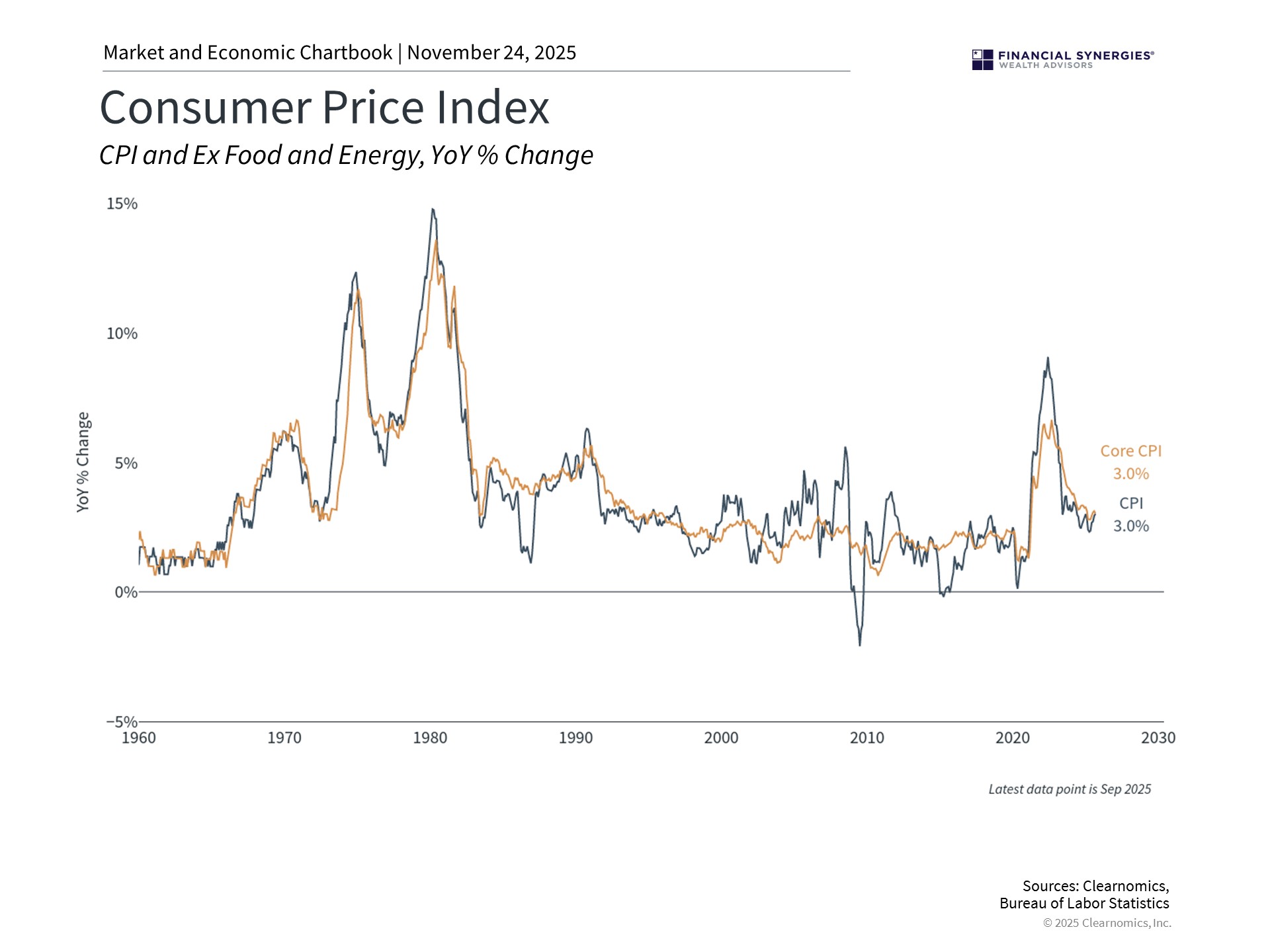
Second, investors can be grateful that inflation has improved, even if progress has been slower than many would prefer. Prices have risen about 3% over the past year, which continues to be a challenge for households and policymakers. However, from an investment standpoint, inflation has been much more stable, and there are fewer fears of runaway inflation compared to prior years.
This has allowed the Fed to begin cutting interest rates after keeping them at restrictive levels for most of the year. This is also to support the job market, which has been weakening since the summer. Historically, lower rates benefit both stocks and bonds by reducing borrowing costs for businesses and consumers while making existing bonds with higher interest rates more valuable. So, even though inflation and interest rates will remain important factors for markets, fears of ever-rising inflation and interest rates appear to be behind us.
Asset allocation helps manage risk while capturing opportunities
Finally, investors should also appreciate the importance of ongoing risk management and proper asset allocation. The year ahead will likely bring new sources of uncertainty just as every year does. When this happens, there will naturally be worries about recessions, bear markets, and that the cycle may be ending. Rather than reacting to every market event, investors can instead hold an appropriate portfolio that can navigate different phases of the market and economic cycle.
We can also be thankful that we have different assets available to help balance risk and reward. Risk management is important at all points in an investor’s journey, and especially so after a three-year rally. The S&P 500 price-to-earnings ratio of 22.6x is above average and steadily approaching its peak dot-com levels.
Valuations do not predict what the market will do in the near-term, so this doesn’t mean markets can’t continue performing well. However, it does suggest that future returns could be more modest, especially when compared with cheaper asset classes and sectors. It’s important to have realistic expectations and to hold different parts of the market with more attractive valuations.
Questions about artificial intelligence (AI) will persist. It’s natural that the effect on stock prices is difficult to predict given the transformative nature of the technology. This is similar to the challenges of predicting how the internet revolution would unfold beginning in the mid-1990s.
Political volatility is also likely to continue as well with ongoing tariff changes, geopolitical worries, the growing national debt, and more. Recent history underscores that reacting to these events is not only counterproductive, but can derail financial plans.
The holiday season is an ideal time to reflect on the many reasons to be thankful. A properly constructed portfolio balances the benefits of different asset classes and aligns them toward financial goals. This remains the key to navigating challenges and opportunities in the year ahead.
Concerns or questions about how your investment portfolio will hold up in the current market environment? Contact Financial Synergies today.
We are a boutique, financial advisory and total wealth management firm with over 35 years helping clients navigate turbulent markets. To learn more about our approach to investment management please reach out to us. One of our seasoned advisors would be happy to help you build a custom financial plan to help ensure you accomplish your financial goals and objectives. Schedule a conversation with us today.
More relevant articles by Financial Synergies:
Blog Disclosures
This content, which contains security-related opinions and/or information, is provided for informational purposes only and should not be relied upon in any manner as professional advice, or an endorsement of any practices, products or services. There can be no guarantees or assurances that the views expressed here will be applicable for any particular facts or circumstances, and should not be relied upon in any manner. You should consult your own financial advisors as to legal, business, tax, and other related matters concerning any investment.
The commentary in this “post” (including any related blogs, videos, and social media) reflects the personal opinions, viewpoints, and analyses of the Financial Synergies Wealth Advisors, Inc. employees providing such comments, and should not be regarded as the views of Financial Synergies Wealth Advisors, Inc. or its respective affiliates or as a description of advisory services provided by Financial Synergies Wealth Advisors, Inc. or performance returns of any Financial Synergies Wealth Advisors, Inc. client.
Any opinions expressed herein do not constitute or imply endorsement, sponsorship, or recommendation by Financial Synergies Wealth Advisors, Inc. or its employees. The views reflected in the commentary are subject to change at any time without notice.
Nothing on this website constitutes investment or financial planning advice, performance data or any recommendation that any particular security, portfolio of securities, transaction or investment strategy is suitable for any specific person. It also should not be construed as an offer soliciting the purchase or sale of any security mentioned. Nor should it be construed as an offer to provide investment advisory services by Financial Synergies Wealth Advisors, Inc.
Any mention of a particular security and related performance data is not a recommendation to buy or sell that security. Financial Synergies Wealth Advisors, Inc. manages its clients’ accounts using a variety of investment techniques and strategies, which are not necessarily discussed in the commentary. Investments in securities involve the risk of loss. Past performance is no guarantee of future results.
Any charts provided here or on any related Financial Synergies Wealth Advisors, Inc. personnel content outlets are for informational purposes only, and should also not be relied upon when making any investment decision. Any indices referenced for comparison are unmanaged and cannot be invested into directly. As always please remember investing involves risk and possible loss of principal capital; please seek advice from a licensed professional. Any projections, estimates, forecasts, targets, prospects and/or opinions expressed in these materials are subject to change without notice and may differ or be contrary to opinions expressed by others. Information in charts have been obtained from third-party sources and data, and may include those from portfolio securities of funds managed by Financial Synergies Wealth Advisors, Inc. While taken from sources believed to be reliable, Financial Synergies Wealth Advisors, Inc. has not independently verified such information and makes no representations about the enduring accuracy of the information or its appropriateness for a given situation. All content speaks only as of the date indicated.
Financial Synergies Wealth Advisors, Inc. is a registered investment adviser. Advisory services are only offered to clients or prospective clients where Financial Synergies Wealth Advisors, Inc. and its representatives are properly licensed or exempt from licensure. Investments in securities involve the risk of loss. Past performance is no guarantee of future results.
See Full Disclosures Page Here
 Skip to content


Why Investors Can Be Thankful in 2025
As the holiday season begins, it’s the perfect time to pause and appreciate what we have, both in our personal and financial lives. This is particularly important since investors tend to focus on what could go wrong rather than what has gone right. At the moment, with markets performing well, it’s helpful to reflect on the past year to gain perspective as new opportunities and challenges emerge.
Financial markets have delivered strong returns over history, and this year has been no exception. The S&P 500 has gained over 14% with dividends year-to-date, while bonds have returned approximately 7% as measured by the Bloomberg U.S. Aggregate Bond Index.
International stocks have outperformed U.S. stocks for the first time in many years. Many diversified portfolios have benefited from this broad-based performance across asset classes. What can investors keep in mind as they prepare for the coming year?
We have entered the fourth year of the bull market
First, investors can be thankful that financial markets have performed well this year despite market swings. This bull market cycle, which began after the market bottom in October 2022, is now entering its fourth year.
While past performance is no guarantee of future results, history shows that bull markets tend to last much longer than bear markets, often running for five to ten years or more. The typical bull market has delivered cumulative returns far exceeding what we’ve seen so far in this cycle, despite the many challenges investors faced during those times. While there are important concerns around valuations and market concentration, investing for the long term requires us to navigate all types of market conditions.
The bond market’s positive returns are important to highlight after the challenging interest rate and inflation environment of recent years. As rates have stabilized and the Federal Reserve has begun easing monetary policy again, bond prices have recovered. This demonstrates why holding both stocks and bonds remains important for portfolios in terms of both balance and income generation.
This resilience underscores an important principle: trying to time markets around short-term events is not only difficult, but can be counterproductive. This was true even in April when markets fell close to bear market levels as new tariffs were announced. Markets not only rebounded quickly, but rose to new all-time highs. Investors who remained disciplined were rewarded, while those who reacted to headlines may have missed opportunities and, in some cases, may still be on the sidelines.
Inflation has improved and the Fed is cutting rates
Second, investors can be grateful that inflation has improved, even if progress has been slower than many would prefer. Prices have risen about 3% over the past year, which continues to be a challenge for households and policymakers. However, from an investment standpoint, inflation has been much more stable, and there are fewer fears of runaway inflation compared to prior years.
This has allowed the Fed to begin cutting interest rates after keeping them at restrictive levels for most of the year. This is also to support the job market, which has been weakening since the summer. Historically, lower rates benefit both stocks and bonds by reducing borrowing costs for businesses and consumers while making existing bonds with higher interest rates more valuable. So, even though inflation and interest rates will remain important factors for markets, fears of ever-rising inflation and interest rates appear to be behind us.
Asset allocation helps manage risk while capturing opportunities
Finally, investors should also appreciate the importance of ongoing risk management and proper asset allocation. The year ahead will likely bring new sources of uncertainty just as every year does. When this happens, there will naturally be worries about recessions, bear markets, and that the cycle may be ending. Rather than reacting to every market event, investors can instead hold an appropriate portfolio that can navigate different phases of the market and economic cycle.
We can also be thankful that we have different assets available to help balance risk and reward. Risk management is important at all points in an investor’s journey, and especially so after a three-year rally. The S&P 500 price-to-earnings ratio of 22.6x is above average and steadily approaching its peak dot-com levels.
Valuations do not predict what the market will do in the near-term, so this doesn’t mean markets can’t continue performing well. However, it does suggest that future returns could be more modest, especially when compared with cheaper asset classes and sectors. It’s important to have realistic expectations and to hold different parts of the market with more attractive valuations.
Questions about artificial intelligence (AI) will persist. It’s natural that the effect on stock prices is difficult to predict given the transformative nature of the technology. This is similar to the challenges of predicting how the internet revolution would unfold beginning in the mid-1990s.
Political volatility is also likely to continue as well with ongoing tariff changes, geopolitical worries, the growing national debt, and more. Recent history underscores that reacting to these events is not only counterproductive, but can derail financial plans.
The holiday season is an ideal time to reflect on the many reasons to be thankful. A properly constructed portfolio balances the benefits of different asset classes and aligns them toward financial goals. This remains the key to navigating challenges and opportunities in the year ahead.
Concerns or questions about how your investment portfolio will hold up in the current market environment? Contact Financial Synergies today.
We are a boutique, financial advisory and total wealth management firm with over 35 years helping clients navigate turbulent markets. To learn more about our approach to investment management please reach out to us. One of our seasoned advisors would be happy to help you build a custom financial plan to help ensure you accomplish your financial goals and objectives. Schedule a conversation with us today.
More relevant articles by Financial Synergies:
Blog Disclosures
This content, which contains security-related opinions and/or information, is provided for informational purposes only and should not be relied upon in any manner as professional advice, or an endorsement of any practices, products or services. There can be no guarantees or assurances that the views expressed here will be applicable for any particular facts or circumstances, and should not be relied upon in any manner. You should consult your own financial advisors as to legal, business, tax, and other related matters concerning any investment.
The commentary in this “post” (including any related blogs, videos, and social media) reflects the personal opinions, viewpoints, and analyses of the Financial Synergies Wealth Advisors, Inc. employees providing such comments, and should not be regarded as the views of Financial Synergies Wealth Advisors, Inc. or its respective affiliates or as a description of advisory services provided by Financial Synergies Wealth Advisors, Inc. or performance returns of any Financial Synergies Wealth Advisors, Inc. client.
Any opinions expressed herein do not constitute or imply endorsement, sponsorship, or recommendation by Financial Synergies Wealth Advisors, Inc. or its employees. The views reflected in the commentary are subject to change at any time without notice.
Nothing on this website constitutes investment or financial planning advice, performance data or any recommendation that any particular security, portfolio of securities, transaction or investment strategy is suitable for any specific person. It also should not be construed as an offer soliciting the purchase or sale of any security mentioned. Nor should it be construed as an offer to provide investment advisory services by Financial Synergies Wealth Advisors, Inc.
Any mention of a particular security and related performance data is not a recommendation to buy or sell that security. Financial Synergies Wealth Advisors, Inc. manages its clients’ accounts using a variety of investment techniques and strategies, which are not necessarily discussed in the commentary. Investments in securities involve the risk of loss. Past performance is no guarantee of future results.
Any charts provided here or on any related Financial Synergies Wealth Advisors, Inc. personnel content outlets are for informational purposes only, and should also not be relied upon when making any investment decision. Any indices referenced for comparison are unmanaged and cannot be invested into directly. As always please remember investing involves risk and possible loss of principal capital; please seek advice from a licensed professional. Any projections, estimates, forecasts, targets, prospects and/or opinions expressed in these materials are subject to change without notice and may differ or be contrary to opinions expressed by others. Information in charts have been obtained from third-party sources and data, and may include those from portfolio securities of funds managed by Financial Synergies Wealth Advisors, Inc. While taken from sources believed to be reliable, Financial Synergies Wealth Advisors, Inc. has not independently verified such information and makes no representations about the enduring accuracy of the information or its appropriateness for a given situation. All content speaks only as of the date indicated.
Financial Synergies Wealth Advisors, Inc. is a registered investment adviser. Advisory services are only offered to clients or prospective clients where Financial Synergies Wealth Advisors, Inc. and its representatives are properly licensed or exempt from licensure. Investments in securities involve the risk of loss. Past performance is no guarantee of future results.
See Full Disclosures Page Here
Recent Posts
Happy Birthday to the Bull Market
Quarterly Webinar: Q4 2026 Market and Economic Themes
Medicare Open Enrollment 2026: What to Know
Subscribe to Our Blog
Chief Investment Officer | Managing Partner