The 19th century geologist Charles Lyell popularized the concept of “uniformitarianism,” a long word that reflects the simple idea that the natural forces shaping the earth today are the same ones that have consistently affected it across history. A similar principle applies to commodities we extract from the ground like oil and copper. While there are events like wars, tariffs, and AI impacting commodity prices at the moment, ultimately it’s supply and demand that always drives these markets in the long run.
As an asset class, commodities have not only outperformed this year, but have also supported other areas of the market such as U.S. stocks. Commodities are closely followed due to their sensitivity to economic conditions as well. Oil prices have swung from month to month, copper has climbed to new record highs, and precious metals surged to all-time highs at the start of the year before pulling back. Short-term price swings in the commodity market are not unusual, and the forces behind them, including geopolitics, tariffs, and changing economic trends, are difficult to predict.
The important question for investors is not where oil or copper will trade next week, but what supply and demand tell us about the broader economy, long run trends, and how they interact with a well-constructed portfolio. Commodities can serve as indicators of global conditions, and their volatility is a natural part of how they function. How can investors maintain perspective when commodity markets are moving sharply?
Oil prices remain tied to geopolitical uncertainty
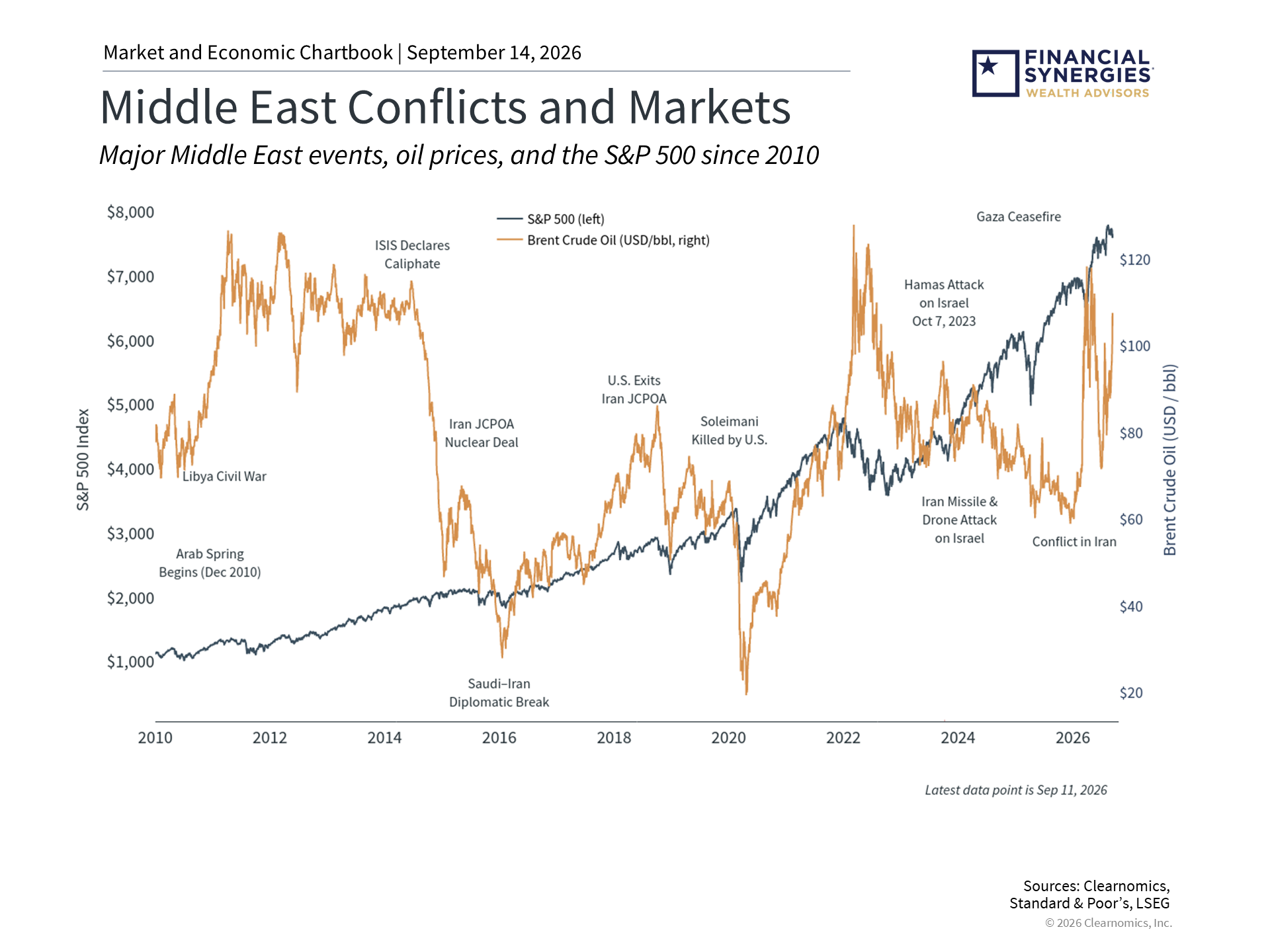
Oil markets have fluctuated dramatically this year, which shows both how sensitive they can be to global events, and also how difficult it can be to forecast commodity prices. Oil jumped to multi-year highs back in March when the war in Iran began. Since then, Brent crude has oscillated from as low as $72 per barrel at the start of July back toward $100 as of today, touching a seven-week high.
The primary driver of these swings is the ongoing conflict in the Middle East, which has continued despite multiple ceasefire attempts and failed peace negotiations. Most recently, the Houthis, a group of militants in Yemen, conducted strikes on Saudi Arabian energy infrastructure, raising new concerns about regional supply disruptions and pushing Brent crude back toward $100 per barrel.
While the Strait of Hormuz, which connects the Persian Gulf to the rest of the world, is still the main focus in energy markets, Houthi forces have continued to target the Bab al-Mandab Strait, another important transportation chokepoint. Since it sits at the southern entrance to the Red Sea, it is an increasingly vital route for Saudi oil exports. All told, hostilities across the Middle East region have made the shipping of oil extremely fragile.
For everyday consumers, these moves translate directly into prices at the pump. The national average for regular grade gasoline has hovered around $4.15 per gallon according to AAA, and over $5.00 per gallon for premium, levels that have kept energy costs elevated and headline inflation higher than policymakers would prefer.1 This has affected inflation numbers all year since the energy component comprises over 7% of the total Consumer Price Index.2
From a historical perspective, oil price volatility of this kind is not unusual. During the Russia-Ukraine conflict in 2022, for instance, Brent crude surpassed $120 per barrel before declining sharply. In the mid-2000s, oil stayed around $100 for several years as global demand grew rapidly ahead of the financial crisis. Today, it’s clear that high oil prices are primarily due to geopolitics, not an overheating economy per se. Additionally, with the U.S. now producing more than 13.8 million barrels per day, it is somewhat more insulated from shocks than in the past.3
Copper reflects both trade policy and long-term structural demand
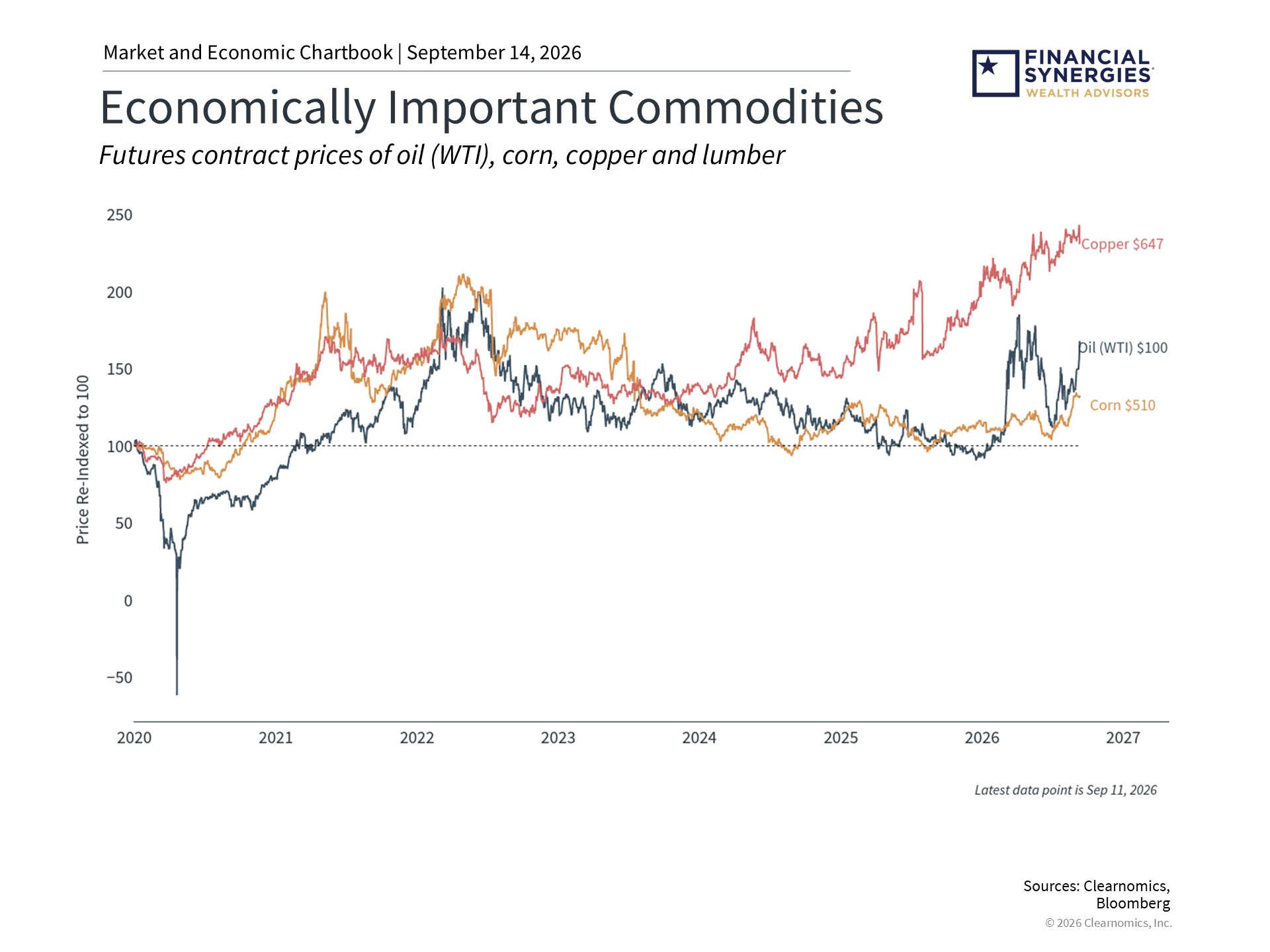
While oil has been the biggest commodity story this year, copper has also reached its own record highs. Investors often use the term “Dr. Copper” to refer to the metal, since it can be perceived as a forward-looking economic indicator. This is because copper has a wide array of industrial uses, from building construction and energy, to electronics and transportation.
The latest jump in copper prices is primarily driven by two factors: tariff concerns with tight supply, and long-term structural demand from trends such as AI data centers. When it comes to tariffs, there are concerns about the possibility of new U.S. import duties on refined copper. It may seem unusual that the U.S. would impose additional tariffs on copper given how important it is, but the administration’s goal is exactly to promote domestic production for national security reasons. These tariffs are being explored under Section 232 of the Trade Expansion Act of 1962, which is meant to target foreign reliance on sensitive goods.4 These issues, along with tight supplies and slower production, have driven copper prices higher.
At the same time, demand for copper has jumped as well. AI data centers, for instance, naturally use thousands of tons of copper.5 Not only is copper a critical component in power delivery systems, including electrical wiring, it is very efficient at transferring heat. This makes it a critical part of the infrastructure needed for keeping large data centers and thousands of semiconductor chips cool. As the “hyperscalers” continue to build out larger data centers, more and more copper has been needed.
Like most commodities, prices and demand can react quickly, but it takes a long time to bring new production online. This naturally leads to large swings in prices. While copper is different from precious metals, there are parallels with the large rallies and pullbacks in gold and silver at the beginning of the year. What’s true across all of these metals is the need to maintain a longer-term perspective and not overreact to near-term moves.
Commodities are best viewed in a portfolio context
What matters for long-term investors is what these commodities signal about the broader economic environment, and how these assets behave within the context of a diversified portfolio.
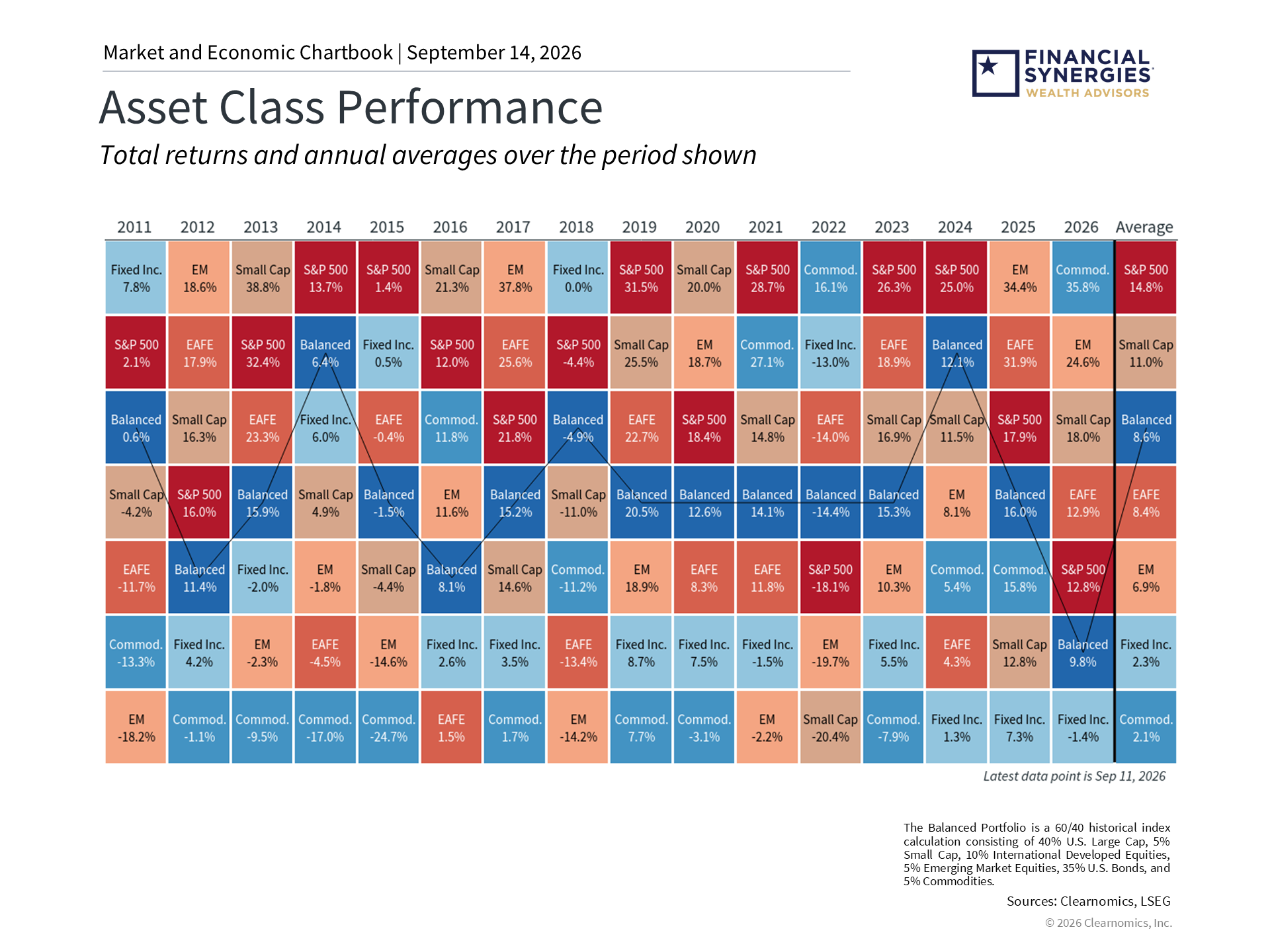
Year-to-date, the Bloomberg Commodity Index is the leading asset class, reflecting high oil prices, as well as the supply and demand dynamics for other metals and materials. The chart above shows how volatile commodities can be, with the asset class outperforming in some years and underperforming in many others.
What’s most important is that many other asset classes have performed well this year too. Emerging market stocks, small caps, U.S. stocks, and other major asset classes have also delivered solid returns. This is partly because these parts of the market also benefit from higher commodity prices. The energy sector, for instance, has been the best performing S&P 500 sector for this reason.
All of this underscores the importance of maintaining a portfolio perspective, rather than focusing on individual asset classes or investments. The purpose of a well-constructed portfolio is to benefit from all of these trends which can interact in complex ways, while managing risk, all in service of achieving long-term financial goals.
References
1. https://gasprices.aaa.com/
2. https://www.bls.gov/cpi/tables/relative-importance/home.htm
3. https://www.eia.gov/dnav/pet/hist/leafhandler.ashx?n=pet&s=mcrfpus2&f=m
4. https://www.congress.gov/crs-product/IN12614
5. https://www.spglobal.com/en/research-insights/special-reports/copper-in-the-age-of-ai
Concerns or questions about how your investment portfolio will hold up in the current market environment? Contact Financial Synergies today.
We are a boutique, financial advisory and total wealth management firm with over 35 years helping clients navigate turbulent markets. To learn more about our approach to investment management, financial planning, and retirement planning, please reach out to us. One of our seasoned advisors would be happy to help you build a custom financial plan to help ensure you accomplish your financial goals and objectives. Schedule a conversation with us today.
More relevant articles by Financial Synergies:
Blog Disclosures
This content, which may contain security-related opinions and/or information, is provided for informational purposes only and should not be relied upon in any manner as professional advice, or an endorsement of any practices, products or services. There can be no guarantees or assurances that the views expressed here will be applicable for any particular facts or circumstances, and should not be relied upon in any manner. You should consult your own financial advisors as to legal, business, tax, and other related matters concerning any investment.
The commentary in this “post” (including any related blogs, videos, and social media) reflects the personal opinions, viewpoints, and analyses of the Financial Synergies Wealth Advisors, Inc. employees providing such comments, and should not be regarded as the views of Financial Synergies Wealth Advisors, Inc. or its respective affiliates or as a description of advisory services provided by Financial Synergies Wealth Advisors, Inc. or performance returns of any Financial Synergies Wealth Advisors, Inc. client.
Any opinions expressed herein do not constitute or imply endorsement, sponsorship, or recommendation by Financial Synergies Wealth Advisors, Inc. or its employees. The views reflected in the commentary are subject to change at any time without notice.
Nothing on this website or Blog constitutes investment or financial planning advice, performance data or any recommendation that any particular security, portfolio of securities, transaction or investment strategy is suitable for any specific person. It also should not be construed as an offer soliciting the purchase or sale of any security mentioned. Nor should it be construed as an offer to provide investment advisory services by Financial Synergies Wealth Advisors, Inc.
Any mention of a particular security and related performance data is not a recommendation to buy or sell that security. Financial Synergies Wealth Advisors, Inc. manages its clients’ accounts using a variety of investment techniques and strategies, which are not necessarily discussed in the commentary. Investments in securities involve the risk of loss. Past performance is no guarantee of future results.
Any charts provided here or on any related Financial Synergies Wealth Advisors, Inc. personnel content outlets are for informational purposes only, and should also not be relied upon when making any investment decision. Any indices referenced for comparison are unmanaged and cannot be invested into directly. As always please remember investing involves risk and possible loss of principal capital; please seek advice from a licensed professional. Any projections, estimates, forecasts, targets, prospects and/or opinions expressed in these materials are subject to change without notice and may differ or be contrary to opinions expressed by others. Information in charts have been obtained from third-party sources and data, and may include those from portfolio securities of funds managed by Financial Synergies Wealth Advisors, Inc. While taken from sources believed to be reliable, Financial Synergies Wealth Advisors, Inc. has not independently verified such information and makes no representations about the enduring accuracy of the information or its appropriateness for a given situation. All content speaks only as of the date indicated.
Financial Synergies Wealth Advisors, Inc. is a registered investment adviser. Advisory services are only offered to clients or prospective clients where Financial Synergies Wealth Advisors, Inc. and its representatives are properly licensed or exempt from licensure. Investments in securities involve the risk of loss. Past performance is no guarantee of future results.
See Full Disclosures Page Here
 Skip to content


What’s Driving Portfolios: The Impact of High Oil and Copper Prices
The 19th century geologist Charles Lyell popularized the concept of “uniformitarianism,” a long word that reflects the simple idea that the natural forces shaping the earth today are the same ones that have consistently affected it across history. A similar principle applies to commodities we extract from the ground like oil and copper. While there are events like wars, tariffs, and AI impacting commodity prices at the moment, ultimately it’s supply and demand that always drives these markets in the long run.
As an asset class, commodities have not only outperformed this year, but have also supported other areas of the market such as U.S. stocks. Commodities are closely followed due to their sensitivity to economic conditions as well. Oil prices have swung from month to month, copper has climbed to new record highs, and precious metals surged to all-time highs at the start of the year before pulling back. Short-term price swings in the commodity market are not unusual, and the forces behind them, including geopolitics, tariffs, and changing economic trends, are difficult to predict.
The important question for investors is not where oil or copper will trade next week, but what supply and demand tell us about the broader economy, long run trends, and how they interact with a well-constructed portfolio. Commodities can serve as indicators of global conditions, and their volatility is a natural part of how they function. How can investors maintain perspective when commodity markets are moving sharply?
Oil prices remain tied to geopolitical uncertainty
Oil markets have fluctuated dramatically this year, which shows both how sensitive they can be to global events, and also how difficult it can be to forecast commodity prices. Oil jumped to multi-year highs back in March when the war in Iran began. Since then, Brent crude has oscillated from as low as $72 per barrel at the start of July back toward $100 as of today, touching a seven-week high.
The primary driver of these swings is the ongoing conflict in the Middle East, which has continued despite multiple ceasefire attempts and failed peace negotiations. Most recently, the Houthis, a group of militants in Yemen, conducted strikes on Saudi Arabian energy infrastructure, raising new concerns about regional supply disruptions and pushing Brent crude back toward $100 per barrel.
While the Strait of Hormuz, which connects the Persian Gulf to the rest of the world, is still the main focus in energy markets, Houthi forces have continued to target the Bab al-Mandab Strait, another important transportation chokepoint. Since it sits at the southern entrance to the Red Sea, it is an increasingly vital route for Saudi oil exports. All told, hostilities across the Middle East region have made the shipping of oil extremely fragile.
For everyday consumers, these moves translate directly into prices at the pump. The national average for regular grade gasoline has hovered around $4.15 per gallon according to AAA, and over $5.00 per gallon for premium, levels that have kept energy costs elevated and headline inflation higher than policymakers would prefer.1 This has affected inflation numbers all year since the energy component comprises over 7% of the total Consumer Price Index.2
From a historical perspective, oil price volatility of this kind is not unusual. During the Russia-Ukraine conflict in 2022, for instance, Brent crude surpassed $120 per barrel before declining sharply. In the mid-2000s, oil stayed around $100 for several years as global demand grew rapidly ahead of the financial crisis. Today, it’s clear that high oil prices are primarily due to geopolitics, not an overheating economy per se. Additionally, with the U.S. now producing more than 13.8 million barrels per day, it is somewhat more insulated from shocks than in the past.3
Copper reflects both trade policy and long-term structural demand
While oil has been the biggest commodity story this year, copper has also reached its own record highs. Investors often use the term “Dr. Copper” to refer to the metal, since it can be perceived as a forward-looking economic indicator. This is because copper has a wide array of industrial uses, from building construction and energy, to electronics and transportation.
The latest jump in copper prices is primarily driven by two factors: tariff concerns with tight supply, and long-term structural demand from trends such as AI data centers. When it comes to tariffs, there are concerns about the possibility of new U.S. import duties on refined copper. It may seem unusual that the U.S. would impose additional tariffs on copper given how important it is, but the administration’s goal is exactly to promote domestic production for national security reasons. These tariffs are being explored under Section 232 of the Trade Expansion Act of 1962, which is meant to target foreign reliance on sensitive goods.4 These issues, along with tight supplies and slower production, have driven copper prices higher.
At the same time, demand for copper has jumped as well. AI data centers, for instance, naturally use thousands of tons of copper.5 Not only is copper a critical component in power delivery systems, including electrical wiring, it is very efficient at transferring heat. This makes it a critical part of the infrastructure needed for keeping large data centers and thousands of semiconductor chips cool. As the “hyperscalers” continue to build out larger data centers, more and more copper has been needed.
Like most commodities, prices and demand can react quickly, but it takes a long time to bring new production online. This naturally leads to large swings in prices. While copper is different from precious metals, there are parallels with the large rallies and pullbacks in gold and silver at the beginning of the year. What’s true across all of these metals is the need to maintain a longer-term perspective and not overreact to near-term moves.
Commodities are best viewed in a portfolio context
What matters for long-term investors is what these commodities signal about the broader economic environment, and how these assets behave within the context of a diversified portfolio.
Year-to-date, the Bloomberg Commodity Index is the leading asset class, reflecting high oil prices, as well as the supply and demand dynamics for other metals and materials. The chart above shows how volatile commodities can be, with the asset class outperforming in some years and underperforming in many others.
What’s most important is that many other asset classes have performed well this year too. Emerging market stocks, small caps, U.S. stocks, and other major asset classes have also delivered solid returns. This is partly because these parts of the market also benefit from higher commodity prices. The energy sector, for instance, has been the best performing S&P 500 sector for this reason.
All of this underscores the importance of maintaining a portfolio perspective, rather than focusing on individual asset classes or investments. The purpose of a well-constructed portfolio is to benefit from all of these trends which can interact in complex ways, while managing risk, all in service of achieving long-term financial goals.
References
1. https://gasprices.aaa.com/
2. https://www.bls.gov/cpi/tables/relative-importance/home.htm
3. https://www.eia.gov/dnav/pet/hist/leafhandler.ashx?n=pet&s=mcrfpus2&f=m
4. https://www.congress.gov/crs-product/IN12614
5. https://www.spglobal.com/en/research-insights/special-reports/copper-in-the-age-of-ai
Concerns or questions about how your investment portfolio will hold up in the current market environment? Contact Financial Synergies today.
We are a boutique, financial advisory and total wealth management firm with over 35 years helping clients navigate turbulent markets. To learn more about our approach to investment management, financial planning, and retirement planning, please reach out to us. One of our seasoned advisors would be happy to help you build a custom financial plan to help ensure you accomplish your financial goals and objectives. Schedule a conversation with us today.
More relevant articles by Financial Synergies:
Blog Disclosures
This content, which may contain security-related opinions and/or information, is provided for informational purposes only and should not be relied upon in any manner as professional advice, or an endorsement of any practices, products or services. There can be no guarantees or assurances that the views expressed here will be applicable for any particular facts or circumstances, and should not be relied upon in any manner. You should consult your own financial advisors as to legal, business, tax, and other related matters concerning any investment.
The commentary in this “post” (including any related blogs, videos, and social media) reflects the personal opinions, viewpoints, and analyses of the Financial Synergies Wealth Advisors, Inc. employees providing such comments, and should not be regarded as the views of Financial Synergies Wealth Advisors, Inc. or its respective affiliates or as a description of advisory services provided by Financial Synergies Wealth Advisors, Inc. or performance returns of any Financial Synergies Wealth Advisors, Inc. client.
Any opinions expressed herein do not constitute or imply endorsement, sponsorship, or recommendation by Financial Synergies Wealth Advisors, Inc. or its employees. The views reflected in the commentary are subject to change at any time without notice.
Nothing on this website or Blog constitutes investment or financial planning advice, performance data or any recommendation that any particular security, portfolio of securities, transaction or investment strategy is suitable for any specific person. It also should not be construed as an offer soliciting the purchase or sale of any security mentioned. Nor should it be construed as an offer to provide investment advisory services by Financial Synergies Wealth Advisors, Inc.
Any mention of a particular security and related performance data is not a recommendation to buy or sell that security. Financial Synergies Wealth Advisors, Inc. manages its clients’ accounts using a variety of investment techniques and strategies, which are not necessarily discussed in the commentary. Investments in securities involve the risk of loss. Past performance is no guarantee of future results.
Any charts provided here or on any related Financial Synergies Wealth Advisors, Inc. personnel content outlets are for informational purposes only, and should also not be relied upon when making any investment decision. Any indices referenced for comparison are unmanaged and cannot be invested into directly. As always please remember investing involves risk and possible loss of principal capital; please seek advice from a licensed professional. Any projections, estimates, forecasts, targets, prospects and/or opinions expressed in these materials are subject to change without notice and may differ or be contrary to opinions expressed by others. Information in charts have been obtained from third-party sources and data, and may include those from portfolio securities of funds managed by Financial Synergies Wealth Advisors, Inc. While taken from sources believed to be reliable, Financial Synergies Wealth Advisors, Inc. has not independently verified such information and makes no representations about the enduring accuracy of the information or its appropriateness for a given situation. All content speaks only as of the date indicated.
Financial Synergies Wealth Advisors, Inc. is a registered investment adviser. Advisory services are only offered to clients or prospective clients where Financial Synergies Wealth Advisors, Inc. and its representatives are properly licensed or exempt from licensure. Investments in securities involve the risk of loss. Past performance is no guarantee of future results.
See Full Disclosures Page Here
Recent Posts
Chart of the Month | Stocks vs. Bonds: More Choices for Investors as Bond Yields Rise
Weekly Market Recap – September Inflation & Retail Sales Data, AI Financing, & Bank Earnings
Happy Birthday to the Bull Market
Subscribe to Our Blog
Chief Investment Officer | Managing Partner