Treasury rates have surged to their highest levels in recent years due to a combination of concerns around inflation, oil prices, the national debt, and the Fed. The 10-year Treasury yield is once again above 4.6% and the 30-year has been above 5% for the longest streak since 2007.1 In general, this is positive for long-term investors since higher yields support portfolio goals such as income and stability.
Perhaps more importantly, real yields have risen even further. For investors, these moves are helpful to understand because they influence many aspects of investing and planning. Portfolios and financial plans should take these evolving interest rates and economic circumstances into careful consideration, especially because they have changed significantly over the past decade.
The difference between nominal and real interest rates is quite simple, even if it sounds technical. A nominal yield is simply the stated interest rate on a bond, whether it’s a corporate investment grade bond or a U.S. Treasury note. The real yield goes one step further by showing what an investor earns after adjusting for inflation. Real yields represent the true return for savers, and therefore serve as a key benchmark against which all other asset classes are measured. Given the importance of rising real yields, what do investors need to consider?
Long-term real yields are near multi-year highs
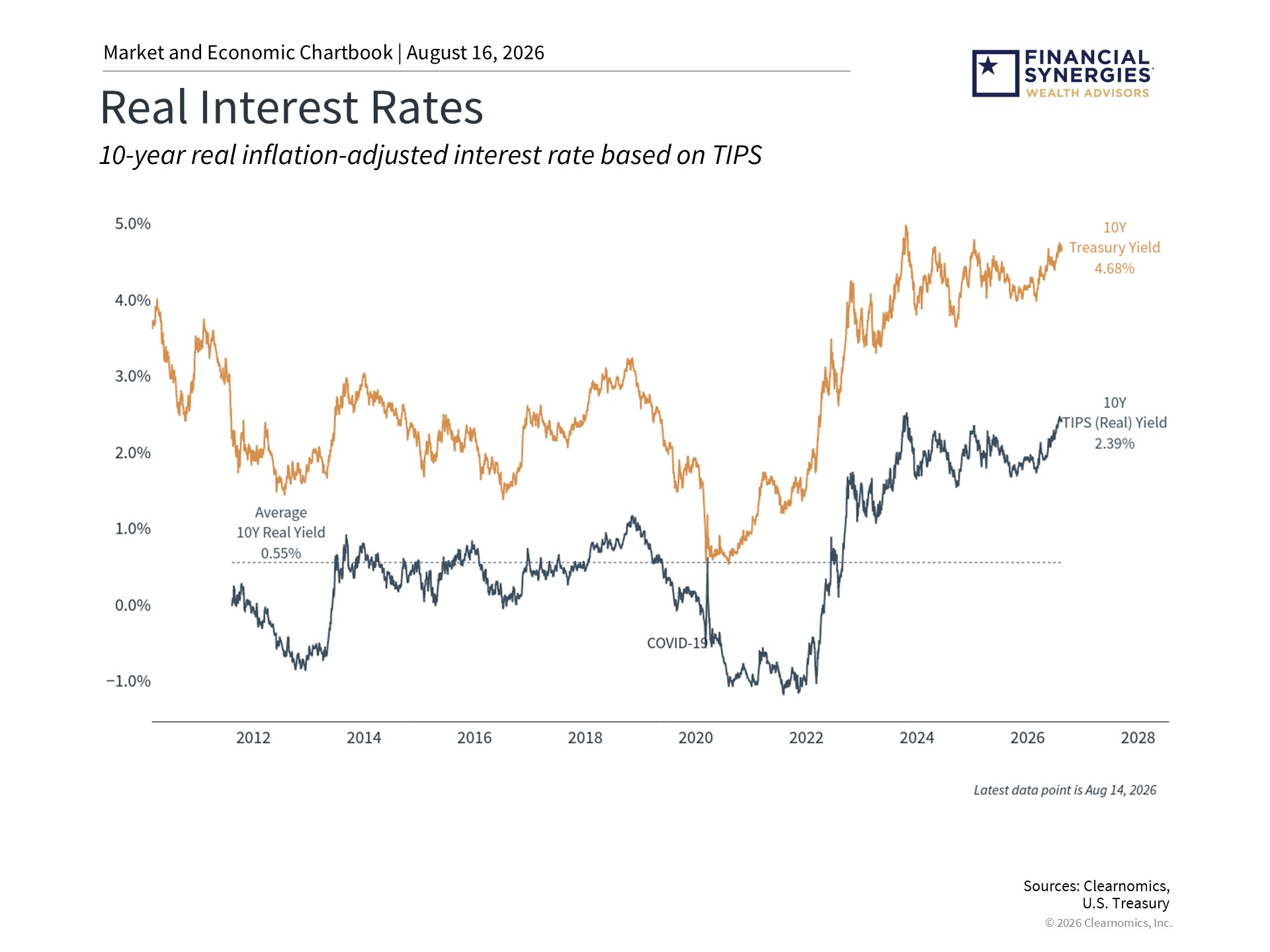
The chart above shows how real yields have evolved over the past decade and a half. In 2020, for instance, real yields on government bonds actually turned negative, meaning investors were either expecting little to no inflation in the coming years, or accepting a guaranteed loss of purchasing power for the safety of U.S. Treasury securities. This was in large part by design as the Fed cut rates to support the economy and push investors toward stocks, real estate, and other higher-yielding assets.
Yields then shifted in 2022 when inflation spiked, prompting the Fed to reverse course by raising the federal funds rate at the fastest pace in decades. Both nominal and real yields surged as a result. Today, the 10-year nominal Treasury yield stands at roughly 4.7% while the corresponding real yield is 2.4%, well above levels since the global financial crisis. This is based on expectations of inflation over the next ten years, and not just the latest figures.
Several factors are keeping long-term yields elevated today. Oil prices have risen back above $90 per barrel for Brent crude amid the ongoing war in Iran, and gasoline prices have climbed back above $4 per gallon nationally.2 Higher energy costs can feed directly into broader inflation, which in turn pushes nominal yields higher. What’s interesting is that inflation expectations haven’t risen much based on market measures and surveys, but this is largely because many anticipate the Fed may raise rates over the next several months to fight rising prices.
Separately, the rising national debt and federal budget deficit continue to create uncertainty for government bond yields. This affects what economists call the “term premium,” or the extra yield investors require to hold longer-term bonds. With the total national debt now above $39 trillion, greater interest payments naturally raise the borrowing cost for the government, pushing U.S. Treasury yields higher.3
Higher yields affect all parts of the market
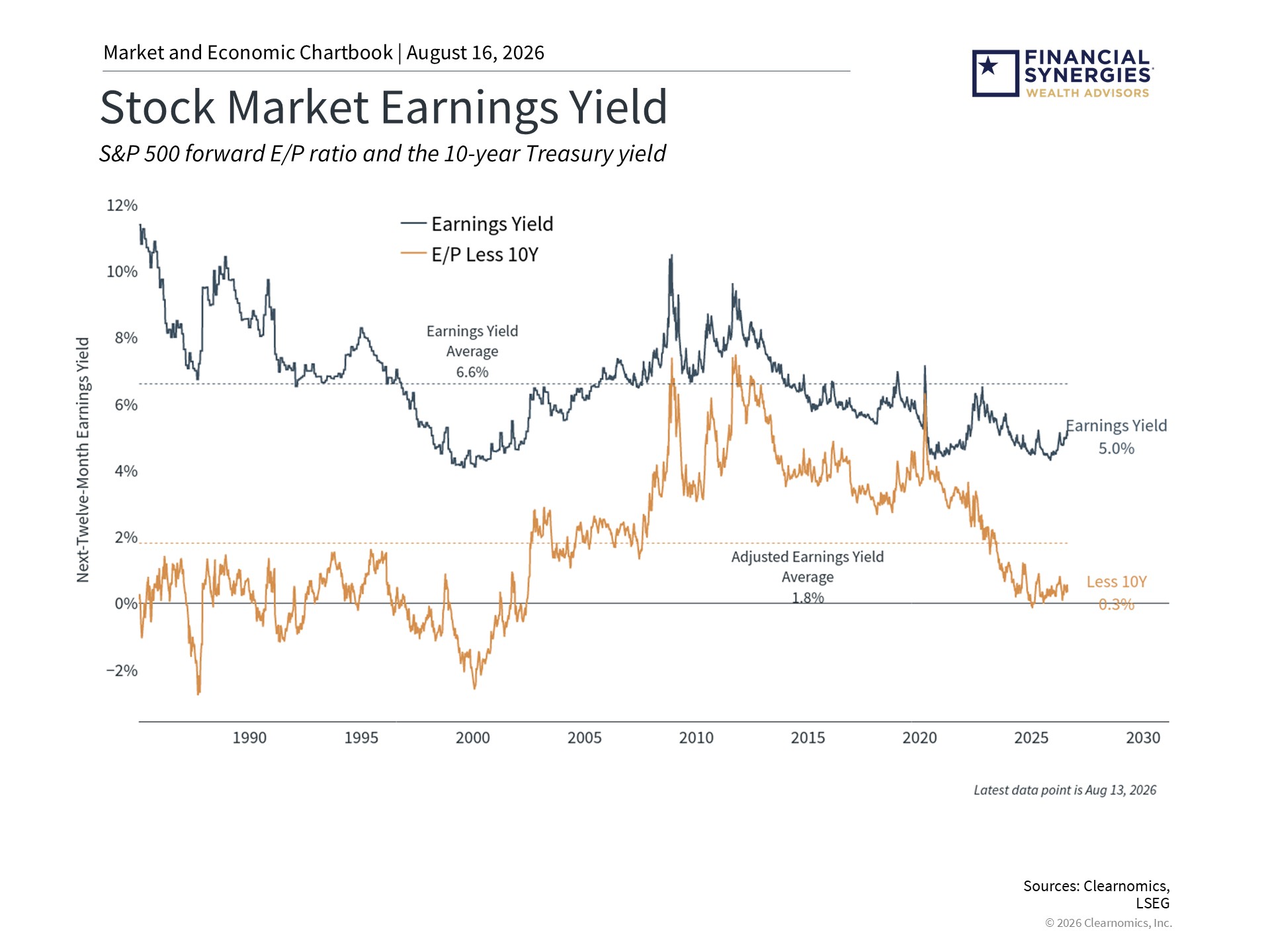
Interest rates are not just about bonds, but affect how attractive different asset classes are compared to one another. This is especially important for long-term investors since it influences the relative attractiveness of different asset classes in a balanced portfolio. For example, the chart above shows the S&P 500 earnings yield, which is the level of earnings-per-share divided by the price of the S&P 500. This is an important valuation measure that helps us compare the stock market against bond yields.
This comparison is often referred to as the “equity risk premium” since it measures how much additional benefit is available for taking on greater risk in the stock market. When real bond yields were near zero or negative, as they were for much of the post-2008 era, stocks had little competition. Investors accepted lower earnings yields from equities because there were few alternatives for yield and growth. This was commonly referred to as TINA, or “there is no alternative.”
At current levels, the 10-year real yield of 2.4% means that investors can earn an attractive, inflation-adjusted return from government bonds. The S&P 500 earnings yield sits at roughly 4.9%, corresponding to a forward price-to-earnings ratio of around 20x. This means that understanding and evaluating the balance of stocks and bonds in a portfolio is potentially more important than before.4
The Fed balance sheet and what it means for yields
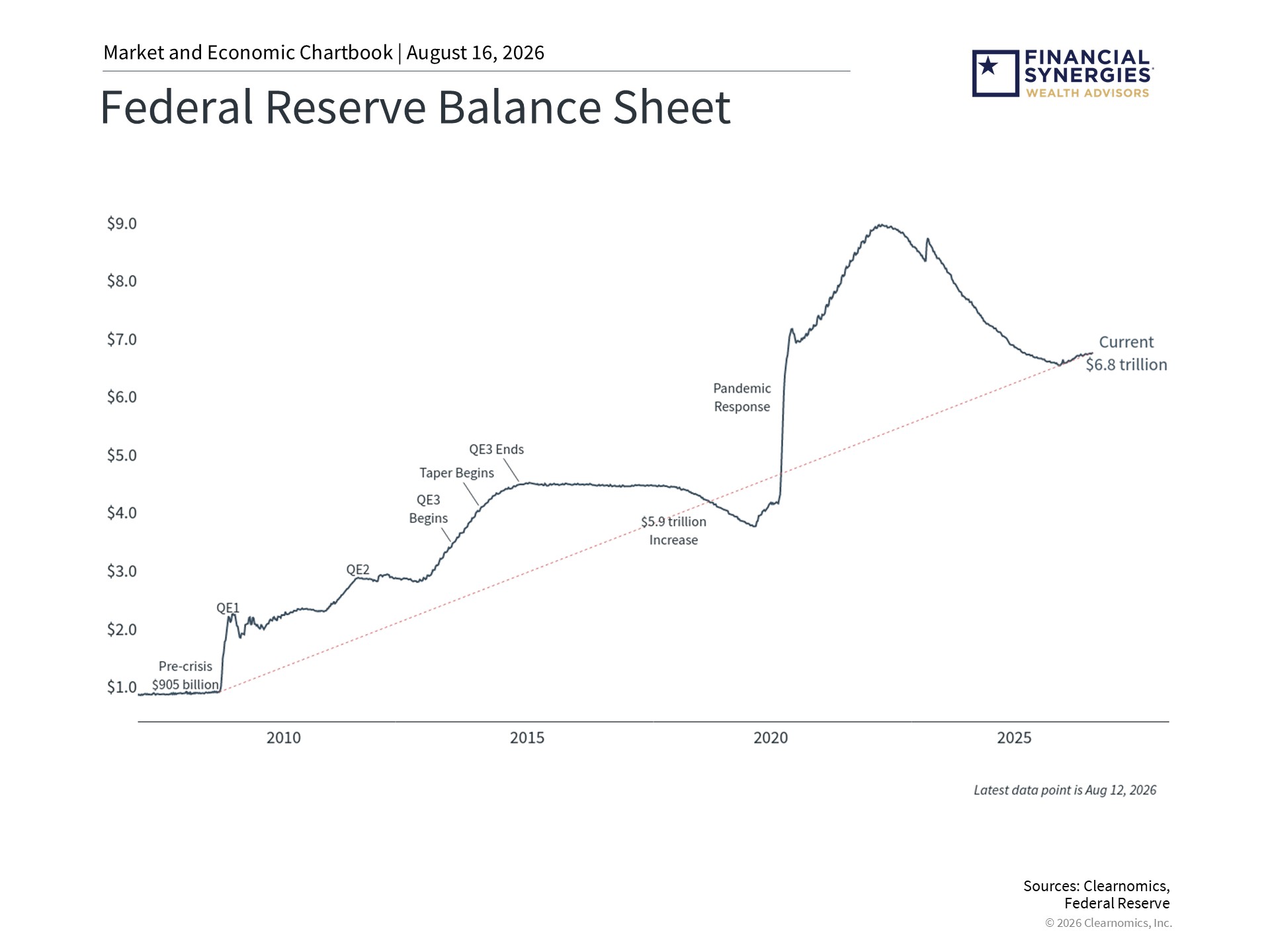
Another factor affecting bond yields is uncertainty around Fed policy under the new leadership of Kevin Warsh. One task force he has launched, for instance, seeks to address the central bank’s $6.8 trillion balance sheet.5 As shown in the chart above, the level of assets held by the Fed has increased with each economic crisis. While it has shrunk in recent years as assets have matured, it is still far larger than it was prior to 2008.
Warsh has long held the view that the Fed ought to shrink its balance sheet when the economy is healthy. This would involve selling Treasury securities and mortgage-backed securities, which effectively pushes Treasury bond yields higher, raising borrowing costs for businesses and homebuyers. Along with the expectation of Fed rate hikes, these actions could keep both short-term and long-term interest rates higher for longer.
For long-term investors, this means it’s more important than ever to hold a thoughtful balance of stocks, bonds, and other assets that are designed to achieve financial goals.
References
- https://home.treasury.gov/policy-issues/financing-the-government/interest-rate-statistics
- https://gasprices.aaa.com/
- https://www.jec.senate.gov/public/index.cfm/republicans/debt-dashboard
- Clearnomics research and LSEG data as of July 27, 2026
- https://www.federalreserve.gov/monetarypolicy/task-forces.htm
Concerns or questions about how your investment portfolio will hold up in the current market environment? Contact Financial Synergies today.
We are a boutique, financial advisory and total wealth management firm with over 35 years helping clients navigate turbulent markets. To learn more about our approach to investment management please reach out to us. One of our seasoned advisors would be happy to help you build a custom financial plan to help ensure you accomplish your financial goals and objectives. Schedule a conversation with us today.
More relevant articles by Financial Synergies:
Blog Disclosures
This content, which contains security-related opinions and/or information, is provided for informational purposes only and should not be relied upon in any manner as professional advice, or an endorsement of any practices, products or services. There can be no guarantees or assurances that the views expressed here will be applicable for any particular facts or circumstances, and should not be relied upon in any manner. You should consult your own financial advisors as to legal, business, tax, and other related matters concerning any investment.
The commentary in this “post” (including any related blogs, videos, and social media) reflects the personal opinions, viewpoints, and analyses of the Financial Synergies Wealth Advisors, Inc. employees providing such comments, and should not be regarded as the views of Financial Synergies Wealth Advisors, Inc. or its respective affiliates or as a description of advisory services provided by Financial Synergies Wealth Advisors, Inc. or performance returns of any Financial Synergies Wealth Advisors, Inc. client.
Any opinions expressed herein do not constitute or imply endorsement, sponsorship, or recommendation by Financial Synergies Wealth Advisors, Inc. or its employees. The views reflected in the commentary are subject to change at any time without notice.
Nothing on this website constitutes investment or financial planning advice, performance data or any recommendation that any particular security, portfolio of securities, transaction or investment strategy is suitable for any specific person. It also should not be construed as an offer soliciting the purchase or sale of any security mentioned. Nor should it be construed as an offer to provide investment advisory services by Financial Synergies Wealth Advisors, Inc.
Any mention of a particular security and related performance data is not a recommendation to buy or sell that security. Financial Synergies Wealth Advisors, Inc. manages its clients’ accounts using a variety of investment techniques and strategies, which are not necessarily discussed in the commentary. Investments in securities involve the risk of loss. Past performance is no guarantee of future results.
Any charts provided here or on any related Financial Synergies Wealth Advisors, Inc. personnel content outlets are for informational purposes only, and should also not be relied upon when making any investment decision. Any indices referenced for comparison are unmanaged and cannot be invested into directly. As always please remember investing involves risk and possible loss of principal capital; please seek advice from a licensed professional. Any projections, estimates, forecasts, targets, prospects and/or opinions expressed in these materials are subject to change without notice and may differ or be contrary to opinions expressed by others. Information in charts have been obtained from third-party sources and data, and may include those from portfolio securities of funds managed by Financial Synergies Wealth Advisors, Inc. While taken from sources believed to be reliable, Financial Synergies Wealth Advisors, Inc. has not independently verified such information and makes no representations about the enduring accuracy of the information or its appropriateness for a given situation. All content speaks only as of the date indicated.
Financial Synergies Wealth Advisors, Inc. is a registered investment adviser. Advisory services are only offered to clients or prospective clients where Financial Synergies Wealth Advisors, Inc. and its representatives are properly licensed or exempt from licensure. Investments in securities involve the risk of loss. Past performance is no guarantee of future results.
See Full Disclosures Page Here
 Skip to content


What Rising Real Yields Mean for Investors
Treasury rates have surged to their highest levels in recent years due to a combination of concerns around inflation, oil prices, the national debt, and the Fed. The 10-year Treasury yield is once again above 4.6% and the 30-year has been above 5% for the longest streak since 2007.1 In general, this is positive for long-term investors since higher yields support portfolio goals such as income and stability.
Perhaps more importantly, real yields have risen even further. For investors, these moves are helpful to understand because they influence many aspects of investing and planning. Portfolios and financial plans should take these evolving interest rates and economic circumstances into careful consideration, especially because they have changed significantly over the past decade.
The difference between nominal and real interest rates is quite simple, even if it sounds technical. A nominal yield is simply the stated interest rate on a bond, whether it’s a corporate investment grade bond or a U.S. Treasury note. The real yield goes one step further by showing what an investor earns after adjusting for inflation. Real yields represent the true return for savers, and therefore serve as a key benchmark against which all other asset classes are measured. Given the importance of rising real yields, what do investors need to consider?
Long-term real yields are near multi-year highs
The chart above shows how real yields have evolved over the past decade and a half. In 2020, for instance, real yields on government bonds actually turned negative, meaning investors were either expecting little to no inflation in the coming years, or accepting a guaranteed loss of purchasing power for the safety of U.S. Treasury securities. This was in large part by design as the Fed cut rates to support the economy and push investors toward stocks, real estate, and other higher-yielding assets.
Yields then shifted in 2022 when inflation spiked, prompting the Fed to reverse course by raising the federal funds rate at the fastest pace in decades. Both nominal and real yields surged as a result. Today, the 10-year nominal Treasury yield stands at roughly 4.7% while the corresponding real yield is 2.4%, well above levels since the global financial crisis. This is based on expectations of inflation over the next ten years, and not just the latest figures.
Several factors are keeping long-term yields elevated today. Oil prices have risen back above $90 per barrel for Brent crude amid the ongoing war in Iran, and gasoline prices have climbed back above $4 per gallon nationally.2 Higher energy costs can feed directly into broader inflation, which in turn pushes nominal yields higher. What’s interesting is that inflation expectations haven’t risen much based on market measures and surveys, but this is largely because many anticipate the Fed may raise rates over the next several months to fight rising prices.
Separately, the rising national debt and federal budget deficit continue to create uncertainty for government bond yields. This affects what economists call the “term premium,” or the extra yield investors require to hold longer-term bonds. With the total national debt now above $39 trillion, greater interest payments naturally raise the borrowing cost for the government, pushing U.S. Treasury yields higher.3
Higher yields affect all parts of the market

Interest rates are not just about bonds, but affect how attractive different asset classes are compared to one another. This is especially important for long-term investors since it influences the relative attractiveness of different asset classes in a balanced portfolio. For example, the chart above shows the S&P 500 earnings yield, which is the level of earnings-per-share divided by the price of the S&P 500. This is an important valuation measure that helps us compare the stock market against bond yields.
This comparison is often referred to as the “equity risk premium” since it measures how much additional benefit is available for taking on greater risk in the stock market. When real bond yields were near zero or negative, as they were for much of the post-2008 era, stocks had little competition. Investors accepted lower earnings yields from equities because there were few alternatives for yield and growth. This was commonly referred to as TINA, or “there is no alternative.”
At current levels, the 10-year real yield of 2.4% means that investors can earn an attractive, inflation-adjusted return from government bonds. The S&P 500 earnings yield sits at roughly 4.9%, corresponding to a forward price-to-earnings ratio of around 20x. This means that understanding and evaluating the balance of stocks and bonds in a portfolio is potentially more important than before.4
The Fed balance sheet and what it means for yields
Another factor affecting bond yields is uncertainty around Fed policy under the new leadership of Kevin Warsh. One task force he has launched, for instance, seeks to address the central bank’s $6.8 trillion balance sheet.5 As shown in the chart above, the level of assets held by the Fed has increased with each economic crisis. While it has shrunk in recent years as assets have matured, it is still far larger than it was prior to 2008.
Warsh has long held the view that the Fed ought to shrink its balance sheet when the economy is healthy. This would involve selling Treasury securities and mortgage-backed securities, which effectively pushes Treasury bond yields higher, raising borrowing costs for businesses and homebuyers. Along with the expectation of Fed rate hikes, these actions could keep both short-term and long-term interest rates higher for longer.
For long-term investors, this means it’s more important than ever to hold a thoughtful balance of stocks, bonds, and other assets that are designed to achieve financial goals.
References
Concerns or questions about how your investment portfolio will hold up in the current market environment? Contact Financial Synergies today.
We are a boutique, financial advisory and total wealth management firm with over 35 years helping clients navigate turbulent markets. To learn more about our approach to investment management please reach out to us. One of our seasoned advisors would be happy to help you build a custom financial plan to help ensure you accomplish your financial goals and objectives. Schedule a conversation with us today.
More relevant articles by Financial Synergies:
Blog Disclosures
This content, which contains security-related opinions and/or information, is provided for informational purposes only and should not be relied upon in any manner as professional advice, or an endorsement of any practices, products or services. There can be no guarantees or assurances that the views expressed here will be applicable for any particular facts or circumstances, and should not be relied upon in any manner. You should consult your own financial advisors as to legal, business, tax, and other related matters concerning any investment.
The commentary in this “post” (including any related blogs, videos, and social media) reflects the personal opinions, viewpoints, and analyses of the Financial Synergies Wealth Advisors, Inc. employees providing such comments, and should not be regarded as the views of Financial Synergies Wealth Advisors, Inc. or its respective affiliates or as a description of advisory services provided by Financial Synergies Wealth Advisors, Inc. or performance returns of any Financial Synergies Wealth Advisors, Inc. client.
Any opinions expressed herein do not constitute or imply endorsement, sponsorship, or recommendation by Financial Synergies Wealth Advisors, Inc. or its employees. The views reflected in the commentary are subject to change at any time without notice.
Nothing on this website constitutes investment or financial planning advice, performance data or any recommendation that any particular security, portfolio of securities, transaction or investment strategy is suitable for any specific person. It also should not be construed as an offer soliciting the purchase or sale of any security mentioned. Nor should it be construed as an offer to provide investment advisory services by Financial Synergies Wealth Advisors, Inc.
Any mention of a particular security and related performance data is not a recommendation to buy or sell that security. Financial Synergies Wealth Advisors, Inc. manages its clients’ accounts using a variety of investment techniques and strategies, which are not necessarily discussed in the commentary. Investments in securities involve the risk of loss. Past performance is no guarantee of future results.
Any charts provided here or on any related Financial Synergies Wealth Advisors, Inc. personnel content outlets are for informational purposes only, and should also not be relied upon when making any investment decision. Any indices referenced for comparison are unmanaged and cannot be invested into directly. As always please remember investing involves risk and possible loss of principal capital; please seek advice from a licensed professional. Any projections, estimates, forecasts, targets, prospects and/or opinions expressed in these materials are subject to change without notice and may differ or be contrary to opinions expressed by others. Information in charts have been obtained from third-party sources and data, and may include those from portfolio securities of funds managed by Financial Synergies Wealth Advisors, Inc. While taken from sources believed to be reliable, Financial Synergies Wealth Advisors, Inc. has not independently verified such information and makes no representations about the enduring accuracy of the information or its appropriateness for a given situation. All content speaks only as of the date indicated.
Financial Synergies Wealth Advisors, Inc. is a registered investment adviser. Advisory services are only offered to clients or prospective clients where Financial Synergies Wealth Advisors, Inc. and its representatives are properly licensed or exempt from licensure. Investments in securities involve the risk of loss. Past performance is no guarantee of future results.
See Full Disclosures Page Here
Recent Posts
Chart of the Month | Stocks vs. Bonds: More Choices for Investors as Bond Yields Rise
Weekly Market Recap – September Inflation & Retail Sales Data, AI Financing, & Bank Earnings
Happy Birthday to the Bull Market
Subscribe to Our Blog
Chief Investment Officer | Managing Partner