August Job Growth, Rising Oil Prices & Interest Rates, & Next Week’s Fed Meeting
Weekly Market Recap
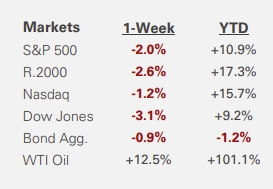 Markets traded lower this week as rising oil prices and long-term interest rates weighed on risk assets. The S&P 500 fell -2.0%, the Nasdaq declined -1.2%, and the Russell 2000 small-cap index returned -2.6%. Growth (-1.7%) outperformed Value (-2.4%), while the Equal-Weight S&P 500 fell -3.1%, signaling broad weakness beneath the major indexes. Energy (+0.7%) was the only sector to finish higher, while Technology was nearly flat. Health Care (-4.3%), Consumer Discretionary (-3.9%), and Materials (-3.6%) led to the downside.
Bonds declined as Treasury yields rose, with long-maturity Treasuries falling -1.7% and the 10-year yield approaching 5%. Corporate bonds also declined but outperformed Treasuries. Oil surged +12.5%, volatility increased, the U.S. dollar was little changed, and Bitcoin fell nearly -6% after a +20% rally.
Key Takeaways
Labor Conditions Improved in August After Several Weak Months of Hiring
Employers added +162,000 jobs, while the unemployment rate held at 4.1%. Prior months also looked better after revisions: June payroll growth was raised to +31,000 from +20,000, and July was revised from an initially reported -23,000 jobs to +21,000. Combined, the revisions added +55,000 jobs to the previous two months. The report does not suggest the labor market has returned to the strength of earlier years, but it paints a less concerning picture than investors saw after July’s initial release. Why it matters: The labor market still appears to be cooling, but August suggests that deterioration is occurring more gradually than previously feared.
Middle East Conflict is Becoming Harder for Markets to Treat as a Temporary Disruption
Oil prices moved sharply higher as fighting intensified and disruptions to energy shipments through the Strait of Hormuz continued. U.S. crude moved back above $100 per barrel after falling substantially earlier in the summer. More importantly, repeated escalations are making it harder to assume that each increase in energy prices will quickly unwind. Why it matters: The longer the disruption persists, the more relevant energy becomes as an ongoing source of inflation uncertainty rather than a series of isolated weekly price swings.
Long-Term Borrowing Costs Continue to Rise Across Global Bond Markets
The 10-year Treasury yield climbed above 4.90% this week, its highest level since October 2023, while the 30-year moved above 5.3%. Government-bond yields also rose across several major developed markets as investors weighed inflation, higher energy costs, government borrowing needs, and tighter monetary policy. The breadth of the move suggests that higher long-term rates are not simply a reaction to one U.S. economic report or a shift in Fed expectations. Why it matters: A wider set of global forces is putting upward pressure on long-term borrowing costs, making it harder to attribute elevated yields to any single economic report or shift in central-bank policy.
Expectations for a Rate Hike at Next Week’s Fed Meeting Continue to Build
The Fed held rates at 3.50%–3.75% in July, although three policymakers preferred a +0.25% hike. At Jackson Hole, Chair Warsh described the labor market as stable and said inflation should remain the Fed’s predominant focus. Since then, stronger August job growth, higher oil prices, and renewed producer-price pressure have strengthened the case for an increase. Futures markets now place roughly a 70% probability on a +0.25% move at the September 15–16 meeting. Why it matters: Next week’s decision will show whether firmer labor data and persistent inflation pressure have been enough to move the Fed from considering a rate hike to delivering one.
AI Infrastructure Spending Remains Resilient Despite Volatile Macro Backdrop
Oil prices and long-term yields have risen, inflation pressure has increased, and the market expects a Fed hike. Those shifts would normally make large capital projects more expensive and could lead companies to reconsider spending plans. So far, however, the largest tech companies have continued committing substantial capital to data centers, computing capacity, and other AI infrastructure. Why it matters: AI investment has become a significant contributor to both economic growth and corporate earnings, and so far, the largest tech companies appear willing to continue that spending despite volatility in rates, energy prices, and inflation.
Concerns or questions about how your investment portfolio will hold up in the current market environment? Contact Financial Synergies today.
We are a boutique, financial advisory and total wealth management firm with over 35 years helping clients navigate turbulent markets. To learn more about our approach to investment management and financial planning, please reach out to us. One of our seasoned advisors would be happy to help you build a custom financial plan to help ensure you accomplish your financial goals and objectives. Schedule a conversation with us today.
More relevant articles by Financial Synergies Wealth Advisors:
Blog Disclosures
This content, which contains security-related opinions and/or information, is provided for informational purposes only and should not be relied upon in any manner as professional advice, or an endorsement of any practices, products or services. There can be no guarantees or assurances that the views expressed here will be applicable for any particular facts or circumstances, and should not be relied upon in any manner. You should consult your own financial advisors as to legal, business, tax, and other related matters concerning any investment.
The commentary in this “post” (including any related blogs, videos, and social media) reflects the personal opinions, viewpoints, and analyses of the Financial Synergies Wealth Advisors, Inc. employees providing such comments, and should not be regarded as the views of Financial Synergies Wealth Advisors, Inc. or its respective affiliates or as a description of advisory services provided by Financial Synergies Wealth Advisors, Inc. or performance returns of any Financial Synergies Wealth Advisors, Inc. client.
Any opinions expressed herein do not constitute or imply endorsement, sponsorship, or recommendation by Financial Synergies Wealth Advisors, Inc. or its employees. The views reflected in the commentary are subject to change at any time without notice.
Nothing on this website constitutes investment or financial planning advice, performance data or any recommendation that any particular security, portfolio of securities, transaction or investment strategy is suitable for any specific person. It also should not be construed as an offer soliciting the purchase or sale of any security mentioned. Nor should it be construed as an offer to provide investment advisory services by Financial Synergies Wealth Advisors, Inc.
Any mention of a particular security and related performance data is not a recommendation to buy or sell that security. Financial Synergies Wealth Advisors, Inc. manages its clients’ accounts using a variety of investment techniques and strategies, which are not necessarily discussed in the commentary. Investments in securities involve the risk of loss. Past performance is no guarantee of future results.
Any charts provided here or on any related Financial Synergies Wealth Advisors, Inc. personnel content outlets are for informational purposes only, and should also not be relied upon when making any investment decision. Any indices referenced for comparison are unmanaged and cannot be invested into directly. As always please remember investing involves risk and possible loss of principal capital; please seek advice from a licensed professional. Any projections, estimates, forecasts, targets, prospects and/or opinions expressed in these materials are subject to change without notice and may differ or be contrary to opinions expressed by others. Information in charts have been obtained from third-party sources and data, and may include those from portfolio securities of funds managed by Financial Synergies Wealth Advisors, Inc. While taken from sources believed to be reliable, Financial Synergies Wealth Advisors, Inc. has not independently verified such information and makes no representations about the enduring accuracy of the information or its appropriateness for a given situation. All content speaks only as of the date indicated.
Financial Synergies Wealth Advisors, Inc. is a registered investment adviser. Advisory services are only offered to clients or prospective clients where Financial Synergies Wealth Advisors, Inc. and its representatives are properly licensed or exempt from licensure. Investments in securities involve the risk of loss. Past performance is no guarantee of future results.
See Full Disclosures Page Here
 Skip to content


Weekly Market Recap – August Job Growth, Rising Oil Prices & Interest Rates, & Next Week’s Fed Meeting
August Job Growth, Rising Oil Prices & Interest Rates, & Next Week’s Fed Meeting
Weekly Market Recap
Bonds declined as Treasury yields rose, with long-maturity Treasuries falling -1.7% and the 10-year yield approaching 5%. Corporate bonds also declined but outperformed Treasuries. Oil surged +12.5%, volatility increased, the U.S. dollar was little changed, and Bitcoin fell nearly -6% after a +20% rally.
Key Takeaways
Labor Conditions Improved in August After Several Weak Months of Hiring
Employers added +162,000 jobs, while the unemployment rate held at 4.1%. Prior months also looked better after revisions: June payroll growth was raised to +31,000 from +20,000, and July was revised from an initially reported -23,000 jobs to +21,000. Combined, the revisions added +55,000 jobs to the previous two months. The report does not suggest the labor market has returned to the strength of earlier years, but it paints a less concerning picture than investors saw after July’s initial release. Why it matters: The labor market still appears to be cooling, but August suggests that deterioration is occurring more gradually than previously feared.
Middle East Conflict is Becoming Harder for Markets to Treat as a Temporary Disruption
Oil prices moved sharply higher as fighting intensified and disruptions to energy shipments through the Strait of Hormuz continued. U.S. crude moved back above $100 per barrel after falling substantially earlier in the summer. More importantly, repeated escalations are making it harder to assume that each increase in energy prices will quickly unwind. Why it matters: The longer the disruption persists, the more relevant energy becomes as an ongoing source of inflation uncertainty rather than a series of isolated weekly price swings.
Long-Term Borrowing Costs Continue to Rise Across Global Bond Markets
The 10-year Treasury yield climbed above 4.90% this week, its highest level since October 2023, while the 30-year moved above 5.3%. Government-bond yields also rose across several major developed markets as investors weighed inflation, higher energy costs, government borrowing needs, and tighter monetary policy. The breadth of the move suggests that higher long-term rates are not simply a reaction to one U.S. economic report or a shift in Fed expectations. Why it matters: A wider set of global forces is putting upward pressure on long-term borrowing costs, making it harder to attribute elevated yields to any single economic report or shift in central-bank policy.
Expectations for a Rate Hike at Next Week’s Fed Meeting Continue to Build
The Fed held rates at 3.50%–3.75% in July, although three policymakers preferred a +0.25% hike. At Jackson Hole, Chair Warsh described the labor market as stable and said inflation should remain the Fed’s predominant focus. Since then, stronger August job growth, higher oil prices, and renewed producer-price pressure have strengthened the case for an increase. Futures markets now place roughly a 70% probability on a +0.25% move at the September 15–16 meeting. Why it matters: Next week’s decision will show whether firmer labor data and persistent inflation pressure have been enough to move the Fed from considering a rate hike to delivering one.
AI Infrastructure Spending Remains Resilient Despite Volatile Macro Backdrop
Oil prices and long-term yields have risen, inflation pressure has increased, and the market expects a Fed hike. Those shifts would normally make large capital projects more expensive and could lead companies to reconsider spending plans. So far, however, the largest tech companies have continued committing substantial capital to data centers, computing capacity, and other AI infrastructure. Why it matters: AI investment has become a significant contributor to both economic growth and corporate earnings, and so far, the largest tech companies appear willing to continue that spending despite volatility in rates, energy prices, and inflation.
Concerns or questions about how your investment portfolio will hold up in the current market environment? Contact Financial Synergies today.
We are a boutique, financial advisory and total wealth management firm with over 35 years helping clients navigate turbulent markets. To learn more about our approach to investment management and financial planning, please reach out to us. One of our seasoned advisors would be happy to help you build a custom financial plan to help ensure you accomplish your financial goals and objectives. Schedule a conversation with us today.
More relevant articles by Financial Synergies Wealth Advisors:
Blog Disclosures
This content, which contains security-related opinions and/or information, is provided for informational purposes only and should not be relied upon in any manner as professional advice, or an endorsement of any practices, products or services. There can be no guarantees or assurances that the views expressed here will be applicable for any particular facts or circumstances, and should not be relied upon in any manner. You should consult your own financial advisors as to legal, business, tax, and other related matters concerning any investment.
The commentary in this “post” (including any related blogs, videos, and social media) reflects the personal opinions, viewpoints, and analyses of the Financial Synergies Wealth Advisors, Inc. employees providing such comments, and should not be regarded as the views of Financial Synergies Wealth Advisors, Inc. or its respective affiliates or as a description of advisory services provided by Financial Synergies Wealth Advisors, Inc. or performance returns of any Financial Synergies Wealth Advisors, Inc. client.
Any opinions expressed herein do not constitute or imply endorsement, sponsorship, or recommendation by Financial Synergies Wealth Advisors, Inc. or its employees. The views reflected in the commentary are subject to change at any time without notice.
Nothing on this website constitutes investment or financial planning advice, performance data or any recommendation that any particular security, portfolio of securities, transaction or investment strategy is suitable for any specific person. It also should not be construed as an offer soliciting the purchase or sale of any security mentioned. Nor should it be construed as an offer to provide investment advisory services by Financial Synergies Wealth Advisors, Inc.
Any mention of a particular security and related performance data is not a recommendation to buy or sell that security. Financial Synergies Wealth Advisors, Inc. manages its clients’ accounts using a variety of investment techniques and strategies, which are not necessarily discussed in the commentary. Investments in securities involve the risk of loss. Past performance is no guarantee of future results.
Any charts provided here or on any related Financial Synergies Wealth Advisors, Inc. personnel content outlets are for informational purposes only, and should also not be relied upon when making any investment decision. Any indices referenced for comparison are unmanaged and cannot be invested into directly. As always please remember investing involves risk and possible loss of principal capital; please seek advice from a licensed professional. Any projections, estimates, forecasts, targets, prospects and/or opinions expressed in these materials are subject to change without notice and may differ or be contrary to opinions expressed by others. Information in charts have been obtained from third-party sources and data, and may include those from portfolio securities of funds managed by Financial Synergies Wealth Advisors, Inc. While taken from sources believed to be reliable, Financial Synergies Wealth Advisors, Inc. has not independently verified such information and makes no representations about the enduring accuracy of the information or its appropriateness for a given situation. All content speaks only as of the date indicated.
Financial Synergies Wealth Advisors, Inc. is a registered investment adviser. Advisory services are only offered to clients or prospective clients where Financial Synergies Wealth Advisors, Inc. and its representatives are properly licensed or exempt from licensure. Investments in securities involve the risk of loss. Past performance is no guarantee of future results.
See Full Disclosures Page Here
Recent Posts
Chart of the Month | Stocks vs. Bonds: More Choices for Investors as Bond Yields Rise
Weekly Market Recap – September Inflation & Retail Sales Data, AI Financing, & Bank Earnings
Happy Birthday to the Bull Market
Subscribe to Our Blog
Chief Investment Officer | Managing Partner