Middle East Ceasefire Agreement, Oil Decline, Equity Rally, & Q1 Earnings Season Kickoff
Weekly Market Recap
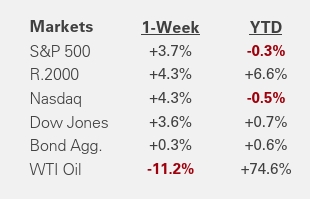 Stocks traded higher for a second consecutive week as a ceasefire announcement between the U.S. and Iran triggered the strongest single-day rally in roughly a year. The S&P 500 gained +3.7%, the Nasdaq rose +4.2%, and the Russell 2000 returned +4.3%. Most of the rally occurred Wednesday following news of a two-week ceasefire contingent on Iran reopening the Strait of Hormuz. Oil fell -11%, the VIX dropped below 20, and international stocks rose as energy-importing nations benefited from lower oil prices. Industrials led all sectors with a gain of +5.3%, with most sectors participating in the rally. Treasury yields declined modestly, and corporate bonds outperformed as credit spreads tightened to levels from late January. However, the ceasefire was being tested by late in the week, with markets closely monitoring weekend talks.
Key Takeaways
Stocks Trade Higher on Middle East Ceasefire Headlines
The U.S. and Iran agreed to a two-week ceasefire, triggering a relief rally. Late Tuesday, the White House announced an agreement contingent on Iran reopening the Strait of Hormuz, less than two hours before a stated deadline to launch strikes. Markets reacted decisively Wednesday: the S&P 500 surged +2.5%, its best single-day gain in a year, the Dow jumped +2.9%, the Russell 2000 gained +3.0%, and international equities rallied +3.5%.
Unlike prior headlines, this was an actual agreement confirmed by both sides, with talks scheduled for this weekend. Implication – The ceasefire is meaningful, but it was tested within hours. Israel launched strikes across Lebanon, Iran accused the U.S. of violating three conditions, and the Strait remained effectively closed Thursday morning. This weekend’s talks will determine whether the agreement marks a turning point.
Oil Prices Fall as Market Prices in Hormuz Reopening
Oil fell -16% on Wednesday, its largest single-day decline since April 2020, as markets priced in a potential Hormuz reopening. WTI crude dropped from around $112 to roughly $94, erasing weeks of war-driven gains that had pushed oil up more than +65% year-to-date. The move had immediate ripple effects: airline stocks rallied, and expectations for a Fed rate cut increased as near-term inflation concerns eased. However, the physical reopening of the Strait hadn’t occurred as of Thursday, and oil prices were moving back toward $100.
Why it matters: Oil is the primary channel through which this conflict affects inflation, the Federal Reserve’s decisions, consumers, and corporate profits. Wednesday’s swing showed how quickly that dynamic can shift when headlines change. The key question is whether the ceasefire produces an actual reopening.
Credit Market & Volatility Signal Improving Risk Appetite Across Asset Classes
High-yield credit spreads, which measure the extra yield investors require to hold corporate bonds over comparable Treasuries, tightened nearly -0.50% over the past two weeks and reached their lowest levels since late January. The VIX, a measure of expected market volatility, closed below 20 for the first time since late February, after briefly touching 28 intraday Tuesday before the ceasefire announcement. Why it matters: When credit markets and volatility measures move in the same direction as stocks, it generally signals that the rally reflects genuine improvement in investor confidence rather than a narrow or speculative move. Both confirmed the week’s stock market advance.
Treasury Yields Hold Steady Despite the Ceasefire Rally
The 10-year Treasury yield fell less than -0.05% on the week to around 4.30%, a muted response given the scale of moves elsewhere. The bond market’s reaction reflects the Fed’s policy forecast. Seven of nineteen Fed members forecast zero cuts in 2026, and the Fed’s March minutes, released this week, reaffirmed its patient approach. Why it matters: The bond market’s muted reaction suggests investors are waiting to see whether the ceasefire meaningfully changes the inflation and growth picture before adjusting their rate expectations.
Earnings Season Kicks Off Next Week
First-quarter earnings season unofficially begins next week, with the major Wall Street banks reporting.
Beyond the typical focus on revenue and profit results, investors will be listening closely to management commentary on the conflict’s effects: energy costs, supply chain conditions, consumer demand, and any changes to forward guidance. Why it matters: Corporate earnings calls will offer the first direct read on how the energy shock has worked its way through company costs, pricing, and demand. Forward guidance and tone may matter more than the headline numbers this quarter.
Concerns or questions about how your investment portfolio will hold up in the current market environment? Contact Financial Synergies today.
We are a boutique, financial advisory and total wealth management firm with over 35 years helping clients navigate turbulent markets. To learn more about our approach to investment management please reach out to us. One of our seasoned advisors would be happy to help you build a custom financial plan to help ensure you accomplish your financial goals and objectives. Schedule a conversation with us today.
More relevant articles by Financial Synergies:
Blog Disclosures
This content, which contains security-related opinions and/or information, is provided for informational purposes only and should not be relied upon in any manner as professional advice, or an endorsement of any practices, products or services. There can be no guarantees or assurances that the views expressed here will be applicable for any particular facts or circumstances, and should not be relied upon in any manner. You should consult your own financial advisors as to legal, business, tax, and other related matters concerning any investment.
The commentary in this “post” (including any related blogs, videos, and social media) reflects the personal opinions, viewpoints, and analyses of the Financial Synergies Wealth Advisors, Inc. employees providing such comments, and should not be regarded as the views of Financial Synergies Wealth Advisors, Inc. or its respective affiliates or as a description of advisory services provided by Financial Synergies Wealth Advisors, Inc. or performance returns of any Financial Synergies Wealth Advisors, Inc. client.
Any opinions expressed herein do not constitute or imply endorsement, sponsorship, or recommendation by Financial Synergies Wealth Advisors, Inc. or its employees. The views reflected in the commentary are subject to change at any time without notice.
Nothing on this website constitutes investment or financial planning advice, performance data or any recommendation that any particular security, portfolio of securities, transaction or investment strategy is suitable for any specific person. It also should not be construed as an offer soliciting the purchase or sale of any security mentioned. Nor should it be construed as an offer to provide investment advisory services by Financial Synergies Wealth Advisors, Inc.
Any mention of a particular security and related performance data is not a recommendation to buy or sell that security. Financial Synergies Wealth Advisors, Inc. manages its clients’ accounts using a variety of investment techniques and strategies, which are not necessarily discussed in the commentary. Investments in securities involve the risk of loss. Past performance is no guarantee of future results.
Any charts provided here or on any related Financial Synergies Wealth Advisors, Inc. personnel content outlets are for informational purposes only, and should also not be relied upon when making any investment decision. Any indices referenced for comparison are unmanaged and cannot be invested into directly. As always please remember investing involves risk and possible loss of principal capital; please seek advice from a licensed professional. Any projections, estimates, forecasts, targets, prospects and/or opinions expressed in these materials are subject to change without notice and may differ or be contrary to opinions expressed by others. Information in charts have been obtained from third-party sources and data, and may include those from portfolio securities of funds managed by Financial Synergies Wealth Advisors, Inc. While taken from sources believed to be reliable, Financial Synergies Wealth Advisors, Inc. has not independently verified such information and makes no representations about the enduring accuracy of the information or its appropriateness for a given situation. All content speaks only as of the date indicated.
Financial Synergies Wealth Advisors, Inc. is a registered investment adviser. Advisory services are only offered to clients or prospective clients where Financial Synergies Wealth Advisors, Inc. and its representatives are properly licensed or exempt from licensure. Investments in securities involve the risk of loss. Past performance is no guarantee of future results.
See Full Disclosures Page Here
 Skip to content


Weekly Market Recap | April 10, 2026
Middle East Ceasefire Agreement, Oil Decline, Equity Rally, & Q1 Earnings Season Kickoff
Weekly Market Recap
Key Takeaways
Stocks Trade Higher on Middle East Ceasefire Headlines
The U.S. and Iran agreed to a two-week ceasefire, triggering a relief rally. Late Tuesday, the White House announced an agreement contingent on Iran reopening the Strait of Hormuz, less than two hours before a stated deadline to launch strikes. Markets reacted decisively Wednesday: the S&P 500 surged +2.5%, its best single-day gain in a year, the Dow jumped +2.9%, the Russell 2000 gained +3.0%, and international equities rallied +3.5%.
Unlike prior headlines, this was an actual agreement confirmed by both sides, with talks scheduled for this weekend. Implication – The ceasefire is meaningful, but it was tested within hours. Israel launched strikes across Lebanon, Iran accused the U.S. of violating three conditions, and the Strait remained effectively closed Thursday morning. This weekend’s talks will determine whether the agreement marks a turning point.
Oil Prices Fall as Market Prices in Hormuz Reopening
Oil fell -16% on Wednesday, its largest single-day decline since April 2020, as markets priced in a potential Hormuz reopening. WTI crude dropped from around $112 to roughly $94, erasing weeks of war-driven gains that had pushed oil up more than +65% year-to-date. The move had immediate ripple effects: airline stocks rallied, and expectations for a Fed rate cut increased as near-term inflation concerns eased. However, the physical reopening of the Strait hadn’t occurred as of Thursday, and oil prices were moving back toward $100.
Why it matters: Oil is the primary channel through which this conflict affects inflation, the Federal Reserve’s decisions, consumers, and corporate profits. Wednesday’s swing showed how quickly that dynamic can shift when headlines change. The key question is whether the ceasefire produces an actual reopening.
Credit Market & Volatility Signal Improving Risk Appetite Across Asset Classes
High-yield credit spreads, which measure the extra yield investors require to hold corporate bonds over comparable Treasuries, tightened nearly -0.50% over the past two weeks and reached their lowest levels since late January. The VIX, a measure of expected market volatility, closed below 20 for the first time since late February, after briefly touching 28 intraday Tuesday before the ceasefire announcement. Why it matters: When credit markets and volatility measures move in the same direction as stocks, it generally signals that the rally reflects genuine improvement in investor confidence rather than a narrow or speculative move. Both confirmed the week’s stock market advance.
Treasury Yields Hold Steady Despite the Ceasefire Rally
The 10-year Treasury yield fell less than -0.05% on the week to around 4.30%, a muted response given the scale of moves elsewhere. The bond market’s reaction reflects the Fed’s policy forecast. Seven of nineteen Fed members forecast zero cuts in 2026, and the Fed’s March minutes, released this week, reaffirmed its patient approach. Why it matters: The bond market’s muted reaction suggests investors are waiting to see whether the ceasefire meaningfully changes the inflation and growth picture before adjusting their rate expectations.
Earnings Season Kicks Off Next Week
First-quarter earnings season unofficially begins next week, with the major Wall Street banks reporting.
Beyond the typical focus on revenue and profit results, investors will be listening closely to management commentary on the conflict’s effects: energy costs, supply chain conditions, consumer demand, and any changes to forward guidance. Why it matters: Corporate earnings calls will offer the first direct read on how the energy shock has worked its way through company costs, pricing, and demand. Forward guidance and tone may matter more than the headline numbers this quarter.
Concerns or questions about how your investment portfolio will hold up in the current market environment? Contact Financial Synergies today.
We are a boutique, financial advisory and total wealth management firm with over 35 years helping clients navigate turbulent markets. To learn more about our approach to investment management please reach out to us. One of our seasoned advisors would be happy to help you build a custom financial plan to help ensure you accomplish your financial goals and objectives. Schedule a conversation with us today.
More relevant articles by Financial Synergies:
Blog Disclosures
This content, which contains security-related opinions and/or information, is provided for informational purposes only and should not be relied upon in any manner as professional advice, or an endorsement of any practices, products or services. There can be no guarantees or assurances that the views expressed here will be applicable for any particular facts or circumstances, and should not be relied upon in any manner. You should consult your own financial advisors as to legal, business, tax, and other related matters concerning any investment.
The commentary in this “post” (including any related blogs, videos, and social media) reflects the personal opinions, viewpoints, and analyses of the Financial Synergies Wealth Advisors, Inc. employees providing such comments, and should not be regarded as the views of Financial Synergies Wealth Advisors, Inc. or its respective affiliates or as a description of advisory services provided by Financial Synergies Wealth Advisors, Inc. or performance returns of any Financial Synergies Wealth Advisors, Inc. client.
Any opinions expressed herein do not constitute or imply endorsement, sponsorship, or recommendation by Financial Synergies Wealth Advisors, Inc. or its employees. The views reflected in the commentary are subject to change at any time without notice.
Nothing on this website constitutes investment or financial planning advice, performance data or any recommendation that any particular security, portfolio of securities, transaction or investment strategy is suitable for any specific person. It also should not be construed as an offer soliciting the purchase or sale of any security mentioned. Nor should it be construed as an offer to provide investment advisory services by Financial Synergies Wealth Advisors, Inc.
Any mention of a particular security and related performance data is not a recommendation to buy or sell that security. Financial Synergies Wealth Advisors, Inc. manages its clients’ accounts using a variety of investment techniques and strategies, which are not necessarily discussed in the commentary. Investments in securities involve the risk of loss. Past performance is no guarantee of future results.
Any charts provided here or on any related Financial Synergies Wealth Advisors, Inc. personnel content outlets are for informational purposes only, and should also not be relied upon when making any investment decision. Any indices referenced for comparison are unmanaged and cannot be invested into directly. As always please remember investing involves risk and possible loss of principal capital; please seek advice from a licensed professional. Any projections, estimates, forecasts, targets, prospects and/or opinions expressed in these materials are subject to change without notice and may differ or be contrary to opinions expressed by others. Information in charts have been obtained from third-party sources and data, and may include those from portfolio securities of funds managed by Financial Synergies Wealth Advisors, Inc. While taken from sources believed to be reliable, Financial Synergies Wealth Advisors, Inc. has not independently verified such information and makes no representations about the enduring accuracy of the information or its appropriateness for a given situation. All content speaks only as of the date indicated.
Financial Synergies Wealth Advisors, Inc. is a registered investment adviser. Advisory services are only offered to clients or prospective clients where Financial Synergies Wealth Advisors, Inc. and its representatives are properly licensed or exempt from licensure. Investments in securities involve the risk of loss. Past performance is no guarantee of future results.
See Full Disclosures Page Here
Recent Posts
Putting This Week’s Market Volatility in Perspective
The Midterms Changed Congress, Not the Fundamentals
Monthly Market Update: Market Leadership Rotates as Investors Reassess the AI Trade
Subscribe to Our Blog
Chief Investment Officer | Managing Partner