For much of the history of the stock market, investing was primarily about individual stocks and bonds. Over the past few decades, however, macroeconomic developments have increasingly influenced markets.
Significant events, whether related to central bank policy, geopolitics, or global trade, now affect nearly all stocks across the market, regardless of their individual stories. For investors, this means that building modern portfolios is less about finding attractive stocks, and more about making asset allocation decisions that are aligned with financial goals.
This has been the case over the past year and a half, since the two biggest macroeconomic drivers have been the war in Iran and U.S. tariff policy. While these are quite different, they both affect consumer prices and business demand, either directly through higher energy prices or indirectly through the cost of imported goods. A key characteristic of these macro-driven events, however, is that their effects tend to fade over time. Thus, it’s important to stay focused on the longer-term trends, and avoid the temptation to make portfolio changes based on a single event.
The war in the Middle East, gasoline prices, and OPEC
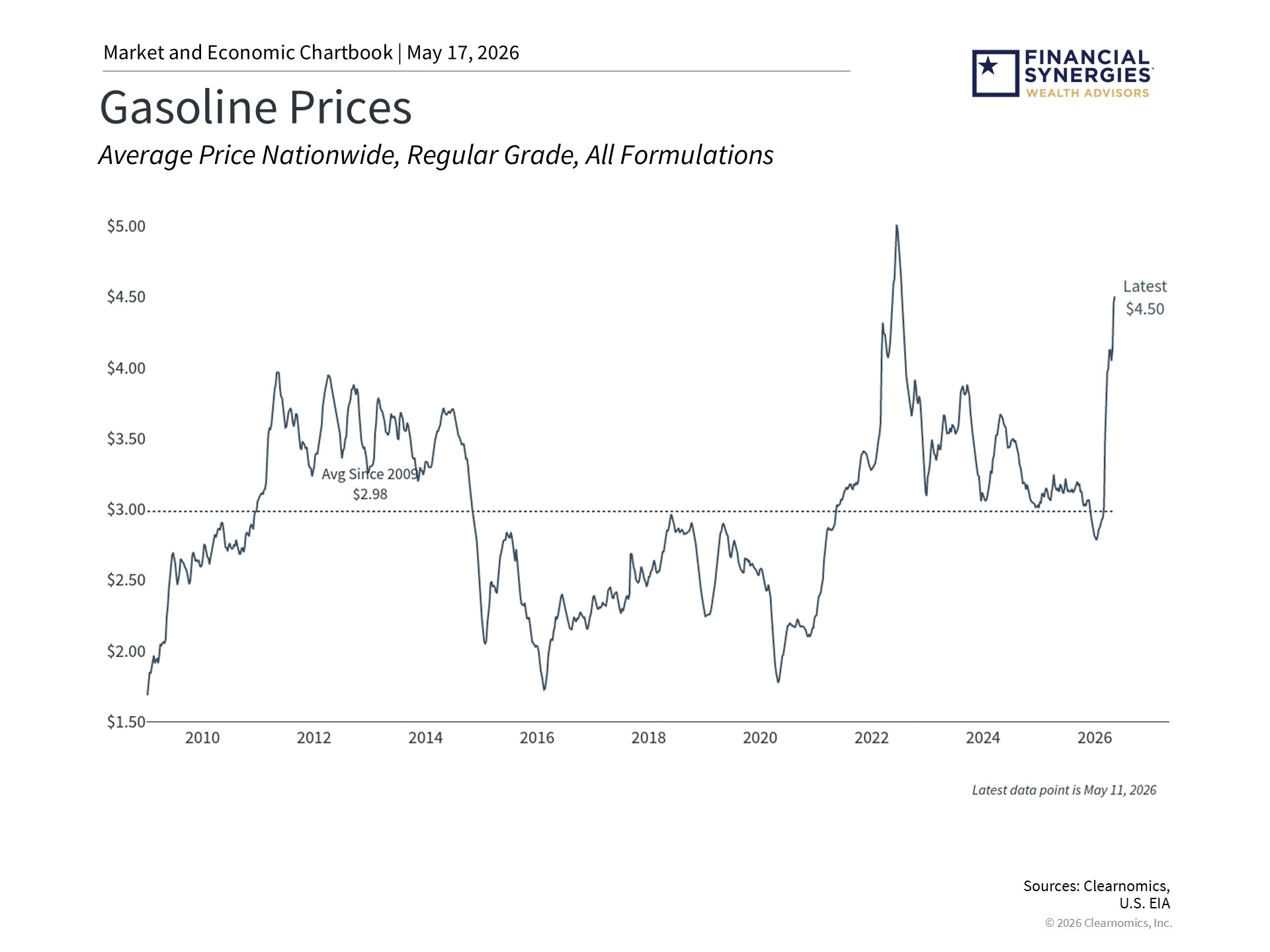
The most visible way the conflict in Iran has reached American households is through the price at the pump. The national average for regular unleaded gasoline has climbed to around $4.50 per gallon, well above the long-term average and a meaningful jump from levels seen just a few months ago. In some parts of the country, gasoline is already above $6 per gallon.1 Because energy expenses directly affect the Consumer Price Index, headline inflation has moved higher, complicating an economic picture that was previously improving.
For some, this environment may bring back memories of the 1970s Arab Oil Embargo, when oil supply shocks led to skyrocketing inflation and gasoline rationing. However, the world has changed considerably since then. First, the U.S. is now the largest energy producer in the world, pumping more than 13 million barrels of oil per day. This has helped to reduce the sensitivity of the U.S. economy to global oil disruptions.
Second, the recent decision by the United Arab Emirates (UAE) to exit OPEC is another reminder of how the global energy landscape has changed. For decades, OPEC members played a central role in setting global oil prices. This was primarily done by agreeing on production levels, which is difficult to achieve and verify across about a dozen countries. Specifically, it is difficult to prevent OPEC member countries from producing more than their agreed-upon limits.
The UAE’s departure shows how the cartel is not as relevant as it once was, as member countries pursue their own national strategies and production capacities. At its peak in the 1970s, OPEC accounted for at least half of the world’s oil supply. Today, it is closer to one-third.2 To offset this, a broader group known as OPEC+, which includes Russia and other countries, was formed, but the same coordination challenges apply.
So, the declining relevance of OPEC does not eliminate the risk of oil price spikes during geopolitical events, but it does mean that oil prices are not quite as sensitive to their decisions as in the past. While this provides little comfort to households whose budgets are affected by higher gasoline prices, it does help to explain why the impact on markets has not been more dramatic.
Tariff policy continues to evolve through the courts
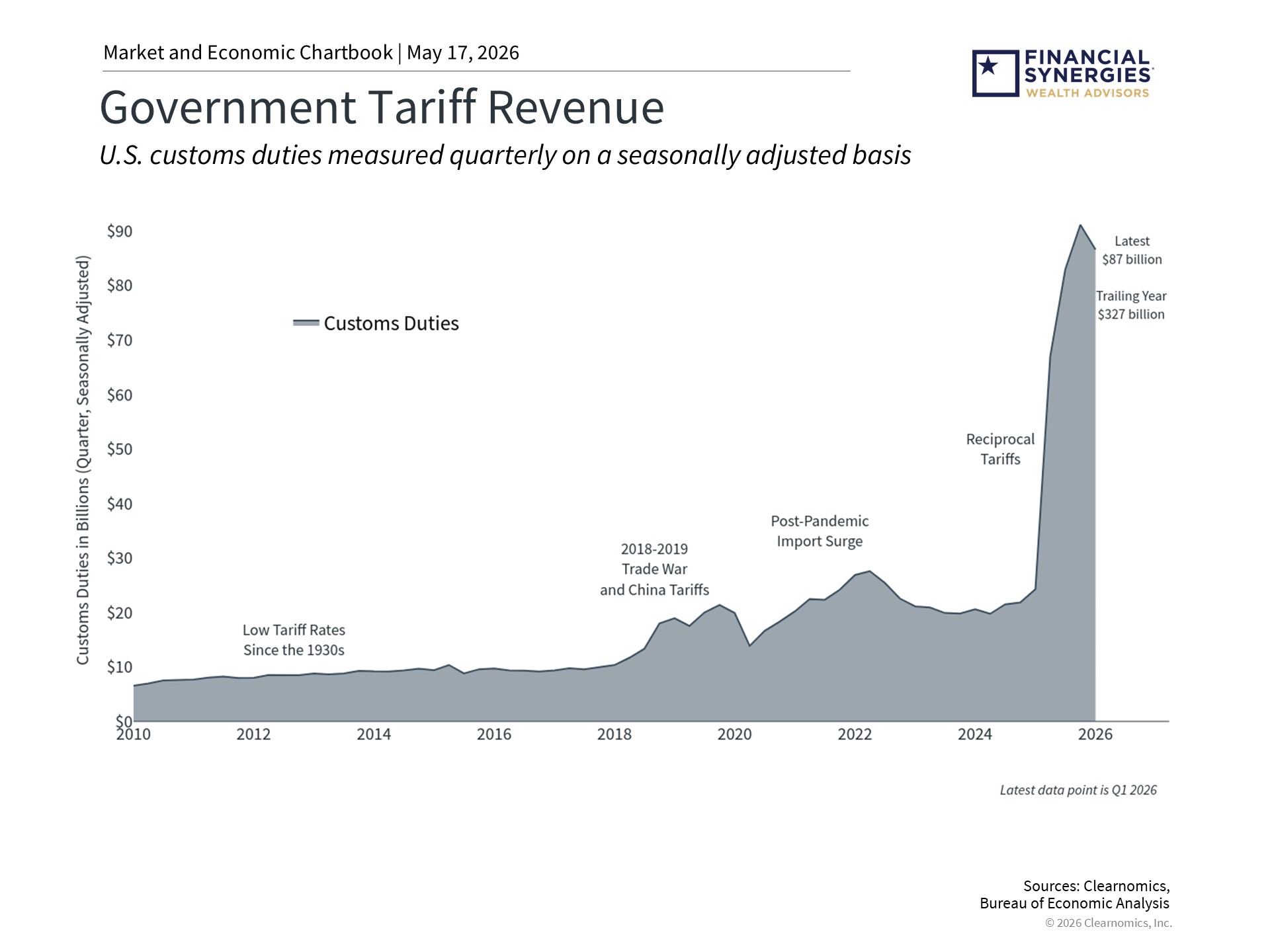
The second major macroeconomic driver has been tariff policy, which continues to face legal challenges. In February, the Supreme Court ruled that the tariffs implemented last April under the International Emergency Economic Powers Act (IEEPA) are illegal.3 In response, the administration shifted these tariffs to utilize what is known as Section 122 of the Trade Act of 1974. More recently, the U.S. Court of International Trade ruled that these Section 122 tariffs are also unlawful.4
On the one hand, the administration will continue to pursue tariffs as a key part of their geopolitical strategy. The administration has other legal authorities it can potentially rely on, including Section 301 of the Trade Act of 1974, which allows for tariffs after investigations into specific countries’ trade practices. These investigations have already been launched against dozens of countries, which suggests that tariffs will likely continue, just in the form of country-specific rates.
On the other hand, the refund process for previously collected tariffs is now underway. Customs and Border Protection has begun processing refund claims, and some importers have already started receiving payments.5 Estimates suggest that these could total $160 to $170 billion.
While the total scope and timing of refunds remains uncertain, any that do occur could boost earnings and cash flow for the importers that paid them. From a purely economic perspective, this represents a transfer that was first taken away and is now being returned, so it is not a true gain per se. Regardless, they are positive for businesses and consumers.
Markets have reached new all-time highs despite uncertainty
For investors, global events mean that broad market indices and individual stocks can swing based on events that have little to do with any specific company’s performance. However, another characteristic of these types of events is that their impact on markets tends to fade over time. Headlines around wars, oil prices, tariffs, and other issues can create volatility, but they are rarely the factors that determine long-term outcomes.
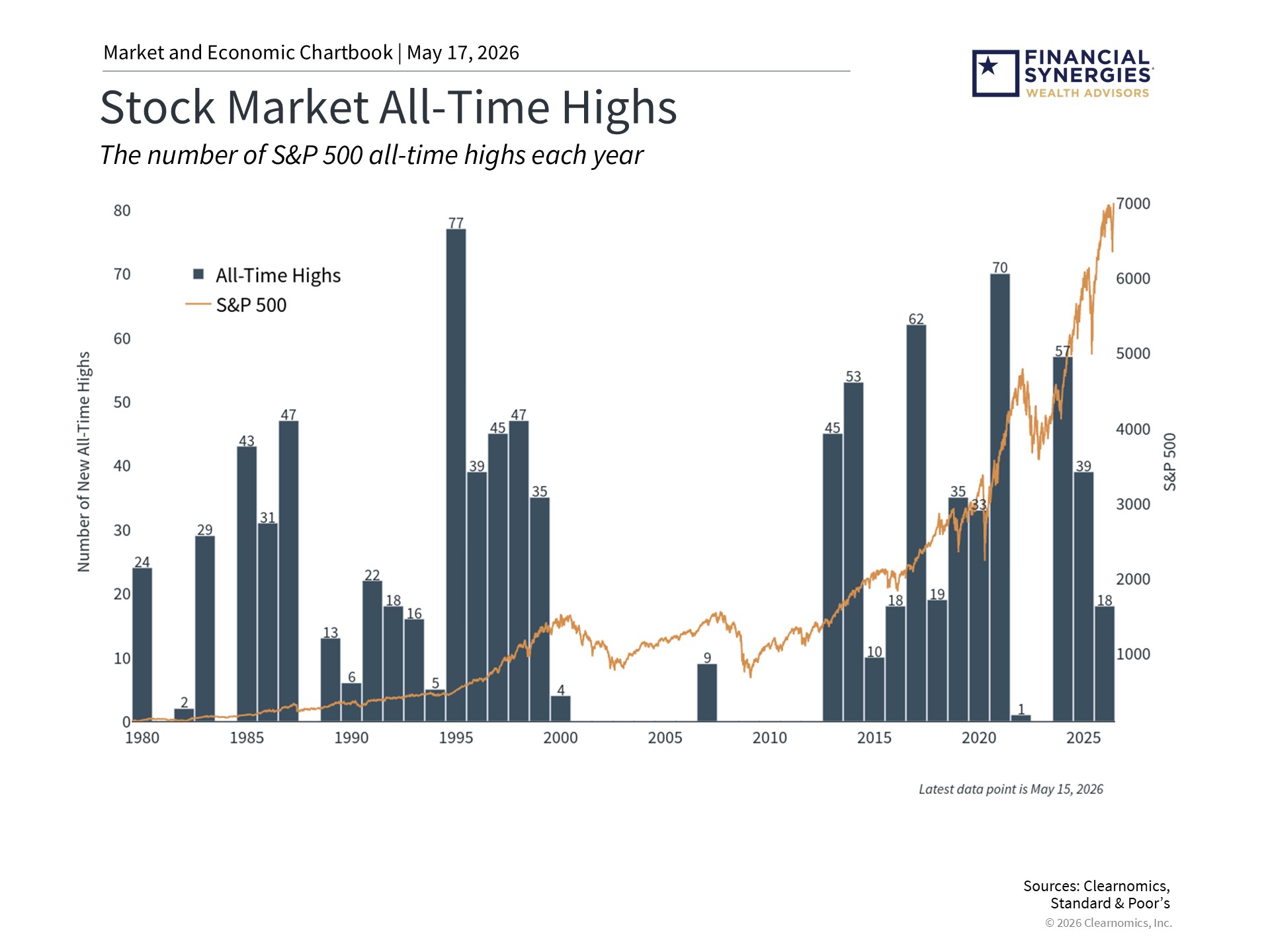
This is why, despite all of the uncertainty of the past year and a half, the S&P 500 has still achieved more than a dozen new all-time highs this year. As the accompanying chart shows, new all-time highs are a normal feature of bull markets, despite the steady stream of investor concerns. What matters is the broader backdrop of corporate earnings and economic growth, all of which have remained healthy.
References
1. https://gasprices.aaa.com
2. https://www.eia.gov/international/content/analysis/special_topics/Global_Surplus_Crude_Oil_Production_Capacity/full-report.pdf
3. https://www.congress.gov/crs-product/LSB11398
4. https://www.cit.uscourts.gov/sites/cit/files/26-47.pdf
5. https://www.cbp.gov/trade/programs-administration/trade-remedies/ieepa-duty-refunds
Concerns or questions about how your investment portfolio will hold up in the current market environment? Contact Financial Synergies today.
We are a boutique, financial advisory and total wealth management firm with over 35 years helping clients navigate turbulent markets. To learn more about our approach to investment management please reach out to us. One of our seasoned advisors would be happy to help you build a custom financial plan to help ensure you accomplish your financial goals and objectives. Schedule a conversation with us today.
More relevant articles by Financial Synergies:
Blog Disclosures
This content, which may contain security-related opinions and/or information, is provided for informational purposes only and should not be relied upon in any manner as professional advice, or an endorsement of any practices, products or services. There can be no guarantees or assurances that the views expressed here will be applicable for any particular facts or circumstances, and should not be relied upon in any manner. You should consult your own financial advisors as to legal, business, tax, and other related matters concerning any investment.
The commentary in this “post” (including any related blogs, videos, and social media) reflects the personal opinions, viewpoints, and analyses of the Financial Synergies Wealth Advisors, Inc. employees providing such comments, and should not be regarded as the views of Financial Synergies Wealth Advisors, Inc. or its respective affiliates or as a description of advisory services provided by Financial Synergies Wealth Advisors, Inc. or performance returns of any Financial Synergies Wealth Advisors, Inc. client.
Any opinions expressed herein do not constitute or imply endorsement, sponsorship, or recommendation by Financial Synergies Wealth Advisors, Inc. or its employees. The views reflected in the commentary are subject to change at any time without notice.
Nothing on this website or Blog constitutes investment or financial planning advice, performance data or any recommendation that any particular security, portfolio of securities, transaction or investment strategy is suitable for any specific person. It also should not be construed as an offer soliciting the purchase or sale of any security mentioned. Nor should it be construed as an offer to provide investment advisory services by Financial Synergies Wealth Advisors, Inc.
Any mention of a particular security and related performance data is not a recommendation to buy or sell that security. Financial Synergies Wealth Advisors, Inc. manages its clients’ accounts using a variety of investment techniques and strategies, which are not necessarily discussed in the commentary. Investments in securities involve the risk of loss. Past performance is no guarantee of future results.
Any charts provided here or on any related Financial Synergies Wealth Advisors, Inc. personnel content outlets are for informational purposes only, and should also not be relied upon when making any investment decision. Any indices referenced for comparison are unmanaged and cannot be invested into directly. As always please remember investing involves risk and possible loss of principal capital; please seek advice from a licensed professional. Any projections, estimates, forecasts, targets, prospects and/or opinions expressed in these materials are subject to change without notice and may differ or be contrary to opinions expressed by others. Information in charts have been obtained from third-party sources and data, and may include those from portfolio securities of funds managed by Financial Synergies Wealth Advisors, Inc. While taken from sources believed to be reliable, Financial Synergies Wealth Advisors, Inc. has not independently verified such information and makes no representations about the enduring accuracy of the information or its appropriateness for a given situation. All content speaks only as of the date indicated.
Financial Synergies Wealth Advisors, Inc. is a registered investment adviser. Advisory services are only offered to clients or prospective clients where Financial Synergies Wealth Advisors, Inc. and its representatives are properly licensed or exempt from licensure. Investments in securities involve the risk of loss. Past performance is no guarantee of future results.
See Full Disclosures Page Here
 Skip to content


OPEC, Tariffs, and All-Time Highs: Macro Events and Investing
For much of the history of the stock market, investing was primarily about individual stocks and bonds. Over the past few decades, however, macroeconomic developments have increasingly influenced markets.
Significant events, whether related to central bank policy, geopolitics, or global trade, now affect nearly all stocks across the market, regardless of their individual stories. For investors, this means that building modern portfolios is less about finding attractive stocks, and more about making asset allocation decisions that are aligned with financial goals.
This has been the case over the past year and a half, since the two biggest macroeconomic drivers have been the war in Iran and U.S. tariff policy. While these are quite different, they both affect consumer prices and business demand, either directly through higher energy prices or indirectly through the cost of imported goods. A key characteristic of these macro-driven events, however, is that their effects tend to fade over time. Thus, it’s important to stay focused on the longer-term trends, and avoid the temptation to make portfolio changes based on a single event.
The war in the Middle East, gasoline prices, and OPEC
The most visible way the conflict in Iran has reached American households is through the price at the pump. The national average for regular unleaded gasoline has climbed to around $4.50 per gallon, well above the long-term average and a meaningful jump from levels seen just a few months ago. In some parts of the country, gasoline is already above $6 per gallon.1 Because energy expenses directly affect the Consumer Price Index, headline inflation has moved higher, complicating an economic picture that was previously improving.
For some, this environment may bring back memories of the 1970s Arab Oil Embargo, when oil supply shocks led to skyrocketing inflation and gasoline rationing. However, the world has changed considerably since then. First, the U.S. is now the largest energy producer in the world, pumping more than 13 million barrels of oil per day. This has helped to reduce the sensitivity of the U.S. economy to global oil disruptions.
Second, the recent decision by the United Arab Emirates (UAE) to exit OPEC is another reminder of how the global energy landscape has changed. For decades, OPEC members played a central role in setting global oil prices. This was primarily done by agreeing on production levels, which is difficult to achieve and verify across about a dozen countries. Specifically, it is difficult to prevent OPEC member countries from producing more than their agreed-upon limits.
The UAE’s departure shows how the cartel is not as relevant as it once was, as member countries pursue their own national strategies and production capacities. At its peak in the 1970s, OPEC accounted for at least half of the world’s oil supply. Today, it is closer to one-third.2 To offset this, a broader group known as OPEC+, which includes Russia and other countries, was formed, but the same coordination challenges apply.
So, the declining relevance of OPEC does not eliminate the risk of oil price spikes during geopolitical events, but it does mean that oil prices are not quite as sensitive to their decisions as in the past. While this provides little comfort to households whose budgets are affected by higher gasoline prices, it does help to explain why the impact on markets has not been more dramatic.
Tariff policy continues to evolve through the courts
The second major macroeconomic driver has been tariff policy, which continues to face legal challenges. In February, the Supreme Court ruled that the tariffs implemented last April under the International Emergency Economic Powers Act (IEEPA) are illegal.3 In response, the administration shifted these tariffs to utilize what is known as Section 122 of the Trade Act of 1974. More recently, the U.S. Court of International Trade ruled that these Section 122 tariffs are also unlawful.4
On the one hand, the administration will continue to pursue tariffs as a key part of their geopolitical strategy. The administration has other legal authorities it can potentially rely on, including Section 301 of the Trade Act of 1974, which allows for tariffs after investigations into specific countries’ trade practices. These investigations have already been launched against dozens of countries, which suggests that tariffs will likely continue, just in the form of country-specific rates.
On the other hand, the refund process for previously collected tariffs is now underway. Customs and Border Protection has begun processing refund claims, and some importers have already started receiving payments.5 Estimates suggest that these could total $160 to $170 billion.
While the total scope and timing of refunds remains uncertain, any that do occur could boost earnings and cash flow for the importers that paid them. From a purely economic perspective, this represents a transfer that was first taken away and is now being returned, so it is not a true gain per se. Regardless, they are positive for businesses and consumers.
Markets have reached new all-time highs despite uncertainty
For investors, global events mean that broad market indices and individual stocks can swing based on events that have little to do with any specific company’s performance. However, another characteristic of these types of events is that their impact on markets tends to fade over time. Headlines around wars, oil prices, tariffs, and other issues can create volatility, but they are rarely the factors that determine long-term outcomes.
This is why, despite all of the uncertainty of the past year and a half, the S&P 500 has still achieved more than a dozen new all-time highs this year. As the accompanying chart shows, new all-time highs are a normal feature of bull markets, despite the steady stream of investor concerns. What matters is the broader backdrop of corporate earnings and economic growth, all of which have remained healthy.
References
1. https://gasprices.aaa.com
2. https://www.eia.gov/international/content/analysis/special_topics/Global_Surplus_Crude_Oil_Production_Capacity/full-report.pdf
3. https://www.congress.gov/crs-product/LSB11398
4. https://www.cit.uscourts.gov/sites/cit/files/26-47.pdf
5. https://www.cbp.gov/trade/programs-administration/trade-remedies/ieepa-duty-refunds
Concerns or questions about how your investment portfolio will hold up in the current market environment? Contact Financial Synergies today.
We are a boutique, financial advisory and total wealth management firm with over 35 years helping clients navigate turbulent markets. To learn more about our approach to investment management please reach out to us. One of our seasoned advisors would be happy to help you build a custom financial plan to help ensure you accomplish your financial goals and objectives. Schedule a conversation with us today.
More relevant articles by Financial Synergies:
Blog Disclosures
This content, which may contain security-related opinions and/or information, is provided for informational purposes only and should not be relied upon in any manner as professional advice, or an endorsement of any practices, products or services. There can be no guarantees or assurances that the views expressed here will be applicable for any particular facts or circumstances, and should not be relied upon in any manner. You should consult your own financial advisors as to legal, business, tax, and other related matters concerning any investment.
The commentary in this “post” (including any related blogs, videos, and social media) reflects the personal opinions, viewpoints, and analyses of the Financial Synergies Wealth Advisors, Inc. employees providing such comments, and should not be regarded as the views of Financial Synergies Wealth Advisors, Inc. or its respective affiliates or as a description of advisory services provided by Financial Synergies Wealth Advisors, Inc. or performance returns of any Financial Synergies Wealth Advisors, Inc. client.
Any opinions expressed herein do not constitute or imply endorsement, sponsorship, or recommendation by Financial Synergies Wealth Advisors, Inc. or its employees. The views reflected in the commentary are subject to change at any time without notice.
Nothing on this website or Blog constitutes investment or financial planning advice, performance data or any recommendation that any particular security, portfolio of securities, transaction or investment strategy is suitable for any specific person. It also should not be construed as an offer soliciting the purchase or sale of any security mentioned. Nor should it be construed as an offer to provide investment advisory services by Financial Synergies Wealth Advisors, Inc.
Any mention of a particular security and related performance data is not a recommendation to buy or sell that security. Financial Synergies Wealth Advisors, Inc. manages its clients’ accounts using a variety of investment techniques and strategies, which are not necessarily discussed in the commentary. Investments in securities involve the risk of loss. Past performance is no guarantee of future results.
Any charts provided here or on any related Financial Synergies Wealth Advisors, Inc. personnel content outlets are for informational purposes only, and should also not be relied upon when making any investment decision. Any indices referenced for comparison are unmanaged and cannot be invested into directly. As always please remember investing involves risk and possible loss of principal capital; please seek advice from a licensed professional. Any projections, estimates, forecasts, targets, prospects and/or opinions expressed in these materials are subject to change without notice and may differ or be contrary to opinions expressed by others. Information in charts have been obtained from third-party sources and data, and may include those from portfolio securities of funds managed by Financial Synergies Wealth Advisors, Inc. While taken from sources believed to be reliable, Financial Synergies Wealth Advisors, Inc. has not independently verified such information and makes no representations about the enduring accuracy of the information or its appropriateness for a given situation. All content speaks only as of the date indicated.
Financial Synergies Wealth Advisors, Inc. is a registered investment adviser. Advisory services are only offered to clients or prospective clients where Financial Synergies Wealth Advisors, Inc. and its representatives are properly licensed or exempt from licensure. Investments in securities involve the risk of loss. Past performance is no guarantee of future results.
See Full Disclosures Page Here
Recent Posts
Happy Birthday to the Bull Market 🎉
Quarterly Webinar: Q4 2026 Market and Economic Themes
Medicare Open Enrollment 2026: What to Know
Subscribe to Our Blog
Chief Investment Officer | Managing Partner