Monthly Market Update: Stocks Hold Steady Despite a Busy Month of Geopolitical and AI Headlines
For your convenience, we’ve also provided a PDF copy of the Monthly Market Update: Stocks Hold Steady Despite a Busy Month of Geopolitical and AI Headlines.
Monthly Market Summary
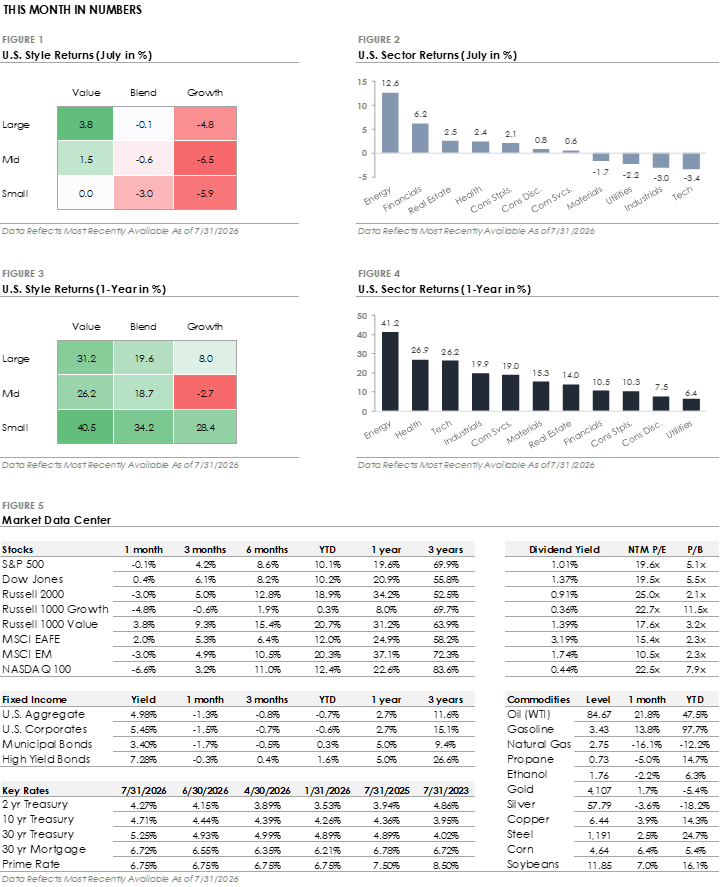
- The S&P 500 Index returned -0.1%. Energy led all S&P 500 sectors with a +12.6% return as geopolitical tensions caused oil to trade higher. Financials (+6.2%) was the second-best performing sector, followed by the defensive trio of Real Estate (+2.5%), Health Care (+2.4%), and Consumer Staples (+2.1%). Technology (-3.4%) underperformed as AI stocks gave back some of their gains from earlier in the year.
- Bonds traded lower as Treasury yields rose. The U.S. Bond Aggregate returned -1.3% as rising oil prices tied to the U.S.-Iran conflict reignited inflation concerns. Investment-grade corporates underperformed with a -1.5% total return, while high-yield corporates were relative outperformers with a -0.3% return.
- International stocks produced mixed returns during July. Developed markets gained +2.0% and outperformed the S&P 500, while emerging markets returned -3.0% and underperformed as the same U.S. tech selloff weighed on South Korean stocks.
Markets Turn Back to the Middle East as Tensions Resurface
The ceasefire from earlier this spring didn’t hold in July. Renewed conflict between the U.S. and Iran resurfaced the same headlines and concerns from earlier in the year, as uncertainty around the Strait of Hormuz once again raised the risk of reduced oil supply. Late-month headlines pointed to another round of de-escalation, but the conflict’s status remains fluid. The situation matters for the same reason it did the first time around: energy prices feed directly into inflation, and inflation impacts Federal Reserve policy. The Fed ultimately held interest rates steady for a fifth consecutive meeting in July, though a handful of officials pushed for a +0.25% rate hike given the renewed inflation risk.
This isn’t the first time this year that markets have moved through this cycle. There have been multiple mini cycles of conflict escalating, oil prices rising, and tensions easing, only for the pattern to repeat. The specific headlines and details shift from week to week, but markets have now absorbed the same shock more than once. The Fed’s split decision in late July reflects the lack of certainty. Officials are debating their next move but choosing to gather more information rather than react to headlines. Despite the headline volatility, the net impact on markets has been limited. The stock market rebounded from the March selloff, and the S&P 500 has returned nearly +10%.
AI Stocks Trade Lower as Investors Shift Focus from Growth to Discipline
Second quarter earnings season kicked off in July, with leading AI companies Alphabet, Microsoft, Meta, Apple, and Amazon all reporting. The group, which is investing heavily in data centers and other AI-related infrastructure, talked about their forecasts and spending plans. For the past two years, the conversation around AI centered on scale. Investors focused on how much companies were spending, how fast they were building, and how big the opportunity could become. This quarter, there was a noticeable shift toward profitability and return on investment.
In a shift from recent quarters, investors pushed back on the spending. Companies whose investments are translating into growth, like Microsoft’s cloud business, were rewarded, while others, whose spending has outpaced their cash flow or weighed on profit margins, saw their stocks trade lower. The market is no longer simply rewarding growth and big spending numbers. It’s asking whether the spending is profitable, or whether rising expenses are outpacing revenue growth. This is a natural and, in many ways, healthy form of discipline. Every major technological buildout eventually reaches a point where investors stop rewarding growth alone and start looking for it to be matched by results. July was the moment that question arrived for AI.
Semiconductor stocks, along with other parts of the AI trade, gave back some of their gains from earlier in the year as investors questioned the sustainability of current spending levels. Despite the semiconductor and AI selloff, the volatility was relatively contained. The equal-weight S&P 500, a proxy for the average S&P 500 stock, set a new all-time high late in the month, and seven of eleven S&P 500 sectors traded higher. Credit spreads, which measure the market’s concern about credit risk, expanded modestly but remain very tight by historical standards. Even after the pullback, semiconductor stocks are still up nearly +60% year-to-date. As for the companies doing the spending, they forecast even higher spending levels in the coming quarters.
Disclosures
The information and opinions provided herein are provided as general market commentary only and are subject to change at any time without notice. This commentary may contain forward-looking statements that are subject to various risks and uncertainties. None of the events or outcomes mentioned here may come to pass, and actual results may differ materially from those expressed or implied in these statements. No mention of a particular security, index, or other instrument in this report constitutes a recommendation to buy, sell, or hold that or any other security, nor does it constitute an opinion on the suitability of any security or index. The report is strictly an informational publication and has been prepared without regard to the particular investments and circumstances of the recipient.
Past performance does not guarantee or indicate future results. Any index performance mentioned is for illustrative purposes only and does not reflect any management fees, transaction costs, or expenses. Indexes are unmanaged, and one cannot invest directly in an index. Index performance does not represent the actual performance that would be achieved by investing in a fund.
Stock performance and fundamental data is based on the following instruments: SPDR S&P 500 ETF (SPY), SPDR Dow Jones ETF (DIA), iShares Russell 2000 ETF (IWM), iShares Russell 1000 Growth ETF (IWF), iShares Russell 1000 Value ETF (IWD), iShares MSCI EAFE ETF (EFA), iShares MSCI Emerging Markets ETF (EEM), Invesco QQQ Trust (QQQ).
Fixed Income performance is based on the following instruments: iShares Core U.S. Aggregate Bond ETF (AGG), iShares Investment Grade Corporate ETF (LQD), iShares National Muni Bond ETF (MUB), iShares High Yield Corporate ETF (HYG).
Fixed Income yields and key rates are based on the following instruments: Bloomberg US Aggregate, ICE BofA US Corporate, ICE BofA US Municipal Securities, ICE BofA US High Yield, 2 Year US Benchmark Bond, 10 Year US Benchmark Bond, 30 Year US Benchmark Bond, 30 Year US Fixed Mortgage Rate, US Prime Rate.
Commodity prices are based on the following instruments: Crude Oil WTI (NYM $/bbl), Gasoline Regular U.S. Gulf Coast ($/gal), Natural Gas (NYM $/mmbtu), Propane (NYM $/gal), Ethanol (CRB $/gallon), Gold (NYM $/ozt), Silver (NYM $/ozt), Copper NYMEX ($/lb), U.S. Midwest Domestic Hot-Rolled Coil Steel (NYM $/st), Corn (CBT $/bu), Soybeans (Chicago $/bu).
U.S. Style performance is based on the following instruments: iShares Russell 1000 Value ETF (IWD), SPDR S&P 500 ETF Trust (SPY), iShares Russell 1000 Growth ETF (IWF), iShares Russell Mid-Cap Value ETF (IWS), iShares Russell Midcap ETF (IWR), iShares Russell Mid-Cap Growth ETF (IWP), iShares Russell 2000 Value ETF (IWN), iShares Russell 2000 ETF (IWM), iShares Russell 2000 Growth ETF (IWO).
U.S. Sector performance is based on the following instruments: Consumer Discretionary Sector SPDR ETF (XLY), Consumer Staples Sector SPDR ETF (XLP), Energy Sector SPDR ETF (XLE), Financial Sector SPDR ETF (XLF), Health Care Sector SPDR ETF (XLV), Industrial Sector SPDR ETF (XLI), Materials Sector SPDR ETF (XLB), Technology Sector SPDR ETF (XLK), Communication Services Sector SPDR ETF (XLC), Utilities Sector SPDR ETF (XLU), Real Estate Sector SPDR ETF (XLRE).
Concerns or questions about how your investment portfolio will hold up in the current market environment? Contact Financial Synergies today.
We are a boutique, financial advisory and total wealth management firm with over 35 years helping clients navigate turbulent markets. To learn more about our approach to investment management please reach out to us. One of our seasoned advisors would be happy to help you build a custom financial plan to help ensure you accomplish your financial goals and objectives. Schedule a conversation with us today.
More relevant articles by Financial Synergies:
Blog Disclosures
This content, which contains security-related opinions and/or information, is provided for informational purposes only and should not be relied upon in any manner as professional advice, or an endorsement of any practices, products or services. There can be no guarantees or assurances that the views expressed here will be applicable for any particular facts or circumstances, and should not be relied upon in any manner. You should consult your own financial advisors as to legal, business, tax, and other related matters concerning any investment.
The commentary in this “post” (including any related blogs, videos, and social media) reflects the personal opinions, viewpoints, and analyses of the Financial Synergies Wealth Advisors, Inc. employees providing such comments, and should not be regarded as the views of Financial Synergies Wealth Advisors, Inc. or its respective affiliates or as a description of advisory services provided by Financial Synergies Wealth Advisors, Inc. or performance returns of any Financial Synergies Wealth Advisors, Inc. client.
Any opinions expressed herein do not constitute or imply endorsement, sponsorship, or recommendation by Financial Synergies Wealth Advisors, Inc. or its employees. The views reflected in the commentary are subject to change at any time without notice.
Nothing on this website constitutes investment or financial planning advice, performance data or any recommendation that any particular security, portfolio of securities, transaction or investment strategy is suitable for any specific person. It also should not be construed as an offer soliciting the purchase or sale of any security mentioned. Nor should it be construed as an offer to provide investment advisory services by Financial Synergies Wealth Advisors, Inc.
Any mention of a particular security and related performance data is not a recommendation to buy or sell that security. Financial Synergies Wealth Advisors, Inc. manages its clients’ accounts using a variety of investment techniques and strategies, which are not necessarily discussed in the commentary. Investments in securities involve the risk of loss. Past performance is no guarantee of future results.
Any charts provided here or on any related Financial Synergies Wealth Advisors, Inc. personnel content outlets are for informational purposes only, and should also not be relied upon when making any investment decision. Any indices referenced for comparison are unmanaged and cannot be invested into directly. As always please remember investing involves risk and possible loss of principal capital; please seek advice from a licensed professional. Any projections, estimates, forecasts, targets, prospects and/or opinions expressed in these materials are subject to change without notice and may differ or be contrary to opinions expressed by others. Information in charts have been obtained from third-party sources and data, and may include those from portfolio securities of funds managed by Financial Synergies Wealth Advisors, Inc. While taken from sources believed to be reliable, Financial Synergies Wealth Advisors, Inc. has not independently verified such information and makes no representations about the enduring accuracy of the information or its appropriateness for a given situation. All content speaks only as of the date indicated.
Financial Synergies Wealth Advisors, Inc. is a registered investment adviser. Advisory services are only offered to clients or prospective clients where Financial Synergies Wealth Advisors, Inc. and its representatives are properly licensed or exempt from licensure. Investments in securities involve the risk of loss. Past performance is no guarantee of future results.
See Full Disclosures Page Here
 Skip to content


Monthly Market Update: Stocks Hold Steady Despite a Busy Month of Geopolitical and AI Headlines
Monthly Market Update: Stocks Hold Steady Despite a Busy Month of Geopolitical and AI Headlines
For your convenience, we’ve also provided a PDF copy of the Monthly Market Update: Stocks Hold Steady Despite a Busy Month of Geopolitical and AI Headlines.
Monthly Market Summary
Markets Turn Back to the Middle East as Tensions Resurface
The ceasefire from earlier this spring didn’t hold in July. Renewed conflict between the U.S. and Iran resurfaced the same headlines and concerns from earlier in the year, as uncertainty around the Strait of Hormuz once again raised the risk of reduced oil supply. Late-month headlines pointed to another round of de-escalation, but the conflict’s status remains fluid. The situation matters for the same reason it did the first time around: energy prices feed directly into inflation, and inflation impacts Federal Reserve policy. The Fed ultimately held interest rates steady for a fifth consecutive meeting in July, though a handful of officials pushed for a +0.25% rate hike given the renewed inflation risk.
This isn’t the first time this year that markets have moved through this cycle. There have been multiple mini cycles of conflict escalating, oil prices rising, and tensions easing, only for the pattern to repeat. The specific headlines and details shift from week to week, but markets have now absorbed the same shock more than once. The Fed’s split decision in late July reflects the lack of certainty. Officials are debating their next move but choosing to gather more information rather than react to headlines. Despite the headline volatility, the net impact on markets has been limited. The stock market rebounded from the March selloff, and the S&P 500 has returned nearly +10%.
AI Stocks Trade Lower as Investors Shift Focus from Growth to Discipline
Second quarter earnings season kicked off in July, with leading AI companies Alphabet, Microsoft, Meta, Apple, and Amazon all reporting. The group, which is investing heavily in data centers and other AI-related infrastructure, talked about their forecasts and spending plans. For the past two years, the conversation around AI centered on scale. Investors focused on how much companies were spending, how fast they were building, and how big the opportunity could become. This quarter, there was a noticeable shift toward profitability and return on investment.
In a shift from recent quarters, investors pushed back on the spending. Companies whose investments are translating into growth, like Microsoft’s cloud business, were rewarded, while others, whose spending has outpaced their cash flow or weighed on profit margins, saw their stocks trade lower. The market is no longer simply rewarding growth and big spending numbers. It’s asking whether the spending is profitable, or whether rising expenses are outpacing revenue growth. This is a natural and, in many ways, healthy form of discipline. Every major technological buildout eventually reaches a point where investors stop rewarding growth alone and start looking for it to be matched by results. July was the moment that question arrived for AI.
Semiconductor stocks, along with other parts of the AI trade, gave back some of their gains from earlier in the year as investors questioned the sustainability of current spending levels. Despite the semiconductor and AI selloff, the volatility was relatively contained. The equal-weight S&P 500, a proxy for the average S&P 500 stock, set a new all-time high late in the month, and seven of eleven S&P 500 sectors traded higher. Credit spreads, which measure the market’s concern about credit risk, expanded modestly but remain very tight by historical standards. Even after the pullback, semiconductor stocks are still up nearly +60% year-to-date. As for the companies doing the spending, they forecast even higher spending levels in the coming quarters.
Disclosures
The information and opinions provided herein are provided as general market commentary only and are subject to change at any time without notice. This commentary may contain forward-looking statements that are subject to various risks and uncertainties. None of the events or outcomes mentioned here may come to pass, and actual results may differ materially from those expressed or implied in these statements. No mention of a particular security, index, or other instrument in this report constitutes a recommendation to buy, sell, or hold that or any other security, nor does it constitute an opinion on the suitability of any security or index. The report is strictly an informational publication and has been prepared without regard to the particular investments and circumstances of the recipient.
Past performance does not guarantee or indicate future results. Any index performance mentioned is for illustrative purposes only and does not reflect any management fees, transaction costs, or expenses. Indexes are unmanaged, and one cannot invest directly in an index. Index performance does not represent the actual performance that would be achieved by investing in a fund.
Stock performance and fundamental data is based on the following instruments: SPDR S&P 500 ETF (SPY), SPDR Dow Jones ETF (DIA), iShares Russell 2000 ETF (IWM), iShares Russell 1000 Growth ETF (IWF), iShares Russell 1000 Value ETF (IWD), iShares MSCI EAFE ETF (EFA), iShares MSCI Emerging Markets ETF (EEM), Invesco QQQ Trust (QQQ).
Fixed Income performance is based on the following instruments: iShares Core U.S. Aggregate Bond ETF (AGG), iShares Investment Grade Corporate ETF (LQD), iShares National Muni Bond ETF (MUB), iShares High Yield Corporate ETF (HYG).
Fixed Income yields and key rates are based on the following instruments: Bloomberg US Aggregate, ICE BofA US Corporate, ICE BofA US Municipal Securities, ICE BofA US High Yield, 2 Year US Benchmark Bond, 10 Year US Benchmark Bond, 30 Year US Benchmark Bond, 30 Year US Fixed Mortgage Rate, US Prime Rate.
Commodity prices are based on the following instruments: Crude Oil WTI (NYM $/bbl), Gasoline Regular U.S. Gulf Coast ($/gal), Natural Gas (NYM $/mmbtu), Propane (NYM $/gal), Ethanol (CRB $/gallon), Gold (NYM $/ozt), Silver (NYM $/ozt), Copper NYMEX ($/lb), U.S. Midwest Domestic Hot-Rolled Coil Steel (NYM $/st), Corn (CBT $/bu), Soybeans (Chicago $/bu).
U.S. Style performance is based on the following instruments: iShares Russell 1000 Value ETF (IWD), SPDR S&P 500 ETF Trust (SPY), iShares Russell 1000 Growth ETF (IWF), iShares Russell Mid-Cap Value ETF (IWS), iShares Russell Midcap ETF (IWR), iShares Russell Mid-Cap Growth ETF (IWP), iShares Russell 2000 Value ETF (IWN), iShares Russell 2000 ETF (IWM), iShares Russell 2000 Growth ETF (IWO).
U.S. Sector performance is based on the following instruments: Consumer Discretionary Sector SPDR ETF (XLY), Consumer Staples Sector SPDR ETF (XLP), Energy Sector SPDR ETF (XLE), Financial Sector SPDR ETF (XLF), Health Care Sector SPDR ETF (XLV), Industrial Sector SPDR ETF (XLI), Materials Sector SPDR ETF (XLB), Technology Sector SPDR ETF (XLK), Communication Services Sector SPDR ETF (XLC), Utilities Sector SPDR ETF (XLU), Real Estate Sector SPDR ETF (XLRE).
Concerns or questions about how your investment portfolio will hold up in the current market environment? Contact Financial Synergies today.
We are a boutique, financial advisory and total wealth management firm with over 35 years helping clients navigate turbulent markets. To learn more about our approach to investment management please reach out to us. One of our seasoned advisors would be happy to help you build a custom financial plan to help ensure you accomplish your financial goals and objectives. Schedule a conversation with us today.
More relevant articles by Financial Synergies:
Blog Disclosures
This content, which contains security-related opinions and/or information, is provided for informational purposes only and should not be relied upon in any manner as professional advice, or an endorsement of any practices, products or services. There can be no guarantees or assurances that the views expressed here will be applicable for any particular facts or circumstances, and should not be relied upon in any manner. You should consult your own financial advisors as to legal, business, tax, and other related matters concerning any investment.
The commentary in this “post” (including any related blogs, videos, and social media) reflects the personal opinions, viewpoints, and analyses of the Financial Synergies Wealth Advisors, Inc. employees providing such comments, and should not be regarded as the views of Financial Synergies Wealth Advisors, Inc. or its respective affiliates or as a description of advisory services provided by Financial Synergies Wealth Advisors, Inc. or performance returns of any Financial Synergies Wealth Advisors, Inc. client.
Any opinions expressed herein do not constitute or imply endorsement, sponsorship, or recommendation by Financial Synergies Wealth Advisors, Inc. or its employees. The views reflected in the commentary are subject to change at any time without notice.
Nothing on this website constitutes investment or financial planning advice, performance data or any recommendation that any particular security, portfolio of securities, transaction or investment strategy is suitable for any specific person. It also should not be construed as an offer soliciting the purchase or sale of any security mentioned. Nor should it be construed as an offer to provide investment advisory services by Financial Synergies Wealth Advisors, Inc.
Any mention of a particular security and related performance data is not a recommendation to buy or sell that security. Financial Synergies Wealth Advisors, Inc. manages its clients’ accounts using a variety of investment techniques and strategies, which are not necessarily discussed in the commentary. Investments in securities involve the risk of loss. Past performance is no guarantee of future results.
Any charts provided here or on any related Financial Synergies Wealth Advisors, Inc. personnel content outlets are for informational purposes only, and should also not be relied upon when making any investment decision. Any indices referenced for comparison are unmanaged and cannot be invested into directly. As always please remember investing involves risk and possible loss of principal capital; please seek advice from a licensed professional. Any projections, estimates, forecasts, targets, prospects and/or opinions expressed in these materials are subject to change without notice and may differ or be contrary to opinions expressed by others. Information in charts have been obtained from third-party sources and data, and may include those from portfolio securities of funds managed by Financial Synergies Wealth Advisors, Inc. While taken from sources believed to be reliable, Financial Synergies Wealth Advisors, Inc. has not independently verified such information and makes no representations about the enduring accuracy of the information or its appropriateness for a given situation. All content speaks only as of the date indicated.
Financial Synergies Wealth Advisors, Inc. is a registered investment adviser. Advisory services are only offered to clients or prospective clients where Financial Synergies Wealth Advisors, Inc. and its representatives are properly licensed or exempt from licensure. Investments in securities involve the risk of loss. Past performance is no guarantee of future results.
See Full Disclosures Page Here
Recent Posts
Asset Location vs. Asset Allocation in Financial Planning
Putting This Week’s Market Volatility in Perspective
The Midterms Changed Congress, Not the Fundamentals
Subscribe to Our Blog
Chief Investment Officer | Managing Partner