Skip to content


The holiday season is a natural time to reflect on charitable giving and the role it can play as part of a comprehensive financial plan. Thoughtful charitable planning can not only support philanthropic goals, but increase tax efficiency as well.
The question isn’t just whether to give, but how to give in ways that maximize both the impact on causes you care about and the benefits to your overall financial plan.
This year presents a unique opportunity for charitable planning. The recently passed One Big Beautiful Bill Act (OBBBA) includes provisions that impact these considerations. Additionally, donations for this tax year must be made by December 31, creating a window to review your giving strategy. Understanding how to structure charitable gifts can transform generosity into a core pillar of your planning strategy.
Household net worth has reached a new record level
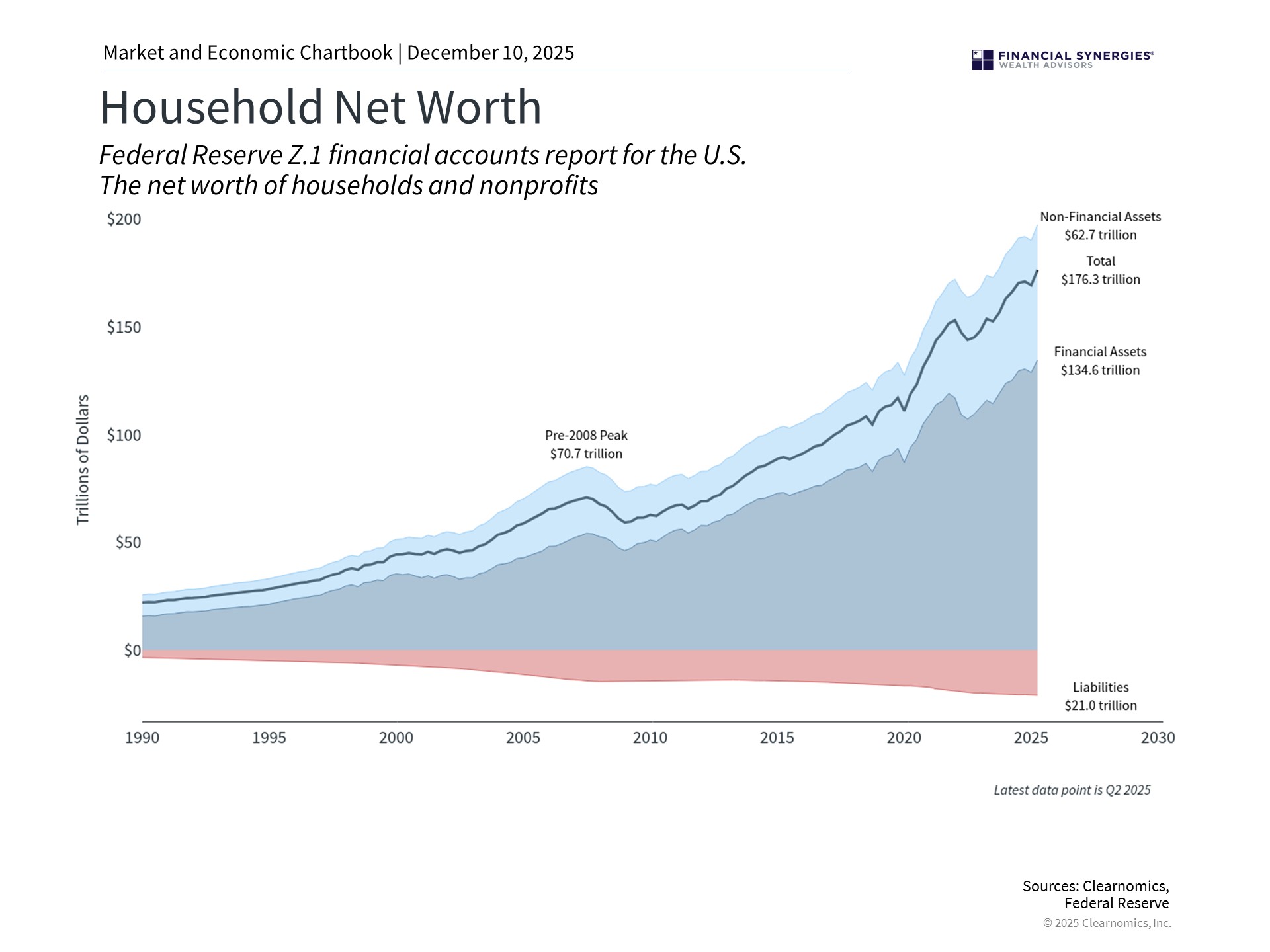
Americans gave $593 billion to charity in 2024, a 6.3% increase from 2023, according to the National Philanthropic Trust. This shows that charitable giving remains an important value for many households, even as the percentage of Americans who donate has declined in recent years. As the accompanying chart highlights, household net worth has increased steadily alongside economic growth and the stock market. Greater income and wealth, along with changes in the tax code, have created new incentives to give.
Charitable giving also plays an important role in estate planning. Assets left to charity are not subject to estate tax, making charitable bequests an efficient way to reduce estate tax liability while supporting causes you care about. For those with estates large enough to be subject to estate tax, the combination of lifetime giving and charitable bequests can significantly reduce the tax burden on heirs.
Most importantly, charitable giving can help leave a durable legacy, reinforce family values across generations, and reduce lifetime taxes. For many families, philanthropy becomes a way to involve children and grandchildren in meaningful discussions about values and stewardship. The challenge for investors is that while the desire to give is straightforward, the optimal approach requires thoughtful planning.
Timing and structure matter more than ever
The OBBBA has created important changes for charitable giving. Most significantly, it increases the number of people who are able to itemize their tax returns due to the increase in the state and local tax (SALT) deduction cap from $10,000 to $40,000. Since charitable contributions are only tax deductible if you itemize, this increases their importance in tax planning today.
Additionally, there is a time-sensitive window from 2025 through 2029 to optimize the timing and structure of gifts. This is because, starting in 2026, the OBBBA introduces a floor for charitable deductions for itemizers of 0.5% adjusted gross income (AGI). This means that only the portion of charitable gifts exceeding 0.5% of your AGI will be deductible. For someone with $200,000 in AGI, for example, only donations above $1,000 (0.5% of $200,000) would be deductible.
One strategy that some investors use to overcome this challenge is known as “bunching,” or incorporating multiple years of giving into a single tax year to exceed the deduction threshold. This approach has become increasingly popular since the 2017 Tax Cuts and Jobs Act nearly doubled the standard deduction, which reduced the percentage of households that itemized.
Another key consideration is deciding which assets to donate. For example, gifting highly appreciated securities offers three key tax benefits: it avoids capital gains tax from an outright sale, removes further appreciation from the gross estate, and provides a deduction on ordinary income.
For ordinary income deductions, consideration should be given to whether the recipient is a public or private charity and the investor’s estimated AGI. This “triple benefit” can be especially attractive during years with significant capital gains, such as when equity compensation vests or following a business sale, and when there are no losses to offset the gain.
Integrating charitable giving into portfolio rebalancing can also enhance efficiency. Some investors prioritize gifts of appreciated assets held in taxable accounts, then replenish those holdings through purchases in tax-deferred accounts. This approach can maintain the desired asset allocation while maximizing tax benefits.
Example vehicles for charitable giving
Different charitable giving vehicles serve different purposes, and selecting the right one depends on your specific circumstances and goals. The following are some common examples, although it is not an exhaustive list:
Donor-advised funds (DAFs) have grown in popularity, with assets exceeding $250 billion. DAFs function like charitable investment accounts: you make a contribution, receive an immediate tax deduction, and then recommend grants to charities over time. The funds can be invested and grow tax-free while you decide on the timing and recipients of your gifts. DAFs are especially valuable in years when maximizing deductions is important.
Under the new tax rules, donors can structure DAF contributions to ensure they exceed the 0.5% AGI floor threshold described earlier. DAFs are also simpler than other options, making them accessible to a wider range of donors.
Qualified charitable distributions (QCDs) are another option for those aged 70½ or older with traditional IRAs. QCDs allow you to transfer up to $108,000 for tax year 2025 directly from your IRA to charities. This can satisfy required minimum distribution (RMD) rules while excluding the amount from taxable income. QCDs provide tax benefits regardless of whether you itemize, so they can be valuable in years when itemized deductions are less favorable.
Charitable remainder trusts (CRTs) provide yet another option to support charitable causes as part of estate planning. With a CRT, you transfer assets into a trust that pays beneficiaries income for a specified period, with the remainder going to charity. This can be especially useful for highly appreciated assets, since the trust can sell them without you incurring immediate capital gains taxes.
As with any other trust vehicle, care should be taken in the structure. For example, certain retained powers could trigger inclusion of the asset in the grantor’s gross estate. Additionally, naming beneficiaries other than the grantor or spouse could trigger a gift tax.
For those fortunate enough to have substantial assets and long-term philanthropic goals, additional considerations may include:
- Private foundations, which offer maximum control and family governance structures but come with higher administrative requirements, minimum distribution rules, and excise taxes on investment income.
- Charitable lead trusts, which provide income to charity for a period before assets pass to heirs.
- Supporting organizations, which work closely with specific public charities.
- Pooled income funds offered by certain charitable institutions.
These examples represent some of the most common charitable giving vehicles, but there are additional options and variations that may be appropriate depending on your specific situation. Working with a financial advisor can help determine which approach best aligns with your goals.
Charitable giving as part of comprehensive financial planning
The most effective charitable planning integrates giving into your broader financial strategy rather than treating it as separate from other financial decisions. This holistic approach considers how charitable giving intersects with investment management, tax planning, retirement income, and estate planning.
Perhaps most importantly, involving children and grandchildren in charitable decision-making creates opportunities to discuss what matters most to your family, why certain causes deserve support, and how to evaluate nonprofit effectiveness. These conversations can be among the most meaningful aspects of wealth planning, helping ensure that your family’s values and sense of stewardship continue across generations.
The bottom line?
With year-end approaching and new tax rules creating both opportunities and considerations, it is important to optimize the timing, structure, and vehicles for your charitable gifts. This can help maximize both your philanthropic impact and your financial goals.
1. https://www.nptrust.org/philanthropic-resources/charitable-giving-statistics/
A Truly Unique Wealth Management Experience
Let’s create a financial plan and investment strategy that allows you to live the life of your dreams. Schedule your free consultation today to explore tailored financial strategies designed to secure your future!
Concerns or questions about how your investment portfolio will hold up in the current market environment? Contact Financial Synergies today.
We are a boutique, financial advisory and total wealth management firm with over 35 years helping clients navigate turbulent markets. To learn more about our approach to investment management please reach out to us. One of our seasoned advisors would be happy to help you build a custom financial plan to help ensure you accomplish your financial goals and objectives. Schedule a conversation with us today.
More relevant tax planning articles by Financial Synergies:
- Your 2025 Year End Tax Planning Checklist
- Top 11 Tax Reduction Strategies for High Earners
- 5 Important Tax Considerations for Your Financial Planning
Blog Disclosures
This content, which contains security-related opinions and/or information, is provided for informational purposes only and should not be relied upon in any manner as professional advice, or an endorsement of any practices, products or services. There can be no guarantees or assurances that the views expressed here will be applicable for any particular facts or circumstances, and should not be relied upon in any manner. You should consult your own financial advisors as to legal, business, tax, and other related matters concerning any investment.
The commentary in this “post” (including any related blogs, videos, and social media) reflects the personal opinions, viewpoints, and analyses of the Financial Synergies Wealth Advisors, Inc. employees providing such comments, and should not be regarded as the views of Financial Synergies Wealth Advisors, Inc. or its respective affiliates or as a description of advisory services provided by Financial Synergies Wealth Advisors, Inc. or performance returns of any Financial Synergies Wealth Advisors, Inc. client.
Any opinions expressed herein do not constitute or imply endorsement, sponsorship, or recommendation by Financial Synergies Wealth Advisors, Inc. or its employees. The views reflected in the commentary are subject to change at any time without notice.
Nothing on this website constitutes investment or financial planning advice, performance data or any recommendation that any particular security, portfolio of securities, transaction or investment strategy is suitable for any specific person. It also should not be construed as an offer soliciting the purchase or sale of any security mentioned. Nor should it be construed as an offer to provide investment advisory services by Financial Synergies Wealth Advisors, Inc.
Any mention of a particular security and related performance data is not a recommendation to buy or sell that security. Financial Synergies Wealth Advisors, Inc. manages its clients’ accounts using a variety of investment techniques and strategies, which are not necessarily discussed in the commentary. Investments in securities involve the risk of loss. Past performance is no guarantee of future results.
Any charts provided here or on any related Financial Synergies Wealth Advisors, Inc. personnel content outlets are for informational purposes only, and should also not be relied upon when making any investment decision. Any indices referenced for comparison are unmanaged and cannot be invested into directly. As always please remember investing involves risk and possible loss of principal capital; please seek advice from a licensed professional. Any projections, estimates, forecasts, targets, prospects and/or opinions expressed in these materials are subject to change without notice and may differ or be contrary to opinions expressed by others. Information in charts have been obtained from third-party sources and data, and may include those from portfolio securities of funds managed by Financial Synergies Wealth Advisors, Inc. While taken from sources believed to be reliable, Financial Synergies Wealth Advisors, Inc. has not independently verified such information and makes no representations about the enduring accuracy of the information or its appropriateness for a given situation. All content speaks only as of the date indicated.
Financial Synergies Wealth Advisors, Inc. is a registered investment adviser. Advisory services are only offered to clients or prospective clients where Financial Synergies Wealth Advisors, Inc. and its representatives are properly licensed or exempt from licensure. Investments in securities involve the risk of loss. Past performance is no guarantee of future results.