The stock market has climbed to new all-time highs following several periods of uncertainty this year. This is welcome news for investors, especially because many parts of the market have contributed to the rally, including sectors such as Energy, Information Technology, and Industrials. Interest rates are also near multi-decade highs, pushing bond yields to their most attractive levels in years. At the same time, investors should always be prepared for periods of volatility, which the past few years have shown can occur at any time.
For long-term investors, rising stock prices and higher yields create an environment that requires careful portfolio balance. On the surface, it can seem contradictory for stocks to reach records while interest rates stay high, since rising rates can often slow the economy. However, if both stocks and bonds are being supported by positive trends, long-term portfolios can in turn support financial goals. How should investors think about this environment as markets sit near record levels?
Stocks and bonds support portfolio balance, but in different ways
The S&P 500, Nasdaq, and the Dow Jones Industrial Average have all generated double-digit total returns this year.1 There are important themes driving markets on the surface, influencing which parts of the market have contributed to these returns. Perhaps the most visible are that artificial intelligence continues to drive technology stocks, and the energy sector has been supported by higher oil prices. These are the factors most often cited in the headlines, and they help explain why major indices have reached new highs.
Another important factor is that corporate earnings have grown at a historic pace, providing a fundamental foundation for the rally. In the long run, economic growth helps to drive corporate profits, which then pushes stock prices higher. Interestingly, corporate profits have increased significantly in recent years, despite modest economic growth. Current forecasts suggest that the S&P 500 could reach an earnings-per-share figure of $347 this year, representing an annual growth rate of over 30%. This growth rate, if achieved, would be well above the historical average of around 8%.2
However, there is another important driver of the recent rally in the S&P 500: the Fed and interest rates. In the short run, markets can be highly sensitive to expectations around Fed policy. This is because interest rates play an important role in calculating the price of stocks today based on cash flows in the future. Since oil prices began to rise earlier this year, markets have expected the Fed to hike rates to combat inflation.3 Given the recent cooling of the labor market and steady inflation readings, these expectations have declined, with only one quarter-point hike priced in by next January.
The key to understanding the impact across stocks and bonds is that interest rates can rise for different reasons. Rates that rise because of inflation concerns can act as a drag on both asset classes, as they did in 2022 when the Fed tightened policy aggressively. However, rates can also rise because economic growth expectations are improving, which pushes up what are known as “real rates,” or the interest rate after accounting for inflation. Stronger real rates help support market valuations through improved earnings, while also offering bond investors more attractive yields.
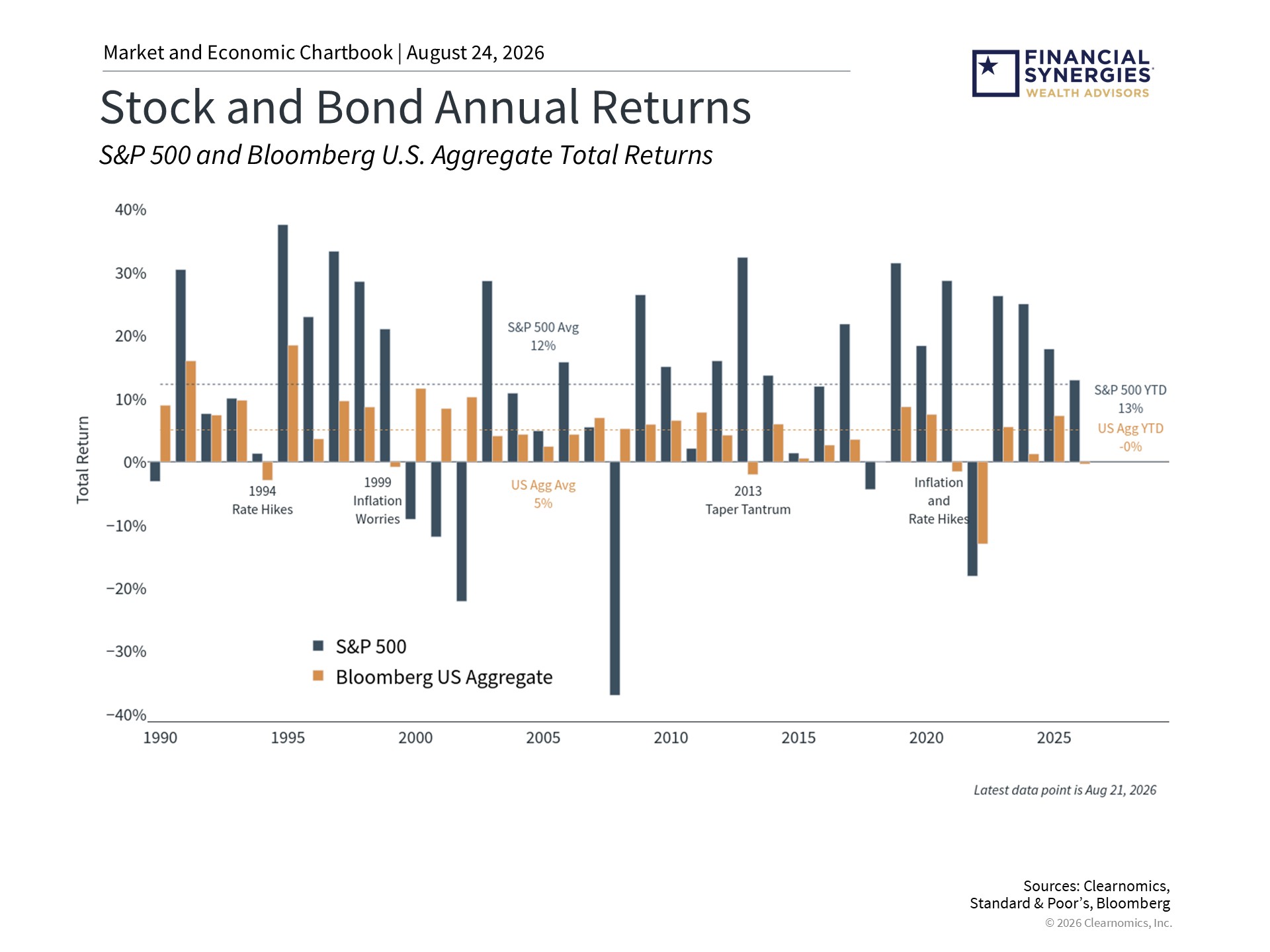
This helps explain why stocks have continued to climb even as rates remain elevated. The chart above shows the relationship between stock and bond returns over the past few decades, including the long periods in which both asset classes perform well during economic expansions. For investors, the lesson is not to try to predict market returns or interest rates, but to hold a portfolio that can benefit from the strengths of each.
Waiting for pullbacks is often counterproductive
With markets near all-time highs, a natural question for many investors is whether they should make portfolio adjustments, or wait before getting invested. History shows that since the economy and markets tend to grow over the long term, trying to time these movements can be counterproductive, and the opportunity cost of waiting is often higher than simply getting invested.
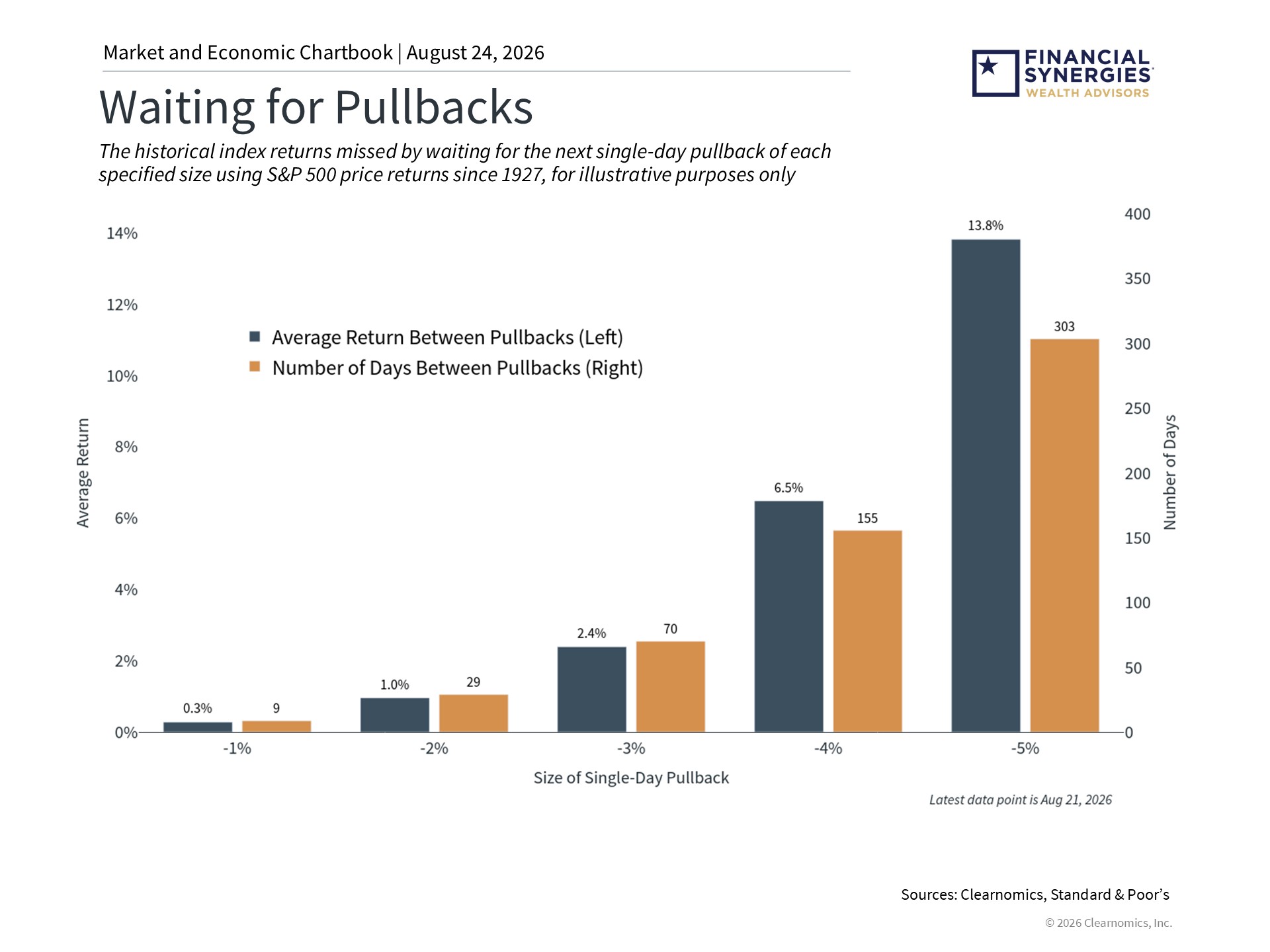
The chart above shows that waiting for the perfect entry point often doesn’t work. For example, an investor waiting for a 5% pullback before investing would have waited 291 days on average. During that time, the market would have already gained nearly 14%. So, even though pullbacks of 5% or worse do occur periodically, and each time is different, the fact that the market tends to rise over time means the next dip is often higher than the last. In other words, the investor who waited would frequently have been better off simply staying invested from the start.
This is not to say that markets move in straight lines, or that pullbacks do not occur. Rather, it reinforces that new all-time highs are a normal part of bull markets, and the best way to achieve long-term goals is often to simply hold onto a well-constructed portfolio.
Of course, there are other strategies for those who need to improve their asset allocations. For example, for those who need to invest a lump sum at these valuations, approaches such as dollar-cost averaging can be helpful. Similarly, balancing a portfolio across different sectors, styles, factors, and geographies can help to reduce exposure to areas of the market with high valuations, while allowing investors to benefit from potential growth.
Bond yields drive long-term fixed income returns
While the stock market has performed well this year, bonds have been flat due to rising interest rates. Bond prices move in the opposite direction of yields, so higher rates mean that existing bonds are less valuable. However, it’s also the case that investors benefit when they can reinvest in bonds at higher yields, or adjust their portfolios to take advantage of them, if it’s appropriate for their financial plans.
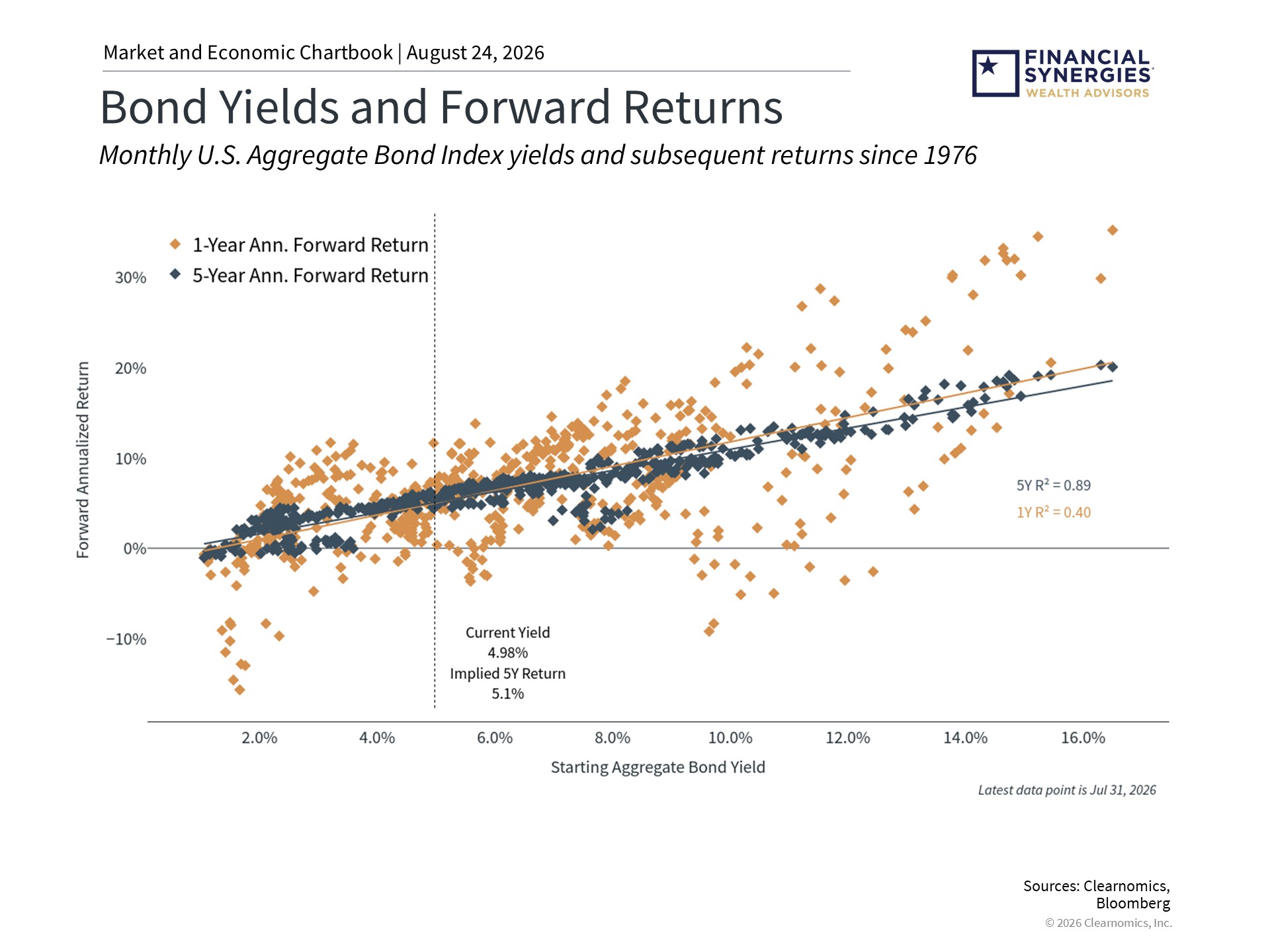
The chart above shows that the starting yield of a bond is an important part of long run returns. At the moment, bond yields have rarely been more attractive over the past two decades. Investment grade corporate bonds and Treasury securities are now offering income levels that were difficult to find during the years following the global financial crisis, when interest rates were held near zero.4 For investors who rely on their portfolios for income, or who are simply looking to balance the risk of equities, this creates greater opportunities across fixed income than have existed in many years.
So, while higher rates can weigh on bond prices, they also mean that bonds can play an important role in portfolios. When combined with stock market trends that have helped portfolios this year, these asset classes can support the financial goals of long-term investors.
The bottom line? Stocks have benefited from growth trends while bond yields are historically attractive, creating opportunities across both asset classes. For long-term investors, maintaining a balanced portfolio is the best way to benefit from this environment while staying focused on financial goals.
References
1. Standard & Poor’s and Nasdaq as of August 14, 2026
2. Clearnomics research using Standard & Poor’s and LSEG data, as of August 14, 2026
3. https://home.treasury.gov/resource-center/data-chart-center/interest-rates
4. Clearnomics research and Bloomberg data, as of August 14, 2026
Concerns or questions about how your investment portfolio will hold up in the current market environment? Contact Financial Synergies today.
We are a boutique, financial advisory and total wealth management firm with over 35 years helping clients navigate turbulent markets. To learn more about our approach to investment management please reach out to us. One of our seasoned advisors would be happy to help you build a custom financial plan to help ensure you accomplish your financial goals and objectives. Schedule a conversation with us today.
More relevant articles by Financial Synergies:
Blog Disclosures
This content, which may contain security-related opinions and/or information, is provided for informational purposes only and should not be relied upon in any manner as professional advice, or an endorsement of any practices, products or services. There can be no guarantees or assurances that the views expressed here will be applicable for any particular facts or circumstances, and should not be relied upon in any manner. You should consult your own financial advisors as to legal, business, tax, and other related matters concerning any investment.
The commentary in this “post” (including any related blogs, videos, and social media) reflects the personal opinions, viewpoints, and analyses of the Financial Synergies Wealth Advisors, Inc. employees providing such comments, and should not be regarded as the views of Financial Synergies Wealth Advisors, Inc. or its respective affiliates or as a description of advisory services provided by Financial Synergies Wealth Advisors, Inc. or performance returns of any Financial Synergies Wealth Advisors, Inc. client.
Any opinions expressed herein do not constitute or imply endorsement, sponsorship, or recommendation by Financial Synergies Wealth Advisors, Inc. or its employees. The views reflected in the commentary are subject to change at any time without notice.
Nothing on this website or Blog constitutes investment or financial planning advice, performance data or any recommendation that any particular security, portfolio of securities, transaction or investment strategy is suitable for any specific person. It also should not be construed as an offer soliciting the purchase or sale of any security mentioned. Nor should it be construed as an offer to provide investment advisory services by Financial Synergies Wealth Advisors, Inc.
Any mention of a particular security and related performance data is not a recommendation to buy or sell that security. Financial Synergies Wealth Advisors, Inc. manages its clients’ accounts using a variety of investment techniques and strategies, which are not necessarily discussed in the commentary. Investments in securities involve the risk of loss. Past performance is no guarantee of future results.
Any charts provided here or on any related Financial Synergies Wealth Advisors, Inc. personnel content outlets are for informational purposes only, and should also not be relied upon when making any investment decision. Any indices referenced for comparison are unmanaged and cannot be invested into directly. As always please remember investing involves risk and possible loss of principal capital; please seek advice from a licensed professional. Any projections, estimates, forecasts, targets, prospects and/or opinions expressed in these materials are subject to change without notice and may differ or be contrary to opinions expressed by others. Information in charts have been obtained from third-party sources and data, and may include those from portfolio securities of funds managed by Financial Synergies Wealth Advisors, Inc. While taken from sources believed to be reliable, Financial Synergies Wealth Advisors, Inc. has not independently verified such information and makes no representations about the enduring accuracy of the information or its appropriateness for a given situation. All content speaks only as of the date indicated.
Financial Synergies Wealth Advisors, Inc. is a registered investment adviser. Advisory services are only offered to clients or prospective clients where Financial Synergies Wealth Advisors, Inc. and its representatives are properly licensed or exempt from licensure. Investments in securities involve the risk of loss. Past performance is no guarantee of future results.
See Full Disclosures Page Here
 Skip to content


What’s Driving Stocks, Bonds, and All-Time Highs?
The stock market has climbed to new all-time highs following several periods of uncertainty this year. This is welcome news for investors, especially because many parts of the market have contributed to the rally, including sectors such as Energy, Information Technology, and Industrials. Interest rates are also near multi-decade highs, pushing bond yields to their most attractive levels in years. At the same time, investors should always be prepared for periods of volatility, which the past few years have shown can occur at any time.
For long-term investors, rising stock prices and higher yields create an environment that requires careful portfolio balance. On the surface, it can seem contradictory for stocks to reach records while interest rates stay high, since rising rates can often slow the economy. However, if both stocks and bonds are being supported by positive trends, long-term portfolios can in turn support financial goals. How should investors think about this environment as markets sit near record levels?
Stocks and bonds support portfolio balance, but in different ways
The S&P 500, Nasdaq, and the Dow Jones Industrial Average have all generated double-digit total returns this year.1 There are important themes driving markets on the surface, influencing which parts of the market have contributed to these returns. Perhaps the most visible are that artificial intelligence continues to drive technology stocks, and the energy sector has been supported by higher oil prices. These are the factors most often cited in the headlines, and they help explain why major indices have reached new highs.
Another important factor is that corporate earnings have grown at a historic pace, providing a fundamental foundation for the rally. In the long run, economic growth helps to drive corporate profits, which then pushes stock prices higher. Interestingly, corporate profits have increased significantly in recent years, despite modest economic growth. Current forecasts suggest that the S&P 500 could reach an earnings-per-share figure of $347 this year, representing an annual growth rate of over 30%. This growth rate, if achieved, would be well above the historical average of around 8%.2
However, there is another important driver of the recent rally in the S&P 500: the Fed and interest rates. In the short run, markets can be highly sensitive to expectations around Fed policy. This is because interest rates play an important role in calculating the price of stocks today based on cash flows in the future. Since oil prices began to rise earlier this year, markets have expected the Fed to hike rates to combat inflation.3 Given the recent cooling of the labor market and steady inflation readings, these expectations have declined, with only one quarter-point hike priced in by next January.
The key to understanding the impact across stocks and bonds is that interest rates can rise for different reasons. Rates that rise because of inflation concerns can act as a drag on both asset classes, as they did in 2022 when the Fed tightened policy aggressively. However, rates can also rise because economic growth expectations are improving, which pushes up what are known as “real rates,” or the interest rate after accounting for inflation. Stronger real rates help support market valuations through improved earnings, while also offering bond investors more attractive yields.
This helps explain why stocks have continued to climb even as rates remain elevated. The chart above shows the relationship between stock and bond returns over the past few decades, including the long periods in which both asset classes perform well during economic expansions. For investors, the lesson is not to try to predict market returns or interest rates, but to hold a portfolio that can benefit from the strengths of each.
Waiting for pullbacks is often counterproductive
With markets near all-time highs, a natural question for many investors is whether they should make portfolio adjustments, or wait before getting invested. History shows that since the economy and markets tend to grow over the long term, trying to time these movements can be counterproductive, and the opportunity cost of waiting is often higher than simply getting invested.
The chart above shows that waiting for the perfect entry point often doesn’t work. For example, an investor waiting for a 5% pullback before investing would have waited 291 days on average. During that time, the market would have already gained nearly 14%. So, even though pullbacks of 5% or worse do occur periodically, and each time is different, the fact that the market tends to rise over time means the next dip is often higher than the last. In other words, the investor who waited would frequently have been better off simply staying invested from the start.
This is not to say that markets move in straight lines, or that pullbacks do not occur. Rather, it reinforces that new all-time highs are a normal part of bull markets, and the best way to achieve long-term goals is often to simply hold onto a well-constructed portfolio.
Of course, there are other strategies for those who need to improve their asset allocations. For example, for those who need to invest a lump sum at these valuations, approaches such as dollar-cost averaging can be helpful. Similarly, balancing a portfolio across different sectors, styles, factors, and geographies can help to reduce exposure to areas of the market with high valuations, while allowing investors to benefit from potential growth.
Bond yields drive long-term fixed income returns
While the stock market has performed well this year, bonds have been flat due to rising interest rates. Bond prices move in the opposite direction of yields, so higher rates mean that existing bonds are less valuable. However, it’s also the case that investors benefit when they can reinvest in bonds at higher yields, or adjust their portfolios to take advantage of them, if it’s appropriate for their financial plans.
The chart above shows that the starting yield of a bond is an important part of long run returns. At the moment, bond yields have rarely been more attractive over the past two decades. Investment grade corporate bonds and Treasury securities are now offering income levels that were difficult to find during the years following the global financial crisis, when interest rates were held near zero.4 For investors who rely on their portfolios for income, or who are simply looking to balance the risk of equities, this creates greater opportunities across fixed income than have existed in many years.
So, while higher rates can weigh on bond prices, they also mean that bonds can play an important role in portfolios. When combined with stock market trends that have helped portfolios this year, these asset classes can support the financial goals of long-term investors.
The bottom line? Stocks have benefited from growth trends while bond yields are historically attractive, creating opportunities across both asset classes. For long-term investors, maintaining a balanced portfolio is the best way to benefit from this environment while staying focused on financial goals.
References
1. Standard & Poor’s and Nasdaq as of August 14, 2026
2. Clearnomics research using Standard & Poor’s and LSEG data, as of August 14, 2026
3. https://home.treasury.gov/resource-center/data-chart-center/interest-rates
4. Clearnomics research and Bloomberg data, as of August 14, 2026
Concerns or questions about how your investment portfolio will hold up in the current market environment? Contact Financial Synergies today.
We are a boutique, financial advisory and total wealth management firm with over 35 years helping clients navigate turbulent markets. To learn more about our approach to investment management please reach out to us. One of our seasoned advisors would be happy to help you build a custom financial plan to help ensure you accomplish your financial goals and objectives. Schedule a conversation with us today.
More relevant articles by Financial Synergies:
Blog Disclosures
This content, which may contain security-related opinions and/or information, is provided for informational purposes only and should not be relied upon in any manner as professional advice, or an endorsement of any practices, products or services. There can be no guarantees or assurances that the views expressed here will be applicable for any particular facts or circumstances, and should not be relied upon in any manner. You should consult your own financial advisors as to legal, business, tax, and other related matters concerning any investment.
The commentary in this “post” (including any related blogs, videos, and social media) reflects the personal opinions, viewpoints, and analyses of the Financial Synergies Wealth Advisors, Inc. employees providing such comments, and should not be regarded as the views of Financial Synergies Wealth Advisors, Inc. or its respective affiliates or as a description of advisory services provided by Financial Synergies Wealth Advisors, Inc. or performance returns of any Financial Synergies Wealth Advisors, Inc. client.
Any opinions expressed herein do not constitute or imply endorsement, sponsorship, or recommendation by Financial Synergies Wealth Advisors, Inc. or its employees. The views reflected in the commentary are subject to change at any time without notice.
Nothing on this website or Blog constitutes investment or financial planning advice, performance data or any recommendation that any particular security, portfolio of securities, transaction or investment strategy is suitable for any specific person. It also should not be construed as an offer soliciting the purchase or sale of any security mentioned. Nor should it be construed as an offer to provide investment advisory services by Financial Synergies Wealth Advisors, Inc.
Any mention of a particular security and related performance data is not a recommendation to buy or sell that security. Financial Synergies Wealth Advisors, Inc. manages its clients’ accounts using a variety of investment techniques and strategies, which are not necessarily discussed in the commentary. Investments in securities involve the risk of loss. Past performance is no guarantee of future results.
Any charts provided here or on any related Financial Synergies Wealth Advisors, Inc. personnel content outlets are for informational purposes only, and should also not be relied upon when making any investment decision. Any indices referenced for comparison are unmanaged and cannot be invested into directly. As always please remember investing involves risk and possible loss of principal capital; please seek advice from a licensed professional. Any projections, estimates, forecasts, targets, prospects and/or opinions expressed in these materials are subject to change without notice and may differ or be contrary to opinions expressed by others. Information in charts have been obtained from third-party sources and data, and may include those from portfolio securities of funds managed by Financial Synergies Wealth Advisors, Inc. While taken from sources believed to be reliable, Financial Synergies Wealth Advisors, Inc. has not independently verified such information and makes no representations about the enduring accuracy of the information or its appropriateness for a given situation. All content speaks only as of the date indicated.
Financial Synergies Wealth Advisors, Inc. is a registered investment adviser. Advisory services are only offered to clients or prospective clients where Financial Synergies Wealth Advisors, Inc. and its representatives are properly licensed or exempt from licensure. Investments in securities involve the risk of loss. Past performance is no guarantee of future results.
See Full Disclosures Page Here
Recent Posts
Chart of the Month | Stocks vs. Bonds: More Choices for Investors as Bond Yields Rise
Weekly Market Recap – September Inflation & Retail Sales Data, AI Financing, & Bank Earnings
Happy Birthday to the Bull Market
Subscribe to Our Blog
Chief Investment Officer | Managing Partner