Consumer Spending & Sentiment Soften, Interest Rates Rise, & Stocks Trade Lower
Weekly Market Recap
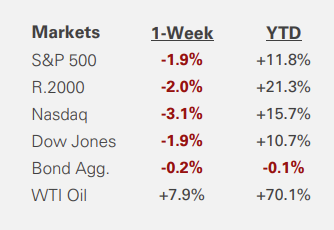 Markets traded lower this week as interest rates continued to rise. The S&P 500 fell -1.9%, the Nasdaq declined -3.1% and the Russell 2000 small-cap index returned -2.0%. Value (-0.6%) outpaced Growth (-3.2%) as high-valuation tech stocks sold off the most, while the equal-weight S&P 500 fell -0.9%. Energy led all sectors with a gain of nearly +5%, followed by Health Care at +3%. Technology was the worst-performing sector with a -4.2% return, followed by Industrials (-3.3%). Bonds traded lower as Treasury yields rose, with longer-maturity Treasuries down roughly -0.3%. Corporate bonds underperformed Treasuries as corporate credit spreads widened. The U.S. dollar weakened -1.1%, the VIX drifted higher, and Bitcoin gained more than +14%.
Key Takeaways
Consumer Spending Unexpectedly Softens in July
Retail and food-service sales fell -0.6% month-over-month after rising just +0.2% in June. Unlike in June, July’s weakness was broader than gasoline alone, with sales excluding autos and gasoline declining -0.2%. A portion of July’s decline likely reflected the timing of Amazon’s Prime Day sales event in late June, which may have pulled forward online purchases. Despite the slowdown, consumers continue to spend. Total retail sales were +5.0% above a year ago, while restaurants and several store categories posted gains. Why it matters: The past two months point to a consumer who is still spending, but at a more moderate pace compared to earlier in the year.
Consumer Sentiment Weakens in Early August Due to Persistent Inflation Concerns
The University of Michigan’s sentiment index fell to 51.0 from 55.2 in July, reversing two months of improvement. Only 8% of consumers said they expected their income growth to outpace inflation over the next year, down from 18% in December, as higher prices, including energy costs, continued to weigh on purchasing power. Why it matters: Sentiment doesn’t always translate directly into spending, but weaker confidence and persistent concerns about purchasing power suggest the consumer may be softening.
Higher Oil Prices and a Cautious Federal Reserve Complicate the Interest Rate Outlook
Oil prices moved higher again this week as tensions around the Strait of Hormuz raised concerns about energy supply. Higher energy costs can pressure consumer purchasing power while also adding to inflation, complicating the Federal Reserve’s policy outlook. Minutes from the Fed’s July meeting showed policymakers remain concerned about inflation, with some officials open to additional tightening if price pressures don’t improve. Why it matters: Softer consumer data would normally strengthen the case for lower interest rates, but higher energy prices and persistent inflation could limit how quickly the Fed is able to respond.
Long-Term Treasury Yields Aren’t Behaving as They Typically Would When Growth Softens
The 30-year Treasury yield climbed above 5.30% this week, its highest level since 2007, even as retail sales and consumer sentiment weakened. Softer growth would typically increase demand for Treasuries and push yields lower. However, inflation concerns and heavy government borrowing continue to put upward pressure on long-term rates. Why it matters: If this relationship persists, longer-maturity Treasury bonds may not provide the same degree of portfolio protection they have historically offered during periods of weaker growth.
Volatility Increases as Stocks Respond to Higher Interest Rates
Rising Treasury yields created a challenging backdrop for equities this week, particularly for areas of the market that trade at higher valuations. Higher bond yields give investors a more attractive alternative to stocks, which can put downward pressure on equity valuations as stocks compete with higher-yielding bonds. Stocks have remained relatively resilient despite the rise in interest rates, but the move in rates has contributed to increased volatility. Why it matters: Higher interest rates can be a potential headwind for equities. However, rates are only one factor influencing market direction, with earnings growth and the economy also impacting forward returns.
Concerns or questions about how your investment portfolio will hold up in the current market environment? Contact Financial Synergies today.
We are a boutique, financial advisory and total wealth management firm with over 35 years helping clients navigate turbulent markets. To learn more about our approach to investment management and financial planning, please reach out to us. One of our seasoned advisors would be happy to help you build a custom financial plan to help ensure you accomplish your financial goals and objectives. Schedule a conversation with us today.
More relevant articles by Financial Synergies Wealth Advisors:
Blog Disclosures
This content, which contains security-related opinions and/or information, is provided for informational purposes only and should not be relied upon in any manner as professional advice, or an endorsement of any practices, products or services. There can be no guarantees or assurances that the views expressed here will be applicable for any particular facts or circumstances, and should not be relied upon in any manner. You should consult your own financial advisors as to legal, business, tax, and other related matters concerning any investment.
The commentary in this “post” (including any related blogs, videos, and social media) reflects the personal opinions, viewpoints, and analyses of the Financial Synergies Wealth Advisors, Inc. employees providing such comments, and should not be regarded as the views of Financial Synergies Wealth Advisors, Inc. or its respective affiliates or as a description of advisory services provided by Financial Synergies Wealth Advisors, Inc. or performance returns of any Financial Synergies Wealth Advisors, Inc. client.
Any opinions expressed herein do not constitute or imply endorsement, sponsorship, or recommendation by Financial Synergies Wealth Advisors, Inc. or its employees. The views reflected in the commentary are subject to change at any time without notice.
Nothing on this website constitutes investment or financial planning advice, performance data or any recommendation that any particular security, portfolio of securities, transaction or investment strategy is suitable for any specific person. It also should not be construed as an offer soliciting the purchase or sale of any security mentioned. Nor should it be construed as an offer to provide investment advisory services by Financial Synergies Wealth Advisors, Inc.
Any mention of a particular security and related performance data is not a recommendation to buy or sell that security. Financial Synergies Wealth Advisors, Inc. manages its clients’ accounts using a variety of investment techniques and strategies, which are not necessarily discussed in the commentary. Investments in securities involve the risk of loss. Past performance is no guarantee of future results.
Any charts provided here or on any related Financial Synergies Wealth Advisors, Inc. personnel content outlets are for informational purposes only, and should also not be relied upon when making any investment decision. Any indices referenced for comparison are unmanaged and cannot be invested into directly. As always please remember investing involves risk and possible loss of principal capital; please seek advice from a licensed professional. Any projections, estimates, forecasts, targets, prospects and/or opinions expressed in these materials are subject to change without notice and may differ or be contrary to opinions expressed by others. Information in charts have been obtained from third-party sources and data, and may include those from portfolio securities of funds managed by Financial Synergies Wealth Advisors, Inc. While taken from sources believed to be reliable, Financial Synergies Wealth Advisors, Inc. has not independently verified such information and makes no representations about the enduring accuracy of the information or its appropriateness for a given situation. All content speaks only as of the date indicated.
Financial Synergies Wealth Advisors, Inc. is a registered investment adviser. Advisory services are only offered to clients or prospective clients where Financial Synergies Wealth Advisors, Inc. and its representatives are properly licensed or exempt from licensure. Investments in securities involve the risk of loss. Past performance is no guarantee of future results.
See Full Disclosures Page Here
 Skip to content


Weekly Market Recap – Consumer Spending & Sentiment Soften, Interest Rates Rise, & Stocks Trade Lower
Consumer Spending & Sentiment Soften, Interest Rates Rise, & Stocks Trade Lower
Weekly Market Recap
Key Takeaways
Consumer Spending Unexpectedly Softens in July
Retail and food-service sales fell -0.6% month-over-month after rising just +0.2% in June. Unlike in June, July’s weakness was broader than gasoline alone, with sales excluding autos and gasoline declining -0.2%. A portion of July’s decline likely reflected the timing of Amazon’s Prime Day sales event in late June, which may have pulled forward online purchases. Despite the slowdown, consumers continue to spend. Total retail sales were +5.0% above a year ago, while restaurants and several store categories posted gains. Why it matters: The past two months point to a consumer who is still spending, but at a more moderate pace compared to earlier in the year.
Consumer Sentiment Weakens in Early August Due to Persistent Inflation Concerns
The University of Michigan’s sentiment index fell to 51.0 from 55.2 in July, reversing two months of improvement. Only 8% of consumers said they expected their income growth to outpace inflation over the next year, down from 18% in December, as higher prices, including energy costs, continued to weigh on purchasing power. Why it matters: Sentiment doesn’t always translate directly into spending, but weaker confidence and persistent concerns about purchasing power suggest the consumer may be softening.
Higher Oil Prices and a Cautious Federal Reserve Complicate the Interest Rate Outlook
Oil prices moved higher again this week as tensions around the Strait of Hormuz raised concerns about energy supply. Higher energy costs can pressure consumer purchasing power while also adding to inflation, complicating the Federal Reserve’s policy outlook. Minutes from the Fed’s July meeting showed policymakers remain concerned about inflation, with some officials open to additional tightening if price pressures don’t improve. Why it matters: Softer consumer data would normally strengthen the case for lower interest rates, but higher energy prices and persistent inflation could limit how quickly the Fed is able to respond.
Long-Term Treasury Yields Aren’t Behaving as They Typically Would When Growth Softens
The 30-year Treasury yield climbed above 5.30% this week, its highest level since 2007, even as retail sales and consumer sentiment weakened. Softer growth would typically increase demand for Treasuries and push yields lower. However, inflation concerns and heavy government borrowing continue to put upward pressure on long-term rates. Why it matters: If this relationship persists, longer-maturity Treasury bonds may not provide the same degree of portfolio protection they have historically offered during periods of weaker growth.
Volatility Increases as Stocks Respond to Higher Interest Rates
Rising Treasury yields created a challenging backdrop for equities this week, particularly for areas of the market that trade at higher valuations. Higher bond yields give investors a more attractive alternative to stocks, which can put downward pressure on equity valuations as stocks compete with higher-yielding bonds. Stocks have remained relatively resilient despite the rise in interest rates, but the move in rates has contributed to increased volatility. Why it matters: Higher interest rates can be a potential headwind for equities. However, rates are only one factor influencing market direction, with earnings growth and the economy also impacting forward returns.
Concerns or questions about how your investment portfolio will hold up in the current market environment? Contact Financial Synergies today.
We are a boutique, financial advisory and total wealth management firm with over 35 years helping clients navigate turbulent markets. To learn more about our approach to investment management and financial planning, please reach out to us. One of our seasoned advisors would be happy to help you build a custom financial plan to help ensure you accomplish your financial goals and objectives. Schedule a conversation with us today.
More relevant articles by Financial Synergies Wealth Advisors:
Blog Disclosures
This content, which contains security-related opinions and/or information, is provided for informational purposes only and should not be relied upon in any manner as professional advice, or an endorsement of any practices, products or services. There can be no guarantees or assurances that the views expressed here will be applicable for any particular facts or circumstances, and should not be relied upon in any manner. You should consult your own financial advisors as to legal, business, tax, and other related matters concerning any investment.
The commentary in this “post” (including any related blogs, videos, and social media) reflects the personal opinions, viewpoints, and analyses of the Financial Synergies Wealth Advisors, Inc. employees providing such comments, and should not be regarded as the views of Financial Synergies Wealth Advisors, Inc. or its respective affiliates or as a description of advisory services provided by Financial Synergies Wealth Advisors, Inc. or performance returns of any Financial Synergies Wealth Advisors, Inc. client.
Any opinions expressed herein do not constitute or imply endorsement, sponsorship, or recommendation by Financial Synergies Wealth Advisors, Inc. or its employees. The views reflected in the commentary are subject to change at any time without notice.
Nothing on this website constitutes investment or financial planning advice, performance data or any recommendation that any particular security, portfolio of securities, transaction or investment strategy is suitable for any specific person. It also should not be construed as an offer soliciting the purchase or sale of any security mentioned. Nor should it be construed as an offer to provide investment advisory services by Financial Synergies Wealth Advisors, Inc.
Any mention of a particular security and related performance data is not a recommendation to buy or sell that security. Financial Synergies Wealth Advisors, Inc. manages its clients’ accounts using a variety of investment techniques and strategies, which are not necessarily discussed in the commentary. Investments in securities involve the risk of loss. Past performance is no guarantee of future results.
Any charts provided here or on any related Financial Synergies Wealth Advisors, Inc. personnel content outlets are for informational purposes only, and should also not be relied upon when making any investment decision. Any indices referenced for comparison are unmanaged and cannot be invested into directly. As always please remember investing involves risk and possible loss of principal capital; please seek advice from a licensed professional. Any projections, estimates, forecasts, targets, prospects and/or opinions expressed in these materials are subject to change without notice and may differ or be contrary to opinions expressed by others. Information in charts have been obtained from third-party sources and data, and may include those from portfolio securities of funds managed by Financial Synergies Wealth Advisors, Inc. While taken from sources believed to be reliable, Financial Synergies Wealth Advisors, Inc. has not independently verified such information and makes no representations about the enduring accuracy of the information or its appropriateness for a given situation. All content speaks only as of the date indicated.
Financial Synergies Wealth Advisors, Inc. is a registered investment adviser. Advisory services are only offered to clients or prospective clients where Financial Synergies Wealth Advisors, Inc. and its representatives are properly licensed or exempt from licensure. Investments in securities involve the risk of loss. Past performance is no guarantee of future results.
See Full Disclosures Page Here
Recent Posts
Chart of the Month | Stocks vs. Bonds: More Choices for Investors as Bond Yields Rise
Weekly Market Recap – September Inflation & Retail Sales Data, AI Financing, & Bank Earnings
Happy Birthday to the Bull Market
Subscribe to Our Blog
Chief Investment Officer | Managing Partner