The monthly jobs report is one of the most closely watched economic indicators because it tells us how many people are finding work and how healthy the labor market is. This can have ripple effects across growth, inflation, and Federal Reserve policy.
Here are some key factors to consider:
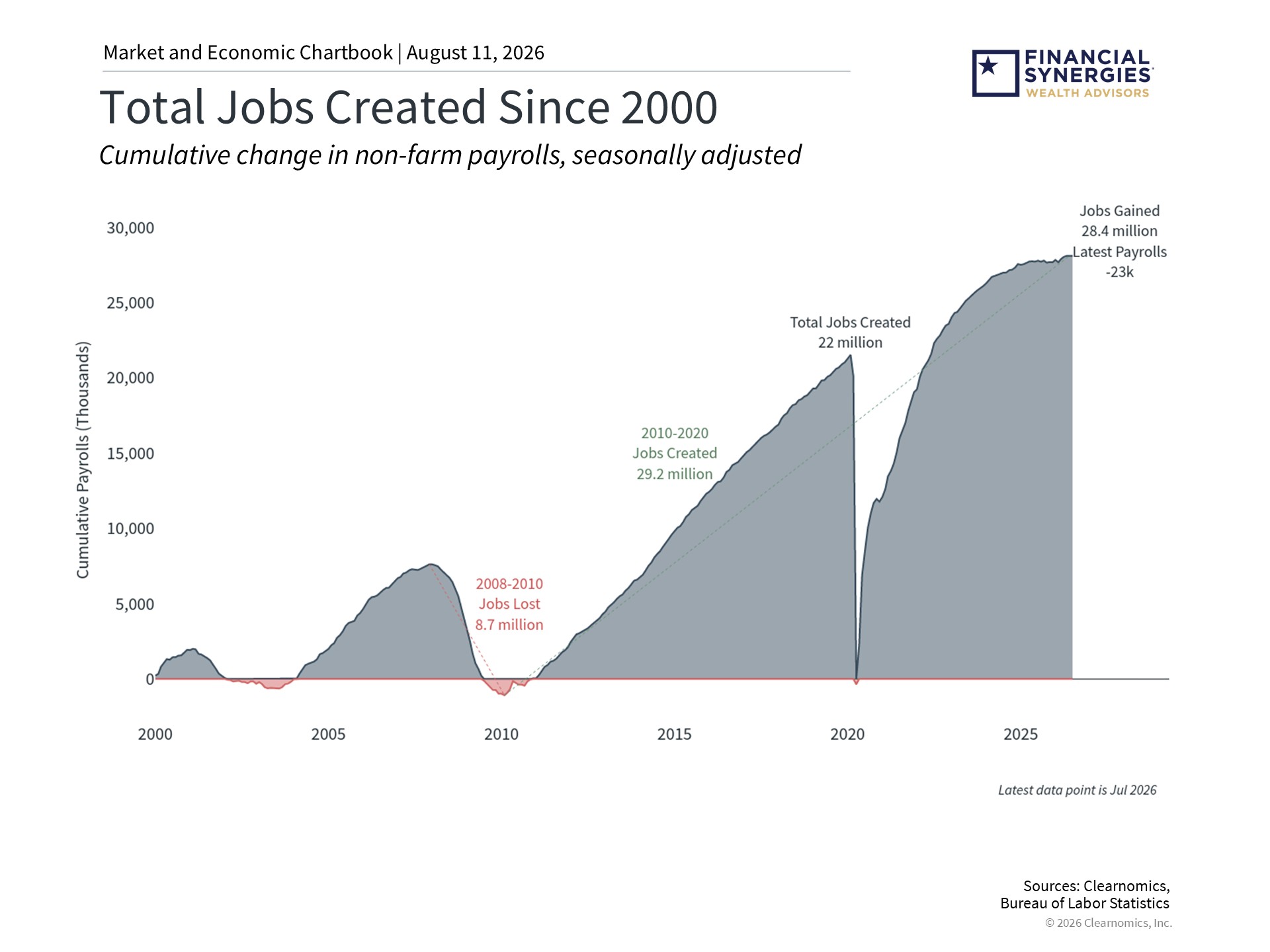
• The latest jobs report for July showed that payrolls fell by -23,000, well below the consensus forecast of +80,000 new jobs. Investors typically expect positive job gains each month, so it can be surprising when we see a negative number. There are many details across sectors and technical factors such as seasonal adjustments. At the same time, the overall economy is still healthy, so it’s important not to overreact to a single month’s numbers.
• The unemployment rate improved slightly to 4.1%, in large part because the labor force participation rate dropped to 61.4%. So while job gains slowed in July, fewer people are actively looking for work, which means that overall unemployment actually improved. This can seem confusing and is due to the way the unemployment rate is calculated, which makes it harder to interpret whether the jobs figures are truly positive.
• The broader labor market has been softening for some time due to these labor supply trends, especially with slower immigration. The economy has averaged only about 60,000 job gains per month this year, after a strong period in March and April. This is also consistent with GDP growth decelerating to 1.5% in the second quarter, and productivity which slowed to 1.4%. Again, these numbers are still positive, just slower.
• The biggest question for investors is how this might impact a potential Fed rate hike in the coming months. Higher inflation means the Fed ought to raise rates, while a weakening job market would usually mean a rate cut. This jobs miss has led to a shift in market probabilities, with investors now expecting the Fed’s next rate hike to come in December rather than October, and no further hikes expected through 2027. It’s important to remember that these expectations can shift quickly, especially as the growth and inflation outlook changes.
The included chart on payrolls shows the magnitude of job gains over the past several years, and how they have slowed more recently.
While a single weak jobs report can cause short-term market volatility, long-term investors are best served by staying focused on the broader economic cycle and remembering that markets have historically navigated periods of labor market weakness and continued to grow over time.
Policy moves like this are somewhat unusual and are typically related to underlying financial market and economic conditions. This means it’s important to understand why the U.S. did this in the right context.
Here are some key points to consider:
• The U.S. recently helped Japan intervene in the yen market for the first time since 1998. The yen had fallen to its lowest value in 40 years due to factors such as slow growth, high debt levels, and pressures from oil imports, in addition to shorter-term trading factors. Typically, Japan would need to sell assets such as U.S. Treasury securities to raise dollars which they could then use to shore up the yen.
• However, by selling Treasury securities, this would raise U.S. interest rates. To avoid this, the U.S. stepped in to effectively lend Japan the dollars to support the yen. They did so by having the Federal Reserve expand its balance sheet and provide a repo facility backed by those Treasury securities, on the order of $60 billion. This was done to avoid Japan selling these securities on the open market.
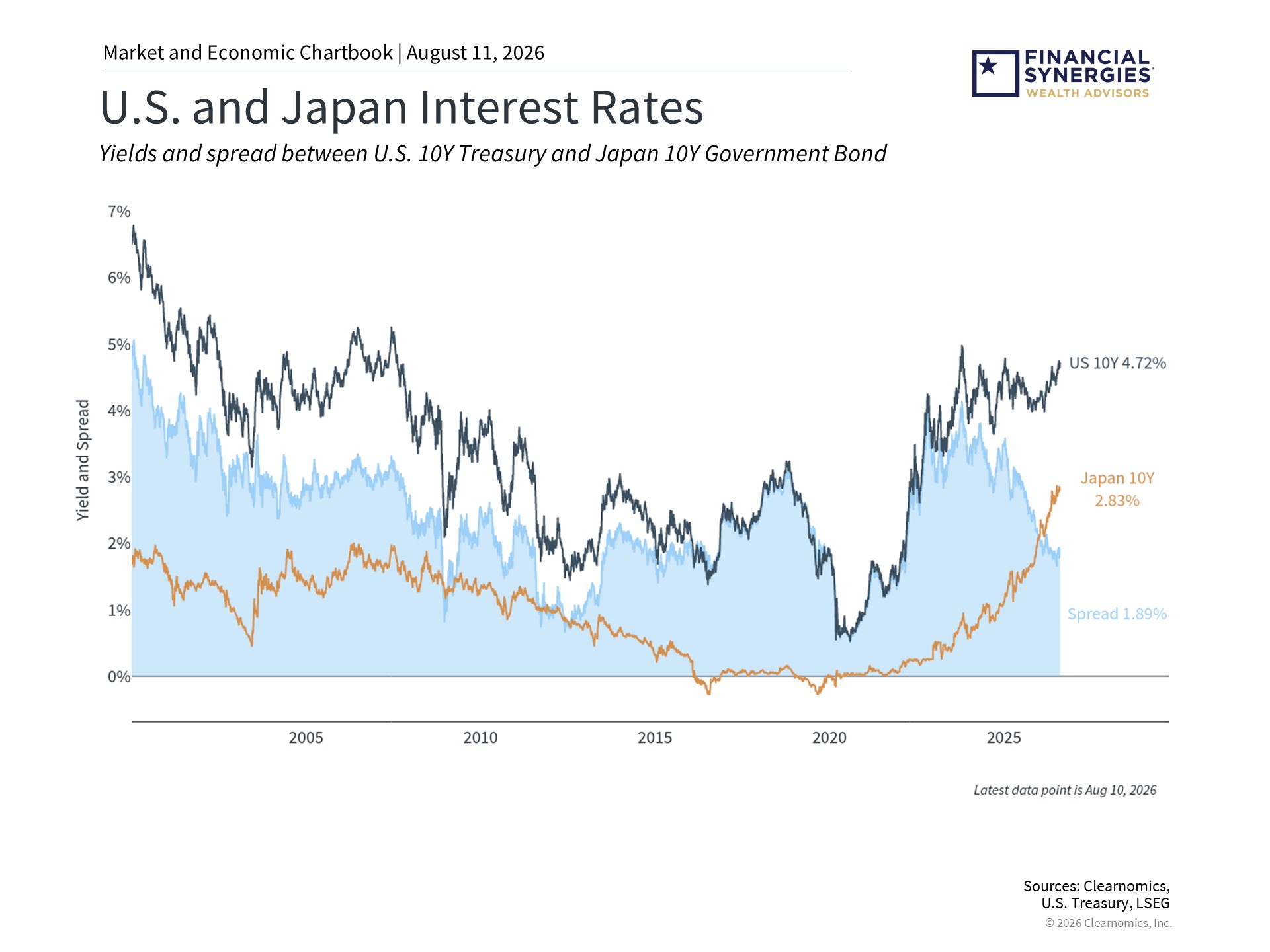
• Of course, there is no free lunch when it comes to financial markets. U.S. interest rates still rose over this period, with longer-term 10-year and 30-year rates at their highest levels in years. However, since this financing arrangement is meant to be temporary, the goal is for markets to not view this as a permanent increase in the Fed balance sheet. Expanding the balance sheet would typically loosen monetary policy at a time when the Fed has been expecting to tighten it.
• This is also not just about interest rate levels. The financial system can experience significant volatility when there are large swings in global interest rates and currencies. A related situation last occurred in 2024 around the Japanese yen “carry trade,” which involves investors borrowing in yen at low rates and investing in higher-yielding assets like U.S. Treasury securities. The rapid unwinding of these trades can create instability.
The included chart on U.S. versus Japan interest rates is directly relevant here, as the wide gap between the two countries’ rates is at the heart of the carry trade dynamic and the Bank of Japan’s goal of supporting the yen.
While currency interventions can create short-term uncertainty, staying focused on long-term investment fundamentals remains the most reliable path to achieving financial goals.
Corporate earnings are one of the most important drivers of stock prices in the long run, and understanding the growth rates that companies are reporting helps investors get a sense of the overall health of financial markets.
Here are some key points to consider:
• This has been a strong earnings season for corporate America. According to FactSet, over 85% of companies have beaten earnings expectations across many sectors. LSEG data shows that consensus forecasts anticipate the S&P 500 earnings-per-share to reach $340 this year, representing a historically strong growth rate that could approach as high as 30%.
• Of course, these expectations can change quickly as new developments occur. So far, many sectors are contributing, including Energy due to higher oil prices, Financials due to interest rates and healthy growth, and technology-related sectors due to AI trends such as data center buildouts.
• While earnings reports are quarterly events, they matter most in the long run. This is because one of the fundamental benefits of owning stocks is that they entitle you to a share of a company’s earnings. Over longer periods, the stock market is supported by earnings growth, which in turn is supported by economic trends.
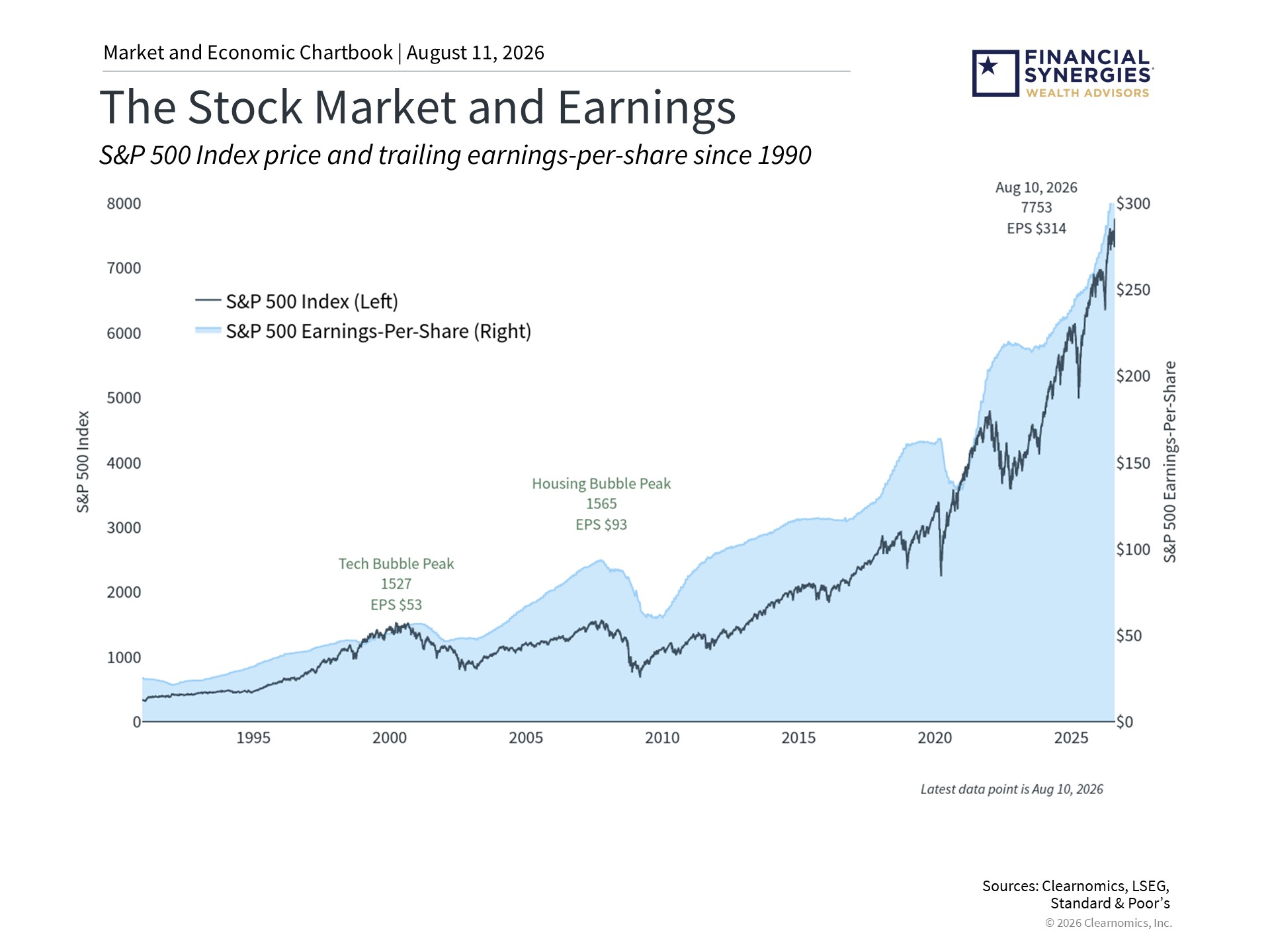
• These trends have helped the S&P 500 reach about 25 new record highs this year. However, it’s important to also pay attention to valuations, which take both prices and earnings into account. The current S&P 500 price-to-earnings ratio has fallen slightly to 19.2x as earnings have grown, but is still well above the historical average of 16x, meaning the stock market is priced at a premium relative to history. It’s important to stay balanced while still benefiting from this growth.
The included chart shows corporate earnings growth and the relationship to the stock market over time, which helps illustrate how earnings have historically been a key engine of long-term returns.
So, while these strong earnings trends are positive for markets and investors, it’s important to stay balanced. The most successful investors tend to focus on the bigger picture, trusting that patient, long-term investing through various market cycles is the most reliable path to building wealth.
Concerns or questions about how your investment portfolio will hold up in the current market environment? Contact Financial Synergies today.
We are a boutique, financial advisory and total wealth management firm with over 35 years helping clients navigate turbulent markets. To learn more about our approach to investment management please reach out to us. One of our seasoned advisors would be happy to help you build a custom financial plan to help ensure you accomplish your financial goals and objectives. Schedule a conversation with us today.
More relevant articles by Financial Synergies:
Blog Disclosures
This content, which contains security-related opinions and/or information, is provided for informational purposes only and should not be relied upon in any manner as professional advice, or an endorsement of any practices, products or services. There can be no guarantees or assurances that the views expressed here will be applicable for any particular facts or circumstances, and should not be relied upon in any manner. You should consult your own financial advisors as to legal, business, tax, and other related matters concerning any investment.
The commentary in this “post” (including any related blogs, videos, and social media) reflects the personal opinions, viewpoints, and analyses of the Financial Synergies Wealth Advisors, Inc. employees providing such comments, and should not be regarded as the views of Financial Synergies Wealth Advisors, Inc. or its respective affiliates or as a description of advisory services provided by Financial Synergies Wealth Advisors, Inc. or performance returns of any Financial Synergies Wealth Advisors, Inc. client.
Any opinions expressed herein do not constitute or imply endorsement, sponsorship, or recommendation by Financial Synergies Wealth Advisors, Inc. or its employees. The views reflected in the commentary are subject to change at any time without notice.
Nothing on this website constitutes investment or financial planning advice, performance data or any recommendation that any particular security, portfolio of securities, transaction or investment strategy is suitable for any specific person. It also should not be construed as an offer soliciting the purchase or sale of any security mentioned. Nor should it be construed as an offer to provide investment advisory services by Financial Synergies Wealth Advisors, Inc.
Any mention of a particular security and related performance data is not a recommendation to buy or sell that security. Financial Synergies Wealth Advisors, Inc. manages its clients’ accounts using a variety of investment techniques and strategies, which are not necessarily discussed in the commentary. Investments in securities involve the risk of loss. Past performance is no guarantee of future results.
Any charts provided here or on any related Financial Synergies Wealth Advisors, Inc. personnel content outlets are for informational purposes only, and should also not be relied upon when making any investment decision. Any indices referenced for comparison are unmanaged and cannot be invested into directly. As always please remember investing involves risk and possible loss of principal capital; please seek advice from a licensed professional. Any projections, estimates, forecasts, targets, prospects and/or opinions expressed in these materials are subject to change without notice and may differ or be contrary to opinions expressed by others. Information in charts have been obtained from third-party sources and data, and may include those from portfolio securities of funds managed by Financial Synergies Wealth Advisors, Inc. While taken from sources believed to be reliable, Financial Synergies Wealth Advisors, Inc. has not independently verified such information and makes no representations about the enduring accuracy of the information or its appropriateness for a given situation. All content speaks only as of the date indicated.
Financial Synergies Wealth Advisors, Inc. is a registered investment adviser. Advisory services are only offered to clients or prospective clients where Financial Synergies Wealth Advisors, Inc. and its representatives are properly licensed or exempt from licensure. Investments in securities involve the risk of loss. Past performance is no guarantee of future results.
See Full Disclosures Page Here
 Skip to content


Top Client Questions: A Surprise Jobs Miss, Historic Yen Intervention, and Strong Earnings
What does the jobs report miss mean for the economy?
The monthly jobs report is one of the most closely watched economic indicators because it tells us how many people are finding work and how healthy the labor market is. This can have ripple effects across growth, inflation, and Federal Reserve policy.
Here are some key factors to consider:
• The latest jobs report for July showed that payrolls fell by -23,000, well below the consensus forecast of +80,000 new jobs. Investors typically expect positive job gains each month, so it can be surprising when we see a negative number. There are many details across sectors and technical factors such as seasonal adjustments. At the same time, the overall economy is still healthy, so it’s important not to overreact to a single month’s numbers.
• The unemployment rate improved slightly to 4.1%, in large part because the labor force participation rate dropped to 61.4%. So while job gains slowed in July, fewer people are actively looking for work, which means that overall unemployment actually improved. This can seem confusing and is due to the way the unemployment rate is calculated, which makes it harder to interpret whether the jobs figures are truly positive.
• The broader labor market has been softening for some time due to these labor supply trends, especially with slower immigration. The economy has averaged only about 60,000 job gains per month this year, after a strong period in March and April. This is also consistent with GDP growth decelerating to 1.5% in the second quarter, and productivity which slowed to 1.4%. Again, these numbers are still positive, just slower.
• The biggest question for investors is how this might impact a potential Fed rate hike in the coming months. Higher inflation means the Fed ought to raise rates, while a weakening job market would usually mean a rate cut. This jobs miss has led to a shift in market probabilities, with investors now expecting the Fed’s next rate hike to come in December rather than October, and no further hikes expected through 2027. It’s important to remember that these expectations can shift quickly, especially as the growth and inflation outlook changes.
The included chart on payrolls shows the magnitude of job gains over the past several years, and how they have slowed more recently.
While a single weak jobs report can cause short-term market volatility, long-term investors are best served by staying focused on the broader economic cycle and remembering that markets have historically navigated periods of labor market weakness and continued to grow over time.
Why did the U.S. intervene to support the Japanese Yen?
Policy moves like this are somewhat unusual and are typically related to underlying financial market and economic conditions. This means it’s important to understand why the U.S. did this in the right context.
Here are some key points to consider:
• The U.S. recently helped Japan intervene in the yen market for the first time since 1998. The yen had fallen to its lowest value in 40 years due to factors such as slow growth, high debt levels, and pressures from oil imports, in addition to shorter-term trading factors. Typically, Japan would need to sell assets such as U.S. Treasury securities to raise dollars which they could then use to shore up the yen.
• However, by selling Treasury securities, this would raise U.S. interest rates. To avoid this, the U.S. stepped in to effectively lend Japan the dollars to support the yen. They did so by having the Federal Reserve expand its balance sheet and provide a repo facility backed by those Treasury securities, on the order of $60 billion. This was done to avoid Japan selling these securities on the open market.
• Of course, there is no free lunch when it comes to financial markets. U.S. interest rates still rose over this period, with longer-term 10-year and 30-year rates at their highest levels in years. However, since this financing arrangement is meant to be temporary, the goal is for markets to not view this as a permanent increase in the Fed balance sheet. Expanding the balance sheet would typically loosen monetary policy at a time when the Fed has been expecting to tighten it.
• This is also not just about interest rate levels. The financial system can experience significant volatility when there are large swings in global interest rates and currencies. A related situation last occurred in 2024 around the Japanese yen “carry trade,” which involves investors borrowing in yen at low rates and investing in higher-yielding assets like U.S. Treasury securities. The rapid unwinding of these trades can create instability.
The included chart on U.S. versus Japan interest rates is directly relevant here, as the wide gap between the two countries’ rates is at the heart of the carry trade dynamic and the Bank of Japan’s goal of supporting the yen.
While currency interventions can create short-term uncertainty, staying focused on long-term investment fundamentals remains the most reliable path to achieving financial goals.
How does the current earnings season affect the market outlook?
Corporate earnings are one of the most important drivers of stock prices in the long run, and understanding the growth rates that companies are reporting helps investors get a sense of the overall health of financial markets.
Here are some key points to consider:
• This has been a strong earnings season for corporate America. According to FactSet, over 85% of companies have beaten earnings expectations across many sectors. LSEG data shows that consensus forecasts anticipate the S&P 500 earnings-per-share to reach $340 this year, representing a historically strong growth rate that could approach as high as 30%.
• Of course, these expectations can change quickly as new developments occur. So far, many sectors are contributing, including Energy due to higher oil prices, Financials due to interest rates and healthy growth, and technology-related sectors due to AI trends such as data center buildouts.
• While earnings reports are quarterly events, they matter most in the long run. This is because one of the fundamental benefits of owning stocks is that they entitle you to a share of a company’s earnings. Over longer periods, the stock market is supported by earnings growth, which in turn is supported by economic trends.
• These trends have helped the S&P 500 reach about 25 new record highs this year. However, it’s important to also pay attention to valuations, which take both prices and earnings into account. The current S&P 500 price-to-earnings ratio has fallen slightly to 19.2x as earnings have grown, but is still well above the historical average of 16x, meaning the stock market is priced at a premium relative to history. It’s important to stay balanced while still benefiting from this growth.
The included chart shows corporate earnings growth and the relationship to the stock market over time, which helps illustrate how earnings have historically been a key engine of long-term returns.
So, while these strong earnings trends are positive for markets and investors, it’s important to stay balanced. The most successful investors tend to focus on the bigger picture, trusting that patient, long-term investing through various market cycles is the most reliable path to building wealth.
Concerns or questions about how your investment portfolio will hold up in the current market environment? Contact Financial Synergies today.
We are a boutique, financial advisory and total wealth management firm with over 35 years helping clients navigate turbulent markets. To learn more about our approach to investment management please reach out to us. One of our seasoned advisors would be happy to help you build a custom financial plan to help ensure you accomplish your financial goals and objectives. Schedule a conversation with us today.
More relevant articles by Financial Synergies:
Blog Disclosures
This content, which contains security-related opinions and/or information, is provided for informational purposes only and should not be relied upon in any manner as professional advice, or an endorsement of any practices, products or services. There can be no guarantees or assurances that the views expressed here will be applicable for any particular facts or circumstances, and should not be relied upon in any manner. You should consult your own financial advisors as to legal, business, tax, and other related matters concerning any investment.
The commentary in this “post” (including any related blogs, videos, and social media) reflects the personal opinions, viewpoints, and analyses of the Financial Synergies Wealth Advisors, Inc. employees providing such comments, and should not be regarded as the views of Financial Synergies Wealth Advisors, Inc. or its respective affiliates or as a description of advisory services provided by Financial Synergies Wealth Advisors, Inc. or performance returns of any Financial Synergies Wealth Advisors, Inc. client.
Any opinions expressed herein do not constitute or imply endorsement, sponsorship, or recommendation by Financial Synergies Wealth Advisors, Inc. or its employees. The views reflected in the commentary are subject to change at any time without notice.
Nothing on this website constitutes investment or financial planning advice, performance data or any recommendation that any particular security, portfolio of securities, transaction or investment strategy is suitable for any specific person. It also should not be construed as an offer soliciting the purchase or sale of any security mentioned. Nor should it be construed as an offer to provide investment advisory services by Financial Synergies Wealth Advisors, Inc.
Any mention of a particular security and related performance data is not a recommendation to buy or sell that security. Financial Synergies Wealth Advisors, Inc. manages its clients’ accounts using a variety of investment techniques and strategies, which are not necessarily discussed in the commentary. Investments in securities involve the risk of loss. Past performance is no guarantee of future results.
Any charts provided here or on any related Financial Synergies Wealth Advisors, Inc. personnel content outlets are for informational purposes only, and should also not be relied upon when making any investment decision. Any indices referenced for comparison are unmanaged and cannot be invested into directly. As always please remember investing involves risk and possible loss of principal capital; please seek advice from a licensed professional. Any projections, estimates, forecasts, targets, prospects and/or opinions expressed in these materials are subject to change without notice and may differ or be contrary to opinions expressed by others. Information in charts have been obtained from third-party sources and data, and may include those from portfolio securities of funds managed by Financial Synergies Wealth Advisors, Inc. While taken from sources believed to be reliable, Financial Synergies Wealth Advisors, Inc. has not independently verified such information and makes no representations about the enduring accuracy of the information or its appropriateness for a given situation. All content speaks only as of the date indicated.
Financial Synergies Wealth Advisors, Inc. is a registered investment adviser. Advisory services are only offered to clients or prospective clients where Financial Synergies Wealth Advisors, Inc. and its representatives are properly licensed or exempt from licensure. Investments in securities involve the risk of loss. Past performance is no guarantee of future results.
See Full Disclosures Page Here
Recent Posts
Chart of the Month | Stocks vs. Bonds: More Choices for Investors as Bond Yields Rise
Weekly Market Recap – September Inflation & Retail Sales Data, AI Financing, & Bank Earnings
Happy Birthday to the Bull Market
Subscribe to Our Blog
Chief Investment Officer | Managing Partner