If tariff refunds and the national debt are on your mind recently, you’re not alone. Since new tariffs were announced last year, global trade has been a source of uncertainty for financial markets and the economy. In February, the Supreme Court ruled that the original “Liberation Day” tariffs were illegal, resulting in a wave of refunds to businesses that are now well underway.1 New tariffs have been implemented since then under different laws, including recently with trading partners such as Canada.
At the same time, tariff refunds have pushed the federal budget deficit higher, with the national debt exceeding $40 trillion for the first time and raising questions about the government’s long-term cost of borrowing.2
While some investors have legitimate concerns around the developments of tariff refunds and the national debt, the impact on portfolios has been muted. In fact, markets have performed well over this period, with broad market indices reaching new all-time highs. This shows how important it is for investors to keep these developments in perspective, since markets have performed well across many different trade and fiscal environments throughout history.
Tariff refunds are making their way back to businesses
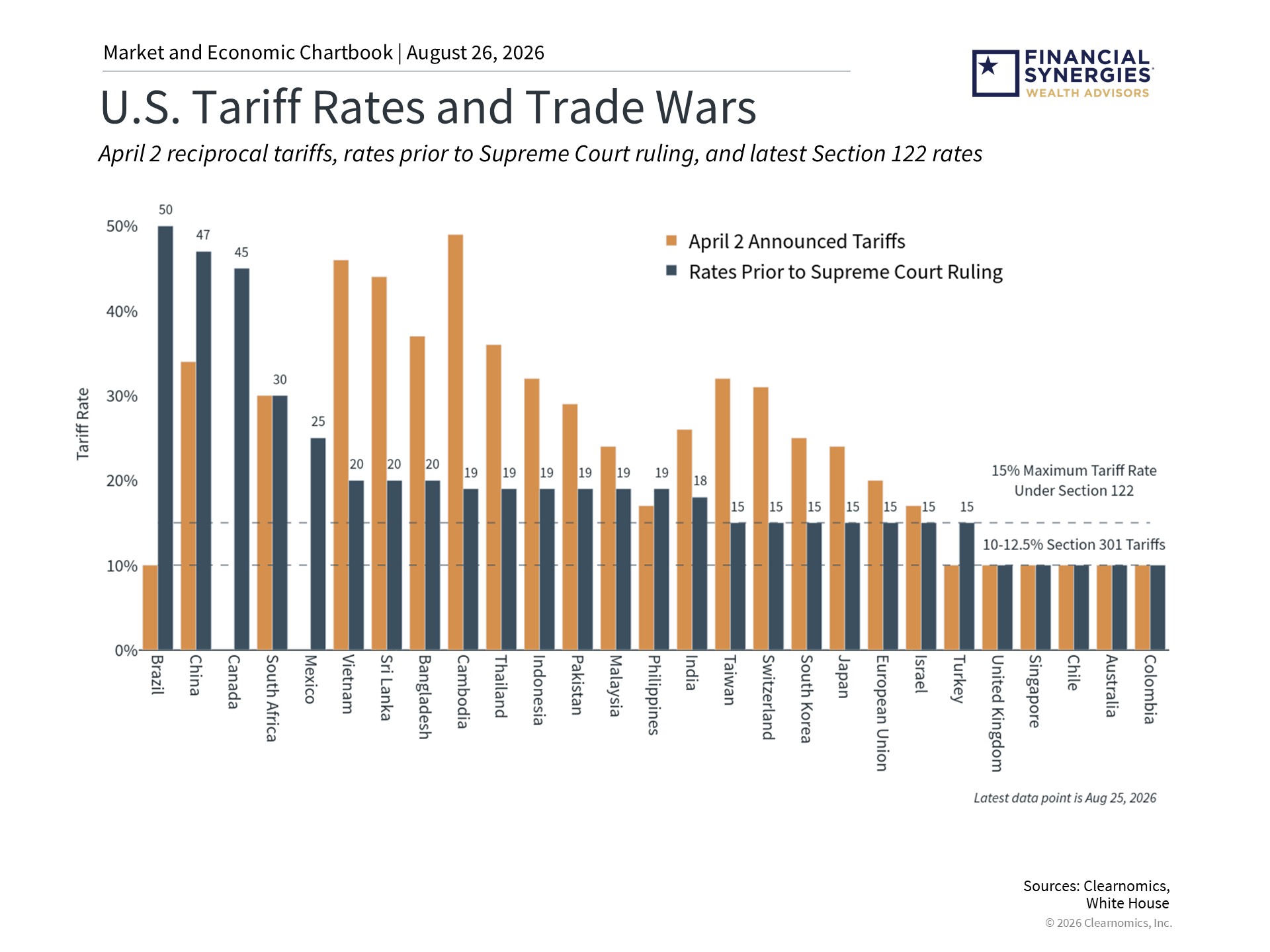
When the Supreme Court ruled in February that billions in tariffs collected under the International Emergency Economic Powers Act (IEEPA) had been unlawfully imposed, markets generally reacted positively. This is because tariffs are typically viewed by markets as an added cost to consumers, so the reversal was expected to support the overall economy.
Since then, companies that had paid those tariffs became eligible for refunds, which are in the process of being paid out. According to U.S. Customs and Border Protection, $129 billion in refund claims had been accepted for processing, representing a significant share of the total amount owed.3 Treasury data shows that tariff refunds have exceeded new tariff collections since May, resulting in net outflows from the government for three consecutive months.4
Specifically, June marked the single largest monthly amount of refunded tariffs ever recorded, with $49.2 billion returned compared to $23.6 billion collected. With roughly 40% of the total refunds still to be processed, net tariff receipts for the government are likely to be negative in the months ahead.
On the surface, these refunds could act as a stimulus, supporting company balance sheets and investments. However, it’s important to remember that this cash was originally paid by each business to begin with. So, while markets may view these refunds as positive, they are largely a one-time event. They do not represent a lasting improvement in underlying fundamentals, and simply reverse last year’s tariff payments. Additionally, many companies continue to pay tariffs under different laws.
For consumers who are asking about tariff refunds and the national debt, one fear was that the tariffs could be inflationary. However, this has not materialized as many expected, since many retailers absorbed or passed on tariff-related costs in indirect ways. This is one reason tariffs did not have the negative effect on consumer spending that some feared. This also makes it difficult to trace how refunds will be returned to and benefit households. For example, some shipping companies have begun returning refunds to customers who paid tariff surcharges directly, while some larger retailers have pledged to pass on savings through lower prices rather than direct payments.
Tariff refunds have added to the deficit and debt
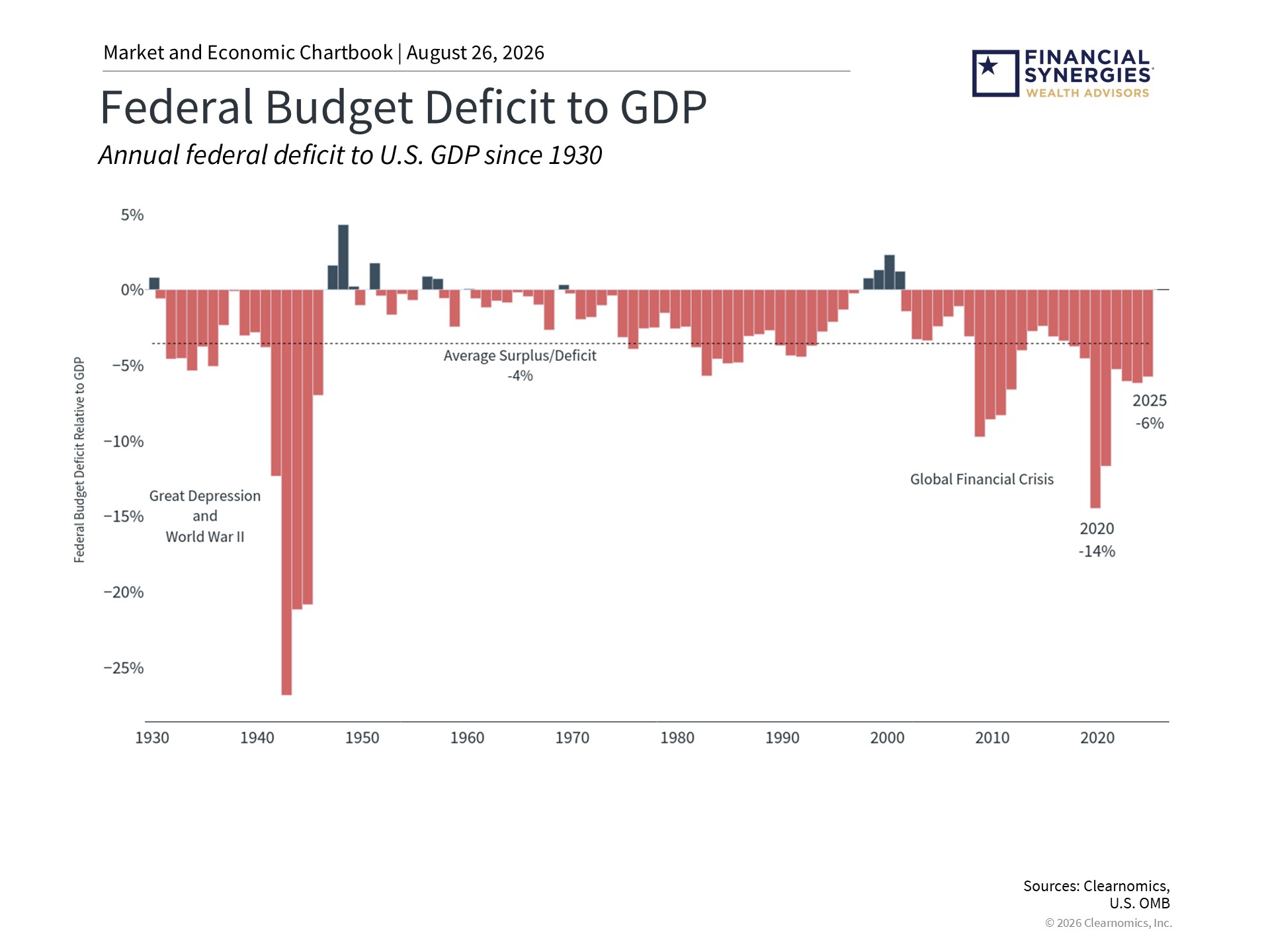
Tariff refunds and the national debt have also reversed the boost to government revenues over the past year. The current annual deficit already stands at approximately $1.8 trillion, even though the fiscal year doesn’t end until September, surpassing the full-year 2025 deficit.5 In fact, the Congressional Budget Office recently projected the full-year deficit will reach $2.1 trillion, roughly $200 billion more than was estimated earlier in the year.6
This means that the national debt now exceeds $40 trillion for the first time in history, a figure that has grown steadily over decades as annual deficits have compounded. The accompanying chart shows this long-run trajectory, with each year’s deficit adding to the total debt. Tariff refunds are contributing to the deficit in the near term, but it’s important to keep in mind that tariffs alone cannot close the budget deficit. Complex issues such as entitlement programs, including Social Security and Medicare, are much larger drivers that are difficult to solve.
While many investors are understandably concerned about tariff refunds and the national debt, history shows that it’s important to separate these issues from how we invest and plan our financial futures. Since 1970, the federal government has run a deficit in all but five years, with the only four surpluses occurring in the past thirty years. And yet, balanced portfolios have performed well over this period. Moreover, the deficit is often at its highest when markets and the economy are in difficult periods, which can coincide with market bottoms. So, while the past is no guarantee of the future, and the size of the national debt does create challenges, investing based on this alone has historically been counterproductive.
The government is trying to manage interest rates
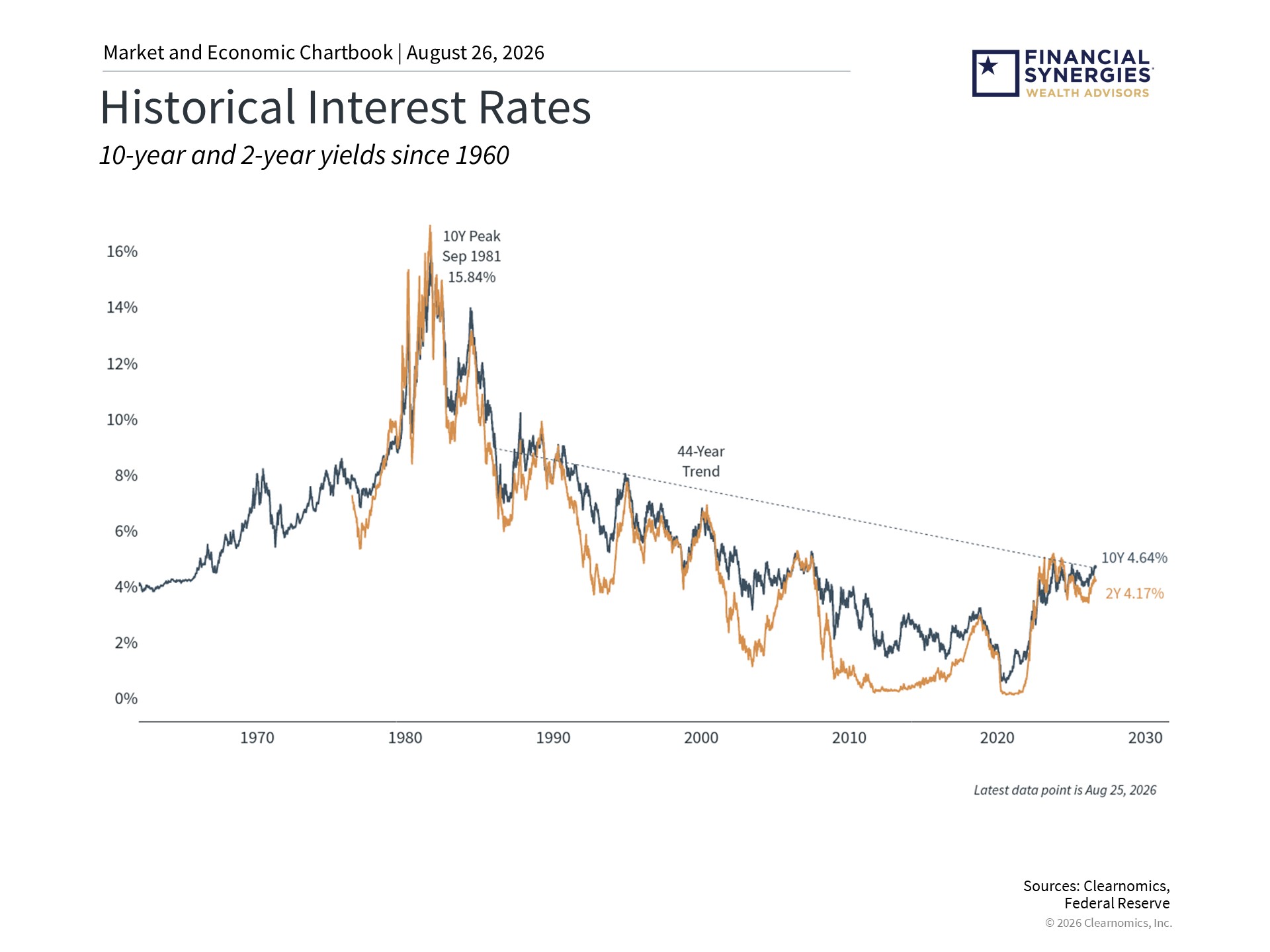
Another effect of rising debt is its impact on interest rates and government borrowing costs. In particular, long-term interest rates have climbed to multi-decade highs recently, which is one of the key ways that fiscal policy affects the broader economy. When yields on 10-year and 30-year Treasuries rise, borrowing can become more expensive for businesses and households.
To manage this, the Treasury Department has increased the size of its buybacks of U.S. Treasury securities, which serves to keep interest rates within a range.7 Other Treasury activities, such as supporting the Japanese Yen, may seem unrelated at first, but this too is intended to ensure that governments such as Japan’s do not sell large amounts of Treasury securities. Still, these efforts are small compared to the overall size of the Treasury market.
The accompanying chart helps to put interest rates in a longer historical context. Rates today are high relative to the past two decades, especially when the Federal Reserve held rates near zero for many years. However, it’s easy to see that rates are not historically extreme. In fact, higher rates also mean that investors have more opportunities in bonds and income generation for their portfolios.
Concerns about tariff refunds and the national debt, as well as interest rates, could continue to grow as we approach the midterm elections in November. Investors should be careful not to let headlines drive portfolio decisions. History shows that markets have navigated many periods of trade and fiscal uncertainty, and that investors who maintained a longer-term perspective were better positioned for their financial goals.
References
1. https://www.cbp.gov/trade/programs-administration/trade-remedies/ieepa-duty-refunds
2. https://fiscaldata.treasury.gov/datasets/debt-to-the-penny/debt-to-the-penny
3. https://storage.courtlistener.com/recap/gov.uscourts.cit.17270/gov.uscourts.cit.17270.25.1.pdf#page=3
4. https://fiscaldata.treasury.gov/datasets/monthly-treasury-statement/receipts-of-the-u-s-government
5. https://fiscaldata.treasury.gov/americas-finance-guide/national-deficit
6. https://www.cbo.gov/system/files/2026-08/61983-2026-07-MBR.pdf
7. https://home.treasury.gov/news/press-releases/sb0607
A Truly Unique Wealth Management Experience
Let’s create a financial plan and investment strategy that allows you to live the life of your dreams. Schedule your free consultation today to explore tailored financial strategies designed to secure your future!
Are We Right for You?
Concerns or questions about how your investment portfolio will hold up in the current market environment? Contact Financial Synergies today.
We are a boutique, financial advisory and total wealth management firm with over 35 years helping clients navigate turbulent markets. To learn more about our approach to investment management, financial planning, and retirement planning, please reach out to us. One of our seasoned advisors would be happy to help you build a custom financial plan to help ensure you accomplish your financial goals and objectives. Schedule a conversation with us today.
More relevant articles by Financial Synergies:
Blog Disclosures
This content, which may contain security-related opinions and/or information, is provided for informational purposes only and should not be relied upon in any manner as professional advice, or an endorsement of any practices, products or services. There can be no guarantees or assurances that the views expressed here will be applicable for any particular facts or circumstances, and should not be relied upon in any manner. You should consult your own financial advisors as to legal, business, tax, and other related matters concerning any investment.
The commentary in this “post” (including any related blogs, videos, and social media) reflects the personal opinions, viewpoints, and analyses of the Financial Synergies Wealth Advisors, Inc. employees providing such comments, and should not be regarded as the views of Financial Synergies Wealth Advisors, Inc. or its respective affiliates or as a description of advisory services provided by Financial Synergies Wealth Advisors, Inc. or performance returns of any Financial Synergies Wealth Advisors, Inc. client.
Any opinions expressed herein do not constitute or imply endorsement, sponsorship, or recommendation by Financial Synergies Wealth Advisors, Inc. or its employees. The views reflected in the commentary are subject to change at any time without notice.
Nothing on this website or Blog constitutes investment or financial planning advice, performance data or any recommendation that any particular security, portfolio of securities, transaction or investment strategy is suitable for any specific person. It also should not be construed as an offer soliciting the purchase or sale of any security mentioned. Nor should it be construed as an offer to provide investment advisory services by Financial Synergies Wealth Advisors, Inc.
Any mention of a particular security and related performance data is not a recommendation to buy or sell that security. Financial Synergies Wealth Advisors, Inc. manages its clients’ accounts using a variety of investment techniques and strategies, which are not necessarily discussed in the commentary. Investments in securities involve the risk of loss. Past performance is no guarantee of future results.
Any charts provided here or on any related Financial Synergies Wealth Advisors, Inc. personnel content outlets are for informational purposes only, and should also not be relied upon when making any investment decision. Any indices referenced for comparison are unmanaged and cannot be invested into directly. As always please remember investing involves risk and possible loss of principal capital; please seek advice from a licensed professional. Any projections, estimates, forecasts, targets, prospects and/or opinions expressed in these materials are subject to change without notice and may differ or be contrary to opinions expressed by others. Information in charts have been obtained from third-party sources and data, and may include those from portfolio securities of funds managed by Financial Synergies Wealth Advisors, Inc. While taken from sources believed to be reliable, Financial Synergies Wealth Advisors, Inc. has not independently verified such information and makes no representations about the enduring accuracy of the information or its appropriateness for a given situation. All content speaks only as of the date indicated.
Financial Synergies Wealth Advisors, Inc. is a registered investment adviser. Advisory services are only offered to clients or prospective clients where Financial Synergies Wealth Advisors, Inc. and its representatives are properly licensed or exempt from licensure. Investments in securities involve the risk of loss. Past performance is no guarantee of future results.
See Full Disclosures Page Here
 Skip to content


Tariff Refunds and the National Debt
If tariff refunds and the national debt are on your mind recently, you’re not alone. Since new tariffs were announced last year, global trade has been a source of uncertainty for financial markets and the economy. In February, the Supreme Court ruled that the original “Liberation Day” tariffs were illegal, resulting in a wave of refunds to businesses that are now well underway.1 New tariffs have been implemented since then under different laws, including recently with trading partners such as Canada.
At the same time, tariff refunds have pushed the federal budget deficit higher, with the national debt exceeding $40 trillion for the first time and raising questions about the government’s long-term cost of borrowing.2
While some investors have legitimate concerns around the developments of tariff refunds and the national debt, the impact on portfolios has been muted. In fact, markets have performed well over this period, with broad market indices reaching new all-time highs. This shows how important it is for investors to keep these developments in perspective, since markets have performed well across many different trade and fiscal environments throughout history.
Tariff refunds are making their way back to businesses
When the Supreme Court ruled in February that billions in tariffs collected under the International Emergency Economic Powers Act (IEEPA) had been unlawfully imposed, markets generally reacted positively. This is because tariffs are typically viewed by markets as an added cost to consumers, so the reversal was expected to support the overall economy.
Since then, companies that had paid those tariffs became eligible for refunds, which are in the process of being paid out. According to U.S. Customs and Border Protection, $129 billion in refund claims had been accepted for processing, representing a significant share of the total amount owed.3 Treasury data shows that tariff refunds have exceeded new tariff collections since May, resulting in net outflows from the government for three consecutive months.4
Specifically, June marked the single largest monthly amount of refunded tariffs ever recorded, with $49.2 billion returned compared to $23.6 billion collected. With roughly 40% of the total refunds still to be processed, net tariff receipts for the government are likely to be negative in the months ahead.
On the surface, these refunds could act as a stimulus, supporting company balance sheets and investments. However, it’s important to remember that this cash was originally paid by each business to begin with. So, while markets may view these refunds as positive, they are largely a one-time event. They do not represent a lasting improvement in underlying fundamentals, and simply reverse last year’s tariff payments. Additionally, many companies continue to pay tariffs under different laws.
For consumers who are asking about tariff refunds and the national debt, one fear was that the tariffs could be inflationary. However, this has not materialized as many expected, since many retailers absorbed or passed on tariff-related costs in indirect ways. This is one reason tariffs did not have the negative effect on consumer spending that some feared. This also makes it difficult to trace how refunds will be returned to and benefit households. For example, some shipping companies have begun returning refunds to customers who paid tariff surcharges directly, while some larger retailers have pledged to pass on savings through lower prices rather than direct payments.
Tariff refunds have added to the deficit and debt
Tariff refunds and the national debt have also reversed the boost to government revenues over the past year. The current annual deficit already stands at approximately $1.8 trillion, even though the fiscal year doesn’t end until September, surpassing the full-year 2025 deficit.5 In fact, the Congressional Budget Office recently projected the full-year deficit will reach $2.1 trillion, roughly $200 billion more than was estimated earlier in the year.6
This means that the national debt now exceeds $40 trillion for the first time in history, a figure that has grown steadily over decades as annual deficits have compounded. The accompanying chart shows this long-run trajectory, with each year’s deficit adding to the total debt. Tariff refunds are contributing to the deficit in the near term, but it’s important to keep in mind that tariffs alone cannot close the budget deficit. Complex issues such as entitlement programs, including Social Security and Medicare, are much larger drivers that are difficult to solve.
While many investors are understandably concerned about tariff refunds and the national debt, history shows that it’s important to separate these issues from how we invest and plan our financial futures. Since 1970, the federal government has run a deficit in all but five years, with the only four surpluses occurring in the past thirty years. And yet, balanced portfolios have performed well over this period. Moreover, the deficit is often at its highest when markets and the economy are in difficult periods, which can coincide with market bottoms. So, while the past is no guarantee of the future, and the size of the national debt does create challenges, investing based on this alone has historically been counterproductive.
The government is trying to manage interest rates
Another effect of rising debt is its impact on interest rates and government borrowing costs. In particular, long-term interest rates have climbed to multi-decade highs recently, which is one of the key ways that fiscal policy affects the broader economy. When yields on 10-year and 30-year Treasuries rise, borrowing can become more expensive for businesses and households.
To manage this, the Treasury Department has increased the size of its buybacks of U.S. Treasury securities, which serves to keep interest rates within a range.7 Other Treasury activities, such as supporting the Japanese Yen, may seem unrelated at first, but this too is intended to ensure that governments such as Japan’s do not sell large amounts of Treasury securities. Still, these efforts are small compared to the overall size of the Treasury market.
The accompanying chart helps to put interest rates in a longer historical context. Rates today are high relative to the past two decades, especially when the Federal Reserve held rates near zero for many years. However, it’s easy to see that rates are not historically extreme. In fact, higher rates also mean that investors have more opportunities in bonds and income generation for their portfolios.
Concerns about tariff refunds and the national debt, as well as interest rates, could continue to grow as we approach the midterm elections in November. Investors should be careful not to let headlines drive portfolio decisions. History shows that markets have navigated many periods of trade and fiscal uncertainty, and that investors who maintained a longer-term perspective were better positioned for their financial goals.
References
1. https://www.cbp.gov/trade/programs-administration/trade-remedies/ieepa-duty-refunds
2. https://fiscaldata.treasury.gov/datasets/debt-to-the-penny/debt-to-the-penny
3. https://storage.courtlistener.com/recap/gov.uscourts.cit.17270/gov.uscourts.cit.17270.25.1.pdf#page=3
4. https://fiscaldata.treasury.gov/datasets/monthly-treasury-statement/receipts-of-the-u-s-government
5. https://fiscaldata.treasury.gov/americas-finance-guide/national-deficit
6. https://www.cbo.gov/system/files/2026-08/61983-2026-07-MBR.pdf
7. https://home.treasury.gov/news/press-releases/sb0607
A Truly Unique Wealth Management Experience
Let’s create a financial plan and investment strategy that allows you to live the life of your dreams. Schedule your free consultation today to explore tailored financial strategies designed to secure your future!
Concerns or questions about how your investment portfolio will hold up in the current market environment? Contact Financial Synergies today.
We are a boutique, financial advisory and total wealth management firm with over 35 years helping clients navigate turbulent markets. To learn more about our approach to investment management, financial planning, and retirement planning, please reach out to us. One of our seasoned advisors would be happy to help you build a custom financial plan to help ensure you accomplish your financial goals and objectives. Schedule a conversation with us today.
More relevant articles by Financial Synergies:
Blog Disclosures
This content, which may contain security-related opinions and/or information, is provided for informational purposes only and should not be relied upon in any manner as professional advice, or an endorsement of any practices, products or services. There can be no guarantees or assurances that the views expressed here will be applicable for any particular facts or circumstances, and should not be relied upon in any manner. You should consult your own financial advisors as to legal, business, tax, and other related matters concerning any investment.
The commentary in this “post” (including any related blogs, videos, and social media) reflects the personal opinions, viewpoints, and analyses of the Financial Synergies Wealth Advisors, Inc. employees providing such comments, and should not be regarded as the views of Financial Synergies Wealth Advisors, Inc. or its respective affiliates or as a description of advisory services provided by Financial Synergies Wealth Advisors, Inc. or performance returns of any Financial Synergies Wealth Advisors, Inc. client.
Any opinions expressed herein do not constitute or imply endorsement, sponsorship, or recommendation by Financial Synergies Wealth Advisors, Inc. or its employees. The views reflected in the commentary are subject to change at any time without notice.
Nothing on this website or Blog constitutes investment or financial planning advice, performance data or any recommendation that any particular security, portfolio of securities, transaction or investment strategy is suitable for any specific person. It also should not be construed as an offer soliciting the purchase or sale of any security mentioned. Nor should it be construed as an offer to provide investment advisory services by Financial Synergies Wealth Advisors, Inc.
Any mention of a particular security and related performance data is not a recommendation to buy or sell that security. Financial Synergies Wealth Advisors, Inc. manages its clients’ accounts using a variety of investment techniques and strategies, which are not necessarily discussed in the commentary. Investments in securities involve the risk of loss. Past performance is no guarantee of future results.
Any charts provided here or on any related Financial Synergies Wealth Advisors, Inc. personnel content outlets are for informational purposes only, and should also not be relied upon when making any investment decision. Any indices referenced for comparison are unmanaged and cannot be invested into directly. As always please remember investing involves risk and possible loss of principal capital; please seek advice from a licensed professional. Any projections, estimates, forecasts, targets, prospects and/or opinions expressed in these materials are subject to change without notice and may differ or be contrary to opinions expressed by others. Information in charts have been obtained from third-party sources and data, and may include those from portfolio securities of funds managed by Financial Synergies Wealth Advisors, Inc. While taken from sources believed to be reliable, Financial Synergies Wealth Advisors, Inc. has not independently verified such information and makes no representations about the enduring accuracy of the information or its appropriateness for a given situation. All content speaks only as of the date indicated.
Financial Synergies Wealth Advisors, Inc. is a registered investment adviser. Advisory services are only offered to clients or prospective clients where Financial Synergies Wealth Advisors, Inc. and its representatives are properly licensed or exempt from licensure. Investments in securities involve the risk of loss. Past performance is no guarantee of future results.
See Full Disclosures Page Here
Recent Posts
Happy Birthday to the Bull Market
Quarterly Webinar: Q4 2026 Market and Economic Themes
Medicare Open Enrollment 2026: What to Know
Subscribe to Our Blog
Chief Investment Officer | Managing Partner