Skip to content


Key Highlights
- Mutual funds vs exchange-traded funds (ETFs): Both offer professionally managed, diversified investment options.
- A key difference in mutual funds vs ETFs is how they trade: you can trade ETF shares throughout the day, while a mutual fund is priced once daily.
- ETFs often have a lower expense ratio and greater tax efficiency compared to many mutual funds.
- The choice of mutual funds vs ETFs depends on your investment goals, trading preferences, and risk tolerance.
- High-net-worth individuals should consider how each vehicle fits into their overall wealth management and retirement planning strategy.
Understanding Mutual Funds vs ETFs

When building a robust portfolio, high-net-worth families often consider various investment vehicles. Mutual funds and exchange-traded funds (ETFs) are two popular choices that allow investors to pool money into a collection of stocks, bonds, or other assets. Both mutual funds and ETFs provide professional management and instant diversification, simplifying the process of aligning your investments with your financial goals.
Although they share similarities, the main differences of mutual funds vs ETFs lie in their trading mechanics, cost structures, and tax implications. While ETFs trade on an exchange like stocks, mutual funds are priced at the end of the day. Understanding these distinctions is crucial for effective retirement planning and wealth management. We will now look closer at what defines each of these investment types.
What Are Mutual Funds?
A mutual fund is an investment vehicle that pools money from numerous investors to purchase a diversified portfolio of securities. When you invest, you buy fund shares, which represent a portion of the ownership in the fund’s overall holdings. You don’t own the individual securities directly; instead, you share in the profits or losses of the fund’s collective investments.
Professional portfolio managers oversee these funds, making decisions about which securities to buy and sell to meet the fund’s stated objective. The value of your investment is determined by the fund’s net asset value (NAV), which is calculated once per day after the market closes. All transactions to buy or sell fund shares are executed at this end-of-day NAV.
This structure offers a hands-off approach for investors, providing access to professional management and a range of investment strategies designed for goals like long-term growth or income generation. For high-net-worth individuals, this can be a convenient way to access diversified investment strategies as part of a broader financial plan.
Types of Mutual Funds (Balanced, Equity/Stock, Bond)
Understanding the different types of mutual funds is essential for building a portfolio that aligns with your risk tolerance and financial objectives. These funds are categorized based on the asset classes they invest in, offering options for various investment strategies.
For beginners and seasoned investors alike, knowing these categories helps in making informed decisions. The primary types of mutual funds include:
- Balanced Funds: These funds combine stocks and bonds within a single portfolio. The allocation mix is defined in the fund’s prospectus, offering a blend of growth potential from equities and stability from fixed-income securities.
- Equity/Stock Funds: Primarily investing in stocks, these funds are categorized by the size of the companies they hold (e.g., large-cap, mid-cap) or their investment style (e.g., growth, value). They offer the potential for significant capital appreciation.
- Bond Funds: These funds invest in various bonds, including government bonds and corporate bonds. They are designed to provide regular income and are generally considered less risky than equity funds.
Each type serves a different purpose within a diversified portfolio, whether for retirement planning or general wealth management.
What Is ETF Investing and How Do ETFs Work?
An ETF is a type of investment fund that, like a mutual fund, holds a basket of underlying assets such as stocks, bonds, or commodities. However, ETF shares trade on the stock market just like individual stocks. This means their prices can fluctuate throughout the trading day as they are bought and sold.
Unlike most mutual funds, the majority of ETFs are passive investments. This means they are designed to track a specific market index, such as the S&P 500. The fund’s goal is to replicate the performance of that index, not to outperform it. This passive approach often results in lower management fees compared to actively managed funds.
For investors, this structure offers flexibility and transparency. You can buy or sell ETF shares at any time during market hours, giving you more control over the price you pay. This intraday trading capability is a key feature that distinguishes ETFs from mutual funds and makes them a versatile tool for high-net-worth financial planning.
Core Similarities Between Mutual Funds and ETFs

Despite their differences, mutual funds and ETFs share fundamental characteristics that make them valuable for investors. Both options provide an efficient way to create a diversified portfolio. By pooling assets, they give you access to a wide range of securities, which helps spread risk more effectively than buying individual stocks or bonds.
Furthermore, both investment vehicles benefit from professional investment management. Whether actively managed or passively tracking an index, there are portfolio managers overseeing the fund to ensure it adheres to its stated investment goals. This oversight saves you the time and effort of managing individual securities yourself, allowing you to focus on your broader financial strategy and risk tolerance. These similarities are important, but their specific features offer different advantages.
Diversification of Holdings
A primary advantage shared by both mutual funds and ETFs is instant diversification. Instead of purchasing numerous individual stocks or bonds, you can buy shares in a single fund that holds tens, hundreds, or even thousands of underlying investments. This built-in diversification is a cornerstone of sound risk management.
This strategy helps insulate your portfolio from the poor performance of any single security. When one investment within the fund is performing poorly, another may be doing well, helping to stabilize your returns. Both investment vehicles allow you to gain exposure to a wide variety of asset classes, sectors, and geographic regions.
Here’s how these investment vehicles provide diversification:
- They spread investments across a broad range of securities, reducing concentration risk.
- They offer access to different asset classes, such as stocks, bonds, and real estate, within a single investment.
- They can be used to target specific market segments, from broad market indexes to niche industries, allowing for tailored diversification strategies.
Professional Management and Oversight
Both mutual funds and ETFs are overseen by professional portfolio managers. These experts are responsible for making investment decisions and ensuring the fund aligns with its stated objectives, saving you the complexity of day-to-day portfolio management. This professional oversight is a key benefit for any investor, especially high-net-worth individuals managing significant assets.
The nature of this management can differ. In actively managed funds, the fund manager uses their expertise to select securities with the goal of outperforming a market benchmark. In passively managed funds, often index funds or ETFs, the portfolio manager’s role is to ensure the fund accurately tracks its target index. Different management styles come with different philosophies and costs.
This professional management should not be confused with the role of a personal financial advisor. A fund manager makes investment decisions for the fund itself, while a financial planner provides personalized wealth management advice tailored to your unique goals, risk tolerance, and overall financial situation.
Key Differences: Mutual Funds vs ETFs
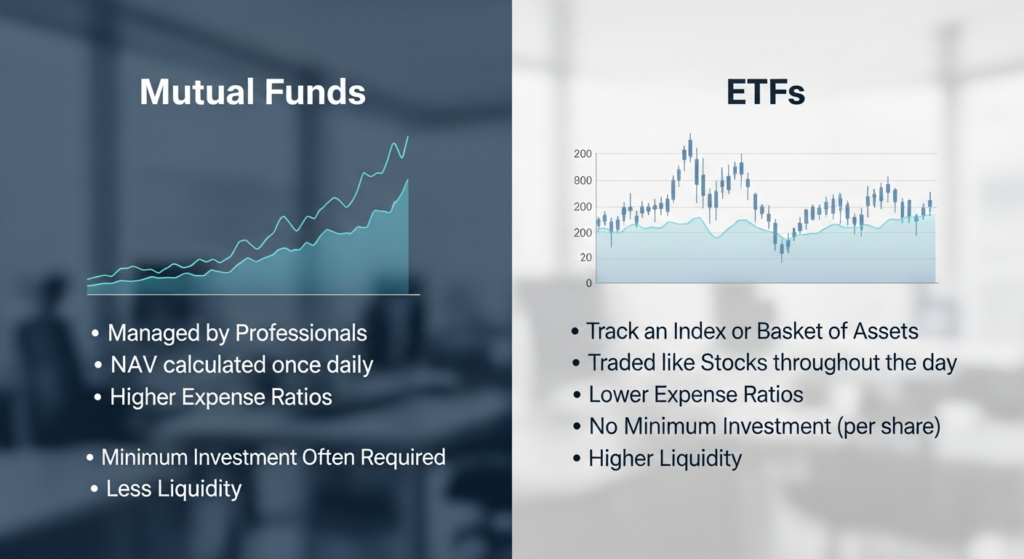
While mutual funds and ETFs share the goal of providing diversified investments, the key differences of mutual funds vs ETFs are significant for your investment strategy. These distinctions are primarily related to trading, costs, and tax efficiency. Understanding them is crucial for high-net-worth families making strategic financial planning decisions.
ETFs generally offer greater trading flexibility and are often associated with lower expense ratios and better tax efficiency. In contrast, mutual funds may have higher minimum investment requirements and are traded differently. The following sections will provide more detail on these differences, including trading accessibility and management fee structures.
Trading Flexibility and Accessibility of Mutual Funds vs ETFs
One of the most significant differences of mutual funds and ETFs is their trading flexibility. ETFs trade on a stock exchange throughout the trading day, just like individual stocks. This means you can buy or sell ETF shares at any time the market is open through a brokerage account, with prices updating in real-time.
On the other hand, mutual fund shares are not traded on an exchange. Orders to buy or sell are placed during the day, but all transactions are executed at a single price—the NAV—which is calculated after the market closes. This means every investor who buys or sells on a given day receives the same price.
This difference in trading mechanics gives ETF investors more control over the price at which they transact. It also allows for the use of more advanced trading strategies, such as limit orders and stop orders, which are not available for mutual funds.
| Feature | Exchange-Traded Funds (ETFs) | Mutual Funds |
|---|---|---|
| Trading Method | Traded on a stock exchange like individual stocks. | Bought and sold through the fund company or a broker. |
| Pricing | Priced and traded in real-time throughout the trading day. | Priced once per day at the Net Asset Value (NAV) after the market closes. |
| Transaction Timing | Can be bought or sold anytime during market hours. | All transactions are executed at the end-of-day NAV. |
| Order Types | Supports market orders, limit orders, and stop orders. | Typically only supports market orders placed for a specific dollar amount. |
Management Styles and Fee Structures of Mutual Funds vs ETFs
Management styles and their associated fees are another critical point of distinction. Most mutual funds are actively managed, meaning a portfolio manager actively selects investments in an attempt to outperform a market benchmark. This active management requires extensive research and frequent trading, which typically leads to higher management fees, reflected in a higher expense ratio.
In contrast, the majority of ETFs follow a passive management style. These funds aim to replicate the performance of a specific index, like the S&P 500. Since this strategy involves simply tracking an index rather than making active investment decisions, it generally results in lower operating costs and a lower expense ratio for the investor.
However, the lines are blurring as the industry evolves. There are now passively managed index mutual funds, as well as a growing number of actively managed ETFs (active ETFs). When choosing an investment, it’s essential for high-net-worth investors to look beyond the label and understand the specific management style and fee structure of the fund.
Comparing Costs and Fees of Mutual Funds vs ETFs
Investment costs can significantly impact your total return over time, making a comparison of fees essential for any investor. ETFs are generally known for having lower fees, largely due to their passive management structure and lower operating expense ratio. However, it’s important to consider all potential costs, including trading costs.
Mutual funds can have various fees, including sales charges known as loads, which are paid when you buy or sell shares. While many ETFs are commission-free, they do have trading costs in the form of bid-ask spreads. The following sections will explore these costs in more detail, including expense ratios and other potential hidden fees.
Expense Ratios in Mutual Funds and ETFs
The expense ratio represents the annual cost of owning a fund, expressed as a percentage of your investment. This fee covers the fund’s operating expenses, including management fees, administrative costs, and marketing. Since these costs are deducted directly from the fund’s assets, a lower expense ratio means more of the returns stay in your pocket.
Generally, ETFs tend to have lower expense ratios than mutual funds. This is particularly true when comparing passively managed index ETFs to actively managed mutual funds. The simpler strategy of tracking an index requires less research and trading, which translates into lower operational costs.
However, it’s important to compare apples to apples. Passively managed index mutual funds can also have very low expense ratios, sometimes comparable to their ETF counterparts. When evaluating an investment, always check the expense ratio in the fund’s prospectus, as even small differences in fees can have a substantial impact on your wealth over the long term.
Hidden Costs: Loads, Commissions, and Bid-Ask Spreads
Beyond the expense ratio, other costs can affect your investment returns. When investing in mutual funds, one potential cost is “loads,” which are sales commissions charged when you buy or sell shares. These can be front-end loads (paid when you buy) or back-end loads (paid when you sell). Fortunately, many no-load funds are available.
When you trade ETFs, you may encounter different types of costs. While many brokerages now offer commission-free trading for ETF shares, this is not always the case. Another inherent cost is the bid-ask spread. This is the small difference between the price you can buy an ETF (the ask price) and the price you can sell it (the bid price). For frequently traded ETFs, this spread is usually minimal, but it can be wider for less liquid funds.
To summarize, be aware of these additional costs:
- Loads: Sales commissions on some mutual funds that can reduce your initial investment or final proceeds.
- Commissions: Fees charged by a broker to execute a trade, which can apply to both mutual funds and ETFs.
- Bid-Ask Spreads: A trading cost associated with ETFs, representing the difference between the buying and selling price.
GUIDE: Investments Review
What issues should you consider when reviewing your investments? A portfolio review can help you evaluate and confirm your investment strategy, ensuring alignment with your financial goals.
Tax Efficiency: Mutual Funds vs ETFs
For high-net-worth individuals, tax efficiency is a critical component of wealth management. In this area, ETFs often have a structural advantage over mutual funds. The way ETF shares are created and redeemed typically results in fewer taxable events for the fund’s investors, which can lead to a lower tax burden over time.
Mutual funds, particularly actively managed ones, may need to sell securities to meet investor redemptions, which can trigger capital gains distributions to all shareholders. Because ETFs trade on the secondary market between investors, the fund itself is often not involved in the transaction, reducing the likelihood of such distributions. The following sections will explain this in more detail and offer strategies for managing your tax obligations.
Capital Gains Distribution and Impact
A key factor in the tax efficiency of an investment is how it handles capital gains. When a mutual fund sells a security for a profit, it realizes a capital gain. By law, the fund must distribute these gains to its shareholders, typically at the end of the year. You, as an investor, are then responsible for paying taxes on that capital gains distribution, even if you reinvested it and didn’t sell any of your shares.
ETFs generally have a more tax-efficient structure. Because ETFs trade on an exchange, when one investor sells their shares, another investor buys them. The fund itself is not usually involved, so it doesn’t have to sell underlying securities to meet redemption requests. In addition, ETF shares are typically created and redeemed in kind through authorized participants, so the portfolio can hand off low-basis positions without triggering capital gains inside the fund. This unique in-kind creation and redemption process allows ETFs to avoid realizing capital gains as frequently as mutual funds.
This difference can be particularly impactful in taxable brokerage accounts. The reduced likelihood of unexpected capital gains distributions makes ETFs a potentially more tax-efficient choice for long-term investors looking to control the timing of their tax liabilities.
Strategies for Reducing Your Tax Burden
Minimizing your tax burden is a vital part of any sophisticated wealth management strategy. When investing in mutual funds and ETFs, there are several approaches you can take to enhance tax efficiency and preserve more of your returns, especially with the guidance of a financial advisor.
Holding investments in tax-advantaged retirement accounts, like a 401(k) or IRA, is a primary strategy. In these accounts, capital gains are not taxed annually, allowing your investments to grow tax-deferred or tax-free. For taxable accounts, choosing more tax-efficient investment vehicles, like index funds or ETFs, can help reduce unexpected tax bills from capital gains distributions.
Here are some key strategies to discuss with your financial planner:
- Asset Location: Place less tax-efficient investments (like actively managed funds) in tax-advantaged accounts and more tax-efficient investments (like ETFs) in taxable accounts.
- Tax-Loss Harvesting: Sell investments at a loss to offset capital gains from other investments, thereby lowering your overall tax liability.
- Holding Period: Hold investments for more than a year to ensure any gains are taxed at the more favorable long-term capital gains rate.
A Truly Unique Wealth Management Experience
Let’s create a financial plan and investment strategy that allows you to live the life of your dreams. Schedule your free consultation today to explore tailored financial strategies designed to secure your future!
Different Investment Goals of Mutual Funds vs ETFs
The choice between a mutual fund and an ETF is not about which is universally better, but which is better for you. The right decision depends on your specific investment goals, risk tolerance, and overall financial situation. A financial advisor can provide personalized investment advice to help you navigate these choices within your retirement planning framework.
Some investors may prefer the simplicity and automated investment features of mutual funds, while others may be drawn to the trading flexibility and lower costs of ETFs. Often, the best approach for high-net-worth families involves a combination of both. The following sections will explore how to align these investment vehicles with your risk profile and how to integrate them into a cohesive portfolio.
Choosing Based on Risk Tolerance and Time Horizon
Your personal risk tolerance and investment time horizon are fundamental factors that should guide your investment decisions. These elements help define your risk profile and determine which types of investments are most suitable for achieving your financial goals, whether you choose mutual funds, ETFs, or a combination of both.
A longer time horizon, such as saving for retirement decades away, generally allows for a higher risk tolerance. In this case, you might favor growth-oriented equity funds or ETFs. Conversely, if you have a shorter time horizon or a lower tolerance for market volatility, you might prefer more conservative options like bond funds or balanced funds that aim to preserve capital.
When making your choice, consider the following:
- Long-Term Growth: If your goal is long-term capital appreciation, both actively managed growth mutual funds and broad-market ETFs can be suitable options.
- Regular Income: For investors seeking income, bond funds (both mutual funds and ETFs) or dividend-focused equity funds can be effective choices.
- Active vs. Passive Preference: Your preference for an active (hands-on) or passive (hands-off) approach can also guide your decision between actively managed mutual funds and passive ETFs.
Integrating ETFs and Mutual Funds into a Holistic Portfolio
For many high-net-worth investors, the debate about mutual funds vs ETFs isn’t about choosing one over the other. Instead, the most effective strategy often involves integrating both mutual funds and ETF shares into a single, diversified portfolio. This approach allows you to leverage the unique strengths of each investment vehicle to achieve your financial objectives.
You might use low-cost ETFs to form the core of your portfolio, providing broad exposure to major asset classes like U.S. and international stocks. Then, you could complement this core with actively managed mutual funds in specific areas where you believe a skilled manager can add value, such as in emerging markets or small-cap stocks.
By combining these investment vehicles, you can build a sophisticated and well-rounded portfolio that is tailored to your specific needs. A financial planner can help you determine the right mix and select the best funds to create a strategy that aligns with your long-term wealth management and retirement planning goals.
GUIDE: Investments Review
What issues should you consider when reviewing your investments? A portfolio review can help you evaluate and confirm your investment strategy, ensuring alignment with your financial goals.
Frequently Asked Questions
Can mutual funds and ETFs both be part of a retirement investment strategy?
Yes, absolutely. A diversified retirement investment strategy can effectively use both mutual funds and ETFs. A financial planner can help you use ETFs for broad, low-cost exposure to core asset classes and select mutual funds for specific strategies where portfolio managers may add value.
Mutual Funds vs ETFs: Which is more suitable for long-term investing?
Both ETF shares and mutual fund shares can be excellent choices for long-term investing. The best option depends on your specific investment goals. ETFs often appeal due to their lower costs and tax efficiency, while some investors prefer mutual funds for their active management or automated investing features.
Are ETFs easier to buy and sell than mutual funds?
ETFs offer more trading flexibility as they trade throughout the day on a brokerage account like stocks. Mutual fund shares are priced only once at the end of the trading day. This makes the process of buying and selling ETFs more immediate and dynamic for investors who value intraday liquidity.
How do I decide if a mutual fund or ETF is right for my investment goals?
To decide, evaluate your investment goals, risk tolerance, and desired level of involvement. Consider ETFs for low-cost, tax-efficient market exposure, and mutual funds if you seek active management from a fund manager. A financial advisor can analyze your financial situation to recommend the best fit for your portfolio.
A Truly Unique Wealth Management Experience
Let’s create a financial plan and investment strategy that allows you to live the life of your dreams. Schedule your free consultation today to explore tailored financial strategies designed to secure your future!
Concerns or questions about your tax situation or financial plan? Contact Financial Synergies today.
We are a boutique, financial advisory and total wealth management firm with over 35 years helping clients navigate markets and developing custom financial plans. To learn more about our approach to financial planning please reach out to us. One of our seasoned advisors would be happy to help you build a custom financial plan to help ensure you accomplish your financial goals and objectives. Schedule a conversation with us today.
More relevant articles by Financial Synergies:
- Discretionary Investment Management for High-Net-Worth Investors
- Investment Management Services for High-Net-Worth Investors
- What Is Diversification and Why It Matters for Investors
- How to Start Investing: Essential Strategies for Success
- Stock Market Basics: A Beginner’s Guide to Investing
Blog Disclosures
This content, which contains security-related opinions and/or information, is provided for informational purposes only and should not be relied upon in any manner as professional advice, or an endorsement of any practices, products or services. There can be no guarantees or assurances that the views expressed here will be applicable for any particular facts or circumstances, and should not be relied upon in any manner. You should consult your own financial advisors as to legal, business, tax, and other related matters concerning any investment.
The commentary in this “post” (including any related blogs, videos, and social media) reflects the personal opinions, viewpoints, and analyses of the Financial Synergies Wealth Advisors, Inc. employees providing such comments, and should not be regarded as the views of Financial Synergies Wealth Advisors, Inc. or its respective affiliates or as a description of advisory services provided by Financial Synergies Wealth Advisors, Inc. or performance returns of any Financial Synergies Wealth Advisors, Inc. client.
Any opinions expressed herein do not constitute or imply endorsement, sponsorship, or recommendation by Financial Synergies Wealth Advisors, Inc. or its employees. The views reflected in the commentary are subject to change at any time without notice.
Nothing on this website constitutes investment or financial planning advice, performance data or any recommendation that any particular security, portfolio of securities, transaction or investment strategy is suitable for any specific person. It also should not be construed as an offer soliciting the purchase or sale of any security mentioned. Nor should it be construed as an offer to provide investment advisory services by Financial Synergies Wealth Advisors, Inc.
Any mention of a particular security and related performance data is not a recommendation to buy or sell that security. Financial Synergies Wealth Advisors, Inc. manages its clients’ accounts using a variety of investment techniques and strategies, which are not necessarily discussed in the commentary. Investments in securities involve the risk of loss. Past performance is no guarantee of future results.
Any charts provided here or on any related Financial Synergies Wealth Advisors, Inc. personnel content outlets are for informational purposes only, and should also not be relied upon when making any investment decision. Any indices referenced for comparison are unmanaged and cannot be invested into directly. As always please remember investing involves risk and possible loss of principal capital; please seek advice from a licensed professional. Any projections, estimates, forecasts, targets, prospects and/or opinions expressed in these materials are subject to change without notice and may differ or be contrary to opinions expressed by others. Information in charts have been obtained from third-party sources and data, and may include those from portfolio securities of funds managed by Financial Synergies Wealth Advisors, Inc. While taken from sources believed to be reliable, Financial Synergies Wealth Advisors, Inc. has not independently verified such information and makes no representations about the enduring accuracy of the information or its appropriateness for a given situation. All content speaks only as of the date indicated.
Financial Synergies Wealth Advisors, Inc. is a registered investment adviser. Advisory services are only offered to clients or prospective clients where Financial Synergies Wealth Advisors, Inc. and its representatives are properly licensed or exempt from licensure. Investments in securities involve the risk of loss. Past performance is no guarantee of future results.