The late Jack Bogle observed that “successful investing is about owning businesses and reaping the huge rewards provided by the earnings growth and dividends of our nation’s—and, for that matter, the world’s—corporations.” This wisdom is relevant today because the benefit of owning stocks is not just about capturing long-run price returns, but also in the dividends corporations pay to investors as they grow their profits.
In today’s environment, the stock market is near all-time highs, and dividend yields are near historic lows, estimated at just 1.3% over the next year for the S&P 500. The last time dividend yields were this low was in 2000 during the dot-com bubble. Fed rate cuts and the uncertain interest rate environment also impact how investors can position their portfolios to generate income today.
While dividends are often seen as boring, especially compared to high-flying stocks that attract investor and media attention, the reality is that the role of dividends in portfolios should not be overlooked. Dividend payments compound over time and can provide a steady source of income, especially during periods when stock prices are volatile.
Companies that combine both dividend payments and stock prices that rise over long periods (“price appreciation”) can potentially offer investors the best of both worlds: regular cash flow alongside long-term wealth building.
Today’s market reflects a decades-long shift in how companies deploy capital and what investors prioritize. How can investors balance both price returns and dividends in their portfolios today?
How investors view dividends has evolved over the past century

The role of dividends in investing has changed over the past hundred years. For much of the 20th century, dividends were a primary source of stock market returns, with yields often exceeding 5 to 7%. Investors purchased stocks much like they might buy bonds today – primarily for the income they generated. Companies were expected to pay and grow their dividends as proof of financial health, and stock price appreciation was often considered secondary to dividend income.
This began to change as investors focused more on technology-driven companies and growth. The dot-com era of the 1990s further reduced the focus on dividends as high-growth technology companies not only reinvested their capital, but were often expected to not pay dividends. Stock buybacks also rose in prominence as a more tax-efficient way of returning shareholder capital than dividends.
Today’s low yields reflect this evolution. As the accompanying chart shows, technology-related sectors such as Information Technology, Consumer Discretionary, and Communication Services offer the lowest dividend yields of 0.6%, 0.7%, and 0.8%, respectively. These sectors include the Magnificent 7 stocks which generally pay lower dividends or none at all.
In contrast, sectors such as Real Estate, Energy, and Utilities that have traditionally focused on income generation offer yields above 3%, showing that higher dividends are available by looking across and within different parts of the market.
This pattern of lower dividend yields for the broader market isn’t necessarily a problem since it reflects different market dynamics and business strategies that can benefit investors in unique ways. However, it does highlight the importance of understanding the purpose of dividends for companies, investors, and in portfolios.
Corporate strategy and interest rates affect the attractiveness of dividends

From a company’s perspective, profits can be used in two ways: to reinvest in the business or to return cash to shareholders through dividends. In theory, companies should return cash to investors when they already have enough capital for attractive investment opportunities or when their business model is specifically designed to generate income for shareholders, such as REITs (real estate investment trusts).
However, dividends serve a broader purpose beyond simply returning excess cash. Many corporations pay steady dividends to attract investors and signal financial stability, particularly when they can demonstrate consistent growth in these payments over time. This dividend growth serves as an indicator of corporate health and management confidence in future earnings, beyond just income alone.
Interest rates and the Fed’s monetary policy also affect the attractiveness of dividend-paying stocks. When Treasury yields exceed dividend yields, they reduce the relative attractiveness of these stocks. Currently, with 10-year Treasury yields around 4.1%, government bonds offer substantially higher income than the overall stock market. As the Fed continues to cut policy rates, this dynamic could shift.
The accompanying chart shows a related concept known as the “earnings yield,” sometimes referred to as the “equity risk premium.” This measures how attractive stocks are compared to Treasurys. This downward trend in recent years is a result of stocks climbing to new highs and higher interest rates. The fact that interest rates have hovered in a range more recently is why the relative earnings yield has stabilized this year.
Dividends are an important consideration for investors
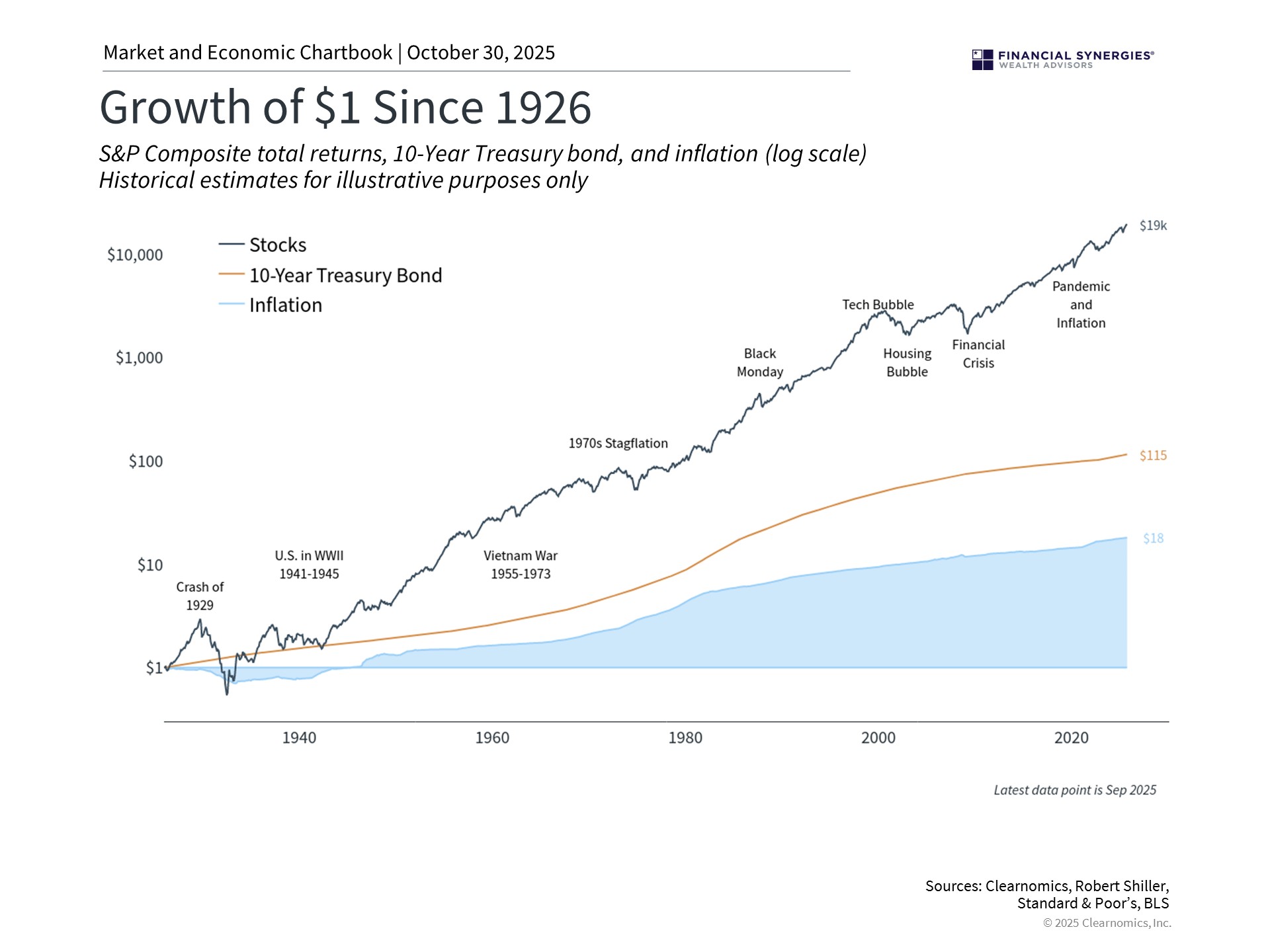
For investors, dividends are an integral part of the total returns generated by a portfolio. According to Standard and Poor’s, dividends have contributed 31% of the total return for the S&P 500 since 1926, while price appreciation has contributed 69%.1 Today, everyday investors seem to focus mostly on stock prices except in cases where portfolio income is needed, such as for those nearing or in retirement.
The accompanying chart shows that $1 invested in stocks in 1926 grew to approximately $18,000 by 2025, demonstrating the power of compound growth over long periods. This growth came from both dividends and price appreciation, but the specific mix varied across different time periods. During some decades, dividends provided most of the return. In others, stock price appreciation dominated. What remained constant was the importance of staying invested through various market cycles, regardless of what drove returns.
For investors approaching or in retirement, the focus naturally shifts toward generating current income. However, this doesn’t mean you should concentrate exclusively on high-dividend stocks. That will definitely lead to trouble. The risk of “yield chasing” – focusing solely on the highest-yielding investments – is that it can lead to poor diversification, concentration in unsustainable companies and industries, and reduced growth for today’s longer retirements.
Investors should seek a balance of dividends and growth for their financial goals. We take a “total return” approach, ensuring our portfolios can generate appropriate returns through various market environments, whether through dividends, capital appreciation, or both.
The bottom line? While dividend yields are near historic lows, they continue to play an important role in portfolios. Investors should focus on both price appreciation and dividends as they work toward their financial goals.
Source:
[1] https://www.spglobal.com/spdji/en/documents/research/research-sp500-dividend-aristocrats.pdf
Concerns or questions about how your investment portfolio will hold up in the current market environment? Contact Financial Synergies today.
We are a boutique, financial advisory and total wealth management firm with over 35 years helping clients navigate turbulent markets. To learn more about our approach to investment management please reach out to us. One of our seasoned advisors would be happy to help you build a custom financial plan to help ensure you accomplish your financial goals and objectives. Schedule a conversation with us today.
More relevant articles by Financial Synergies:
Blog Disclosures
This content, which contains security-related opinions and/or information, is provided for informational purposes only and should not be relied upon in any manner as professional advice, or an endorsement of any practices, products or services. There can be no guarantees or assurances that the views expressed here will be applicable for any particular facts or circumstances, and should not be relied upon in any manner. You should consult your own financial advisors as to legal, business, tax, and other related matters concerning any investment.
The commentary in this “post” (including any related blogs, videos, and social media) reflects the personal opinions, viewpoints, and analyses of the Financial Synergies Wealth Advisors, Inc. employees providing such comments, and should not be regarded as the views of Financial Synergies Wealth Advisors, Inc. or its respective affiliates or as a description of advisory services provided by Financial Synergies Wealth Advisors, Inc. or performance returns of any Financial Synergies Wealth Advisors, Inc. client.
Any opinions expressed herein do not constitute or imply endorsement, sponsorship, or recommendation by Financial Synergies Wealth Advisors, Inc. or its employees. The views reflected in the commentary are subject to change at any time without notice.
Nothing on this website constitutes investment or financial planning advice, performance data or any recommendation that any particular security, portfolio of securities, transaction or investment strategy is suitable for any specific person. It also should not be construed as an offer soliciting the purchase or sale of any security mentioned. Nor should it be construed as an offer to provide investment advisory services by Financial Synergies Wealth Advisors, Inc.
Any mention of a particular security and related performance data is not a recommendation to buy or sell that security. Financial Synergies Wealth Advisors, Inc. manages its clients’ accounts using a variety of investment techniques and strategies, which are not necessarily discussed in the commentary. Investments in securities involve the risk of loss. Past performance is no guarantee of future results.
Any charts provided here or on any related Financial Synergies Wealth Advisors, Inc. personnel content outlets are for informational purposes only, and should also not be relied upon when making any investment decision. Any indices referenced for comparison are unmanaged and cannot be invested into directly. As always please remember investing involves risk and possible loss of principal capital; please seek advice from a licensed professional. Any projections, estimates, forecasts, targets, prospects and/or opinions expressed in these materials are subject to change without notice and may differ or be contrary to opinions expressed by others. Information in charts have been obtained from third-party sources and data, and may include those from portfolio securities of funds managed by Financial Synergies Wealth Advisors, Inc. While taken from sources believed to be reliable, Financial Synergies Wealth Advisors, Inc. has not independently verified such information and makes no representations about the enduring accuracy of the information or its appropriateness for a given situation. All content speaks only as of the date indicated.
Financial Synergies Wealth Advisors, Inc. is a registered investment adviser. Advisory services are only offered to clients or prospective clients where Financial Synergies Wealth Advisors, Inc. and its representatives are properly licensed or exempt from licensure. Investments in securities involve the risk of loss. Past performance is no guarantee of future results.
See Full Disclosures Page Here
 Skip to content


The Role of Dividends as the Fed Cuts Rates
The late Jack Bogle observed that “successful investing is about owning businesses and reaping the huge rewards provided by the earnings growth and dividends of our nation’s—and, for that matter, the world’s—corporations.” This wisdom is relevant today because the benefit of owning stocks is not just about capturing long-run price returns, but also in the dividends corporations pay to investors as they grow their profits.
In today’s environment, the stock market is near all-time highs, and dividend yields are near historic lows, estimated at just 1.3% over the next year for the S&P 500. The last time dividend yields were this low was in 2000 during the dot-com bubble. Fed rate cuts and the uncertain interest rate environment also impact how investors can position their portfolios to generate income today.
While dividends are often seen as boring, especially compared to high-flying stocks that attract investor and media attention, the reality is that the role of dividends in portfolios should not be overlooked. Dividend payments compound over time and can provide a steady source of income, especially during periods when stock prices are volatile.
Companies that combine both dividend payments and stock prices that rise over long periods (“price appreciation”) can potentially offer investors the best of both worlds: regular cash flow alongside long-term wealth building.
Today’s market reflects a decades-long shift in how companies deploy capital and what investors prioritize. How can investors balance both price returns and dividends in their portfolios today?
How investors view dividends has evolved over the past century
The role of dividends in investing has changed over the past hundred years. For much of the 20th century, dividends were a primary source of stock market returns, with yields often exceeding 5 to 7%. Investors purchased stocks much like they might buy bonds today – primarily for the income they generated. Companies were expected to pay and grow their dividends as proof of financial health, and stock price appreciation was often considered secondary to dividend income.
This began to change as investors focused more on technology-driven companies and growth. The dot-com era of the 1990s further reduced the focus on dividends as high-growth technology companies not only reinvested their capital, but were often expected to not pay dividends. Stock buybacks also rose in prominence as a more tax-efficient way of returning shareholder capital than dividends.
Today’s low yields reflect this evolution. As the accompanying chart shows, technology-related sectors such as Information Technology, Consumer Discretionary, and Communication Services offer the lowest dividend yields of 0.6%, 0.7%, and 0.8%, respectively. These sectors include the Magnificent 7 stocks which generally pay lower dividends or none at all.
In contrast, sectors such as Real Estate, Energy, and Utilities that have traditionally focused on income generation offer yields above 3%, showing that higher dividends are available by looking across and within different parts of the market.
This pattern of lower dividend yields for the broader market isn’t necessarily a problem since it reflects different market dynamics and business strategies that can benefit investors in unique ways. However, it does highlight the importance of understanding the purpose of dividends for companies, investors, and in portfolios.
Corporate strategy and interest rates affect the attractiveness of dividends
From a company’s perspective, profits can be used in two ways: to reinvest in the business or to return cash to shareholders through dividends. In theory, companies should return cash to investors when they already have enough capital for attractive investment opportunities or when their business model is specifically designed to generate income for shareholders, such as REITs (real estate investment trusts).
However, dividends serve a broader purpose beyond simply returning excess cash. Many corporations pay steady dividends to attract investors and signal financial stability, particularly when they can demonstrate consistent growth in these payments over time. This dividend growth serves as an indicator of corporate health and management confidence in future earnings, beyond just income alone.
Interest rates and the Fed’s monetary policy also affect the attractiveness of dividend-paying stocks. When Treasury yields exceed dividend yields, they reduce the relative attractiveness of these stocks. Currently, with 10-year Treasury yields around 4.1%, government bonds offer substantially higher income than the overall stock market. As the Fed continues to cut policy rates, this dynamic could shift.
The accompanying chart shows a related concept known as the “earnings yield,” sometimes referred to as the “equity risk premium.” This measures how attractive stocks are compared to Treasurys. This downward trend in recent years is a result of stocks climbing to new highs and higher interest rates. The fact that interest rates have hovered in a range more recently is why the relative earnings yield has stabilized this year.
Dividends are an important consideration for investors
For investors, dividends are an integral part of the total returns generated by a portfolio. According to Standard and Poor’s, dividends have contributed 31% of the total return for the S&P 500 since 1926, while price appreciation has contributed 69%.1 Today, everyday investors seem to focus mostly on stock prices except in cases where portfolio income is needed, such as for those nearing or in retirement.
The accompanying chart shows that $1 invested in stocks in 1926 grew to approximately $18,000 by 2025, demonstrating the power of compound growth over long periods. This growth came from both dividends and price appreciation, but the specific mix varied across different time periods. During some decades, dividends provided most of the return. In others, stock price appreciation dominated. What remained constant was the importance of staying invested through various market cycles, regardless of what drove returns.
For investors approaching or in retirement, the focus naturally shifts toward generating current income. However, this doesn’t mean you should concentrate exclusively on high-dividend stocks. That will definitely lead to trouble. The risk of “yield chasing” – focusing solely on the highest-yielding investments – is that it can lead to poor diversification, concentration in unsustainable companies and industries, and reduced growth for today’s longer retirements.
Investors should seek a balance of dividends and growth for their financial goals. We take a “total return” approach, ensuring our portfolios can generate appropriate returns through various market environments, whether through dividends, capital appreciation, or both.
The bottom line? While dividend yields are near historic lows, they continue to play an important role in portfolios. Investors should focus on both price appreciation and dividends as they work toward their financial goals.
Source:
[1] https://www.spglobal.com/spdji/en/documents/research/research-sp500-dividend-aristocrats.pdf
Concerns or questions about how your investment portfolio will hold up in the current market environment? Contact Financial Synergies today.
We are a boutique, financial advisory and total wealth management firm with over 35 years helping clients navigate turbulent markets. To learn more about our approach to investment management please reach out to us. One of our seasoned advisors would be happy to help you build a custom financial plan to help ensure you accomplish your financial goals and objectives. Schedule a conversation with us today.
More relevant articles by Financial Synergies:
Blog Disclosures
This content, which contains security-related opinions and/or information, is provided for informational purposes only and should not be relied upon in any manner as professional advice, or an endorsement of any practices, products or services. There can be no guarantees or assurances that the views expressed here will be applicable for any particular facts or circumstances, and should not be relied upon in any manner. You should consult your own financial advisors as to legal, business, tax, and other related matters concerning any investment.
The commentary in this “post” (including any related blogs, videos, and social media) reflects the personal opinions, viewpoints, and analyses of the Financial Synergies Wealth Advisors, Inc. employees providing such comments, and should not be regarded as the views of Financial Synergies Wealth Advisors, Inc. or its respective affiliates or as a description of advisory services provided by Financial Synergies Wealth Advisors, Inc. or performance returns of any Financial Synergies Wealth Advisors, Inc. client.
Any opinions expressed herein do not constitute or imply endorsement, sponsorship, or recommendation by Financial Synergies Wealth Advisors, Inc. or its employees. The views reflected in the commentary are subject to change at any time without notice.
Nothing on this website constitutes investment or financial planning advice, performance data or any recommendation that any particular security, portfolio of securities, transaction or investment strategy is suitable for any specific person. It also should not be construed as an offer soliciting the purchase or sale of any security mentioned. Nor should it be construed as an offer to provide investment advisory services by Financial Synergies Wealth Advisors, Inc.
Any mention of a particular security and related performance data is not a recommendation to buy or sell that security. Financial Synergies Wealth Advisors, Inc. manages its clients’ accounts using a variety of investment techniques and strategies, which are not necessarily discussed in the commentary. Investments in securities involve the risk of loss. Past performance is no guarantee of future results.
Any charts provided here or on any related Financial Synergies Wealth Advisors, Inc. personnel content outlets are for informational purposes only, and should also not be relied upon when making any investment decision. Any indices referenced for comparison are unmanaged and cannot be invested into directly. As always please remember investing involves risk and possible loss of principal capital; please seek advice from a licensed professional. Any projections, estimates, forecasts, targets, prospects and/or opinions expressed in these materials are subject to change without notice and may differ or be contrary to opinions expressed by others. Information in charts have been obtained from third-party sources and data, and may include those from portfolio securities of funds managed by Financial Synergies Wealth Advisors, Inc. While taken from sources believed to be reliable, Financial Synergies Wealth Advisors, Inc. has not independently verified such information and makes no representations about the enduring accuracy of the information or its appropriateness for a given situation. All content speaks only as of the date indicated.
Financial Synergies Wealth Advisors, Inc. is a registered investment adviser. Advisory services are only offered to clients or prospective clients where Financial Synergies Wealth Advisors, Inc. and its representatives are properly licensed or exempt from licensure. Investments in securities involve the risk of loss. Past performance is no guarantee of future results.
See Full Disclosures Page Here
Recent Posts
Happy Birthday to the Bull Market
Quarterly Webinar: Q4 2026 Market and Economic Themes
Medicare Open Enrollment 2026: What to Know
Subscribe to Our Blog
Chief Investment Officer | Managing Partner