“How long will this last?”
“Will markets bounce back?”
“Should I make a change now?”
These are some of the most common and understandable questions investors are asking in 2025. When the market takes a sharp turn, it’s only natural to wonder what comes next and how long it might take to feel confident in the markets and economy again.
Let’s start with where we are today.
Over the past two months, markets have fallen sharply. At its worst, the S&P 500 was down more than 18% from its February highs. However, it has since experienced a nice recovery and is now only off around 10% from its high.

What’s driving the decline? It’s not one thing. It’s a mix of economic and political uncertainty.
Heightened trade tensions, aggressive new tariffs, public pressure on the Federal Reserve, and ambiguity around future rate cuts have all contributed. That cocktail of risk has pushed investors to the sidelines and sent volatility soaring.
But what everyone wants to know is, “When will things turn around?”
Of course, I don’t have a crystal ball. And you’ve heard this more than a few times before, but it’s worth repeating: past performance doesn’t guarantee future results. Markets don’t always follow historical patterns, and downturns can deepen before recovery begins. Still, looking at long-term data can offer some much-needed context and perspective.
For starters, markets tend to fall fast.
Historically, based on data from over a century of S&P 500 returns, adjusted for inflation and including dividends, it has taken as little as six months for a 20% decline to reach its bottom. Even deeper drops, like 40% or 50%, have often found their low point in under two years.1
But getting back to where we started? That takes longer.
On average, a 20% drop has historically taken about four years to recover. A 30% decline stretches to over seven years. A 40% drawdown? Nearly nine.2
These numbers reflect the real emotional challenge of investing, not just the drop itself, but the long, patient climb back to previous highs.
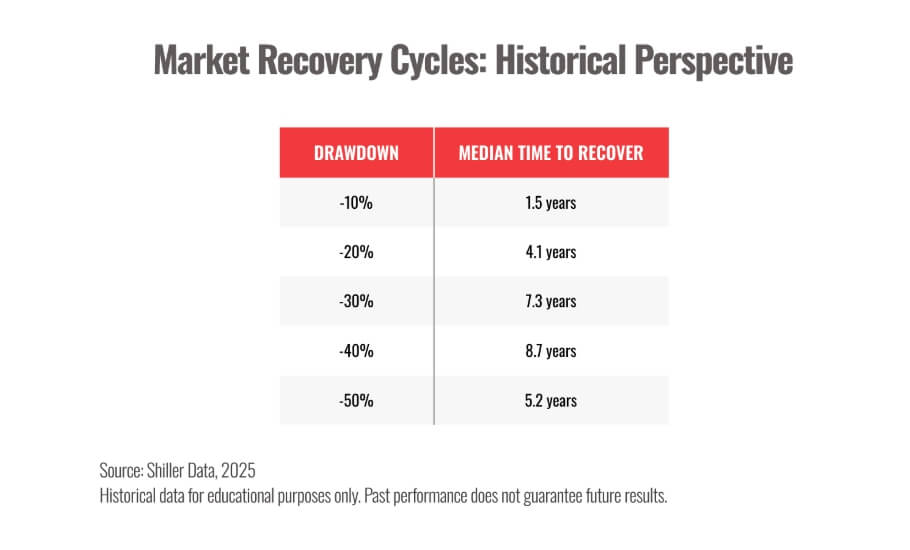
In other words, recoveries are less like flipping a switch and more like repairing a home after a storm. The damage can be done quickly, but rebuilding confidence, earnings, and momentum takes time.
I’ll admit, it can be surprising how long it can take for markets to fully recover.
Since the end of the Great Financial Crisis, we’ve been fortunate. U.S. markets have generally bounced back quickly from declines, sometimes in just months. That kind of speed can create a false sense of how recoveries typically work.
But when you zoom out and look at a broader stretch of market history, it becomes clear that fast recoveries are the exception, not the rule.
Over nearly a century of S&P 500 data, the pattern is clear. Deep declines often take years, not months, to fully heal. And for investors who have only experienced the post-2008 era, this longer timeline can feel unexpectedly drawn out.
That said, there is reason to remain encouraged.
Historically, some of the strongest returns have come after the most difficult periods. Following the 10 worst calendar years since 1975, the S&P 500 delivered an average return of 17.5% one year later, compared to its average one-year return of 9.7% over the same broader time frame.
Over longer periods, the results are even more striking: an average 56% return after three years, and more than 200% after ten.3
Now I know you’ve heard this several times already, but here it is again: Past performance doesn’t guarantee future results. Markets don’t move in straight lines, and downturns can deepen before a recovery begins. Still, history provides helpful context, and it reminds us that long-term discipline has often been rewarded.
So what can we do right now?
Here are a few time-tested best practices we apply on behalf of our clients when markets turn volatile:
- Keep a diversified portfolio: Spreading investments across regions, sectors, and asset classes reduces your exposure to any single area and protects you on the downside.
- Avoid trying to time the market: As tempting as it may be, staying invested through downturns will yield better results than jumping in and out based on emotion.
- Rebalance when needed: Adjusting the mix of stocks and bonds can help manage risk and keeps the portfolio aligned with long-term goals.
- Consider downside protection: In some cases, alternative strategies or specific investment products can help buffer volatility.
We can’t avoid market declines, but we can prepare for them, navigate through them, and stay focused on long-term outcomes.
Sources:
1. Shiller Data, 2025 [URL: https://shillerdata.com/]
2. Shiller Data, 2025 [URL: https://shillerdata.com/]
3. Market Declines: A History of Recoveries, 2025 [URL: https://www.mfs.com/content/dam/mfs-enterprise/mfscom/sales-tools/sales-ideas/mfse_resdwn_fly.pdf]
Chart sources:
Shiller Data, 2025 [URL: https://shillerdata.com/]
Concerns or questions about how your investment portfolio will hold up in the current market environment? Contact Financial Synergies today.
We are a boutique, financial advisory and total wealth management firm with over 35 years helping clients navigate turbulent markets. To learn more about our approach to investment management please reach out to us. One of our seasoned advisors would be happy to help you build a custom financial plan to help ensure you accomplish your financial goals and objectives. Schedule a conversation with us today.
More relevant articles by Financial Synergies:
Blog Disclosures
This content, which contains security-related opinions and/or information, is provided for informational purposes only and should not be relied upon in any manner as professional advice, or an endorsement of any practices, products or services. There can be no guarantees or assurances that the views expressed here will be applicable for any particular facts or circumstances, and should not be relied upon in any manner. You should consult your own financial advisors as to legal, business, tax, and other related matters concerning any investment.
The commentary in this “post” (including any related blogs, videos, and social media) reflects the personal opinions, viewpoints, and analyses of the Financial Synergies Wealth Advisors, Inc. employees providing such comments, and should not be regarded as the views of Financial Synergies Wealth Advisors, Inc. or its respective affiliates or as a description of advisory services provided by Financial Synergies Wealth Advisors, Inc. or performance returns of any Financial Synergies Wealth Advisors, Inc. client.
Any opinions expressed herein do not constitute or imply endorsement, sponsorship, or recommendation by Financial Synergies Wealth Advisors, Inc. or its employees. The views reflected in the commentary are subject to change at any time without notice.
Nothing on this website constitutes investment or financial planning advice, performance data or any recommendation that any particular security, portfolio of securities, transaction or investment strategy is suitable for any specific person. It also should not be construed as an offer soliciting the purchase or sale of any security mentioned. Nor should it be construed as an offer to provide investment advisory services by Financial Synergies Wealth Advisors, Inc.
Any mention of a particular security and related performance data is not a recommendation to buy or sell that security. Financial Synergies Wealth Advisors, Inc. manages its clients’ accounts using a variety of investment techniques and strategies, which are not necessarily discussed in the commentary. Investments in securities involve the risk of loss. Past performance is no guarantee of future results.
Any charts provided here or on any related Financial Synergies Wealth Advisors, Inc. personnel content outlets are for informational purposes only, and should also not be relied upon when making any investment decision. Any indices referenced for comparison are unmanaged and cannot be invested into directly. As always please remember investing involves risk and possible loss of principal capital; please seek advice from a licensed professional. Any projections, estimates, forecasts, targets, prospects and/or opinions expressed in these materials are subject to change without notice and may differ or be contrary to opinions expressed by others. Information in charts have been obtained from third-party sources and data, and may include those from portfolio securities of funds managed by Financial Synergies Wealth Advisors, Inc. While taken from sources believed to be reliable, Financial Synergies Wealth Advisors, Inc. has not independently verified such information and makes no representations about the enduring accuracy of the information or its appropriateness for a given situation. All content speaks only as of the date indicated.
Financial Synergies Wealth Advisors, Inc. is a registered investment adviser. Advisory services are only offered to clients or prospective clients where Financial Synergies Wealth Advisors, Inc. and its representatives are properly licensed or exempt from licensure. Investments in securities involve the risk of loss. Past performance is no guarantee of future results.
See Full Disclosures Page Here
 Skip to content


Is The Market Recovery Here? Historical Perspective.
“How long will this last?”
“Will markets bounce back?”
“Should I make a change now?”
These are some of the most common and understandable questions investors are asking in 2025. When the market takes a sharp turn, it’s only natural to wonder what comes next and how long it might take to feel confident in the markets and economy again.
Let’s start with where we are today.
Over the past two months, markets have fallen sharply. At its worst, the S&P 500 was down more than 18% from its February highs. However, it has since experienced a nice recovery and is now only off around 10% from its high.
What’s driving the decline? It’s not one thing. It’s a mix of economic and political uncertainty.
Heightened trade tensions, aggressive new tariffs, public pressure on the Federal Reserve, and ambiguity around future rate cuts have all contributed. That cocktail of risk has pushed investors to the sidelines and sent volatility soaring.
But what everyone wants to know is, “When will things turn around?”
Of course, I don’t have a crystal ball. And you’ve heard this more than a few times before, but it’s worth repeating: past performance doesn’t guarantee future results. Markets don’t always follow historical patterns, and downturns can deepen before recovery begins. Still, looking at long-term data can offer some much-needed context and perspective.
For starters, markets tend to fall fast.
Historically, based on data from over a century of S&P 500 returns, adjusted for inflation and including dividends, it has taken as little as six months for a 20% decline to reach its bottom. Even deeper drops, like 40% or 50%, have often found their low point in under two years.1
But getting back to where we started? That takes longer.
On average, a 20% drop has historically taken about four years to recover. A 30% decline stretches to over seven years. A 40% drawdown? Nearly nine.2
These numbers reflect the real emotional challenge of investing, not just the drop itself, but the long, patient climb back to previous highs.
In other words, recoveries are less like flipping a switch and more like repairing a home after a storm. The damage can be done quickly, but rebuilding confidence, earnings, and momentum takes time.
I’ll admit, it can be surprising how long it can take for markets to fully recover.
Since the end of the Great Financial Crisis, we’ve been fortunate. U.S. markets have generally bounced back quickly from declines, sometimes in just months. That kind of speed can create a false sense of how recoveries typically work.
But when you zoom out and look at a broader stretch of market history, it becomes clear that fast recoveries are the exception, not the rule.
Over nearly a century of S&P 500 data, the pattern is clear. Deep declines often take years, not months, to fully heal. And for investors who have only experienced the post-2008 era, this longer timeline can feel unexpectedly drawn out.
That said, there is reason to remain encouraged.
Historically, some of the strongest returns have come after the most difficult periods. Following the 10 worst calendar years since 1975, the S&P 500 delivered an average return of 17.5% one year later, compared to its average one-year return of 9.7% over the same broader time frame.
Over longer periods, the results are even more striking: an average 56% return after three years, and more than 200% after ten.3
Now I know you’ve heard this several times already, but here it is again: Past performance doesn’t guarantee future results. Markets don’t move in straight lines, and downturns can deepen before a recovery begins. Still, history provides helpful context, and it reminds us that long-term discipline has often been rewarded.
So what can we do right now?
Here are a few time-tested best practices we apply on behalf of our clients when markets turn volatile:
We can’t avoid market declines, but we can prepare for them, navigate through them, and stay focused on long-term outcomes.
Sources:
1. Shiller Data, 2025 [URL: https://shillerdata.com/]
2. Shiller Data, 2025 [URL: https://shillerdata.com/]
3. Market Declines: A History of Recoveries, 2025 [URL: https://www.mfs.com/content/dam/mfs-enterprise/mfscom/sales-tools/sales-ideas/mfse_resdwn_fly.pdf]
Chart sources:
Shiller Data, 2025 [URL: https://shillerdata.com/]
Concerns or questions about how your investment portfolio will hold up in the current market environment? Contact Financial Synergies today.
We are a boutique, financial advisory and total wealth management firm with over 35 years helping clients navigate turbulent markets. To learn more about our approach to investment management please reach out to us. One of our seasoned advisors would be happy to help you build a custom financial plan to help ensure you accomplish your financial goals and objectives. Schedule a conversation with us today.
More relevant articles by Financial Synergies:
Blog Disclosures
This content, which contains security-related opinions and/or information, is provided for informational purposes only and should not be relied upon in any manner as professional advice, or an endorsement of any practices, products or services. There can be no guarantees or assurances that the views expressed here will be applicable for any particular facts or circumstances, and should not be relied upon in any manner. You should consult your own financial advisors as to legal, business, tax, and other related matters concerning any investment.
The commentary in this “post” (including any related blogs, videos, and social media) reflects the personal opinions, viewpoints, and analyses of the Financial Synergies Wealth Advisors, Inc. employees providing such comments, and should not be regarded as the views of Financial Synergies Wealth Advisors, Inc. or its respective affiliates or as a description of advisory services provided by Financial Synergies Wealth Advisors, Inc. or performance returns of any Financial Synergies Wealth Advisors, Inc. client.
Any opinions expressed herein do not constitute or imply endorsement, sponsorship, or recommendation by Financial Synergies Wealth Advisors, Inc. or its employees. The views reflected in the commentary are subject to change at any time without notice.
Nothing on this website constitutes investment or financial planning advice, performance data or any recommendation that any particular security, portfolio of securities, transaction or investment strategy is suitable for any specific person. It also should not be construed as an offer soliciting the purchase or sale of any security mentioned. Nor should it be construed as an offer to provide investment advisory services by Financial Synergies Wealth Advisors, Inc.
Any mention of a particular security and related performance data is not a recommendation to buy or sell that security. Financial Synergies Wealth Advisors, Inc. manages its clients’ accounts using a variety of investment techniques and strategies, which are not necessarily discussed in the commentary. Investments in securities involve the risk of loss. Past performance is no guarantee of future results.
Any charts provided here or on any related Financial Synergies Wealth Advisors, Inc. personnel content outlets are for informational purposes only, and should also not be relied upon when making any investment decision. Any indices referenced for comparison are unmanaged and cannot be invested into directly. As always please remember investing involves risk and possible loss of principal capital; please seek advice from a licensed professional. Any projections, estimates, forecasts, targets, prospects and/or opinions expressed in these materials are subject to change without notice and may differ or be contrary to opinions expressed by others. Information in charts have been obtained from third-party sources and data, and may include those from portfolio securities of funds managed by Financial Synergies Wealth Advisors, Inc. While taken from sources believed to be reliable, Financial Synergies Wealth Advisors, Inc. has not independently verified such information and makes no representations about the enduring accuracy of the information or its appropriateness for a given situation. All content speaks only as of the date indicated.
Financial Synergies Wealth Advisors, Inc. is a registered investment adviser. Advisory services are only offered to clients or prospective clients where Financial Synergies Wealth Advisors, Inc. and its representatives are properly licensed or exempt from licensure. Investments in securities involve the risk of loss. Past performance is no guarantee of future results.
See Full Disclosures Page Here
Recent Posts
Happy Birthday to the Bull Market
Quarterly Webinar: Q4 2026 Market and Economic Themes
Medicare Open Enrollment 2026: What to Know
Subscribe to Our Blog
Chief Investment Officer | Managing Partner