For many households, a home represents not only where they live and raise their family, but also their largest financial asset, monthly expense, and source of debt. From a broader economic perspective, the housing market is deeply intertwined with consumer confidence and economic growth. So, while investor attention has been on geopolitics and market volatility this year, the fact that home prices remain near all-time highs continues to play an important role in financial planning.
Housing activity is mixed but prices remain near record levels
Housing activity has been mixed in recent years across a number of measures. For new buyers, the biggest challenge with affordability is mortgage rates. The 30-year fixed mortgage rate is around 6.3%, well above the lows of 3% or less in 2020 and 2021, and the average of 4.6% since 2008. This means that the monthly cost of purchasing a home is significantly higher than it was just a few years ago, even for buyers with substantial down payments.
For those homeowners who were able to lock in mortgage rates near historic lows over the past decade, it can be a difficult decision to sell and give up these rates. This has kept the supply of existing homes limited, leading to a tighter housing market. In March, the sales volume of existing homes fell 3.6%, a reversal to its low one year ago, after climbing earlier this year.
In reaction to this, new construction has increased, with housing starts accelerating to 1.5 million units per year in January, but it will take time for this to ease pressure on prices. Even among homebuilders, however, the outlook remains uncertain. The NAHB/Wells Fargo Housing Market Index, which measures sentiment among homebuilders, fell from 38 to 34 in April. From a stock market perspective, the homebuilding subindustry within the S&P 500 index has been roughly flat on the year with a gain of only 0.4%, after several years of mixed performance.
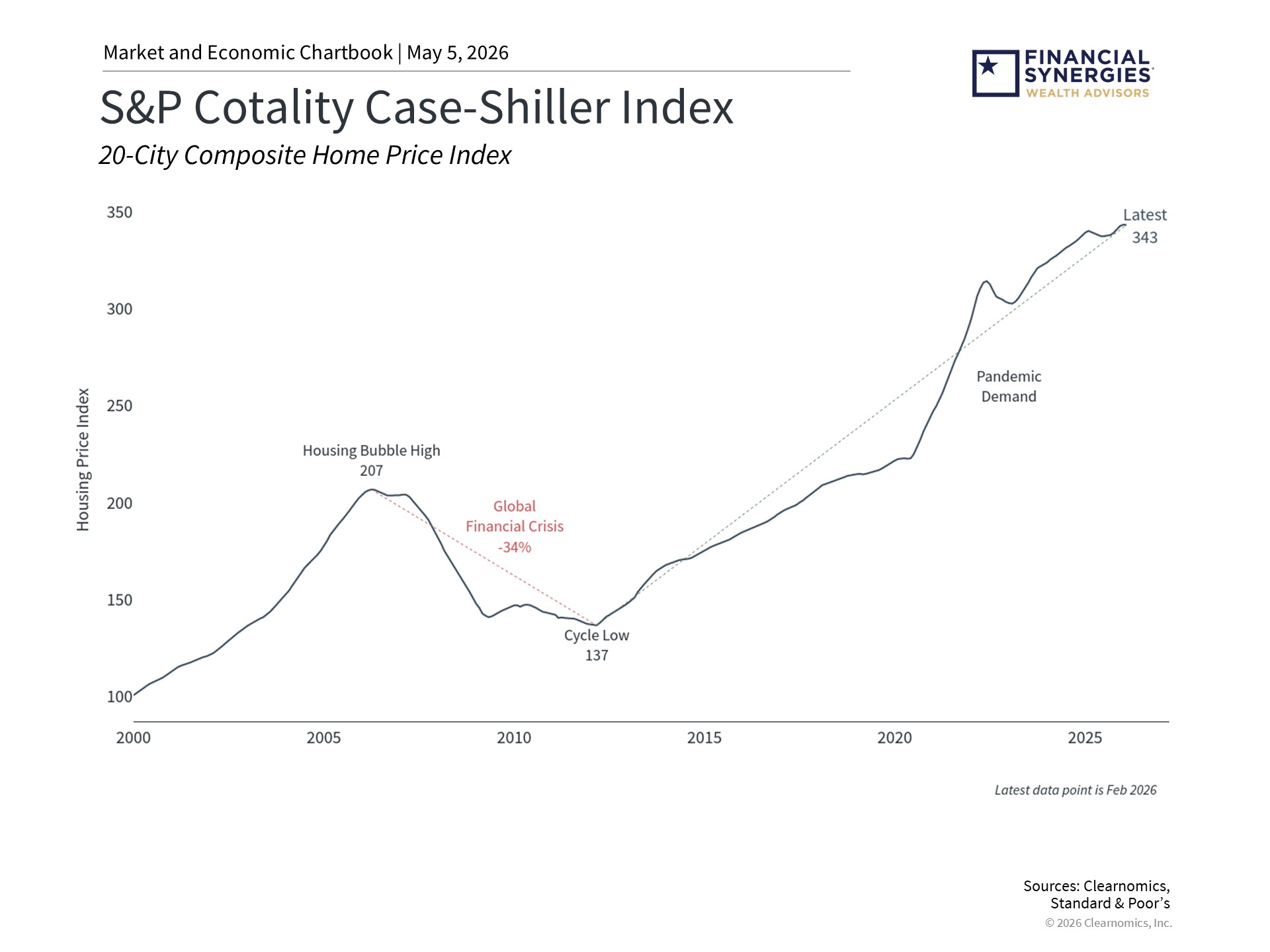
Despite these challenges with housing activity, home prices are still near record levels across the country. The S&P Cotality Case-Shiller indices, which measure prices nationally and across the largest U.S. cities, have climbed steadily. Across the country, home prices have experienced significant declines in only two periods in recent history: the 2008 housing bust and the brief pullback that followed the rapid rise in inflation beginning in 2022.
Higher home prices mean that, from a macroeconomic perspective, balance sheets for homeowners have generally remained healthy. This has been further supported by a low unemployment rate and strong wage gains, and are important reasons that overall consumer spending has held up better than many feared. These factors have helped to offset poor consumer sentiment driven by inflation and job losses in certain sectors, such as in tech.
Housing is often the foundation of wealth across generations
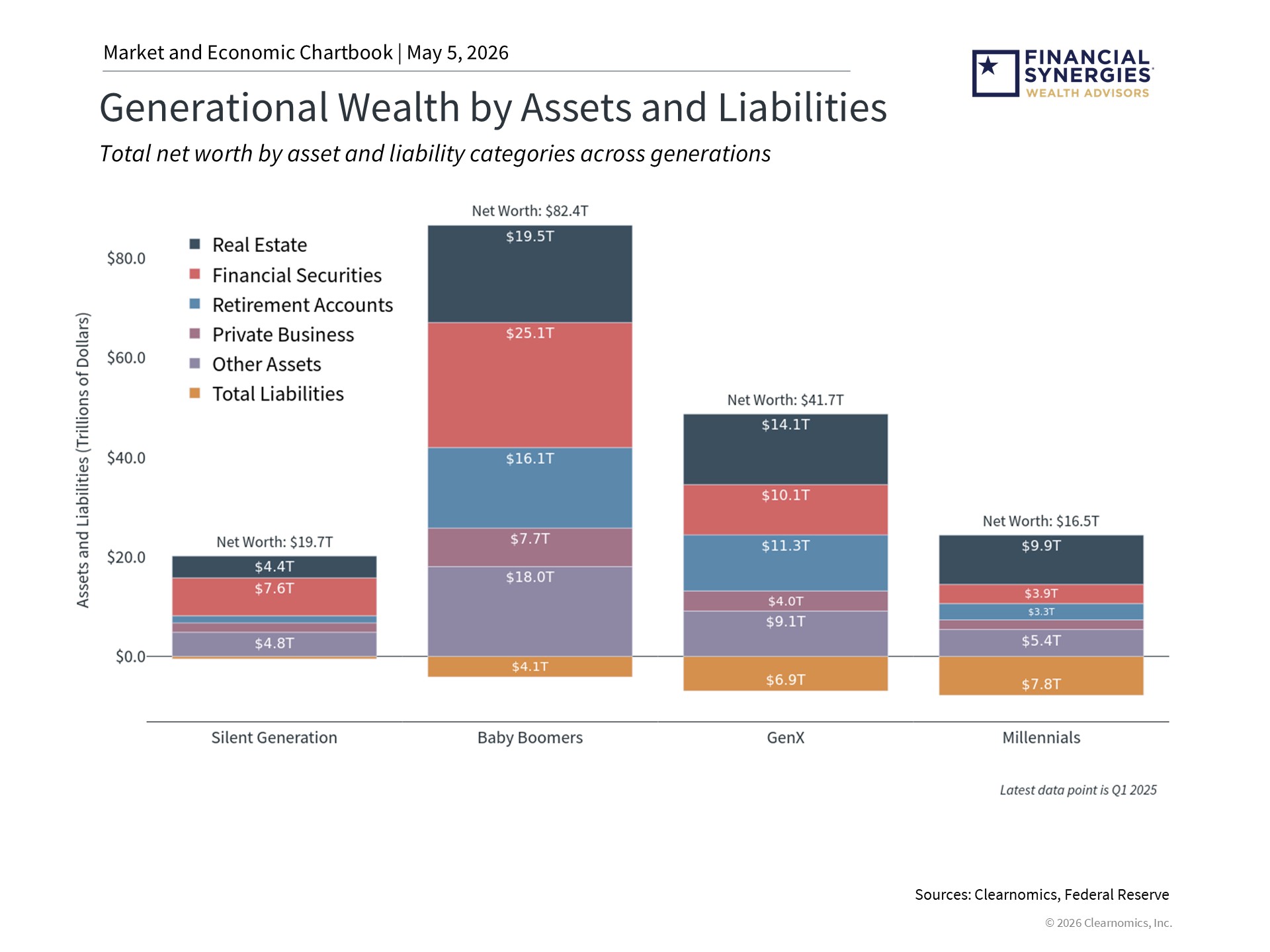
As the chart above illustrates, real estate is an important component of household net worth across all generations. For older Americans, real estate holdings often represent a significant share of total assets accumulated over decades. Baby Boomers, for instance, hold over $19.5 trillion in real estate, representing roughly 24% of their total net worth. For Gen X and Millennials, that share rises to approximately 34% and 60%, respectively. Of course, real estate is also a significant source of outstanding debt for younger households that have not had time to pay off their mortgages or benefit from decades of housing market growth.
This “wealth effect” is important, especially when the stock market is volatile and the world feels uncertain. When home values rise, homeowners tend to feel more financially secure and may be more willing to spend on goods and services, supporting broader economic growth. They may feel this way even if they do not actively access their home equity, such as through a reverse mortgage or home equity line of credit.
This also highlights the importance of maintaining a holistic perspective around financial planning. This is because short-term stock market swings, while never pleasant, may be less impactful to an investor’s financial picture than they may perceive, since much of their wealth is tied to other assets. In fact, depending on the investor’s specific situation, prioritizing mortgages and other forms of debt may be more helpful than focusing on the stock market.
These psychological and financial effects make the housing market important as both an economic indicator and when it comes to financial planning. Inflation is another factor that is affected by housing costs, since it is the primary driver of the “shelter” category within the Consumer Price Index. Even before energy prices led to the latest jump in headline inflation, elevated shelter costs were an important reason that inflation has been slower to return to the Fed’s 2% target.
Household debt levels reflect both mortgage and consumer borrowing
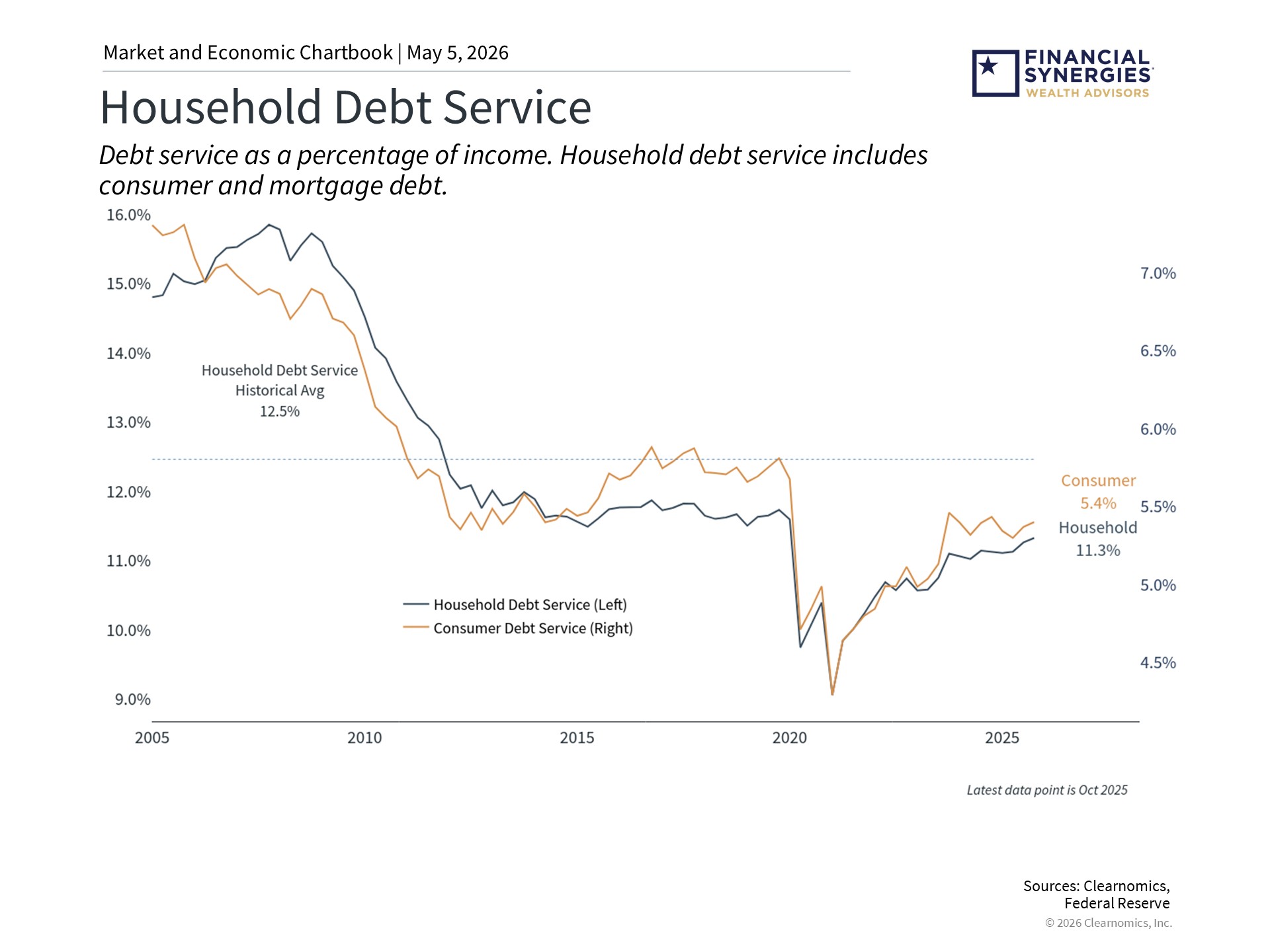
Of course, housing is not only the largest asset on most household balance sheets, but also the largest source of debt. The accompanying chart shows both household debt, which includes mortgages, and consumer debt, which does not. Even as other forms of debt rise, including credit cards and student loans, mortgage debt represents by far the largest component of total household borrowing.
One encouraging aspect of today’s environment is that debt service levels (the size of debt payments relative to household income) are still moderate relative to history. Mortgage underwriting standards have also been considerably more conservative since the 2008 financial crisis, when household debt levels were far higher. Still, the burden of these debt payments is a real consideration for many households, particularly those who purchased homes in recent years at higher prices and interest rates.
So, from an economic perspective, healthy home prices could continue to support consumer balance sheets and the broader economy despite mixed activity. From a financial planning perspective, it’s important for investors to have a clear understanding of their full financial picture. While headlines have focused on stock market swings and the Middle East conflict, the truth is that focusing on aspects of our financial plans closer to home may play a much larger role in achieving long-term goals.
The bottom line? The housing market remains a core part of both household finances and the broader economy. With ongoing market volatility, understanding the key drivers of household wealth can help investors maintain perspective and stay focused on their long-term financial plans.
Concerns or questions about how your investment portfolio will hold up in the current market environment? Contact Financial Synergies today.
We are a boutique, financial advisory and total wealth management firm with over 35 years helping clients navigate turbulent markets. To learn more about our approach to investment management please reach out to us. One of our seasoned advisors would be happy to help you build a custom financial plan to help ensure you accomplish your financial goals and objectives. Schedule a conversation with us today.
More relevant articles by Financial Synergies:
Blog Disclosures
This content, which may contain security-related opinions and/or information, is provided for informational purposes only and should not be relied upon in any manner as professional advice, or an endorsement of any practices, products or services. There can be no guarantees or assurances that the views expressed here will be applicable for any particular facts or circumstances, and should not be relied upon in any manner. You should consult your own financial advisors as to legal, business, tax, and other related matters concerning any investment.
The commentary in this “post” (including any related blogs, videos, and social media) reflects the personal opinions, viewpoints, and analyses of the Financial Synergies Wealth Advisors, Inc. employees providing such comments, and should not be regarded as the views of Financial Synergies Wealth Advisors, Inc. or its respective affiliates or as a description of advisory services provided by Financial Synergies Wealth Advisors, Inc. or performance returns of any Financial Synergies Wealth Advisors, Inc. client.
Any opinions expressed herein do not constitute or imply endorsement, sponsorship, or recommendation by Financial Synergies Wealth Advisors, Inc. or its employees. The views reflected in the commentary are subject to change at any time without notice.
Nothing on this website or Blog constitutes investment or financial planning advice, performance data or any recommendation that any particular security, portfolio of securities, transaction or investment strategy is suitable for any specific person. It also should not be construed as an offer soliciting the purchase or sale of any security mentioned. Nor should it be construed as an offer to provide investment advisory services by Financial Synergies Wealth Advisors, Inc.
Any mention of a particular security and related performance data is not a recommendation to buy or sell that security. Financial Synergies Wealth Advisors, Inc. manages its clients’ accounts using a variety of investment techniques and strategies, which are not necessarily discussed in the commentary. Investments in securities involve the risk of loss. Past performance is no guarantee of future results.
Any charts provided here or on any related Financial Synergies Wealth Advisors, Inc. personnel content outlets are for informational purposes only, and should also not be relied upon when making any investment decision. Any indices referenced for comparison are unmanaged and cannot be invested into directly. As always please remember investing involves risk and possible loss of principal capital; please seek advice from a licensed professional. Any projections, estimates, forecasts, targets, prospects and/or opinions expressed in these materials are subject to change without notice and may differ or be contrary to opinions expressed by others. Information in charts have been obtained from third-party sources and data, and may include those from portfolio securities of funds managed by Financial Synergies Wealth Advisors, Inc. While taken from sources believed to be reliable, Financial Synergies Wealth Advisors, Inc. has not independently verified such information and makes no representations about the enduring accuracy of the information or its appropriateness for a given situation. All content speaks only as of the date indicated.
Financial Synergies Wealth Advisors, Inc. is a registered investment adviser. Advisory services are only offered to clients or prospective clients where Financial Synergies Wealth Advisors, Inc. and its representatives are properly licensed or exempt from licensure. Investments in securities involve the risk of loss. Past performance is no guarantee of future results.
See Full Disclosures Page Here
 Skip to content


Housing Market Update: Impact on the Economy and Financial Plans
For many households, a home represents not only where they live and raise their family, but also their largest financial asset, monthly expense, and source of debt. From a broader economic perspective, the housing market is deeply intertwined with consumer confidence and economic growth. So, while investor attention has been on geopolitics and market volatility this year, the fact that home prices remain near all-time highs continues to play an important role in financial planning.
Housing activity is mixed but prices remain near record levels
Housing activity has been mixed in recent years across a number of measures. For new buyers, the biggest challenge with affordability is mortgage rates. The 30-year fixed mortgage rate is around 6.3%, well above the lows of 3% or less in 2020 and 2021, and the average of 4.6% since 2008. This means that the monthly cost of purchasing a home is significantly higher than it was just a few years ago, even for buyers with substantial down payments.
For those homeowners who were able to lock in mortgage rates near historic lows over the past decade, it can be a difficult decision to sell and give up these rates. This has kept the supply of existing homes limited, leading to a tighter housing market. In March, the sales volume of existing homes fell 3.6%, a reversal to its low one year ago, after climbing earlier this year.
In reaction to this, new construction has increased, with housing starts accelerating to 1.5 million units per year in January, but it will take time for this to ease pressure on prices. Even among homebuilders, however, the outlook remains uncertain. The NAHB/Wells Fargo Housing Market Index, which measures sentiment among homebuilders, fell from 38 to 34 in April. From a stock market perspective, the homebuilding subindustry within the S&P 500 index has been roughly flat on the year with a gain of only 0.4%, after several years of mixed performance.
Despite these challenges with housing activity, home prices are still near record levels across the country. The S&P Cotality Case-Shiller indices, which measure prices nationally and across the largest U.S. cities, have climbed steadily. Across the country, home prices have experienced significant declines in only two periods in recent history: the 2008 housing bust and the brief pullback that followed the rapid rise in inflation beginning in 2022.
Higher home prices mean that, from a macroeconomic perspective, balance sheets for homeowners have generally remained healthy. This has been further supported by a low unemployment rate and strong wage gains, and are important reasons that overall consumer spending has held up better than many feared. These factors have helped to offset poor consumer sentiment driven by inflation and job losses in certain sectors, such as in tech.
Housing is often the foundation of wealth across generations
As the chart above illustrates, real estate is an important component of household net worth across all generations. For older Americans, real estate holdings often represent a significant share of total assets accumulated over decades. Baby Boomers, for instance, hold over $19.5 trillion in real estate, representing roughly 24% of their total net worth. For Gen X and Millennials, that share rises to approximately 34% and 60%, respectively. Of course, real estate is also a significant source of outstanding debt for younger households that have not had time to pay off their mortgages or benefit from decades of housing market growth.
This “wealth effect” is important, especially when the stock market is volatile and the world feels uncertain. When home values rise, homeowners tend to feel more financially secure and may be more willing to spend on goods and services, supporting broader economic growth. They may feel this way even if they do not actively access their home equity, such as through a reverse mortgage or home equity line of credit.
This also highlights the importance of maintaining a holistic perspective around financial planning. This is because short-term stock market swings, while never pleasant, may be less impactful to an investor’s financial picture than they may perceive, since much of their wealth is tied to other assets. In fact, depending on the investor’s specific situation, prioritizing mortgages and other forms of debt may be more helpful than focusing on the stock market.
These psychological and financial effects make the housing market important as both an economic indicator and when it comes to financial planning. Inflation is another factor that is affected by housing costs, since it is the primary driver of the “shelter” category within the Consumer Price Index. Even before energy prices led to the latest jump in headline inflation, elevated shelter costs were an important reason that inflation has been slower to return to the Fed’s 2% target.
Household debt levels reflect both mortgage and consumer borrowing
Of course, housing is not only the largest asset on most household balance sheets, but also the largest source of debt. The accompanying chart shows both household debt, which includes mortgages, and consumer debt, which does not. Even as other forms of debt rise, including credit cards and student loans, mortgage debt represents by far the largest component of total household borrowing.
One encouraging aspect of today’s environment is that debt service levels (the size of debt payments relative to household income) are still moderate relative to history. Mortgage underwriting standards have also been considerably more conservative since the 2008 financial crisis, when household debt levels were far higher. Still, the burden of these debt payments is a real consideration for many households, particularly those who purchased homes in recent years at higher prices and interest rates.
So, from an economic perspective, healthy home prices could continue to support consumer balance sheets and the broader economy despite mixed activity. From a financial planning perspective, it’s important for investors to have a clear understanding of their full financial picture. While headlines have focused on stock market swings and the Middle East conflict, the truth is that focusing on aspects of our financial plans closer to home may play a much larger role in achieving long-term goals.
The bottom line? The housing market remains a core part of both household finances and the broader economy. With ongoing market volatility, understanding the key drivers of household wealth can help investors maintain perspective and stay focused on their long-term financial plans.
Concerns or questions about how your investment portfolio will hold up in the current market environment? Contact Financial Synergies today.
We are a boutique, financial advisory and total wealth management firm with over 35 years helping clients navigate turbulent markets. To learn more about our approach to investment management please reach out to us. One of our seasoned advisors would be happy to help you build a custom financial plan to help ensure you accomplish your financial goals and objectives. Schedule a conversation with us today.
More relevant articles by Financial Synergies:
Blog Disclosures
This content, which may contain security-related opinions and/or information, is provided for informational purposes only and should not be relied upon in any manner as professional advice, or an endorsement of any practices, products or services. There can be no guarantees or assurances that the views expressed here will be applicable for any particular facts or circumstances, and should not be relied upon in any manner. You should consult your own financial advisors as to legal, business, tax, and other related matters concerning any investment.
The commentary in this “post” (including any related blogs, videos, and social media) reflects the personal opinions, viewpoints, and analyses of the Financial Synergies Wealth Advisors, Inc. employees providing such comments, and should not be regarded as the views of Financial Synergies Wealth Advisors, Inc. or its respective affiliates or as a description of advisory services provided by Financial Synergies Wealth Advisors, Inc. or performance returns of any Financial Synergies Wealth Advisors, Inc. client.
Any opinions expressed herein do not constitute or imply endorsement, sponsorship, or recommendation by Financial Synergies Wealth Advisors, Inc. or its employees. The views reflected in the commentary are subject to change at any time without notice.
Nothing on this website or Blog constitutes investment or financial planning advice, performance data or any recommendation that any particular security, portfolio of securities, transaction or investment strategy is suitable for any specific person. It also should not be construed as an offer soliciting the purchase or sale of any security mentioned. Nor should it be construed as an offer to provide investment advisory services by Financial Synergies Wealth Advisors, Inc.
Any mention of a particular security and related performance data is not a recommendation to buy or sell that security. Financial Synergies Wealth Advisors, Inc. manages its clients’ accounts using a variety of investment techniques and strategies, which are not necessarily discussed in the commentary. Investments in securities involve the risk of loss. Past performance is no guarantee of future results.
Any charts provided here or on any related Financial Synergies Wealth Advisors, Inc. personnel content outlets are for informational purposes only, and should also not be relied upon when making any investment decision. Any indices referenced for comparison are unmanaged and cannot be invested into directly. As always please remember investing involves risk and possible loss of principal capital; please seek advice from a licensed professional. Any projections, estimates, forecasts, targets, prospects and/or opinions expressed in these materials are subject to change without notice and may differ or be contrary to opinions expressed by others. Information in charts have been obtained from third-party sources and data, and may include those from portfolio securities of funds managed by Financial Synergies Wealth Advisors, Inc. While taken from sources believed to be reliable, Financial Synergies Wealth Advisors, Inc. has not independently verified such information and makes no representations about the enduring accuracy of the information or its appropriateness for a given situation. All content speaks only as of the date indicated.
Financial Synergies Wealth Advisors, Inc. is a registered investment adviser. Advisory services are only offered to clients or prospective clients where Financial Synergies Wealth Advisors, Inc. and its representatives are properly licensed or exempt from licensure. Investments in securities involve the risk of loss. Past performance is no guarantee of future results.
See Full Disclosures Page Here
Recent Posts
Quarterly Webinar: Q4 2026 Market and Economic Themes
Medicare Open Enrollment 2026: What to Know
3rd Quarter 2026 Market and Economic Review
Subscribe to Our Blog
Chief Investment Officer | Managing Partner